
Executive Summary
- Modern Origin: The chupacabra emerged in 1995 Puerto Rico, where reports of blood-drained livestock spawned a panic that quickly spread across Latin America and into the United States.
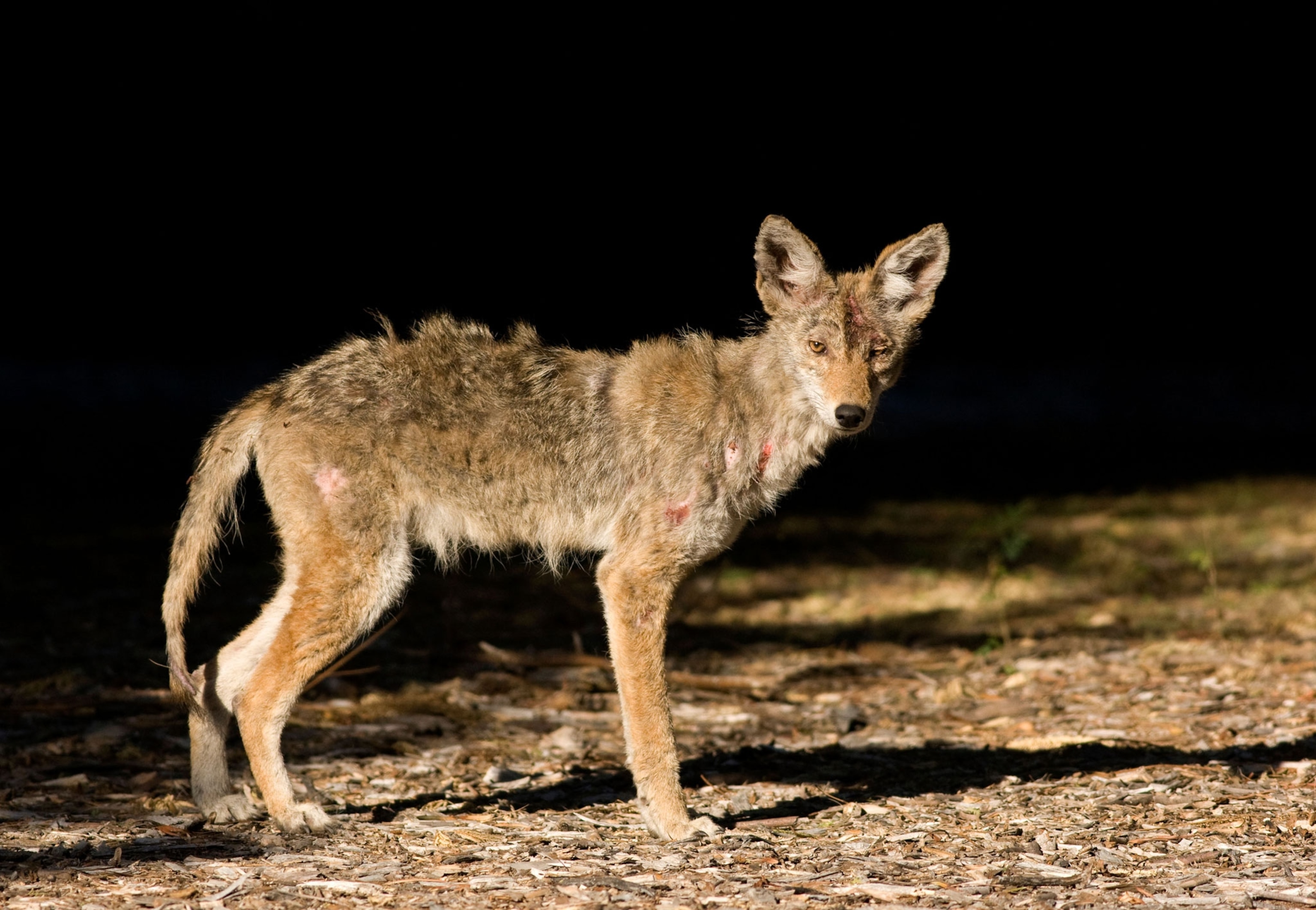
- Scientific Explanation: Nearly all North American "chupacabra" specimens examined by scientists have been identified as coyotes, dogs, or raccoons suffering from severe sarcoptic mange—a skin disease caused by the mite Sarcoptes scabiei.
- Folklore Evolution: The creature's description transformed dramatically: from a bipedal, spiny-backed reptilian monster in 1995 Puerto Rico to a hairless, emaciated canid in 2000s Texas, due to media mistranslation and cultural telephone.
- Behavioral Science: Mange-inflicted animals exhibit precisely the behaviors attributed to the chupacabra: boldness near human settlements, preference for easy prey like penned livestock, and a gaunt, otherworldly appearance.
In the summer of 1995, something strange began happening in the rural communities of Puerto Rico. Goats, sheep, and chickens were turning up dead in their pens—not eaten, not torn apart, but seemingly drained of blood through neat puncture wounds in their necks. Witnesses spoke of a creature they had never seen before: roughly three feet tall, bipedal, with gray scaly skin, huge red eyes, and a row of sharp spines running down its back. A Puerto Rican comedian gave it a name that would soon echo across continents: el chupacabra—the goat-sucker.
Thirty years later, the chupacabra has become something far more interesting than a mere monster. It is a case study in how folklore evolves under pressure from media, migration, and the human brain's relentless pattern-matching machinery. It is also, perhaps surprisingly, a story about wildlife disease. Because when scientists have been given the chance to examine the physical evidence—dead animals, DNA samples, photographs—the chupacabra has almost always turned out to be something real, something tragic, and something entirely explicable: a wild canid in the terminal stages of mange.
The Puerto Rican Genesis
The chupacabra did not emerge from ancient mythology. Unlike the vampire, whose roots trace back millennia to Slavic folklore, or the werewolf, whose lineage winds through medieval European terror, the chupacabra is a thoroughly modern invention. The first concrete reports surfaced in Puerto Rico in March 1995, when eight sheep were found dead on a farm in the town of Canóvanas, each with three puncture wounds and, according to eyewitnesses, completely drained of blood.
The initial descriptions were remarkably consistent. The creature stood upright like a small kangaroo. It had leathery, grayish-green skin, enormous red eyes, and a dorsal ridge of sharp spines or quills. It moved by hopping. It attacked at night. And it left its prey uneaten, as if blood were the only sustenance it required. Within weeks, similar reports were flooding in from across the island. By the end of 1995, over 200 alleged chupacabra attacks had been reported in Puerto Rico alone.
The cultural context mattered. Puerto Rico in the mid-1990s was experiencing economic stress, political uncertainty surrounding its territorial status, and a growing sense of disconnection from the American mainland. The chupacabra arrived at a moment when anxiety needed a vessel, and the creature provided one. It was alien enough to be terrifying, local enough to feel personal, and mysterious enough to resist immediate explanation. The fact that no physical specimen was ever produced only deepened the legend.
Investigative researcher Benjamin Radford would later conduct a five-year investigation into the origins of the Puerto Rican chupacabra. His conclusion, documented in his 2011 book Tracking the Chupacabra, pointed to a surprising source: the 1995 science-fiction horror film Species. The film's alien creature, Sil, bore an almost identical appearance to the descriptions given by the original eyewitness, Madelyne Tolentino. Tolentino had seen the movie before making her report and, according to Radford, "believed that the creatures and events she saw in Species were happening in reality in Puerto Rico at the time." The most important chupacabra description, Radford argued, could not be trusted—and the entire legend's credibility was seriously undermined.
The Great Mutation: From Reptile to Canid
What happened next is one of the most fascinating episodes in modern folklore studies. As the chupacabra legend migrated from Puerto Rico to Mexico, the American Southwest, and beyond, its physical description underwent a radical transformation. The bipedal, spiny-backed reptilian monster of 1995 was gradually replaced by something entirely different: a four-legged, hairless dog-like creature with gray or pink skin, pronounced ribs, and a gaunt, almost skeletal frame.
Loren Coleman, director of the International Cryptozoology Museum in Portland, Maine, has documented this shift in detail. "In 1995 chupacabras was understood to be a bipedal creature that was three feet tall and covered in short gray hair, with spikes out of its back," Coleman noted. "But because of the whole confusion—with most of the media reporting chupacabras now as dogs or coyotes with mange—you really don't even hear any good reports from Puerto Rico or Brazil anymore like you did in the early days. Those reports have disappeared and the reports of canids with mange have increased."
The transformation was not random. It was driven by a combination of factors: mistranslations in news reports, the cultural tendency to interpret unfamiliar animals through the lens of existing folklore, and the simple reality that the American Southwest has an abundance of coyotes, many of which suffer from mange. By the early 2000s, the "Texas chupacabra" had become a distinct subspecies of the legend—one that was, paradoxically, both more common and more scientifically tractable than its Puerto Rican predecessor.
The first major North American specimen appeared in July 2004, when a rancher near San Antonio, Texas, killed a hairless creature attacking his livestock. Dubbed the "Elmendorf Beast," the animal was later identified by DNA analysis at the University of California, Davis, as a coyote with sarcoptic mange. More carcasses followed: in Cuero, Texas, in 2007; in Hood County, Texas, in 2010; in Kentucky, Missouri, and Florida in subsequent years. In almost every case, scientific analysis produced the same verdict: canid, mange, not monster.
"What looks like a terrifying beast of legend is actually a pretty sad sight to see. They've lost almost all their hair except for the little bit between their shoulder blades, which sticks up. Their skin is gray and scaly and looks quite gaunt."
The Science of Mange: Sarcoptes scabiei and the Chupacabra Syndrome
To understand why the chupacabra legend has proven so persistent in North America, one must understand mange. The disease is caused by Sarcoptes scabiei, a microscopic mite that burrows into the skin of its host, laying eggs and depositing waste material that triggers a severe inflammatory response. In humans, the same parasite causes scabies—an itchy, uncomfortable but rarely life-threatening condition. In wild canids, the results can be devastating.
University of Michigan entomologist Barry O'Connor, who has studied Sarcoptes scabiei extensively, explains the evolutionary asymmetry. "Primates are the original hosts of the mite," O'Connor notes. "Our evolutionary history with the mites help us to keep [scabies] in check so that it doesn't get out of hand like it does when it gets into [other] animals." Humans and other primates have co-evolved with the mite for millions of years, developing immune responses that prevent the infection from becoming fatal. Coyotes, dogs, foxes, and wolves have not had that evolutionary time. When the mite jumps from domestic dogs to wild canids, the results are catastrophic.
The symptoms progress in a pattern that eerily matches chupacabra descriptions. First, intense itching causes the animal to scratch and bite at its skin, creating lesions and secondary infections. Then, fur begins to fall out—typically starting at the extremities and progressing toward the body. The last place a canid loses fur is the ruff between the shoulder blades, which sticks up in a ridge that eyewitnesses consistently describe as "spines" or "quills." The skin thickens, cracks, and takes on a gray, scaly appearance. The animal becomes emaciated, its ribs and hip bones protruding grotesquely. Its eyes may appear red or swollen from irritation. And its behavior changes dramatically.
"When you have a coyote that is in late-stage mange, they are bolder as far as approaching residential areas to find food because they are desperate," explains John Tomeček, associate professor at Texas A&M's Department of Rangeland, Wildlife and Fisheries Management. "They're taking risks that an otherwise healthy animal wouldn't take." This behavioral shift explains why "chupacabra" sightings so often occur near human habitation, and why the creatures attack penned livestock rather than wild prey. A healthy coyote can run down a rabbit or a deer. A mange-ravaged coyote cannot.
The "blood-draining" aspect of the legend also has a scientific explanation. Coyotes are not efficient killers. Their jaws are not designed for a single lethal bite, so they typically kill prey through repeated bites to the neck, often puncturing the jugular vein. Multiple puncture wounds in the throat, combined with rapid post-mortem blood coagulation, can create the illusion that the animal has been completely drained. "Coyote's mouths are not good at getting and maintaining a grip, so they have to re-bite," Tomeček explains. "In doing so, they may end up exsanguinating the animal because of puncture wounds to the jugular vein." The blood hasn't been sucked; it has pooled and clotted inside the carcass.
| Feature | Chupacabra Legend | Scientific Explanation (Mange-Infested Canid) |
|---|---|---|
| Hairless or sparse hair | Described as "scaly" or "leathery" skin. | Sarcoptic mange causes progressive fur loss; skin thickens and cracks. |
| Spines or ridge along back | Row of sharp quills or dorsal spines. | Last remaining fur patch is the ruff between shoulder blades, which sticks up. |
| Gaunt, emaciated appearance | Skeletal frame, visible ribs and hip bones. | Chronic mange causes weight loss, dehydration, and metabolic exhaustion. |
| Red or glowing eyes | Large, menacing red eyes. | Eye irritation from mite infestation and secondary infections causes swelling and redness. |
| Attacks on penned livestock | Preference for goats, chickens, sheep in enclosures. | Debilitated predators cannot catch wild prey; easy, confined livestock becomes the only viable target. |
| "Blood-drained" carcasses | Victims found with puncture wounds, seemingly emptied of blood. | Multiple neck bites puncture jugular; blood coagulates internally, creating the appearance of draining. |
| Boldness near humans | Creature approaches houses, roads, and farms without fear. | Desperation overrides natural wariness; sick animals take risks healthy ones avoid. |
The Cuero Phenomenon: When a Town Becomes the "Chupacabra Capital"
No place in America has embraced the chupacabra legend more enthusiastically than Cuero, Texas, a small city of roughly 7,000 people southeast of San Antonio. In August 2007, rancher Phylis Canion discovered the remains of a strange, hairless creature on her property. The animal had reportedly killed around 30 of her chickens over several years. Canion had the remains preserved by a taxidermist and began displaying them in her home, where they became a local attraction.
The story went national. Experts from Texas State University offered to conduct DNA testing, and their analysis identified the creature as a coyote. Unsatisfied, Canion sent samples to the University of California, Davis, for a second opinion. That analysis determined the animal was a coyote-Mexican wolf hybrid—an unusual but not unprecedented genetic combination. The creature's bizarre appearance was attributed to mange, which had left it hairless, emaciated, and gray-skinned.
But the scientific verdict did little to dampen local enthusiasm. Cuero leaned into its new identity. The town became known as the "Chupacabra Capital of the World," hosting festivals, selling merchandise, and encouraging residents to share their sighting stories. By 2024, the legend had attracted the attention of Disney, whose representatives visited Cuero to collect local folklore for potential future projects. "Get your Chupacabra stories out; Disney may want them," Mayor Emil Garza announced to residents.
The Cuero phenomenon illustrates a deeper truth about cryptids: their cultural value often exceeds their biological reality. Whether the chupacabra is "real" in a zoological sense matters less than what it represents for the communities that adopt it. For Cuero, the chupacabra is economic opportunity, civic identity, and a link to a broader tradition of American frontier folklore. The fact that science has explained the creature does not diminish its power; in some ways, it enhances it. The chupacabra becomes a symbol of resilience, of the mysterious surviving at the edges of human settlement, of the wild refusing to be fully tamed by rational explanation.
Behavioral Science: Why We See Monsters
The chupacabra is not merely a story about sick coyotes. It is also a story about human perception. Cognitive scientists have long studied the phenomenon of pareidolia—the brain's tendency to perceive familiar patterns, particularly faces and figures, in random or ambiguous stimuli. In the context of cryptid sightings, pareidolia operates in overdrive. A glimpse of a hairless animal at dusk, seen through the filter of pre-existing folklore, becomes a monster.
"It still looks like a coyote, just a really sorry excuse for a coyote," says wildlife disease specialist Kevin Keel, who has examined alleged chupacabra remains. "I wouldn't think it's a chupacabra if I saw it in the woods, but then I've been looking at coyotes and foxes with mange for a while. A layperson, however, might be confused as to its identity." The difference between expert and lay perception is not merely knowledge; it is expectation. The expert expects a coyote with mange. The layperson, primed by media coverage and local legend, expects a monster.
This perceptual bias is amplified by what psychologists call the "availability heuristic." When people have recently heard about chupacabra sightings, they are more likely to interpret ambiguous stimuli as chupacabra encounters. Social media has accelerated this process exponentially. A blurry photograph of a hairless dog shared on Facebook can generate thousands of comments, each reinforcing the monster narrative, within hours. The 2022 sighting outside the Amarillo Zoo—where a motion-activated camera captured an unidentified "wolf-like figure"—went viral precisely because the chupacabra legend had primed the public to see mystery in the mundane.
Urbanization also plays a role. As human settlements expand into wildland interfaces, encounters between people and wildlife increase. "Wildlife like coyotes, bobcats and raccoons are very well adapted to people, so urbanization is actually increasing the abundance of these animals," Tomeček observes. "They are far denser in urban areas than in rural areas; and, as a result, you have an increased opportunity for wildlife encounters." More encounters mean more chances for misidentification, and more chances for the chupacabra legend to find new converts.
The Global Spread: From the Philippines to Russia
While the chupacabra is most strongly associated with the Americas, reports have surfaced on every inhabited continent. In the Philippines, livestock attacks have been attributed to a local variant of the creature. In Portugal and Spain, the legend has merged with older European traditions of blood-sucking beasts. In Russia, sightings of strange, hairless canids have been reported in the Ural Mountains and Siberian frontier regions.
This global diffusion is not evidence of a real, migratory species. It is evidence of a powerful narrative template. The chupacabra story contains elements that translate across cultures: the vulnerability of livestock, the fear of nocturnal predators, the mystery of unexplained death, and the human tendency to personify threats. Wherever people keep animals and fear the night, the chupacabra—or something very much like it—can take root.
Even within the Americas, regional variations abound. In the Inland Empire of Southern California, a local resident named Carl Shuker described a chupacabra in the Box Springs Mountains as "two feet longer or more than the biggest coyote you've ever seen," hairless and pink, with a rat-like tail and a gruesome growl. In Australia, wombats with severe mite infections have been dubbed "wombat chupacabras." The template is flexible enough to accommodate almost any hairless, sick mammal encountered in twilight conditions.
Conservation and Compassion: Beyond the Legend
For all its entertainment value, the chupacabra legend carries a conservation cost. When people encounter a mange-ravaged coyote and label it a monster, the natural response is fear, and fear often leads to killing. Yet the animal is not a threat in the way legend suggests. "I always make the distinction between an animal being bold and an animal being aggressive," Tomeček emphasizes. "Being bold just means an animal is taking risks and doing things that they normally wouldn't because they're desperate." A mange-inflicted coyote approaching a chicken coop is not a supernatural predator; it is a sick animal trying to survive.
Mange is also transmissible to humans and domestic pets. The same Sarcoptes scabiei mite that devastates wild canids can cause scabies in people, and dogs with mange can pass the infection to household animals. Texas A&M AgriLife experts advise against approaching suspected "chupacabra" animals and recommend contacting local wildlife biologists for guidance. "When dealing with a 'chupacabra,' we are dealing with a real animal—typically a coyote—that's experiencing a serious health problem," Tomeček says. "Treat the situation accordingly so we can help steward our wildlife resources."
There are no known preventative measures for mange in wild populations, but pet owners in affected regions can protect their animals through regular bathing regimes that include acaricide treatments. The disease is not a death sentence for every infected animal; some canids recover, particularly if they have access to adequate nutrition and are not further stressed by human persecution. The chupacabra, in other words, is not a monster to be hunted. It is a symptom of an ecosystem under pressure, and a reminder that the boundary between the wild and the human is never as clear as we pretend.
The Enduring Appeal
Why does the chupacabra persist when so many other cryptids have faded into obscurity? Part of the answer lies in its accessibility. Unlike the Loch Ness Monster, which requires a trip to Scotland, or Bigfoot, which demands wilderness expeditions, the chupacabra can appear in your backyard. It preys on animals that ordinary people keep. It is small enough to be conceivable, strange enough to be frightening, and just plausible enough to resist definitive debunking.
Part of the answer also lies in its scientific tractability. Unlike purely supernatural creatures, the chupacabra leaves physical evidence: carcasses, DNA, photographs. Each piece of evidence that scientists examine and identify as a mangy canid simultaneously debunks the legend and reinforces it. The debunking becomes part of the story. "They said it was just a coyote with mange," believers can say, "but what about the ones they haven't caught?" The chupacabra thrives in the gap between explanation and imagination.
Finally, the chupacabra persists because it serves a psychological function. In a world increasingly mapped, monitored, and controlled, the monster represents the persistence of mystery. It is a rebellion against the assumption that science has explained everything, that the wild has been tamed, that the night holds no surprises. The chupacabra says: there are still things out there that you do not understand. There are still edges to the map.
Those edges, it turns out, are closer than we think. They run along the highway at dusk, where a gaunt, hairless shape crosses the road and disappears into the brush before you can be sure of what you saw. They lie in the chicken coop at dawn, where the birds are dead and the blood has pooled in ways that don't quite make sense. And they live in the stories we tell afterward, the stories that turn a sick coyote into a monster, and a monster into a legend that refuses to die.