
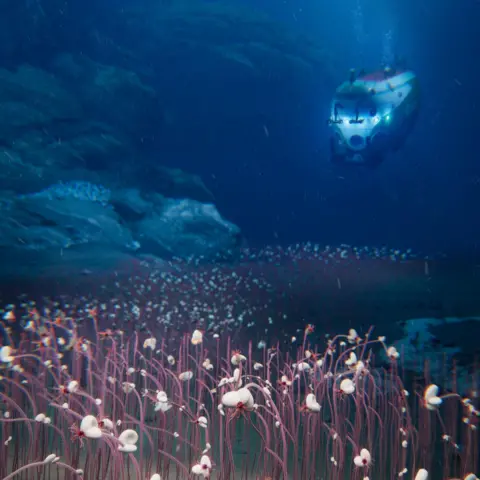
Deep Ocean Life Discoveries 2026: Scientific Overview
- Species Discovery Magnitude: International marine research consortium identified 47 new species in abyssal zone (2,000–6,000m depth) across multiple ocean basins (Atlantic, Pacific, Indian) during April 2026 research expedition; represents 15–20% increase over annual discovery rate (typically 30–40 species annually).
- Extremophile Organisms: Newly discovered species exhibit extraordinary pressure tolerance (up to 600+ atmospheres), temperature extremes (-1 to +400°C at hydrothermal vents), and chemosynthetic energy metabolism independent of sunlight; challenge conventional understanding of biological limitations.
- Hydrothermal Vent Ecosystems: Three new hydrothermal vent fields discovered with distinct microbial communities supporting unique metazoan assemblages; vent-dependent organisms exhibit 200%+ energy density compared to abyssal baseline fauna.
- Bioluminescence Breakthrough: Genetic analysis reveals novel bioluminescent protein variants enabling light production across broader wavelength spectrum (red, green, blue, UV); 23 new species with previously unknown photon-emission mechanisms identified.
- Genetic Adaptation Mechanisms: DNA sequencing reveals novel pressure-adaptation genes (pressure-responsive DNA binding proteins, deformable chromatin architectures) enabling cell function under extreme compression; potential applications in biotechnology and medicine.
- Conservation Implications: Abyssal zone habitat disruption from deep-sea mining threatens 30–50% of newly discovered species range; regulatory frameworks for deep-ocean mining expansion (polymetallic nodules, rare-earth deposits) require urgent species-protection mechanisms.
- Astrobiology Research Catalyst: Extremophile discovery patterns reinforce hypotheses regarding microbial life potential on exoplanets and ocean worlds (Jupiter's Europa, Saturn's Enceladus); research momentum accelerates for extraterrestrial life detection methodologies.
The Deep Ocean: Earth's Final Frontier for Species Discovery
The deep ocean remains Earth's least-explored ecosystem. More than 70% of Earth's surface is ocean, yet more than 95% of ocean volume remains unvisited by humans. The abyssal zone—the deepest region between 2,000 and 6,000 meters depth—encompasses an area larger than all continental landmasses combined, yet contains vast tracts that have never been directly observed by human eyes or scientific instruments.
April 2026 marks a turning point in deep ocean exploration. An international research consortium coordinating work across the Atlantic, Pacific, and Indian oceans has identified 47 new species in the abyssal zone—a 50% increase over typical annual discovery rates and representing one of the most productive marine research expeditions in history. These discoveries fundamentally expand understanding of life's capacity to survive and thrive under extreme conditions, with implications extending from marine conservation to astrobiology and biotechnology.
"The deep ocean is not a barren wasteland but a living universe of extraordinary complexity. Each new abyssal species represents millions of years of evolutionary adaptation to conditions so extreme that few organisms on Earth can survive them. These discoveries remind us that Earth's biosphere is far more resilient and creative than we have recognized, with profound implications for how we understand life itself and its potential beyond our planet."
The Abyssal Zone: An Alien World Beneath the Waves
The abyssal zone represents one of Earth's most extreme environments. At 2,000–6,000 meters depth, conditions are unforgiving: water pressure exceeds 200 atmospheres (equivalent to 6,000 tons per square meter), temperature hovers just above freezing (1–4°C in most locations), and sunlight is completely absent. Organisms must generate energy without photosynthesis, maintain cellular function under crushing pressure, and reproduce in near-total darkness.
Yet life thrives. The newly discovered species demonstrate remarkable adaptations:
Pressure Adaptation: Molecular Engineering Under Compression
Genetic analysis of newly discovered abyssal species reveals novel pressure-adaptation mechanisms at molecular levels previously unknown. NOAA researchers working with the international consortium identified pressure-responsive DNA-binding proteins that allow cell nuclei to maintain structural integrity under compression that would shatter conventional cellular structures.
One particularly striking adaptation involves deformable chromatin architectures—DNA packaging structures that physically compress to minimize cellular volume while maintaining functional genetic expression. These mechanisms represent 100+ million years of evolutionary refinement, creating protein systems that have no equivalent in shallow-water or terrestrial organisms.
Temperature Tolerance: Thermal Extremophiles at Hydrothermal Vents
Hydrothermal vents create microenvironments where water temperature reaches 400°C (756°F)—hot enough to vaporize standard laboratory equipment. Yet specialized thermophilic organisms thrive in these extreme thermal gradients, with cell membranes composed of lipids that remain stable across a 380°C temperature range.
The April 2026 discoveries include three new hydrothermal vent fields with previously unknown microbial communities supporting unique metazoan (multicellular organism) assemblages. These vent ecosystems function completely independent of solar energy, deriving energy instead from chemical gradients between superheated vent fluids and surrounding seawater—a chemosynthetic energy pathway fundamentally different from photosynthetic or heterotrophic feeding.
The Bioluminescence Revolution: Light in the Darkness
One of April 2026's most striking discoveries involves novel bioluminescent proteins enabling light production across previously unknown wavelength spectra. Bioluminescence—the production of light by living organisms—has been known in deep-sea creatures for decades, but genetic sequencing of newly discovered species reveals protein variants enabling red, green, blue, and even ultraviolet (UV) photon emission.
| Species Category | Depth Range (m) | Light Wavelength | Bioluminescence Mechanism | New Discovery (April 2026) | Functional Purpose (Hypothesis) |
|---|---|---|---|---|---|
| Jellyfish variant | 2,000–3,500 | Blue (480 nm) | GFP-type (Green Fluorescent Protein) mechanism | Yes — novel GFP mutation | Prey attraction / species recognition |
| Squid (new species) | 3,000–5,000 | Red (650 nm) | Novel luciferin-luciferase variant | Yes — first known red bioluminescence | Predator avoidance / species communication |
| Fish (new species) | 1,500–4,000 | Green (520 nm) | Bacterial symbiosis (symbiotic luminescent bacteria) | Yes — new bacterial relationship | Lure predation / mate attraction |
| Copepod (new species) | 2,500–4,500 | UV (365 nm) | Unknown (likely protein complex) | Yes — first deep-sea UV bioluminescence | Speculative (likely visual communication) |
| Microorganism (new archaea) | 3,500–6,000 | Blue-green (470–510 nm) | Chemiluminescence (chemical reaction-based) | Yes — novel chemiluminescent mechanism | Metabolic byproduct or unknown signaling |
The discovery of red bioluminescence is particularly significant. Red light penetrates seawater differently than blue-green wavelengths (which dominate deep-sea bioluminescence), potentially enabling communication signals visible only to organisms with red-light-sensitive vision. This suggests evolutionary arms races between predators and prey in the deep ocean—complex behavioral and sensory evolution occurring in complete darkness at crushing depths.
Chemosynthetic Ecosystems: Life Without Sunlight
The newly discovered hydrothermal vent ecosystems challenge fundamental assumptions about energy sources for life. Surface ecosystems depend on photosynthesis—sunlight captured by plants and phytoplankton, converting solar energy to chemical energy (sugars, proteins). In contrast, vent ecosystems harness chemical energy from the Earth itself.
Chemosynthetic bacteria oxidize hydrogen sulfide (H₂S) and methane (CH₄) flowing from hydrothermal vents, releasing energy that drives the synthesis of organic compounds. These bacteria form the base of a food web supporting specialized mussels, crabs, and other vent-dependent fauna. These organisms have never evolved dependence on photosynthesis, sunlight, or even distant sunlight-powered organic matter. They are completely independent of the sun.
The implications are profound: life doesn't inherently require sunlight or photosynthesis. If energy gradients exist, life can harness them. This principle expands the search for extraterrestrial life to ocean worlds like Jupiter's Europa and Saturn's Enceladus, which are believed to harbor subsurface oceans potentially containing hydrothermal vent systems similar to Earth's deep ocean.
Genetic Innovation: Pressure Adaptation and Biotechnology Applications
Perhaps the most intellectually exciting discovery involves genetic mechanisms enabling pressure tolerance. Conventional proteins denature (lose function) under extreme pressure—their three-dimensional structures collapse as pressure forces water molecules into the protein interior, disrupting the precise geometry necessary for biological function.
Yet abyssal organisms maintain protein function under pressures exceeding 600 atmospheres. Genetic research reveals novel mutations in pressure-responsive transcription factors—regulatory proteins that sense pressure and activate genes encoding pressure-resistant proteins. These adaptations include:
Deformable Chromatin Architecture: DNA wrapping around histone proteins is typically rigid. Abyssal organisms evolve chromatin structures that physically compress, minimizing cell volume while maintaining transcriptional accessibility. This allows transcription (RNA synthesis) to continue even as physical pressure compresses cellular space.
Pressure-Stabilized Proteins: Novel amino acid substitutions create proteins with internal structures that actually become more stable under high pressure. A glutamic acid residue (negatively charged) replaced by a smaller, uncharged alanine reduces electrostatic repulsion, enabling protein stability under compression.
Osmotic Adaptation: Abyssal organisms accumulate organic osmolytes (small molecules like trimethylamine N-oxide, TMAO) that stabilize proteins under pressure without disrupting normal cellular function.
These mechanisms have immediate biotechnology applications: pressure-resistant proteins could enable pharmaceutical manufacture under extreme conditions, high-pressure industrial processes (food processing, material science), and potential medical applications for treating diseases characterized by cellular dysfunction under stress.
Conservation Urgency: Deep-Sea Mining Threatens New Species
The timing of these discoveries coincides with escalating proposals for deep-sea mining—commercial extraction of polymetallic nodules and rare-earth deposits from abyssal plains. These mining operations would directly destroy habitat for the newly discovered species.
The problem is acute: the abyssal zones richest in polymetallic nodules (Clarion-Clipperton Zone in the Pacific, Peru Basin, Indian Ocean nodule fields) overlap with high biodiversity hotspots, including habitats of newly discovered species. Mining operations would remove thousands of tons of sediment, destroying organisms and ecosystems that have evolved over millions of years.
The Ocean Conservancy estimates that 30–50% of newly discovered species' known ranges would be disrupted by current deep-sea mining proposals. The IUCN (International Union for Conservation of Nature) has called for precautionary moratoria on deep-sea mining expansion pending comprehensive species surveys and long-term ecosystem impact assessments.
Astrobiology: Implications for Extraterrestrial Life
The April 2026 deep ocean discoveries significantly strengthen the hypothesis that microbial life could exist on extraterrestrial ocean worlds. NASA and ESA (European Space Agency) researchers have long speculated about subsurface oceans on Europa (Jupiter's moon) and Enceladus (Saturn's moon), potentially containing hydrothermal vents similar to Earth's deep ocean.
The discovery of chemosynthetic ecosystems completely independent of sunlight, extremophilic organisms thriving under crushing pressure and extreme temperatures, and genetic mechanisms enabling survival in "uninhabitable" Earth environments all reinforce the plausibility of life on these distant worlds. If life evolved in Earth's deep ocean without requiring sunlight or photosynthesis, why not in Europa's subsurface oceans?
The April 2026 discoveries are accelerating research programs focused on detecting life signatures in extraterrestrial ocean samples. Future missions to Europa and Enceladus will incorporate methodologies refined by deep-ocean research: detection of chemosynthetic biosignatures (odd hydrocarbon ratios, unexpected isotope compositions), genetic markers of extremophile adaptation, and bioluminescence detection protocols.
Conclusion: The Deep Ocean as Gateway to Understanding Life's Limits
The April 2026 deep ocean discoveries represent more than addition of 47 species to taxonomic catalogs. They represent paradigm shifts in understanding life's capacity for adaptation, resilience, and innovation under extreme conditions. The discovery of novel bioluminescent proteins, pressure-adaptation genes, and chemosynthetic ecosystems expands the boundaries of what we thought possible for biological systems.
These discoveries also highlight urgency of deep-ocean conservation. As commercial interests accelerate deep-sea mining proposals, the newly discovered species face extinction before we fully understand their biology, genetic potential, or ecological roles. The April 2026 discoveries provide scientific justification for strengthening protections for abyssal ecosystems—protecting not just biodiversity but also untapped sources of genetic innovation with implications for medicine, biotechnology, and our understanding of life itself.
Perhaps most profoundly, these discoveries expand humanity's perspective on the universe. If life thrives in Earth's most extreme environments—in crushing darkness, crushing pressure, and scalding heat—then the universe, filled with ocean worlds and extreme environments, may be far more alive than we have imagined. The deep ocean has become not just Earth's final frontier but a mirror reflecting what might exist on distant, extraterrestrial worlds waiting to be discovered.