
Executive Summary
- Three Species, One Crisis: The African savanna elephant is Endangered, the African forest elephant is Critically Endangered, and the Asian elephant is Endangered—with combined wild populations below half a million.
- The Longest Childhood: Elephant gestation lasts roughly 22 months, the longest of any mammal. Calves nurse for up to three years and remain emotionally and socially dependent on their mothers for nearly a decade.
- Matriarchal Memory: Herds are led by the oldest female, whose spatial memory of water sources and migration corridors can mean the difference between survival and starvation during drought.
- Habitat Over Poaching: While ivory poaching devastated populations between 2007 and 2014, habitat fragmentation and human-elephant conflict have now overtaken poaching as the primary threat across Africa and Asia.
- Conservation Success Stories: Botswana, Gabon, and parts of southern India demonstrate that stable governance, community integration, and transboundary corridor protection can stabilize and even grow elephant numbers.
There is a moment on the African savanna, just before dawn, when the air is cool enough to carry sound for miles. If you are lucky, you might hear it: a low, thrumming rumble that travels through the ground faster than it does through the air. It is not a call meant for human ears. It is a conversation between a mother and her calf, between a matriarch and her scattered herd, coordinated across distances that would require a radio in any other species. This is the world of elephants—intelligent, emotional, and agonizingly slow to rebuild when broken.
In 2026, the world's three surviving elephant species occupy increasingly narrow slices of the landscapes they once dominated. Their biology, which evolved over millions of years to favor longevity, deep social memory, and extended parental investment, has become a liability in an era of accelerating habitat loss and human expansion. To understand why saving elephants matters, one must first understand how they live—and how long it takes them to grow.
The Architecture of an Elephant Life
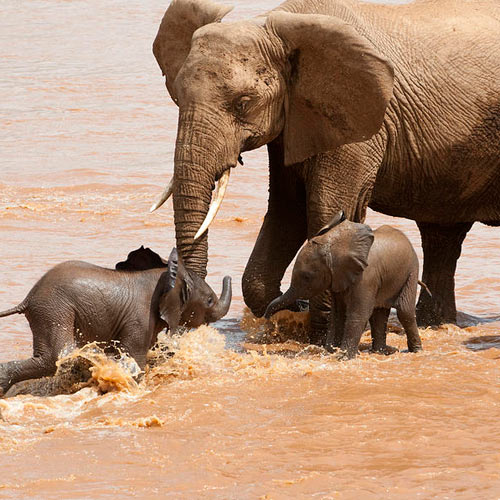
An elephant's life begins after the longest pregnancy in the mammalian world. Twenty-two months—nearly two years—pass between conception and birth. The calf that emerges weighs between 100 and 120 kilograms, already possessing the muscular trunk it will need to nurse, though coordination takes weeks. For the first three months, it cannot control its trunk with any precision; it trips over it, steps on it, and often kneels to drink with its mouth instead.
The mother is not alone in raising the calf. Elephants live in tight-knit matriarchal family units, typically comprising related females and their offspring. Allomothering—where aunts, sisters, and grandmothers assist in protecting and guiding the young—is common. This communal investment makes sense given the biology at stake: a female elephant produces a calf only once every four to five years, and a wild elephant may bear only four to six calves across an entire lifetime.
Weaning occurs gradually, usually between two and three years, though calves may continue to suckle for comfort beyond that point. Adolescence arrives around age 10 to 12, at which point young males begin to leave their natal herd, either drifting alone or joining loose bachelor groups. Young females typically stay, learning the geography of their range from their mothers and grandmothers. This knowledge transfer is not metaphorical. Research from Amboseli, Kenya, spanning five decades has demonstrated that matriarchs who lived through severe droughts in the 1970s led their herds to water and forage during the droughts of 2009 and 2022 with measurably higher success than herds led by younger, inexperienced females.
Male elephants enter musth annually—a state of heightened testosterone and aggression that signals reproductive readiness. During this period, which can last weeks or months depending on age and condition, bulls roam widely, seeking estrous females. Dominance is established not purely by size but by a complex calculus of age, condition, and temperament. A male in his prime, between 35 and 50 years old, commands the reproductive attention of multiple herds.
In the wild, an elephant that survives infancy and adolescence may live 60 to 70 years. In captivity, where exercise, social complexity, and foraging variety are often inadequate, lifespans are frequently shorter and reproductive success lower. The species was never built for confinement.
Three Species, Three Divergent Fates
Taxonomically, the elephant family has contracted dramatically. Where once dozens of proboscidean species roamed every continent except Australia and Antarctica, only three remain. Their statuses, as assessed by the IUCN Red List, make for sobering reading in 2026.
The African savanna elephant (Loxodonta africana), the largest land animal on Earth, is now listed as Endangered. Its population, estimated at roughly 415,000 individuals, represents a decline of approximately 60 percent over the past 50 years. The steepest drops occurred between 2007 and 2014, when organized ivory poaching syndicates decimated herds across East and Central Africa. While anti-poaching efforts and the 2017 closure of China's domestic ivory market have slowed the killing, recovery is glacial. An elephant population cannot bounce back quickly; its reproductive rate is simply too low.
The African forest elephant (Loxodonta cyclotis), smaller and more elusive, inhabits the rainforests of the Congo Basin and West Africa. It is now classified as Critically Endangered, with an estimated population of 40,000 to 50,000. Forest elephants are slower to reproduce than their savanna cousins, bearing calves less frequently and taking longer to reach sexual maturity. Their forest habitat also makes them harder to count and protect. Yet they are ecological engineers of extraordinary importance: their browsing and seed dispersal patterns maintain the composition of the Congo rainforest, one of Earth's largest carbon sinks.
The Asian elephant (Elephas maximus), ranging across India, Sri Lanka, Southeast Asia, and southern China, is listed as Endangered. Its wild population stands at roughly 50,000 to 60,000, with India hosting approximately 60 percent of the total. Unlike African elephants, only male Asian elephants reliably grow tusks; some males are tuskless, and in certain populations—such as Sri Lanka—tusklessness is the norm. This biological quirk has offered partial protection from ivory poaching but has done nothing to shield the species from habitat loss.
| Species | IUCN Status (2021) | Est. Wild Population | Primary Range | Primary Threat |
|---|---|---|---|---|
| African Savanna Elephant | Endangered | ~415,000 | Sub-Saharan Africa | Habitat loss + poaching |
| African Forest Elephant | Critically Endangered | ~40,000–50,000 | Congo Basin | Deforestation + ivory |
| Asian Elephant | Endangered | ~50,000–60,000 | South & Southeast Asia | Habitat fragmentation |
The Poaching Eclipse and the Habitat Squeeze
The conservation narrative around elephants has shifted. A decade ago, the defining image was the carcass in the bush, tusks hacked away by machetes and axes. Between 2007 and 2014, an estimated 30,000 African elephants were killed annually for ivory, driven by demand in East Asia and facilitated by corruption and weak governance in range states. The crisis triggered a global response: militarized anti-poaching units, drone surveillance, DNA tracking of ivory seizures back to source populations, and the eventual shutdown of legal domestic ivory markets in China and the United States.
Poaching has not disappeared. It persists in Central Africa, where governance is weakest, and where armed groups use ivory to finance operations. But in much of East and southern Africa, poaching mortality has declined significantly from its peak. The new crisis is quieter, more systemic, and harder to photograph: the steady erasure of elephant range by human expansion.
Across Africa, elephant habitat has declined by over 60 percent since 1970. The conversion of savanna to agriculture, the fencing of rangelands for livestock, and the expansion of settlements have fragmented once-contiguous populations into isolated pockets. In Asia, the situation is even more acute. India, despite having among the best-protected elephant populations, has seen human-elephant conflict intensify as forest corridors are severed by highways, railways, and plantations. Between 2019 and 2024, an average of 600 people and 100 elephants died annually in India due to conflict incidents—electrocution, train strikes, crop-raiding retaliation, and poisoning.
Climate change compounds the pressure. Droughts in East Africa are becoming more frequent and severe, forcing elephants to travel farther for water and forage, often bringing them into direct contact with human settlements. The matriarchs' memory, once a reliable buffer against environmental variability, is being tested by changes that fall outside living institutional memory.
Conservation Under Pressure
Despite the gravity of the threats, 2026 is not a story of pure decline. There are models that work, and they share common features: stable governance, community buy-in, adequate funding, and landscape-scale planning that treats elephant range as a network rather than a collection of protected islands.
Botswana remains the stronghold of the African savanna elephant, hosting roughly 130,000 individuals—nearly one-third of the continental population. The country's low human population density, strict anti-poaching laws, and community-based natural resource management programmes have created conditions where elephants can still move freely across vast landscapes. However, even Botswana is not immune to pressure. The government's 2019 decision to lift a hunting ban, framed as a response to human-elephant conflict in northern districts, remains controversial and highlights the political complexity of coexisting with large, crop-destroying mammals.
Gabon offers the most hopeful model for forest elephants. The country's network of national parks, covering 11 percent of its territory, is backed by political will and long-term international partnerships. President Ali Bongo Ondimba's administration, despite domestic political turbulence, maintained conservation as a national priority, and Gabon's forest elephant populations have stabilized in core protected areas. The challenge now is extending that protection beyond park boundaries into logging concessions, where elephants are most vulnerable.
In Asia, India's Project Elephant, launched in 1992, has established 33 elephant reserves and invested in corridor restoration, though implementation remains uneven. The most successful interventions have combined physical infrastructure—underpasses beneath highways, elephant-proof trenches, and solar-powered fencing—with community compensation schemes that reduce the incentive for retaliatory killing when elephants raid crops.
"You cannot save elephants with fences alone. You need the people who live next to them to see value in their survival, not just their absence."
Technology is playing an increasingly important role. Satellite collars, acoustic monitoring, and AI-powered camera traps are improving real-time population monitoring. In Kenya, the Save the Elephants tracking programme has mapped migration corridors with GPS precision, providing the data needed to lobby against ill-placed infrastructure projects. In Thailand and Myanmar, blockchain-based supply chain verification is being piloted to ensure that timber and palm oil production do not encroach on critical elephant habitat.
The Path Forward
The fundamental challenge of elephant conservation in 2026 is temporal mismatch. Elephants operate on biological timescales—decades to build a matriarch's knowledge, years to gestate and raise a single calf. Human economies operate on quarterly and electoral cycles. The patience required to protect elephant populations is rarely matched by the patience of political systems.
Yet the case for protection is not merely sentimental. Forest elephants are irreplaceable seed dispersers; without them, the composition of Central Africa's rainforests would shift, reducing carbon sequestration capacity. Savanna elephants control woody plant encroachment, maintaining the grasslands that support hundreds of other species and the pastoralist economies that depend on them. Asian elephants shape forest structure across the Indian subcontinent, creating clearings and trails used by countless smaller animals.
The path forward requires three convergent strategies. First, the protection of remaining habitat must be matched by the restoration of corridors that reconnect isolated populations, allowing genetic exchange and seasonal movement. Second, community-based conservation must move from pilot projects to scaled programmes, ensuring that rural communities living alongside elephants receive tangible benefits—employment, revenue sharing, and conflict mitigation—that exceed the costs of coexistence. Third, the international community must maintain pressure on the illegal ivory trade while addressing the demand-side drivers that sustain it.
Elephants are not relics of a wilder past. They are active architects of the landscapes we depend upon. Their survival is a measure of our willingness to make room—physically, politically, and economically—for lives that unfold on a different rhythm than our own.