
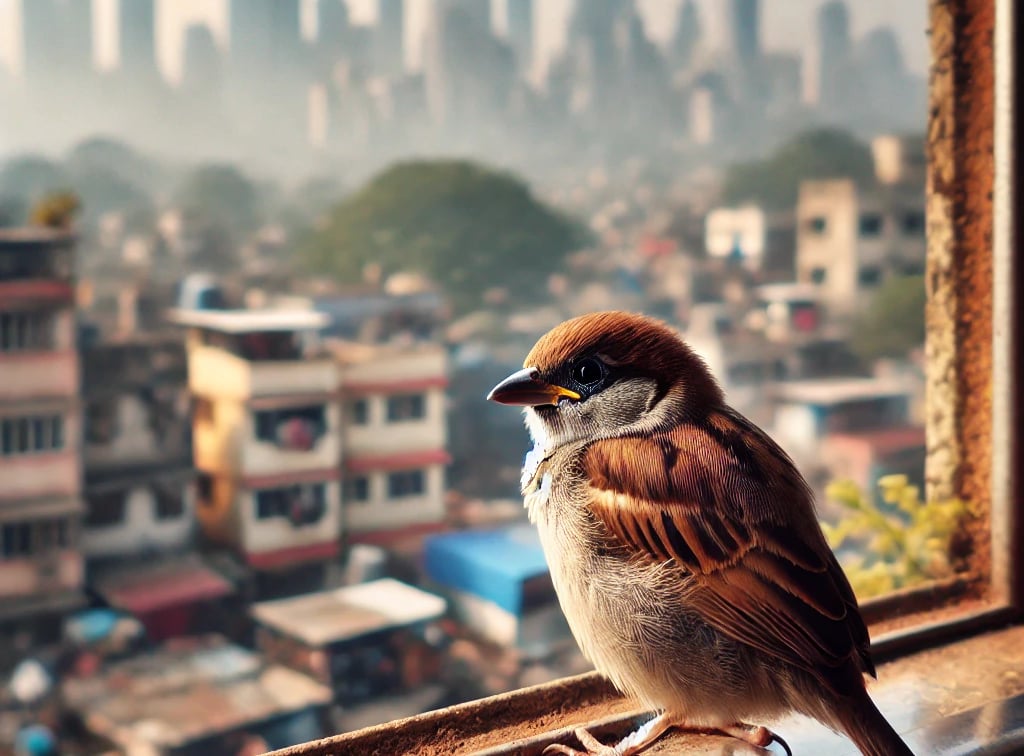
Executive Summary
- Silent Cities: House sparrow populations have declined by 60–70 percent in major European cities since 1980, with similar collapses documented across North American, Indian, and Middle Eastern urban centers.
- The Insect Connection: Declining invertebrate populations—particularly caterpillars and aphids critical for nestling nutrition—are emerging as a primary driver of sparrow breeding failure in polluted and pesticide-heavy environments.
- Architecture Matters: Modern building design eliminates the eaves, cavities, and loose roof tiles that sparrows require for nesting, while sealed windows prevent the indoor nesting that sustained urban populations for centuries.
- Air Quality Link: Research from London, Delhi, and Beijing demonstrates that nitrogen dioxide and particulate pollution directly impair sparrow respiratory efficiency and reduce insect prey abundance.
- Conservation Works: Targeted interventions—nest box programmes, native planting, pesticide reduction, and community monitoring—have stabilized and even reversed declines in pockets of London, Berlin, and Mumbai.
There was a time when the house sparrow was so deeply woven into the fabric of human settlement that it barely registered as wildlife. It was simply there—chirping from gutters, hopping across café terraces, raiding grain stores, building untidy nests in the gaps between roof tiles. In London, sparrows were once as defining as the red double-decker bus. In Delhi, they were the background noise of every morning. In New York, they were the original subway rat with wings, tough and opportunistic and utterly unremarkable.
That unremarkability was the sparrow's evolutionary triumph. Passer domesticus is not a bird of wilderness. It is a bird of us—of our villages, our markets, our farms, our cities. Its natural range, originally confined to parts of Europe and Asia, expanded alongside human migration until it colonized every continent except Antarctica. An estimated 540 million house sparrows existed globally at their mid-twentieth-century peak. Today, no one is certain how many remain, but everyone agrees the number is falling fast.
The decline is not uniform. Rural sparrow populations in traditional agricultural landscapes have held steadier, though they too are slipping. The real collapse is urban. In city after city, the background chirp has faded into something you notice only when it is gone. The question is no longer whether sparrows are declining, but why the architecture of modern life has become so inhospitable to a bird that once thrived precisely because it asked so little of us.
The Life of a Sparrow: Built for Proximity
To understand the sparrow's vulnerability, one must first understand its biology. The house sparrow is a small, stocky passerine—roughly 16 centimeters in length, weighing between 24 and 40 grams. Males carry the species' visual signature: a chestnut mantle, grey crown, black bib, and conical bill adapted for seed-cracking. Females are drabber, streaked brown and buff, a camouflage that serves them well during the vulnerable nesting period.
Sparrows are not migrants. They are permanent residents, tied to a territory year-round. This sedentary lifestyle made them ideal urban colonizers; they do not need wilderness corridors or seasonal foraging ranges. A single city block, if it provides food, nesting crevices, and some measure of safety, can sustain a sparrow population indefinitely.
Breeding begins early. In temperate climates, pairs may start investigating nest sites in February, with the first clutches laid by March. A typical clutch contains four to five eggs, pale grey or white with dense speckling. Incubation lasts 11 to 14 days, shared by both parents. The nestlings that hatch are altricial—naked, blind, and utterly dependent—requiring a constant supply of soft-bodied insects, particularly caterpillars and aphids, for the first week of life. After that, parents gradually introduce seeds.
This dietary shift is critical. Sparrows are often described as seed-eaters, and adults consume large quantities of grain and weed seeds. But nestlings cannot digest hard seeds. They require protein-rich insects to develop properly. A pair of sparrows may raise two to four broods per season, each demanding hundreds of caterpillar deliveries. When insect prey disappears, the entire reproductive cycle collapses.
Sparrows are also intensely social. They nest in loose colonies, roost communally in dense shrubs or reed beds, and maintain a complex vocal repertoire of chirps and calls that regulate flock behavior. This sociability, once an advantage in the cluttered human environment, now works against them when populations fall below the threshold needed to sustain social cohesion and predator vigilance.
The Vanishing: Patterns and Causes
The house sparrow decline was first documented systematically in the United Kingdom. The British Trust for Ornithology's Common Bird Census recorded a 60 percent decline in England between 1977 and 2016. London lost roughly 70 percent of its sparrows during the same period. Similar patterns emerged across Europe: Amsterdam, Paris, Hamburg, and Prague all reported steep losses. North American cities, where sparrows are non-native but long-established, saw parallel declines, particularly in the northeastern United States and eastern Canada.
India's decline is perhaps the most emotionally resonant. The house sparrow is deeply embedded in Indian cultural memory—featured in folklore, children's rhymes, and rural household life. Delhi, which once hosted sparrows in every courtyard, saw populations crash by over 50 percent between 2000 and 2020. Mumbai, Chennai, and Bangalore reported similar trends. The Indian government declared the house sparrow the state bird of Delhi in 2012, a symbolic gesture that acknowledged the crisis without resolving it.
The causes are not singular. They are a cascade of interconnected urban transformations, each harmless in isolation but lethal in combination.
Insect collapse is increasingly understood as the primary driver. Urban light pollution disrupts nocturnal insect behavior. Pesticide use in parks, gardens, and agricultural fringes reduces caterpillar abundance. Impermeable surfaces—concrete, asphalt, sealed soil—eliminate the leaf litter and herbaceous growth that support insect food webs. A study from Leicester, UK, found that sparrow chicks in areas with high nitrogen dioxide pollution received fewer caterpillar deliveries and grew more slowly than chicks in cleaner air, even when parental effort was identical. The pollution was killing the insects, and the chicks were starving invisibly.
Architectural sealing compounds the problem. Modern buildings, with their flush eaves, sealed soffits, and replacement windows, offer no nesting cavities. Old houses with loose tiles, gaps in brickwork, and open eaves were sparrow apartment blocks. New houses are fortresses. Even the shift from wooden window frames to uPVC eliminates the gaps where sparrows once nested inside human dwellings—a behavior so common that it helped earn the species its name.
Food availability has shifted in quality if not quantity. Sparrows adapted to human grain stores, market spillage, and backyard bird feeders. But the nutritional value of urban food has changed. Bread and processed scraps lack the protein and micronutrients of natural seeds and insects. In some cities, sparrows are simultaneously overfed and malnourished, particularly during the critical nesting season when insect prey is scarce.
Predation pressure from cats, corvids, and squirrels has risen in some urban contexts as sparrow populations have fallen below the density threshold where communal vigilance is effective. A sparse sparrow colony is more vulnerable than a dense one; the decline becomes self-reinforcing.
| City / Region | Est. Population Decline | Period | Primary Suspected Cause |
|---|---|---|---|
| London, UK | ~70% | 1994–2024 | Air pollution + insect loss |
| Delhi, India | ~50% | 2000–2020 | Building sealing + pesticide |
| Paris, France | ~60% | 1989–2019 | Green space management |
| New York, USA | ~40% | 2000–2020 | General urban stressors |
| Amsterdam, NL | ~55% | 1990–2020 | Insect decline + architecture |
| Mumbai, India | ~45% | 2005–2025 | Pollution + habitat loss |
The Pollution Connection
Among the emerging research, the link between air quality and sparrow survival is particularly troubling because it implicates the entire model of dense urban development. Studies from Imperial College London have demonstrated that house sparrows in areas with high nitrogen dioxide exposure show reduced foraging efficiency, lower body mass, and smaller clutch sizes. The mechanism appears to be indirect: NO₂ alters plant chemistry, reducing the abundance and nutritional quality of caterpillars, which in turn limits the protein available to nestlings.
In Delhi, where winter air quality routinely registers among the world's worst, post-mortem examinations of sparrows have found respiratory tissue damage consistent with chronic particulate exposure. Whether this directly kills adults or merely weakens them, making them more susceptible to predation and disease, remains under investigation. What is clear is that the sparrow's compact, high-metabolism physiology is poorly suited to breathe the air we have made.
What Recovery Looks Like
The house sparrow is not a species without hope. Its reproductive potential remains high, its adaptability legendary, and its requirements modest. Where conservation interventions have been applied with consistency, populations have stabilized and, in some cases, rebounded.
London's Royal Parks have become a testing ground. Since 2016, the Royal Society for the Protection of Birds has coordinated nest box installation, native hedgerow planting, and pesticide reduction across Hyde Park, Kensington Gardens, and Regent's Park. Sparrow numbers in these managed areas have increased by roughly 15 percent since 2020—a modest but meaningful reversal. The key insight was that sparrows need not just food and nest sites, but the right kind of vegetation: dense, insect-supporting shrubs rather than manicured lawns and ornamental bedding.
In Berlin, a city-wide initiative to replace sealed surfaces with green infrastructure—rain gardens, green roofs, and pollinator corridors—has correlated with slower sparrow declines in treated districts. The programme was not designed for sparrows, but for stormwater management and urban cooling. The birds benefited incidentally, a reminder that ecosystem restoration often outperforms species-specific interventions.
India's Save the Sparrow movement, driven by citizen science and community nest box programmes, has achieved localized successes in Mumbai and Pune. The Bombay Natural History Society's monitoring network, established in 2012, has documented stable or slightly increasing sparrow populations in neighborhoods where native tree planting and pesticide reduction were combined. The challenge is scale; India's urbanization is adding millions of sealed, insect-poor square kilometers faster than conservation can respond.
"The sparrow is not asking for wilderness. It is asking for the messy, imperfect, insect-rich city we used to build without thinking. Its decline is a mirror of how far we have sterilized our own environment."
The Path Forward: Coexistence by Design
The house sparrow's predicament is not unique. It is emblematic. The same urban transformations that have erased sparrows—sealed surfaces, pesticide dependence, light pollution, habitat simplification—are implicated in the broader insect apocalypse, the decline of urban pollinators, and the loss of biodiversity in human-dominated landscapes. Saving the sparrow requires saving the urban ecosystem it represents.
This is not a call to return to pre-industrial cities. It is a call to design cities that function as ecosystems rather than machines. Green infrastructure must be judged not by its aesthetic appeal but by its biological productivity: does it support caterpillars? Does it harbor nesting cavities? Does it generate the messy, insect-rich understory that feeds the next generation of birds?
Building codes can be modified to require sparrow bricks—nest boxes integrated into new construction. Urban tree planting can prioritize native species that support specialist insect communities over ornamental imports. Pesticide use in public spaces can be restricted during breeding seasons. Light pollution can be reduced through shielded fixtures and dimming schedules. None of these measures is technologically complex. They require only the recognition that a city without sparrows is not a city that has succeeded, but a city that has forgotten how to share space.
The house sparrow was once the world's most successful urban bird because it was the most forgiving. It asked for so little: a gap in the eaves, a handful of seeds, a few insects in summer. That we have managed to take even this away is a measure of how thoroughly we have engineered nature out of our daily lives. The sparrow's silence is not just a loss for birdwatchers. It is a warning about the kind of world we are building—one so clean, so controlled, so efficient that even the creatures that evolved to live beside us can no longer survive.