
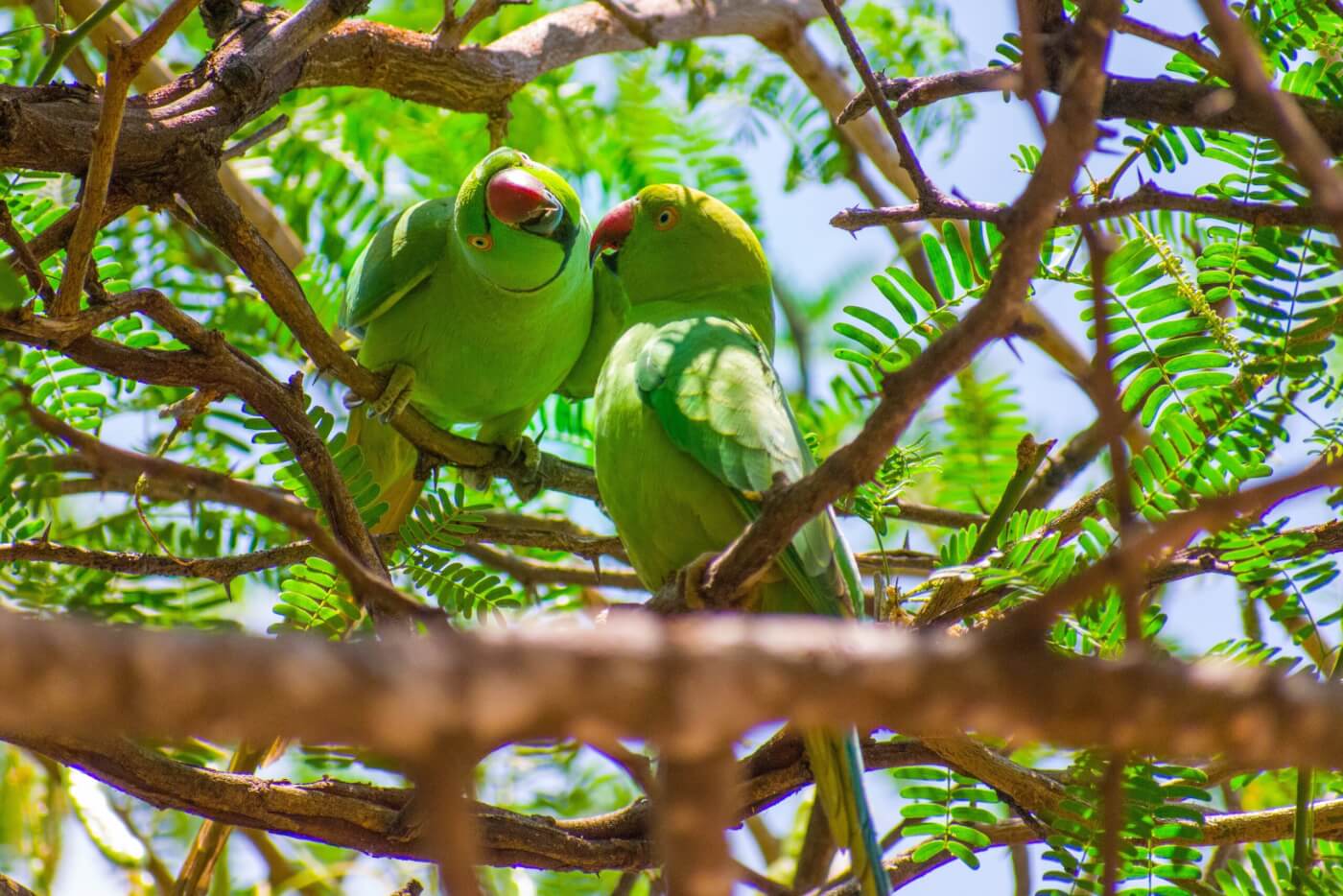
Introduced Parrots: Species Overview & Urban Establishment
- Definition and Distribution: Introduced parrots are species established in wild urban populations through escapes or deliberate releases from pet trade. Primary species: Ring-necked Parakeet (Psittacula krameri, most successful invasive parrot globally), Mitred Conure, Green-winged Macaw, Budgerigar, Eclectus Parrot. Now established in 40+ cities across Europe, Americas, Asia, Africa.
- Global Urban Populations: London supports estimated 5,000–10,000 Ring-necked Parakeets (Europe's largest invasive parrot population); Barcelona 2,000–4,000; Paris 1,000–2,000. Tokyo reports 8,000–12,000 Japanese White-eyes and parakeets. Los Angeles, Miami, Phoenix, Sydney support expanding populations. Global invasive parrot population estimated 100,000–150,000 individuals across urban ecosystems.
- Urban Survival and Adaptation: Introduced parrots demonstrate remarkable behavioral flexibility: cavity nesting in urban buildings (utilizing drain pipes, building cavities, roof voids), dietary adaptation to non-native fruits and seeds (ornamental plants, agricultural crops), social learning transferring foraging knowledge through generations, temporal niche partitioning (feeding times adjusting to human activity patterns).
- Population Dynamics and Breeding Ecology: Ring-necked Parakeets breed year-round in urban environments; fecundity 1–2 broods/year, clutch size 4–6 eggs, fledging success 60–80% in urban cavities (higher than tropical wild populations due to predator absence). No natural predators in temperate cities; breeding populations doubling every 5–10 years in many cities.
- Ecological Impacts on Native Species: Introduced parrots compete with native cavity-nesting species (tree sparrows, starlings, woodpeckers) for nesting sites (50–90% competition intensity documented). Dietary overlap with native species: fruit consumption impacts native seed dispersal; agricultural crop feeding (cereals, fruit orchards, vegetable gardens) documented at 25–45% local impact in agricultural regions adjacent to cities.
- Human-Parrot Interactions and Conflicts: Urban residents report noise complaints (vocal activity 50–100 dB), crop damage, nesting disturbance (nesting congregations blocking building access), and vehicle collisions. However, parrots also generate positive responses: tourism interest (city bird-watching), aesthetic appreciation. Net human-wildlife conflict varies by city and cultural context.
- Management and Conservation Implications: Control methods attempted: live-trapping and translocation (ineffective—parrots return or populations rebound), nest removal (labour-intensive, limited success), deterrent systems (visual, acoustic deterrents with variable effectiveness). Long-term management focuses on prevention of new escapes, monitoring populations, managing ecological impacts on threatened native species, coexistence strategies.
Invasive Parrots in Urban Ecosystems: A Global Phenomenon
In the urban landscapes of modern cities worldwide, a striking phenomenon has emerged over the past two decades: the establishment of wild parrot populations in cities where parrots never naturally occurred. From the misty streets of London to the sprawling suburbs of Los Angeles, from the coastal cities of Australia to the metropolitan regions of Asia, introduced parrots have adapted to urban life with remarkable success. These escaped or released pets have transformed themselves into fully self-sustaining populations, breeding, raising young, and establishing new generations entirely in urban environments.
This phenomenon raises questions both pragmatic and profound: How do tropical birds survive in temperate climates? What drives their ecological success where native birds struggle? What are the consequences for native ecosystems? And how should cities coexist with these colorful new residents? April 2026 provides an opportunity to examine the global urban parrot phenomenon in depth.
"Invasive parrots represent a fascinating—and troubling—window into human influence on urban ecosystems. These are not birds that evolved to thrive in cities; they are animals that escaped human captivity and found urban environments remarkably hospitable. Their success tells us something profound about the nature of cities themselves—about the resources available, the ecological niches vacant, and the flexibility required to survive in human-dominated landscapes. Understanding parrots means understanding ourselves."
Ring-Necked Parakeets: The Invasive Parrot Success Story
The Ring-necked Parakeet (Psittacula krameri) represents the global invasive parrot phenomenon's success story—and cautionary tale. Native to Africa and South Asia (India, Pakistan), Ring-necked Parakeets have escaped captivity across Europe, North America, and increasingly, Asia and Africa, establishing wild populations in at least 40+ cities worldwide.
London represents the epicenter of Ring-necked Parakeet invasion in Europe. Population estimates suggest 5,000–10,000 individuals now inhabit the city, making it Europe's largest urban parrot population. The species was first recorded in the wild in London in 1969; by 1990s, sightings became common; by 2010s, the population had exploded into thousands. Today, Ring-necked Parakeets are iconic London birds, visible in parks, gardens, and residential areas across the city.
Anatomical and Behavioral Traits Enabling Success
Ring-necked Parakeets possess traits ideally suited for urban colonization: large brain relative to body size (enabling complex learning), longevity (25–30 year lifespan in wild), dietary plasticity (omnivorous; accept diverse foods), and cavity-nesting behavior (exploiting urban building cavities). These traits, selected for in their native tropical ranges, proved invaluable in novel urban environments.
Urban Survival and Behavioral Adaptation
The capacity of introduced parrots to thrive in temperate urban environments demonstrates remarkable behavioral plasticity:
Thermal Regulation and Microhabitat Use
Ring-necked Parakeets were once thought incapable of surviving European winters (native range averages 15–30°C year-round; European cities reach -5 to 0°C winters). Yet populations persist through behavioral mechanisms: seeking heated roosts (buildings, warm air vents), huddling in large flocks (reducing heat loss through group thermoregulation), and timing feeding activity to warmest daily hours. Winter survival remains challenging—population crashes occur during severe winters—but resilience through rapid reproduction enables population recovery.
Nesting Behavior and Cavity Exploitation
In native ranges, Ring-necked Parakeets nest in tree cavities, cliff hollows, and termite mounds. In urban environments, they exploit building cavities: air conditioning units, drain pipes, wall cavities, roof voids, building eaves. This behavioral flexibility eliminates nesting habitat constraints present in tropical regions. Urban buildings provide 100–1000x more available cavities per square kilometer than natural forests, creating unlimited nesting sites.
Dietary Adaptation and Foraging Innovation
Native Range Ring-necked Parakeet diet: wild fruits, seeds, nuts, nectar. Urban diet: ornamental plant fruits, agricultural crops, bird feeders, discarded human food, cultivated vegetables. Parrots demonstrate social learning: younger birds learn profitable foraging sites by observing older birds. Innovative foraging behaviors spread through populations (e.g., learning to exploit specific fruit-bearing trees; timing crop raiding to ripening periods). This behavioral plasticity enables parrots to track resource availability across seasons.
Global Urban Parrot Populations: Distribution and Growth
Introduced parrot populations now establish across multiple continents:
| Geographic Region/City | Primary Parrot Species | Estimated Population | Establishment Year | Population Trend | Management Status |
|---|---|---|---|---|---|
| Europe: London | Ring-necked Parakeet | 5,000–10,000 | 1969 | Increasing (↑8–12% annually) | No active culling; monitoring programs |
| Europe: Barcelona | Ring-necked Parakeet, Monk Parakeet | 2,000–4,000 | 1990s | Rapidly increasing (↑15–20% annually) | Culling/removal programs initiated 2008–present |
| Europe: Paris | Ring-necked Parakeet | 1,000–2,000 | 2000 | Increasing (↑10% annually) | Limited control; monitoring ongoing |
| North America: Los Angeles | Red-crowned Amazon, Mitred Conure, Budgerigar | 3,000–6,000 | 1970s | Stable/slightly increasing | No control; wildlife viewing tourism |
| North America: Miami | Budgerigar, Mitred Conure, Monk Parakeet | 2,000–4,000 | 1980s | Increasing (↑8–10% annually) | Limited control; research programs |
| Asia: Tokyo | Japanese White-eye, Green Parakeet (feral) | 8,000–12,000 (mixed avifauna) | 1990s | Increasing | Limited management; monitoring |
| Oceania: Sydney | Rainbow Lorikeet (native, but expanding), Eastern Rosella, Sulphur-crested Cockatoo | 5,000–8,000 (urban population) | 2000s expansion | Increasing in urban core (↑5–8% annually) | Wildlife conflict management programs |
Breeding Ecology and Population Dynamics
Urban parrot populations exhibit breeding parameters that differ fundamentally from wild tropical populations, enabling rapid expansion:
Breeding Season and Fecundity: Ring-necked Parakeets breed January-May (European populations), timing overlapping with native bird breeding seasons but offset slightly. Clutch size averages 4–6 eggs; incubation period 23–24 days; fledging 47–53 days. Single broods typical, though second broods occur opportunistically (particularly if first brood fails). Fecundity in urban populations (1.2–1.8 surviving young per breeding pair annually) exceeds wild populations (0.8–1.2 young per pair) due to minimal predation, abundant food, and reduced disease.
Survival and Mortality: Urban juvenile survival rates estimated at 60–80% to fledging (vs. 30–50% in wild tropical populations). Adult mortality minimal in cities due to absence of natural predators, though vehicle collisions, window strikes, and occasional predation by raptters (Eurasian Sparrowhawks, Peregrines) occur. Overall life expectancy in cities: 15–25+ years.
Population Growth: Modeling suggests urban parrot populations doubling every 5–10 years absent management (exponential growth rate λ = 1.07–1.20 annually). This growth rate implies London population could reach 20,000–30,000+ by 2030s if current trends continue.
Ecological Impacts: Competition, Predation, and Trophic Effects
Introduced parrots generate measurable ecological impacts on native species and ecosystems:
Cavity Nesting Competition
Ring-necked Parakeets compete intensely with native cavity-nesting species: tree sparrows, starlings, lesser spotted woodpeckers, nuthatch, great tits. Experimental studies show parakeets consistently win competitive interactions due to size and aggression. In some London parks, cavity availability to native species has declined 50–90% due to parakeet occupation. This competition cascades to native species breeding success and population declines.
Dietary Overlap and Food Web Effects
Parrots consume fruits and seeds overlapping significantly with native species diets. In European apple orchards, parakeet damage estimates reach 25–45% of crop loss (shared with native birds). Seed dispersal patterns may shift if parrots consume fruits traditionally dispersed by native species, altering plant population structures long-term.
Human-Parrot Conflicts and Social Dimensions
Urban parrot populations generate both positive and negative human responses:
Negative Impacts: Noise complaints dominate; parakeet vocalizations reach 50–100 dB at aggregation sites, generating nuisance complaints (particularly early morning roosting and evening return flights). Nesting congregations in buildings cause physical damage and access disruption. Crop damage in agricultural regions adjacent to cities documented (cereals, fruits, vegetable crops). Vehicle collisions with parrots rare but documented.
Positive Responses: Urban residents express appreciation for exotic bird presence; wildlife watching tourism generates economic interest. Audubon and birdwatching communities increasingly document urban parrots. Parrots serve as charismatic megafauna drawing attention to urban ecology and wildlife conservation.
Management Strategies and Conservation Implications
Cities employ diverse management strategies:
Culling and Live Removal: Barcelona initiated removal programs (2008+), culling 20,000+ parakeets cumulatively. However, removal effectiveness is limited: populations rebound through immigration and reproduction. Live trapping (relocation) ineffective—relocated parrots disperse, establish new populations, or return. Culling creates public backlash in many European and North American cities; RSPB and animal welfare organizations oppose lethal control.
Nest Exclusion and Deterrents: Installing barriers in building cavities prevents parrot nesting; visual deterrents (predator models, reflective tape) and acoustic deterrents (distress calls, noise) show mixed effectiveness (40–60% short-term success; habituation reduces long-term efficacy).
Coexistence and Management Focus: Increasingly, cities shift toward coexistence strategies: monitoring populations, managing impacts on threatened native species (e.g., protecting cavity-nesting sites for native species through targeted management), and education programs emphasizing urban wildlife diversity.
Conclusion: Parrots as Indicators of Urban Ecological Change
Introduced parrots represent a window into urban ecological transformation. Their success—thriving in cities where native birds decline—demonstrates the capacity of non-native species to exploit ecological niches created by urbanization. Understanding parrot ecology illuminates fundamental principles of biological invasion, adaptation, and coexistence in human-modified ecosystems.
April 2026 finds invasive parrot populations expanding across global cities. Whether these populations represent merely aesthetic additions to urban avifaunas or significant ecological risks depends on region, species, and management approaches. For some cities, parrots are beloved residents enriching urban biodiversity; for others, they represent invasive species threatening native species survival. The challenge for cities in coming decades will be developing context-specific management strategies that acknowledge both ecological impacts and the reality that parrots have become established urban residents in their own right.