Gudworld: Verified Real Facts & Timeline
- 2020-2021: Birth of a Modernization Idea: Preeti Shinde, then 22 years old, grew up in family business—40 years of jaggery production in Aurangabad, Maharashtra. Childhood memories: visiting family factory, watching thousands of kilos of jaggery loaded on trucks daily. But when she analyzed her own kitchen, she discovered irony: despite shipping 30,000-40,000 kilos daily, her family rarely used jaggery. Reason was clear—jaggery was inconvenient. Breaking large blocks, manually powdering by hand took hours. Her grandmother spent entire afternoons just pounding jaggery blocks. This was friction point. This was problem to solve. Soft launch: February 2020 at Gulfood Dubai (international trade show). Official launch: April 2021.
- The Problem Addressed: Traditional Jaggery's Limitations: While jaggery has been traditional medicinal sweetener for thousands of years, two problems existed: (1) Hygiene and contamination—many commercial jaggery blocks were contaminated with chemicals, impurities, or contained hidden additives, (2) Convenience—large blocks were hard to handle, difficult to portion, messy to use. Urban consumers wanted jaggery benefits but without hassle. Preeti's solution addressed both through modernization, not replacement.
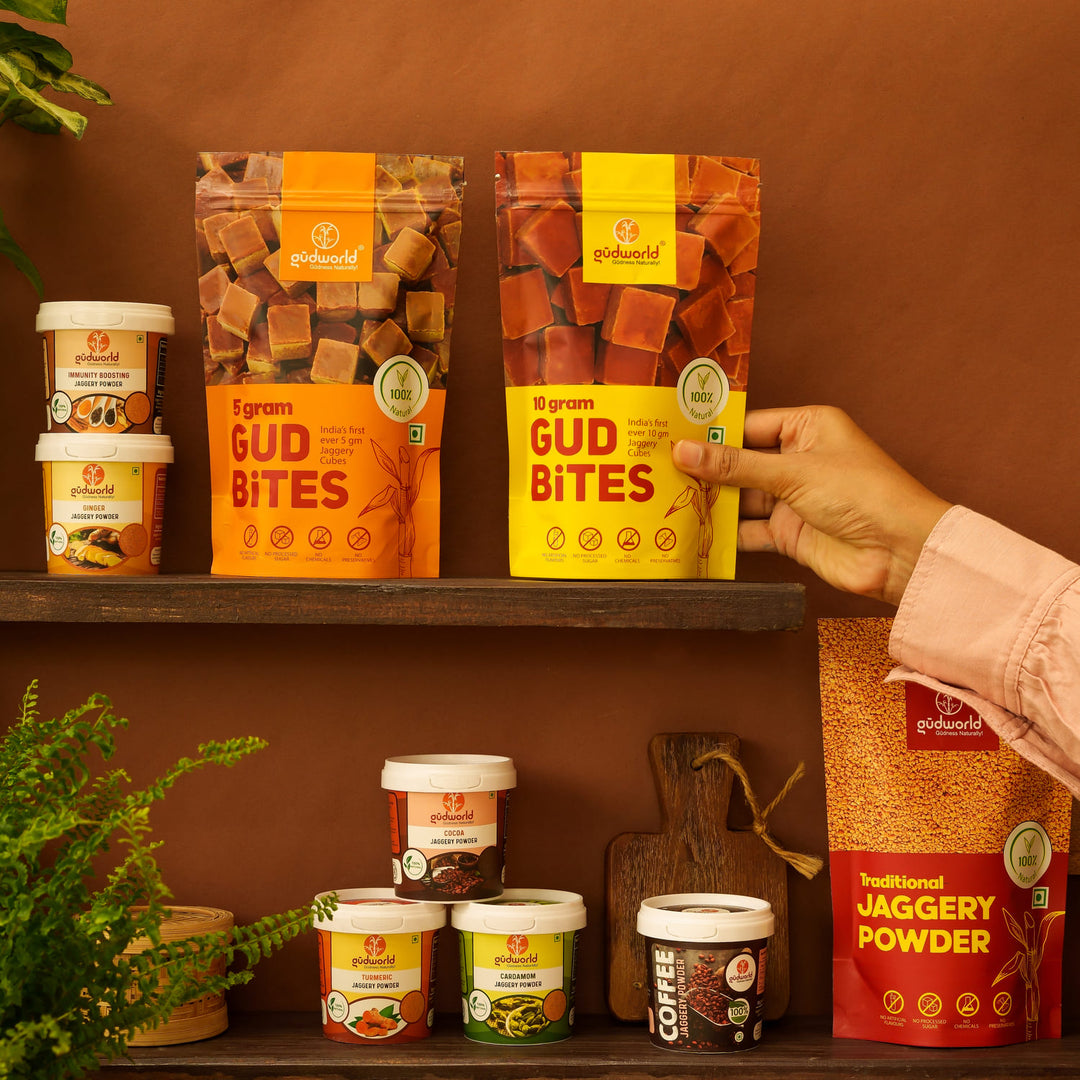
- Innovation: Gud Bites and Flavored Jaggery (2019-2021): Preeti discussed idea with father—he knew every detail of jaggery making. Together they combined his traditional knowledge with modern technology. Result: in-house developed technology to produce 5g and 10g cubes of pure jaggery. These "Gud Bites" were individually wrapped, hygienic, portioned, convenient. But innovation didn't stop there. They added 12 natural infusions: ginger, coffee, turmeric, cardamom, desi ghee, and others. Each flavor maintained authenticity—no artificial sweeteners, no chemicals, just pure jaggery with natural infusions. One-year shelf life using proper packaging and nitrogen flushing technology.
- Family Foundation: 40-Year Legacy + US-FDA Certified Facility: Gudworld backed by family's 40-year expertise in jaggery manufacturing and sugarcane farming. Sugarcane sourced from family farm spanning 100-150 acres in Aurangabad, ensuring quality control from seed to final product. Critical advantage: US-FDA certified in-house manufacturing facility with modern technology. This combination—traditional knowledge plus modern certification—gave credibility and ensured consistency that competitors couldn't match.
- Growth Phase 1: April 2021 to FY24 (₹1.48 Crore Revenue): Officially launched April 2021. Business grew through online channels, e-commerce platforms, and direct-to-consumer model. By FY23-24 (ending March 2024), achieved ₹1.48 crore annual revenue. Sold over 2 crore units (20 million "Gud Bites") since launch. Present in 2,800 retail stores across India. Distribution channels: 45% general trade (local stores), 15% modern trade (chains), 15% e-commerce and website, 20% exports, 5% HoReCa (restaurants/hotels).
- Growth Phase 2: FY25 Projection (₹6-7 Crore Revenue): FY24-25 (till October 2024): ₹2.2 crores already achieved in first 7 months. Monthly revenue: ₹37 lakhs (August), ₹48 lakhs (September), ₹69 lakhs (October 2024). Projected full-year FY24-25 close: ₹6-7 crores. This represents 300%+ growth year-over-year. Growth fueled by: expanded retail presence, increased online sales, growing export demand, brand visibility from Shark Tank India.
- Shark Tank India Season 4 (January 2025): The Pitch: Preeti Shinde and Sayali Babasahib Shinde appeared on Shark Tank India Season 4 (Episode 4). Pitch: asked ₹50 lakh for 2% equity, valuing company at ₹25 crore. They presented: 40-year family legacy, US-FDA facility, 2 crore units sold, ₹1.48 crore FY24 revenue, 75% gross margins (highly profitable), 12 flavors, innovative Gud Bites format, 2,800 retail presence, 20% of revenue from exports. Sharks impressed but questions emerged about valuation, family involvement in equity (30% held by relatives), and raw material sourcing from family farm.
- Shark Responses and Negotiations: Aman Gupta (boAt founder): Impressed by product and market opportunity, initially offered ₹50 lakh for 6% equity. Peyush Bansal (Lenskart): Had reservations about family equity structure and governance. Vineeta Singh (Sugar Cosmetics): Declined due to concerns about go-to-market strategy. Varun Alagh: Made same offer as Aman (₹50L for 6%) but with condition—no family involvement. Anupam Mittal: Stepped out, felt founders already had strong offers. Preeti skillfully negotiated with Aman: accepted ₹50 lakh but negotiated down equity to 5% (not 6%), valuing company at ₹10 crore instead of original ₹25 crore ask.
- Deal Closed: ₹50 Lakh for 5% Equity with Aman Gupta: Final deal: Aman Gupta invested ₹50 lakh for 5% equity, valuing Gudworld at ₹10 crore. Beyond investment, Aman committed mentorship for scaling brand in consumer-facing FMCG market. Deal closed after episode aired (January 2025), signaling genuine commitment. Aman's expertise in scaling consumer brands (boAt grew from startup to multi-crore valuation) provided strategic value beyond capital.
- Business Model: Factory-to-Consumer (F2C) Success: Gudworld operates direct factory-to-consumer model. This eliminates middlemen, maintains high margins (75% gross), and provides direct supply chain control. Products made in company's own facility, sold through owned channels (website, direct orders) and retail partnerships. F2C model allows flexibility in pricing, product variants, and customer relationship management. As they scale, F2C provides competitive advantage because scale improves margins further.
- Why This Works: Modernizing Tradition with Quality: Success rooted in addressing real problem (jaggery convenience) while maintaining authenticity (pure, hygienic, traditional). Market opportunity huge: India jaggery market worth ₹6,500 crores, global market $4.2 billion USD. Growing urban consumer preference for natural sweeteners, health-conscious choices, and convenience products. Gudworld positioned perfectly at intersection of tradition (40-year family legacy) and innovation (convenient Gud Bites format, 12 flavors, US-FDA facility). Premium positioning justified by: authentic quality, hygienic production, convenient format, natural flavors, healthy alternative to refined sugar.
When Family Legacy Meets Modern Innovation
Preeti Shinde grew up surrounded by jaggery. Not as product, but as lifestyle. Childhood in Aurangabad: family farm, sugarcane fields, jaggery factory. Memories of visiting factory, watching thousands of kilos processed daily. Father knew every detail of traditional jaggery making—the exact temperature, the right timing, the perfect consistency. This knowledge was 40 years in making across family generations.
But when Preeti analyzed her own kitchen, she discovered contradiction: despite her family shipping 30,000-40,000 kilos of jaggery daily, she rarely used it at home. Why? Because jaggery was inconvenient. Breaking large blocks required effort. Powdering meant mess and time. Her grandmother spent entire afternoons pounding jaggery blocks just to get usable pieces. This was friction point. This was inefficiency that traditional jaggery market never solved.
Preeti realized something critical: jaggery's traditional form was its limitation, not its feature. Yes, jaggery was healthy, unprocessed, rich in minerals. But its bulk and inconvenience made modern consumers avoid it, despite preferring it over refined sugar. Problem was solvable. If jaggery could be convenient like sugar cubes, hygienic like packaged products, and flavorful like premium treats, it could regain market relevance with urban consumers.
"I have personally experienced the magical effect of jaggery on health. In my younger days, I fell sick very often. The only thing that helped increase my immunity was increasing jaggery intake over sugar. I wanted as many people as possible to experience these benefits. That is how Gudworld was born."
From Idea to Product: Technology Meets Tradition
Developing Gud Bites required solving technical problem: how to create consistently-sized jaggery cubes (5g and 10g) while maintaining purity and shelf life. Not straightforward. Jaggery has specific physical properties—it crystallizes, hardens, can break unevenly. Creating uniform cubes required custom technology.
Preeti discussed idea with father. He provided deep understanding of jaggery chemistry and production. She brought modern technology perspective. Together they developed in-house technology to produce standardized jaggery cubes. Each cube: 5g or 10g, individually wrapped for hygiene, consistent quality, convenient portioning.
But innovation extended beyond format. They infused jaggery with 12 natural flavors: ginger, coffee, turmeric, cardamom, desi ghee, and others. Each flavor maintained authenticity—no artificial sweeteners, no strange chemicals. Just pure jaggery combined with natural ingredients. Results: products that tasted better, offered health benefits, matched urban consumer preferences for flavored, convenient, premium food products.
Building a Business: From April 2021 to ₹1.48 Crore Revenue
Official launch April 2021. Soft launch had been February 2020 at Gulfood Dubai—international trade show that gave early exposure to export markets and international buyers. This early international presence proved valuable for building export revenue stream (eventually 20% of sales).
Initial growth came from online channels: direct website orders, e-commerce platforms, social media marketing. Emphasis on storytelling—40-year family legacy, founder's personal health journey, traditional knowledge plus modern hygiene. This narrative resonated with urban health-conscious consumers seeking authentic alternatives to refined sugar.
By FY23-24, achieved ₹1.48 crore annual revenue. Reached 2,800 retail stores across India. Sold over 2 crore units (20 million Gud Bites). Distribution diversified: 45% from general trade (traditional retail), 15% modern trade (superchains), 15% e-commerce, 20% exports. This diversification meant business wasn't dependent on single channel.
Scaling Rapidly: FY25 Projection ₹6-7 Crore
FY24-25 growth accelerated dramatically. By October 2024 (7 months into fiscal year), already achieved ₹2.2 crores revenue. Monthly progression: ₹37 lakhs (August), ₹48 lakhs (September), ₹69 lakhs (October). This acceleration suggested momentum. Projected full-year close: ₹6-7 crores—more than 300% growth from prior year.
Growth drivers: expanded retail partnerships (more stores carrying product), increased consumer awareness (word-of-mouth plus digital marketing), growing export demand (international customers discovering product), improved production capacity, brand building through media coverage and industry events.
Margins remained healthy at 75% gross, indicating profitable business model. F2C (Factory-to-Consumer) structure maintained, avoiding middlemen and maintaining direct control over supply chain and customer relationships.
Shark Tank India Season 4: Validation and Investment
Appearing on Shark Tank India was pivotal moment. Preeti and Sayali pitched with confidence. They presented: 40-year family legacy, US-FDA certified facility, 2 crore units sold, ₹1.48 crore FY24 revenue, 75% gross margins, 12 flavors, innovative format, 2,800 retail stores, 20% export revenue. Numbers showed business fundamentals were solid.
Asked for ₹50 lakh for 2% equity (₹25 crore valuation). Sharks had different reactions. Aman Gupta saw opportunity—his background in scaling consumer brands (boAt) aligned with Gudworld's growth trajectory. Others had concerns about family equity structure (30% held by relatives) and governance implications. Preeti skillfully addressed concerns, explaining that family involvement wouldn't interfere with professional operations.
Negotiation was sharp. Aman initially offered ₹50 lakh for 6% equity. Preeti countered: ₹50 lakh for 5% equity. Deal negotiated down from Aman's opening position. Final: ₹50 lakh for 5% equity, valuing company at ₹10 crore (not ₹25 crore ask, but realistic valuation based on current revenue and growth trajectory).
The Market: ₹6,500 Crore India Opportunity
Gudworld operates in massive market. India jaggery market valued at ₹6,500 crores annually. Global market even larger: $4.2 billion USD, with China as largest importer of jaggery. Growing global consumer preference for natural, unprocessed sweeteners creates tailwinds for jaggery products, especially convenient formats like Gudworld's Gud Bites.
Urban India specifically shows strong trends: health consciousness increasing, willingness to pay premium for quality, preference for convenient consumption formats, interest in traditional foods repackaged for modern lifestyle. Gudworld positioned perfectly at these convergence points.
Conclusion: Modernizing Tradition at Scale
Gudworld story is about modernizing traditional product without destroying its essence. Not inventing new category—jaggery already existed for thousands of years. But making it convenient, hygienic, flavored, premium positioned. Combining family's 40-year expertise with modern production technology. Building direct-to-consumer model that maintains margins and control. Scaling from ₹1.48 crore to ₹6-7 crore in one year.
This is Indian entrepreneurship: taking traditional product, solving real consumer problem, scaling through quality and distribution, attracting investment from partners who understand consumer brands. Gudworld shows that disruption isn't always about creating something entirely new. Sometimes it is about modernizing what already exists, making it better, more convenient, more accessible to modern consumers.