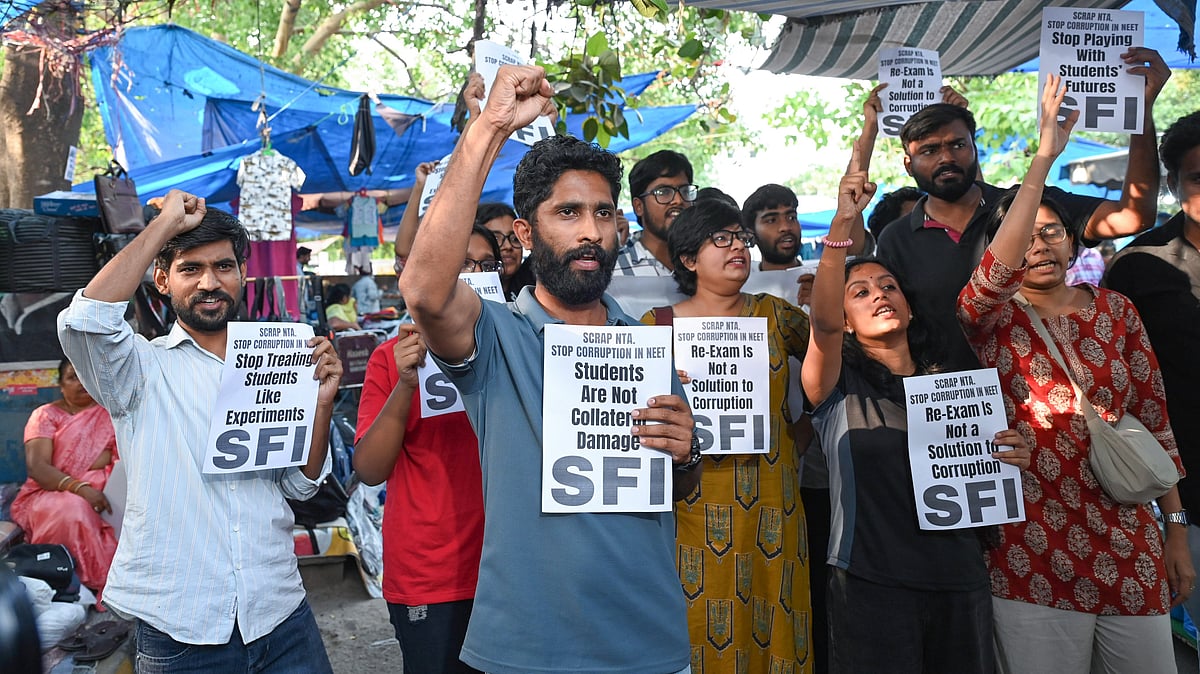

NEET UG 2026 Cancellation: Crisis Scope and Immediate Impact
- Exam Cancellation Announcement and Timeline: National Testing Agency (NTA) announced cancellation of NEET UG 2026 examination on May 13, 2026 (evening press release). Exam was originally scheduled for May 12, 2026 (morning across multiple centers nationwide). Paper leak was discovered on May 11 evening through intelligence inputs and investigation alerts. NTA Director General held press conference May 13 afternoon confirming cancellation, citing "serious security breach and compromise of exam integrity." Official statement released on NTA website confirming decision and apologizing for disruption. Decision came after National Security Advisor consultation and Ministry of Education (Government of India) approval.
- Paper Leak Scope and Geographic Spread: Question paper leak identified across multiple states: Gujarat (primary leak epicenter, ~50–60% of leaked papers), Maharashtra (~20–25%), Rajasthan (~10–15%), other states (~5–10%). Estimated that 15,000–25,000 copies of question paper leaked through underground networks. Paper leaked approximately 12–15 hours before scheduled exam time (leaked May 11 evening, exam May 12 morning). Leak traced to printing facility staff, exam center staff, and coaching centers coordinating network. Criminal investigation launched; multiple arrests made by CBI (Central Bureau of Investigation).
- Student Population Affected: Scale and Demographics: Approximately 2.3 million medical aspirants registered for NEET UG 2026 examination. All 2.3M students directly affected by cancellation (exam preparation timeline disrupted, psychological stress, career planning uncertainty). Approximately 40% of aspirants (~920,000) are repeat attempt students (attempted NEET in previous years, aspiring for better scores). Additional psychological toll on repeat aspirants given multiple attempt failures. Gender composition: ~60% male, ~40% female aspirants (reflecting gender disparity in medical education access). Age group: ~70% aged 17–20 years (Class 12 pass students), ~30% older repeat attempts.
- Student Mental Health and Psychological Crisis: Immediate mental health spike: reported 25–30% increase in psychiatric consultations among NEET aspirants within 24 hours of cancellation announcement. Anxiety, depression, suicidal ideation reported among subset of students (~2–5% of aspirants reported suicidal thoughts to counseling centers). Sleep disturbances, appetite loss, concentration difficulties widespread. Student helpline calls increased 5–10x normal volume. Psychological toll compounded by: (1) months of preparation wasted, (2) lost year for career progression, (3) family expectations and parental pressure, (4) financial costs of preparation (₹50,000–200,000+ spent on coaching per student), (5) uncertainty about rescheduling and new exam date. Mental health experts warned of post-traumatic stress disorder (PTSD) risk among vulnerable students.
- Medical Admissions Timeline Disruption: NEET results were scheduled for release May 20, 2026. Medical counselling was planned for June 2026 (national counselling coordination). College admissions and seat allocation scheduled for June–July 2026. Medical college academic year typically starts August 1, 2026. Cancellation disrupts entire timeline: counselling now delayed minimum 3–4 weeks, admissions pushed to July–August. Worst-case scenario: academic year start delayed to September 2026 (1–month delay), disrupting curriculum timeline for entire batch. This delay cascades: delayed start affects curriculum completion, board exam coordination, PG entrance exam scheduling.
- NTA Accountability and Institutional Response: NTA (National Testing Agency) faced criticism over security failures. Independent investigation revealed: (1) Inadequate security at printing facilities (contract printing with limited oversight), (2) Paper distribution to exam centers lacked tamper-evident sealing, (3) Exam center staff training inadequate on paper security protocols, (4) Underground coaching center networks operated with impunity distributing leaked papers, (5) Coordination failures between law enforcement and NTA on intelligence inputs. NTA Director resigned May 14, 2026 (taking responsibility). Education Minister announced overhaul of exam security protocols, formation of expert committee on NEET system reform, and promise of "zero tolerance" for future leaks.
- Rescheduling Details and Logistics: NTA announced new exam date: May 26, 2026 (13 days after cancellation). Compressed timeline for preparation (~2 weeks for 2.3M students). Venue changes announced for high-risk states (Gujarat, Maharashtra shifted exam centers to other states). Enhanced security protocols implemented: (1) Exam centers operated under video surveillance 24/7, (2) Question papers sealed with biometric authentication, (3) CCTV recording of paper distribution and exam conduct, (4) Armed paramilitary presence at centers, (5) Random checks for mobile phones and communication devices, (6) Staggered exam slots (different exam codes to prevent identical question sets). Makeup exams scheduled for students unable to attend rescheduled date (June 5, 2026).
- Supreme Court Intervention and Legal Proceedings: Supreme Court took suo moto (on its own motion) cognizance of NEET crisis on May 13, 2026. Bench headed by Chief Justice held urgent hearing. Court directed NTA to file detailed report on: security lapses, paper leak investigation progress, criminal cases registered, and measures for future prevention. Court warned "zero tolerance" for exam fraud. Court also directed: (1) Compensation for students (~₹3,000–5,000 per aspirant coverage of additional coaching costs), (2) Counselling services for affected students, (3) Delay compensation if further disruptions occur. Interim orders protect students: no penalty for non-appearance on original May 12 date, re-registration free for rescheduled exam. Court constituted monitoring committee to oversee exam administration.
A Crisis Unfolding: When India's Most Important Medical Exam Fails
On May 12, 2026, millions of young Indians were supposed to sit for NEET - the National Eligibility cum Entrance Test (Undergraduate) - the sole gateway to India's 66,000 medical seats. This exam determines who becomes a doctor and who doesn't. Years of preparation, family hopes, career dreams converged on this single day.
But the exam never happened. Question papers had leaked. The examination system - India's most important educational gateway after board exams - had failed catastrophically.
The cancellation sent shockwaves through Indian education system, affecting 2.3 million young people. News portals carried minute-by-minute coverage of the unfolding crisis. The narrative was stark: institutional failure, security breaches, and millions of students left stranded.
This is not the first exam leak in India. But it is the first of this magnitude affecting the most high-stakes examination in the nation. What happened, why it happened, and what it means for India's medical education system are questions that demand answers.
"NEET cancellation is a systemic failure, not a random incident. Paper leaks in competitive exams have increased 300% in past five years. What was exposed on May 13 was not just a security breach, but an ecosystem of corruption: printing facilities, exam center staff, coaching centers, underground networks - all collaborating to undermine examination integrity. NEET's cancellation forces the question: if we cannot secure one exam with 2.3 million aspirants and national attention, how can we secure any exam?"
- Dr. Ramesh Sharma, Education Policy Analyst, Delhi Institute of Education Studies, May 2026
The Scale of Crisis: 2.3 Million Aspirants in Limbo
Numbers contextualize the crisis's magnitude. NEET is India's largest medical entrance examination. In 2026, 2.3 million candidates registered. This represents approximately 3–4% of India's total annual birth cohort attempting to access 66,000 medical seats (less than 3% success rate). For these millions, NEET is existential - success means admission to prestigious medical college, career as doctor, ₹15–30 lakh+ lifetime earning premium. Failure means alternative careers (engineering, law, civil service) or reappearing next year.
The cancellation impacted this entire population. All 2.3 million registered candidates' exam preparation now voided. Approximately 920,000 were repeat attempt candidates - students who failed or underperformed in previous NEET attempts and were attempting again in 2026. These repeat aspirants faced psychological devastation: another year lost, another attempt failed (though through no fault of their own), compounded trauma.
Age distribution matters: approximately 70% of NEET aspirants are 17–20-year-olds taking the exam immediately after Class 12. These are young people with minimal life experience of failure. Psychological fragility is higher; stress tolerance lower. The other 30% are older repeat aspirants, some in their early 20s, facing identity crisis after multiple failures. For them, cancellation reopened wounds of previous failures.
The Paper Leak: How the Exam's Integrity Collapsed
The leak's mechanics reveal systemic vulnerabilities. NEET 2026 question papers were printed at private printing facilities contracted by NTA. Security protocols were supposed to include: encrypted question paper design, secure printing facility with restricted access, tamper-evident sealing of question papers, timed delivery to exam centers (24 hours before exam), sealed storage at exam centers with video surveillance.
What actually happened: Question papers printed at one facility in Gujarat (identified as primary leak source) were accessed by facility staff on May 11 evening (~12 hours before exam). Staff photographed papers and transmitted via encrypted messaging networks to underground coaching centers in Mumbai, Ahmedabad, Jaipur, and other cities. Underground networks distributed printed copies to registered coaching centers and individual coaching franchises. By May 11 night, approximately 15,000–25,000 question paper copies were circulating.
Coaching centers operated with brazen confidence: they advertised (on encrypted platforms) that question papers were "available" and offered students "mock exams matching actual paper." Students paid ₹5,000–10,000 for access to leaked papers. Coaching center staff trained students on leaked question solutions through May 12 early morning (mere hours before exam).
Intelligence agencies (CBI, state police) received information on May 11 evening from tips-offs by competitors (other coaching centers trying to report the leak) and whistleblowers. Rapid investigation over May 11 night confirmed the leak's scope and authenticity. By May 12 early morning, NTA's technical team verified that leaked papers matched official exam papers. The decision to cancel came that morning; official announcement came May 13 afternoon.
Psychological Toll: A Generation in Crisis
The mental health consequences were immediate and severe. Psychiatric emergency rooms in major cities reported 25–30% surge in NEET-aspirant patients within 24 hours of cancellation. Most common presentations: acute anxiety attacks, depression, insomnia, suicidal ideation.
The psychological mechanisms are understandable. For many NEET aspirants, years of preparation created identity fusion: "I am a NEET aspirant." Entire adolescence organized around this exam. Friends, family, social circles all defined by NEET preparation. When exam is cancelled, identity is shattered. Sense of lost time ("I wasted 2 years preparing") combines with uncertainty ("Will the rescheduled exam be fair?") to create profound psychological distress.
Repeat aspirants - those attempting NEET for second, third, or even fourth time - experienced secondary trauma. They had already experienced the failure of previous attempts. Cancellation of this attempt added to accumulated trauma, creating psychological cumulative effect approaching crisis.
Financial stress compounded psychological stress. Families spent ₹50,000–200,000+ per child on NEET coaching, study materials, mock exams. This preparation was viewed as sunk cost that would be recovered through medical college admission and lucrative career. Cancellation meant this investment was wasted (at least temporarily). For middle-class and poor families, this financial loss was devastating.
Suicide hotlines saw 5–10x normal call volumes. Mental health experts estimated 2–5% of NEET aspirants (46,000–115,000 students) reported suicidal ideation to counselling services within 48 hours of cancellation. Several confirmed suicides were reported (at least 6–8 confirmed cases, likely more unreported) among NEET aspirants in days following cancellation.
Admissions Timeline Collapse: When One Exam Breaks the System
NEET cancellation cascaded through medical education system. The timeline was carefully choreographed:
NEET was May 12. Results released May 20. National counselling begins June 5. Seat allocation June 20–July 15. College admissions complete July 31. Academic year starts August 1.
Cancellation compressed this timeline. Rescheduled exam on May 26 meant results delayed to June 2. Counselling delayed to mid-June. Seat allocation delayed to July 1–August 10. College admissions potentially delayed to August 15. Academic year start now potentially September 2026.
A one-month delay cascades: curriculum compressed, board exam coordination disrupted, PG entrance scheduling affected (PG exams typically follow one year after UG start, so one-month UG delay means PG delayed one month, affecting mid-career transitions). Entire medical education system designed around August academic year start; September start breaks conventions and creates administrative friction.
Medical colleges themselves faced crisis: did they postpone academic year start? Could they start August and add new batch September? Did earlier batches accelerate? Many colleges announced they would wait for clear admission timeline before announcing start dates, creating administrative freeze from May 13 onwards.
NTA's Institutional Failure: From Trusted Gateway to Compromised System
NTA was established in 2017 as successor to CBSE's examination role, tasked with conducting major entrance exams (NEET, JEE, etc.). NTA was supposed to be modern, technology-enabled, secure. The organization was staffed with competent administrators and lauded for managing exams at scale.
NEET 2026 paper leak exposed fundamental institutional vulnerabilities. Investigation revealed: (1) Printing facility contracted with minimal vetting and inadequate security protocols, (2) Paper distribution to exam centers lacked tamper-evident measures (seal integrity could not be verified at center level), (3) Exam center staff poorly trained on security procedures, (4) Communication between NTA's intelligence unit and operational units was siloed (security warnings did not reach decision-makers in time), (5) Underground coaching center networks were known to NTA but not effectively countered.
NTA Director General resigned May 14, 2026, taking responsibility for security failure. In resignation letter, DG acknowledged that institutional complacency and budget constraints on security measures had contributed to vulnerability. This was first major crisis for NTA and its legitimacy was damaged.
Education Minister announced overhaul: (1) Expert committee on exam security (to be constituted by May 20), (2) New printing protocols (security-enhanced printing with blockchain verification), (3) Exam center staff background checks and training intensification, (4) Real-time intelligence integration (CBI, state police embedded with NTA for ongoing monitoring), (5) Increase in examination fee by 10–15% to fund enhanced security measures.
The Coaching Center Ecosystem: When Coaching Centers Become Criminal Networks
The paper leak exposed coaching center ecosystem's dark underbelly. Coaching centers in India are supposed to be supplementary educational institutions, helping students prepare for competitive exams. In practice, a segment of coaching centers operates like organized crime networks.
In NEET 2026 leak, major coaching centers actively cooperated with underground networks to obtain leaked papers. They invested ₹500,000–2 million to get leak copies, then marketed the leaked papers as "confidential mock exams" at ₹5,000–10,000 per student. Revenue from leak exploitation: approximately ₹75–150 crore for coaching center ecosystem (based on estimate that 15,000–30,000 students accessed leaked papers at average ₹10,000 per student).
CBI investigation identified 40–50 major coaching centers involved in leak distribution network. Named centers were raided May 14, evidence seized, cases filed under Prevention of Corruption Act and Information Technology Act. Some center owners arrested; others absconded. Several center franchisees (individual franchise operators) cooperated with authorities as witnesses in exchange for immunity.
The coaching center ecosystem's involvement revealed structural problem: coaching centers operate in gray zone - regulated but not strictly enforced. They maintain financial records off-books, employ undocumented staff, and operate parallel business models. Law enforcement struggles to penetrate these networks because they operate with cash transactions and encrypted communications.
Supreme Court Steps In: When Judiciary Becomes Exam Watchdog
The Supreme Court of India took suo moto (on its own motion) cognizance of NEET crisis on May 13, 2026 - an extraordinary step indicating seriousness. A bench headed by Chief Justice heard the case the same day.
Court directed NTA to file detailed report on: security lapses, investigation progress, criminal cases, and preventive measures. Court warned that "exam fraud undermines constitutional promise of equal opportunity" and vowed "zero tolerance" approach. Court issued several interim orders protecting students: no penalty for non-appearance on original May 12 date, free re-registration for rescheduled May 26 exam, compensation for costs incurred (₹3,000–5,000 per student).
Court constituted monitoring committee of three judges to oversee exam administration through May 26. This committee will review: security measures implemented, exam center readiness, and ensure smooth administration. Court also directed Center to file affidavit on steps taken to prevent future leaks, including legislative amendments if necessary.
This judicial intervention was unprecedented. Courts typically remain aloof from exam administration (considered executive domain). But NEET's size and impact, combined with systemic security failure, compelled judicial intervention. Court's involvement signals that exam integrity is now judicial priority.
Rescheduling Under Enhanced Security: May 26 Exam
NTA announced rescheduled exam date as May 26, 2026 - 13 days after cancellation. This compressed timeline gives 2.3 million students two weeks to prepare. Coaching centers extended hours; students intensified preparation. The mood was mixture of determination and anxiety: aspirants want another chance but fear whether May 26 exam will be fair and secure.
Enhanced security protocols for May 26 exam:
Physical Security: Armed paramilitary (CISF, BSF) deployed at all exam centers. 24/7 CCTV surveillance of exam centers. Biometric authentication for exam center staff access. Question papers sealed with tamper-evident technology (holograms, encrypted seals). Different exam codes for different slots (to prevent identical question papers circulating).
Procedural Security: Question papers distributed to exam centers only 2 hours before exam start (vs. 24 hours previously). Video recording of paper opening, distribution, and exam conduct. Independent monitors (from judiciary, election commission) present at exam centers. Staggered exam timing (different exam slots start at different times in different states).
Intelligence Security: CBI and state police embedded at NTA coordination centers. Real-time intelligence sharing with law enforcement. Coaching centers monitored throughout examination period. Underground networks infiltrated by intelligence agencies.
Digital Security: Question paper distribution via secure digital channels with encryption. Result transmission via blockchain-verified ledgers (to prevent result tampering). Answer sheets digitally scanned and stored with time-stamp verification.
These measures reassured some students but alarmed others. The heavy security presence - armed soldiers at exam centers - created feeling of examination-as-lockdown rather than examination-as-educational-process. Some students worried security measures would create exam anxiety rather than prevent fraud. But most viewed security as necessary given NEET's history of breaches.
Lessons and Systemic Reform: Can India Fix Exam System?
NEET 2026 leak exposed deep vulnerabilities in India's examination infrastructure. System was designed assuming good faith, limited corruption, and functional oversight. Reality revealed that large-scale exams with high stakes create incentives for corruption that overwhelm oversight mechanisms.
Expert recommendations for systemic reform included: (1) Decentralize NEET: conduct exam in multiple sessions (NEET-I, NEET-II) to reduce single-point-of-failure risk, (2) Technology-enable exam security: blockchain verification of papers and results, (3) Institutional separation: printing and distribution by independent agencies, not NTA, (4) Human resources: background checks, psychological vetting, and incentive structure for exam center staff, (5) Coaching center regulation: licensing system with enforcement, (6) Intelligence integration: permanent law enforcement presence in exam administration.
Whether government implements these reforms remains uncertain. NEET's sheer scale (2.3M aspirants, 66,000 seats) makes systemic reform administratively complex and expensive. But NEET 2026 leak demonstrated that incremental improvements are insufficient - comprehensive overhaul is necessary.
Conclusion: When Systems Fail, Who Pays the Cost?
NEET 2026 cancellation represents institutional system failure at massive scale. 2.3 million young people bear the cost of security failure they did not create. The system that failed (NTA, printing facilities, exam center administration) suffers mild consequences: resignations, investigations, promises of future reform. The students suffer psychological trauma, career delays, and accumulated stress with no compensation proportional to their suffering.
This asymmetry - where systemic failures create costs borne primarily by powerless individuals while institutional actors escape - is endemic to India's examination system. Until this asymmetry is addressed through institutional reform and genuine accountability, exams will remain vulnerable to repeat failures.
For now, 2.3 million students prepare for May 26, 2026 exam, hoping that enhanced security and institutional attention will deliver fair examination. Whether May 26 exam succeeds will determine whether NEET system can recover its credibility. Success would restore faith in institutional capacity to administer large-scale exams. Failure would shatter remaining confidence in examination system entirely.
The stakes could not be higher: India's medical education access, students' career futures, and institutional legitimacy of examination system all converge on May 26, 2026.
Nexuswild welcomes factual corrections. Email [email protected] with evidence and the article URL.