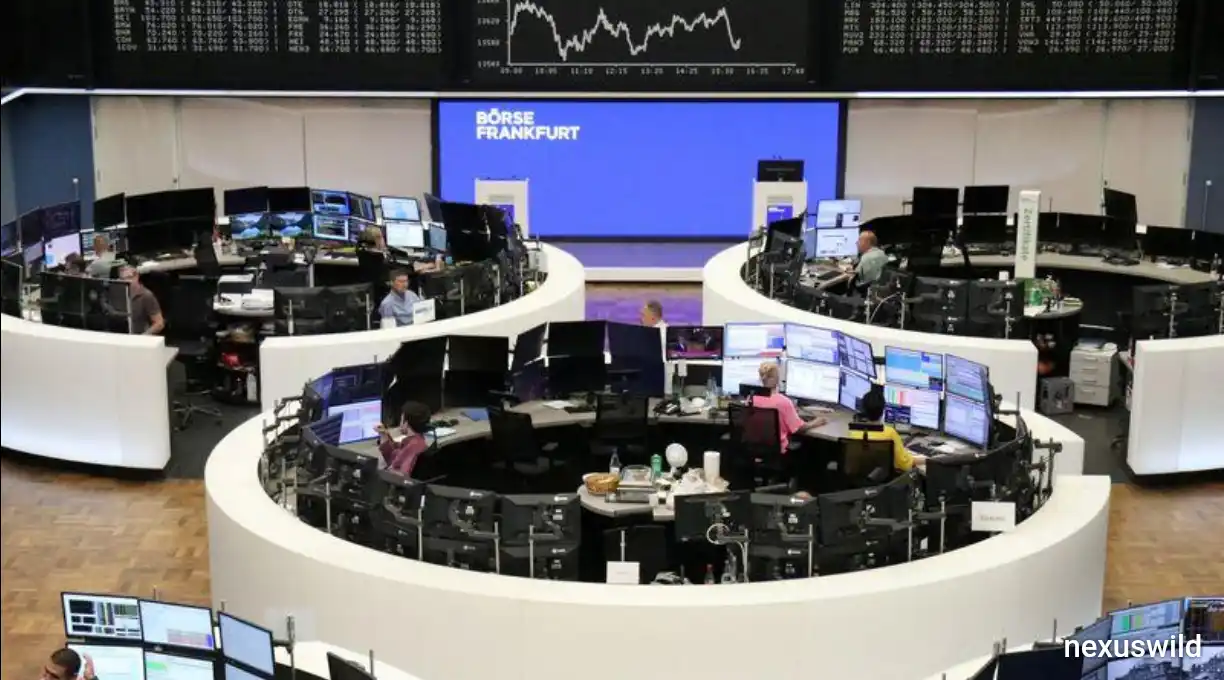

Asian and European stock markets advanced on Thursday, November 26, 2026, recovering some ground after a technology-led sell-off triggered sharp intraday swings on Wall Street earlier in the week.
The rebound came as investors reassessed semiconductor and artificial intelligence-related shares, while US markets remained closed for the Thanksgiving holiday. Asian benchmarks recorded gains across Taiwan, Japan, Hong Kong, South Korea and Australia, while early European trading showed advances in Germany, France and the United Kingdom.
The recovery followed a turbulent Wednesday session in the United States, when the Nasdaq Composite and S&P 500 pared substantial intraday losses but still finished lower. Nvidia's decline and a negative credit-rating review by S&P Global Ratings added to concerns about corporate governance and the financial risks surrounding the AI investment boom.
However, Thursday's gains did not eliminate broader market uncertainty. Investors continued to monitor elevated AI infrastructure spending, international trade tensions, oil-market risks and the potential consequences of proposed US tariffs on major trading partners.
Asian Stock Markets Recover Across Major Technology Markets
Taiwan led the major regional benchmarks, with the Taiex rising approximately 2.5% on Thursday. The advance came despite a slight decline in Taiwan Semiconductor Manufacturing Company (TSMC), whose shares edged down 0.2%.
The contrast highlighted the uneven performance within the semiconductor sector. Gains in parts of the wider technology and electronics supply chain did not translate into a uniform advance across every major chipmaker.
Japan's Nikkei 225 rose 0.9% to close at 57,499.16. Memory manufacturer Kioxia Holdings gained 12.6%, while SoftBank Group advanced 7.3%. Tokyo Electron, a major semiconductor production-equipment supplier, added 0.6%.
The Hang Seng Index in Hong Kong advanced 1.2% to 22,226.88. The Shanghai Composite was nearly unchanged, gaining less than 0.1% to finish at 3,476.88.
Australia's S&P/ASX 200 rose 0.8% to 8,763.80.
South Korea's Kospi added 0.3% to close at 4,711.21, recovering part of Wednesday's 6.2% decline. Samsung Electronics gained 0.4%, while SK Hynix advanced 2.2%.
The regional performance suggests that investors were willing to return selectively to technology-linked shares after the previous session's sharp declines. However, the different performances of individual companies indicate that the recovery was not a broad-based endorsement of every part of the AI trade.
European Markets Follow the Asian Recovery
European equities also moved higher in early trading on Thursday.
Germany's DAX climbed 1.8% to 25,131.36, while France's CAC 40 advanced 1.6% to 8,110.88. The UK's FTSE 100 rose 1.3% to 10,563.62.
These figures represent early-session trading levels, not confirmed final closing prices.
The advance followed a volatile period for global equities, with investors balancing concerns about expensive technology valuations against expectations for continued investment in artificial intelligence infrastructure.
The US tariff announcement on November 25 also remained an important consideration for European exporters. The European Union was among the economies covered by the latest Section 301 determinations and proposed trade actions.
Despite the positive opening, a single morning's advance does not establish that European markets have entered a sustained recovery. Trading conditions were also affected by the US Thanksgiving holiday, which reduced the participation of some global market participants.
Wall Street's Thanksgiving-Eve Session: Sharp Losses Followed by a Partial Recovery
Wednesday's US trading session provided the immediate backdrop for Thursday's international rebound.
The Nasdaq Composite fell 0.6% to close at 23,585.80 after recovering from an intraday decline of as much as 4.6%.
The S&P 500 lost 0.3% to finish at 7,182.78, having fallen as much as 3.2% earlier in the session.
The Dow Jones Industrial Average moved in the opposite direction, adding 0.3% to close at 50,182.95.
The intraday reversal demonstrated the level of uncertainty surrounding technology valuations and the broader equity market. Investors initially sold technology shares aggressively before buying activity reduced the final losses in the major indices.
Nvidia fell approximately 3.9% on Wednesday, adding pressure to sentiment around the semiconductor and AI sectors.
The company's decline came as investors assessed a warning from S&P Global Ratings concerning its corporate governance and board oversight.
US equity markets remained closed on Thursday for Thanksgiving and were scheduled to reopen on Friday for a shortened trading session.
Nvidia's Credit-Rating Warning Adds to AI Market Uncertainty
Nvidia remained a central focus for investors following S&P Global Ratings' November 25 decision to place the company's 'AA' credit rating on CreditWatch with negative implications.
The ratings agency cited concerns surrounding management oversight and the independence of certain long-serving board members.
S&P said it could lower Nvidia's credit rating by one notch within 90 days. A more substantial deterioration in the company's reputation or business prospects could affect the eventual outcome of the review.
The action was not an immediate downgrade. Nvidia retained its 'AA' rating while the review remained pending.
Moody's position also provided an important contrast. The agency maintained Nvidia's Aa1 rating with a stable outlook, while acknowledging that governance and regulatory uncertainty remained.
The disagreement between the agencies illustrates how credit analysts can reach different conclusions about the same corporate developments.
For equity investors, the issue extends beyond Nvidia's short-term share performance. The company occupies a central position in the AI infrastructure supply chain, and concerns about its governance, financing relationships and long-term business risks can influence sentiment across semiconductor and technology stocks.
The warning also arrives during a period of heightened scrutiny over the scale of investment required to build AI data centres and the eventual returns expected from that spending.
AI Capital Expenditure and Semiconductor Valuations Remain Key Risks
The technology sector's recent volatility reflects a broader debate about the economics of the AI boom.
Major technology companies continue to invest heavily in computing infrastructure, including GPUs, networking equipment, data centres and electricity capacity.
These investments have created significant demand for semiconductor manufacturers and equipment suppliers. However, investors are increasingly examining whether future revenue and productivity gains will justify the scale of capital expenditure.
The distinction between companies positioned to benefit directly from AI infrastructure spending and those whose valuations already assume exceptional future growth has become increasingly important.
Memory suppliers, semiconductor equipment manufacturers and advanced packaging companies may experience different demand patterns from leading AI chip designers.
Thursday's gains in Kioxia and SK Hynix, alongside the more modest performance of TSMC and Tokyo Electron, illustrate why the semiconductor sector should not be treated as a single investment category.
The rebound may reflect selective buying after steep declines, but it does not establish that concerns over AI valuations or investment returns have been resolved.
US Section 301 Tariff Proposals Put 14 Economies Under Scrutiny
Trade policy added another layer of uncertainty to the global market outlook.
On November 25, the Office of the United States Trade Representative announced determinations under Section 301 of the Trade Act of 1974 involving 14 economies.
The list includes:
- China.
- European Union.
- India.
- Japan.
- South Korea.
- Taiwan.
- Singapore.
- Switzerland.
- Indonesia.
- Malaysia.
- Cambodia.
- Thailand.
- Vietnam.
- Bangladesh.
The investigations concern what the USTR describes as structural excess capacity and production in manufacturing sectors.
Following its determinations, the agency proposed possible tariff actions and opened a public-comment process. The proposals include different potential tariff rates for individual economies and product categories.
These are proposed actions, not duties that had already taken effect on November 26.
The announcement matters to international markets because several of the affected economies are major participants in global electronics, semiconductor, automotive, industrial machinery and manufacturing supply chains.
For exporters, the possibility of additional US import duties creates uncertainty around pricing, investment decisions and supply-chain planning.
For investors, the eventual impact will depend on the final policy decisions, exemptions, existing trade arrangements and negotiations between Washington and the affected economies.
The inclusion of India, Japan, South Korea, Taiwan and the European Union means the issue extends well beyond US-China trade relations.
Oil Prices and Geopolitical Risks Keep Investors Cautious
Energy markets also remained part of the global risk picture.
Brent crude traded around $90.79 per barrel in early Thursday trading, while US benchmark crude was approximately $84.10 per barrel.
Persistent tensions in the Middle East continued to attract attention because disruptions to regional supply routes could affect energy prices and inflation expectations.
Higher oil prices can complicate the outlook for major energy-importing economies, particularly in Asia, where imported crude is an important component of industrial activity and consumer inflation.
A sustained rise in energy costs could also affect corporate margins, transportation expenses and the future path of monetary policy.
However, the observed Brent price should not be treated as evidence that crude was consistently trading throughout the session at the upper end of a $90–$94 range.
Thanksgiving Creates a Different Trading Environment
The US Thanksgiving holiday meant that American stock exchanges were closed on Thursday.
Although Asian and European markets continued operating, the absence of regular US equity trading reduced one important source of global market activity.
This matters because US technology stocks and major equity benchmarks exert substantial influence over sentiment in other markets.
Thursday's rebound therefore took place under different liquidity conditions from a normal full global trading session.
US equity futures offered some indication of market expectations, but they did not replace the price discovery that would occur when regular trading resumed.
Friday's shortened US session was consequently an important next checkpoint for investors assessing whether the global recovery could continue.
What Investors Should Watch Next
Several developments are likely to influence market direction over the coming sessions.
US market reopening: The shortened Friday session will provide the next direct indication of how American investors respond to the global rebound and the latest tariff proposals.
Nvidia's credit review: Investors will monitor whether S&P Global Ratings maintains its negative CreditWatch assessment, changes the outlook or proceeds with a downgrade.
AI-sector earnings and capital expenditure: Market participants will continue examining whether investment in GPUs, data centres and networking infrastructure is translating into sustainable revenue growth.
Semiconductor stock dispersion: The performance of memory manufacturers, foundries, chip-equipment suppliers and AI chip designers may remain uneven.
Section 301 consultations: Public comments, negotiations and any subsequent policy changes could affect companies with significant exposure to the US market.
Oil and geopolitical developments: Changes in crude prices and regional supply risks could influence inflation expectations and equity valuations.
Outlook: A Relief Rally, Not Yet a Confirmed Market Reversal
Thursday's gains across Asia and early European trading offered some relief after the previous session's technology-led volatility.
The recovery was visible across major benchmarks, but it occurred against a backdrop of continuing concerns about AI valuations, corporate governance, trade policy and energy prices.
The divergence between individual semiconductor stocks also suggests that investors are becoming more selective about where they allocate capital within the AI ecosystem.
The Thanksgiving holiday added another complication by reducing normal US market participation, making it difficult to treat Thursday's advance as definitive evidence of a sustained global recovery.
The next important test will come when Wall Street reopens. If US technology shares stabilise and buying interest broadens beyond selected memory and semiconductor names, the rebound could gain credibility. If selling pressure returns, Thursday's advance may prove to have been a temporary relief rally.
For now, global equity markets have recovered some lost ground, but investors have not yet received convincing evidence that the technology-sector volatility has run its course.
Nexuswild welcomes factual corrections. Email contact@nexuswild.com with evidence and the article URL.