
BepiColombo is arriving at Mercury after an eight-year journey that has tested both engineering patience and orbital precision. The joint mission of the European Space Agency and the Japan Aerospace Exploration Agency is due to begin orbit insertion on 21 November 2026, more than eight years after it lifted off from French Guiana on 20 October 2018. If the sequence succeeds, it will become only the second mission ever to orbit Mercury and the first to operate two spacecraft around the planet at the same time.
The spacecraft has already travelled about 9.9 billion kilometres through the inner Solar System and completed nine planetary flybys. Those encounters were not sightseeing stops. They were braking manoeuvres designed to shed speed in a region where the Sun's gravity constantly pulls a spacecraft inward and accelerates it towards the planet. The final approach is now being handled from ESA's mission control centre in Darmstadt, Germany, with confirmation arriving from hundreds of millions of kilometres away.
The scientific payoff lies beyond arrival. BepiColombo is not simply trying to photograph Mercury. It is carrying two complementary orbiters equipped to map the surface, measure the interior, sample the exosphere and track the magnetic field. Together they could clarify why a planet so small has such a large iron core, why ice may survive in permanently shadowed polar craters, and why Mercury remains chemically strange despite decades of study.
Those questions explain why the mission has taken so long to reach its destination. Mercury is the least explored rocky planet in the inner Solar System, and every previous visit has been brief. Mariner 10 flew past three times in the 1970s. NASA's Messenger orbited the planet from 2011 to 2015. BepiColombo aims to provide a sustained, two-spacecraft view that neither predecessor could deliver.
What BepiColombo actually consists of
The word spacecraft is misleading when applied to BepiColombo as a whole. During cruise, the mission has been a stack of four elements: the Mercury Transfer Module, ESA's Mercury Planetary Orbiter, JAXA's Mercury Magnetospheric Orbiter, known as Mio, and the Mio Sunshield and Interface Structure, or MOSIF. Only two of those elements are science orbiters. The other two were transport and protection hardware.
The Mercury Transfer Module, roughly the size of a small car, carried two 15-metre solar wings and used solar electric propulsion. That system turns xenon gas into plasma and expels it through four ion thrusters. Unlike a chemical rocket, which produces a short, powerful burst, solar electric propulsion delivers gentle thrust over long periods while using far less propellant. That efficiency made the slow spiral towards Mercury possible.
The module separated from the science spacecraft on 3 September 2026. Mission control received confirmation at 15:49 CEST, after a signal had travelled about 200 million kilometres back to Earth. The module has no antenna or onboard computer of its own and will remain in a stable orbit around the Sun. Its departure marked the beginning of the arrival phase, not the end of the journey.
With the transfer module gone, the remaining stack is being guided by the planetary orbiter's chemical propulsion system. The European and Japanese orbiters are still attached for now, protected by MOSIF. They will separate later in December. Until then, any description of BepiColombo as two independently operating spacecraft would be premature.
The mission is led by ESA in close collaboration with JAXA, with Airbus building the spacecraft. The Guardian reports the mission cost at about 1.6 billion euros. That figure covers a complex programme spanning two agencies, several decades of instrument development and an unusually long cruise phase.
Why the route to Mercury took eight years
BepiColombo launched on 20 October 2018. The original plan called for a journey of about seven years, but an issue that reduced the power available from the transfer module's solar arrays forced mission teams to redesign the trajectory. The spacecraft remained on track for Mercury, but arrival slipped by roughly a year.
Getting to Mercury is less like falling inward and more like repeatedly applying brakes. Because the planet orbits close to the Sun, a spacecraft heading towards it gains speed under the Sun's gravity. Without repeated corrections, it would race past the planet rather than be captured into orbit. BepiColombo used one flyby of Earth, two of Venus and six of Mercury to steer and slow down, completing nine planetary flybys in total.
The solar electric propulsion system was switched off on 15 June 2026, ending the transfer module's main task. By early September, the spacecraft was still more than three million kilometres from Mercury. The final approach therefore relies on chemical thrusters and precise timing rather than the long, continuous thrust that characterised the cruise.
BBC News describes the final capture as a 37-minute braking manoeuvre. ESA describes arrival as a six-month sequence of carefully choreographed manoeuvres rather than a single event. Both descriptions are compatible: the first insertion burn is a critical event, but it is followed by Mio separation, shield release and further orbit adjustments. Treating orbit insertion as a single make-or-break moment would miss how the mission is actually designed.
The long route also produced science before arrival. The spacecraft's instruments observed the Moon, Venus and Mercury during flybys, and the transfer module's monitoring cameras kept a visual record of the cruise. Those observations are useful, but they are not a substitute for orbital measurements. The mission's central science goals depend on sustained observations from around Mercury.
Arrival is a sequence, not a single moment
ESA's published timeline sets out the order of operations. The transfer module separated on 3 September. Mercury orbit insertion is due to begin on 21 November. Mio is scheduled to separate on 9–10 December, followed by release of the MOSIF sunshield on 16 December. The planetary orbiter will then continue adjusting its path, reaching its science orbit in March 2027. Science operations are due to begin in April 2027.
That sequence is unusual because most planetary missions concentrate their arrival work into a short window. BepiColombo's arrival phase stretches across roughly six months. ESA calls it a complex sequence of carefully choreographed manoeuvres. Each step changes the shape of the spacecraft and the responsibilities of the control team.
Preparation began long before the spacecraft reached Mercury. Teams from ESA, JAXA and industry ran simulations from June through October 2026, rehearsing separation, orbit insertion, shielding release and orbit adjustment. The exercises deliberately introduced unexpected problems so controllers had to diagnose faults, make decisions and reschedule actions under realistic pressure. A final simulation was completed on 29 October.
The distance from Earth adds another layer of difficulty. After the transfer module separated, the spacecraft entered safe mode, reoriented itself and reconfigured before transmitting its status. Controllers waited nearly two hours for confirmation through ESA's deep-space antennas at Cebreros in Spain and Malargüe in Argentina. At Mercury's distance, real-time intervention is impossible; the sequence has to be planned, rehearsed and executed largely on its own.
For that reason, the careful wording matters. As of publication, BepiColombo is arriving and preparing for orbit insertion. It should not be described as already operating in its final science orbit. Confirmation of each milestone has to come from telemetry before the next step can be treated as secure.
Two orbiters with different jobs
Once separated, the two orbiters will follow different paths and answer different questions. ESA's Mercury Planetary Orbiter will operate from a 2.3-hour polar orbit about 480 to 1,500 kilometres above the surface. That close orbit is designed for high-resolution mapping of the surface, composition and interior. It will be the mission's primary tool for turning Mercury's cratered crust into a detailed geological and chemical record.
JAXA's Mio will take a wider 9.3-hour elliptical polar orbit, ranging from about 590 to 11,640 kilometres above the planet. That orbit is better suited to studying the magnetic field, plasma environment and the extremely thin exosphere. Mio spins at 15 rotations per minute, with its spin axis perpendicular to the Sun, a design that helps distribute heat across its solar cells.
The contrast is deliberate. Mercury's surface and its space environment are linked but not identical problems. A low orbiter can resolve small surface features and measure gravity and thermal properties. A higher, spinning orbiter can sample fields and particles over a larger volume. Using both at once should reduce the risk of drawing surface conclusions from an incomplete environmental picture, or environmental conclusions from an unrepresentative patch of terrain.
Mio's four 15-metre antennas and two five-metre masts make it visually distinct from the compact planetary orbiter. During cruise, it sat atop the European spacecraft and could not spin, which is why MOSIF provided thermal and mechanical protection. That shield is no longer useful once the orbiters separate, and it is scheduled to be released on 16 December.
The presence of two orbiters is the mission's defining feature. Messenger provided a single-spacecraft view from orbit. BepiColombo is designed to observe Mercury from two altitudes simultaneously, which should make it easier to separate local surface effects from planet-wide processes.
The instrument payload: what will actually be measured
The Mercury Planetary Orbiter carries 11 science experiments. The BepiColombo Laser Altimeter will map topography and surface shape. SIMBIO-SYS will use stereo and colour imaging and spectroscopy to study geology, volcanism, tectonics, surface age and composition. MERTIS will measure thermal infrared radiation to determine mineralogy and surface temperature. MIXS will map surface atomic composition, while MGNS will examine elemental composition and volatiles in permanently shadowed polar regions.
Several instruments focus on the interior. The Mercury Orbiter Radio science Experiment will measure the gravity field and constrain the size and physical state of the core. The Italian Spring Accelerometer will provide data on internal structure and also test general relativity. The planetary orbiter's magnetometer will measure the magnetic field and its interaction with the solar wind.
The remaining instruments examine the tenuous environment above the surface. PHEBUS will study the exosphere and search for ice in high-latitude shadowed craters. SERENA will analyse neutral and ionised particles and the exchange between the surface, exosphere, magnetosphere and solar wind. SIXS will monitor X-rays and particles from the Sun, providing context for interpreting the other measurements.
Mio carries five instruments. Its magnetometer will study the magnetosphere in detail. The Mercury Plasma Particle Experiment uses seven sensors to examine plasma and energetic particles. The Plasma Wave Instrument will measure electric fields, plasma waves and radio waves. MSASI will map sodium in the exosphere, and the Mercury Dust Monitor will study dust in Mercury's orbital environment.
No single instrument can resolve Mercury's biggest mysteries. The strength of the payload is overlap: topography can be compared with composition, composition with thermal behaviour, gravity with internal structure, and magnetic measurements with particle data. That is why the mission's long delay, while frustrating, has not made the science obsolete. The questions require coordinated measurements that earlier missions could not provide.
The core, the crust and the question of how Mercury formed
Mercury is only a little larger than the Moon, yet its metal core is estimated to be about 4,000 kilometres across inside a planet less than 5,000 kilometres wide. ESA describes the core as making up more than 55 per cent of the planet's volume. For comparison, Earth's core is proportionally much smaller. This enormous core is one of the central puzzles the mission is designed to investigate.
A second clue comes from chemistry. Messenger found more potassium relative to thorium on Mercury than expected for a planet so close to the Sun. Potassium evaporates easily in hot environments, while thorium is more resistant. Mercury's ratio resembles that of Mars, much farther from the Sun. Existing formation models do not fully explain why a planet in Mercury's orbit retains so much potassium.
One hypothesis is that Mercury formed farther from the Sun and was pushed inward by a major collision. Such an impact might also have stripped away much of the original mantle and crust, leaving an unusually large core. Another idea is that Mercury formed from metal-rich material in the inner Solar System. At present, neither explanation has been confirmed.
BepiColombo can test these ideas by measuring surface composition and gravity more precisely. MERTIS, MIXS, MGNS and SIMBIO-SYS will provide better mineralogical and elemental data than Messenger could deliver. ESA says MERTIS and the other orbiter instruments will improve the accuracy and resolution of elemental-composition data compared with Messenger measurements.
Even so, better data will not automatically produce a single agreed answer. Planetary formation involves several processes, and a mission can narrow the range of plausible histories without proving one beyond dispute. The useful outcome will be a tighter link between Mercury's chemistry, internal structure and orbital position.
Ice, hollows and the possibility of an active planet
Mercury's sunlit surface can reach about 450 degrees Celsius, yet evidence suggests that ice exists in craters near its poles. The planet has almost no axial tilt, so sunlight never reaches the floors of some permanently shadowed polar craters. Those cold traps may preserve water delivered long ago, possibly by asteroids. Comets are less likely sources because few reach Mercury's region without falling into the Sun.
Messenger reported strong indications of ice but did not directly confirm its identity. That distinction remains important. BepiColombo's instruments will look more closely at the elemental composition of the polar regions and may determine whether the bright deposits are water ice and how much is present. A positive result would answer one question while opening another: how and when the ice arrived.
Mercury also has strange shallow depressions known as hollows. They have steep sides, often occur in clusters and appear geologically young, perhaps around 100,000 years old. They are not impact craters. One explanation is that volatile material rises from the surface and sublimates into space, leaving the depressions behind. The exact mechanism is still uncertain.
Because BepiColombo arrives about a decade after Messenger's orbital mission ended, scientists hope to compare images and look for changes in the hollows. If any are growing or shrinking, Mercury would be more geologically active than its cratered surface suggests. Here, active means surface change driven by heat, particles or volatile loss, not biological activity.
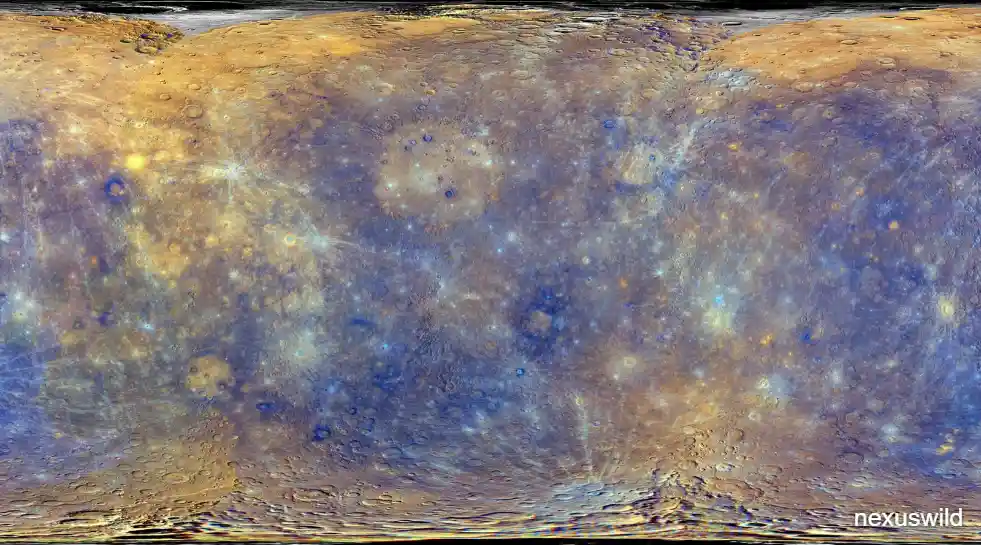
The mission will also investigate why Mercury is darker than the Moon. Its surface reflects only about two-thirds as much light as lunar material. Possible explanations include iron-poor minerals, extreme heating effects or a graphite-rich layer brought to the surface. MERTIS and the other surface instruments should help distinguish between those possibilities.
The magnetic field and the invisible environment
Among the rocky planets of the inner Solar System, only Earth and Mercury have a global magnetic field today. Mercury's is roughly a hundred times weaker than Earth's, and scientists are unsure what sustains it. That is difficult to reconcile with a small world that should have cooled substantially since formation.
One explanation is that part of Mercury's core remains molten. Measurements of tidal deformation support that idea: as Mercury moves from about 46 million to 70 million kilometres from the Sun, its shape changes slightly. Estimates put the largest tidal bulge at up to 14 metres. Measuring that response should help constrain the size and state of the liquid inner core.
The magnetic field also shapes Mercury's space environment. The solar wind strikes the planet directly and interacts with the magnetosphere, the exosphere and the surface. Mio is particularly important here. Its magnetometer, plasma sensors, wave instrument and sodium imager will measure how particles and fields behave around Mercury, while MPO monitors the Sun's X-ray and particle output.
This division of labour matters. A magnetometer on one spacecraft can measure the field at a single location. Two orbiters at different distances can help distinguish a planetary field from local plasma structures and temporary solar-wind effects. That is one reason the mission's two-spacecraft design is not merely a redundancy measure.
Understanding Mercury's magnetic environment also supports the surface science. Solar particles can alter surface materials, contribute to exosphere formation and possibly influence the evolution of hollows. Without these measurements, composition data would be harder to interpret.
What the flybys have already revealed
BepiColombo is the third mission to visit Mercury, but it has already made observations no earlier spacecraft could make. During its fifth Mercury flyby on 1 December 2024, it passed about 37,626 kilometres above the surface. MERTIS became the first instrument to observe Mercury in mid-infrared light, revealing differences in temperature and composition across the cratered terrain.
The instrument is sensitive to wavelengths of roughly 7 to 14 micrometres, a range useful for distinguishing rock-forming minerals. During that flyby it achieved a ground resolution of about 26 to 30 kilometres and observed part of the Caloris Basin and the Bashō crater. The radiometer measured surface temperatures up to about 420 degrees Celsius. After orbit insertion, MERTIS aims to produce a global mineral map with resolution down to about 500 metres.
Those flyby results are promising, but they are not the same as orbital science. A flyby offers a brief look at a limited area under a particular geometry. Repeated orbital measurements will allow scientists to compare regions, track changes and separate temperature effects from mineral composition.
Instrument commissioning continued during the arrival phase. In September 2026, ESA reported that all instruments on the planetary orbiter had been switched on together for the first time since the transfer module separated. BELA fired more than 700,000 laser pulses over 21.5 hours, MERTIS returned about a gigabit of test data, and SIMBIO-SYS captured its first image in space.
These first-light tests show that the instruments are healthy. They do not yet constitute a complete scientific survey. That distinction matters because early images and engineering data can be visually compelling while still being limited by calibration, geometry and operating conditions.
What happens after orbit insertion
Once in orbit, the two spacecraft are expected to work for about three years. The Guardian reports that they will eventually run out of fuel, lose altitude and impact the surface. There is no return planned. That ending is normal for a planetary orbiter operating in a strong gravity field with a finite propellant supply.
Science operations are due to start in April 2027, after Mio separation, MOSIF release and the planetary orbiter's final orbit adjustments. The first results will likely focus on calibration and mapping rather than dramatic conclusions. Planetary science usually advances through careful comparison of datasets, not a single announcement.
Dates are also planning targets, not guarantees. Spacecraft operations can change because of anomalies, trajectory updates or instrument performance. ESA's simulations deliberately introduced unexpected problems because controllers need practice adapting to them. A delay in one milestone would not necessarily mean mission failure, but it would change when science data become available.
The expected scientific return is broad. BepiColombo should improve understanding of planet formation, extreme space weather, volatile preservation, internal structure and surface evolution. Those topics extend beyond Mercury: they help explain how rocky planets form, lose atmospheres and interact with their stars.
For readers, the safest formulation is also the most accurate one. BepiColombo is arriving at Mercury, is due to enter orbit on 21 November and will begin full science operations in 2027. Those are separate stages, and each needs confirmation before the next can be treated as complete.
What the mission still cannot answer
BepiColombo will not prove that life exists on Mercury, and it is not designed to. Its search is for minerals, ice, fields, particles and the physical history of a planet. Even its geological findings will require interpretation. Detecting a bright deposit in a polar crater, for example, is not the same as proving the source, age and purity of the ice without supporting measurements.
The mission also cannot be expected to deliver instant consensus on Mercury's formation. The giant-impact hypothesis and alternative formation models may both be refined by the data. Scientific conclusions will depend on how well the instruments agree, how representative the observed regions are and how the results fit with Messenger's earlier measurements.
Nor should the success of orbit insertion be assumed from the launch, the cruise or the flybys. Those milestones demonstrate that the spacecraft has survived and reached the right neighbourhood. The remaining separation and orbit-adjustment operations are still critical, which is why the teams have spent months rehearsing them.
The mission's value lies in the quality of the measurements it can make once those operations are complete. Two orbiters, 16 instruments and data gathered across the cruise and orbital phases could transform Mercury from a briefly visited world into a planet studied in sustained detail. That is a large claim, but it is a justified one if the arrival sequence succeeds and the instruments perform as expected.
Nexuswild welcomes factual corrections. Email contact@nexuswild.com with evidence and the article URL.