
Physicists at CERN have reported the first evidence from a single experiment of a beauty-particle decay so rare that the Standard Model predicts it only once in about ten billion cases. The result comes from the upgraded LHCb detector after a search that spans more than four decades. It is evidence, not a discovery, but it gives scientists a sharper way to test whether the theory that has guided particle physics for half a century is complete.
The decay involves a neutral B meson turning into two muons. In the language of the field it is B0 to mu-plus mu-minus. The measurement is statistically strong enough to be called evidence, at 3.2 standard deviations after combining new and older data, yet still below the five-sigma threshold physicists require before announcing a discovery. The measured rate agrees with the Standard Model. That agreement is itself useful: rare processes leave very little room for unknown particles to hide.
The announcement matters because this channel has been treated for decades as a clean test of the weak interaction. It is also a technological result. LHCb's upgraded detector recorded data at up to five times the previous rate, with better particle identification and machine-learning methods that suppressed backgrounds. Without that upgrade, the signal would still have been buried.
A decay predicted to be almost impossible
B mesons are particles containing a beauty quark or its antiparticle. They are produced copiously at the Large Hadron Collider and decay quickly. Most decays proceed through allowed paths. The transition into two muons is different. It is a flavour-changing neutral current, meaning the quark changes flavour without emitting a charged W boson at the simplest level. In the Standard Model it can only occur through higher-order quantum loops and is further suppressed because the final particles are muons rather than lighter electrons.
That combination makes the process extraordinarily rare. The Standard Model prediction for the neutral B0 meson is a branching fraction of about 1.03 times 10 to the minus ten. In practical terms, if a large sample of these mesons is produced, only about one in ten billion will decay into two oppositely charged muons. The related B-s meson decays into two muons about thirty times more often, roughly three times in a billion, which is why it was observed first.
The distinction between the two B mesons is easy to blur in headlines. LHCb's new result concerns the B0, also called B-d, which contains a beauty quark and a down antiquark. The B-s contains a beauty quark and a strange antiquark. Both are produced at CERN, but the B0 channel is far harder because its expected signal is so much smaller and because the B0 is produced more abundantly, complicating the ratio of signal to background.
The theoretical cleanliness is the reward. Because the final state consists only of two leptons, the calculation has comparatively small uncertainties. If the observed rate deviated from the prediction, physicists could infer that something not in the Standard Model had contributed to the loop. Extra Higgs bosons, a new heavy Z-like particle or leptoquarks are among the possibilities often discussed in this context. No such deviation has appeared.
What LHCb actually saw
LHCb does not see a decay directly. It reconstructs candidate events from the tracks and hits left by particles passing through its detector. For this analysis, the collaboration looked for two muons whose trajectories pointed back to a common decay point displaced slightly from the proton-proton collision. That displaced vertex is the signature of a B meson, which lives for roughly a trillionth of a second before decaying.
The new analysis used data recorded during Run 3 of the Large Hadron Collider in 2024 and 2025. LHCb collected about 18 inverse femtobarns of proton-proton collisions at a centre-of-mass energy of 13.6 teraelectronvolts. That sample was combined with about 9 inverse femtobarns from Run 1 and Run 2, taken between 2011 and 2018. The Run 3 data alone give a significance of about three standard deviations. Combined with the earlier sample, the significance rises to 3.2.
The measured branching fraction for B0 to two muons is about 1.14 times 10 to the minus ten, with an uncertainty that comfortably overlaps the Standard Model expectation. The collaboration also produced its most precise measurements of the B-s channel. Its updated value is roughly 3.25 times 10 to the minus nine, again consistent with the predicted rate. LHCb also measured the effective lifetime of the B-s decay to two muons as about 1.60 picoseconds, with uncertainties of 0.16 and 0.01 picoseconds.
These numbers are not just a win for one analysis. They show that the upgraded detector can handle a much busier collision environment while preserving the vertex resolution needed to pick out rare decays. The result was submitted to Physical Review X, and a preprint is available through arXiv. At the time of the announcement, the paper had not yet completed journal peer review, a caveat that matters when interpreting the word evidence.
Why forty years of searching mattered
The search for B mesons decaying into two muons reaches back to the 1980s. CERN's own account describes physicists chasing the decay for more than forty years. The University of Cambridge puts the start of the quest at 1984. That long timescale is not simply a story about patience. It reflects how the sensitivity of experiments improved across generations of accelerators and detectors.
Early searches had too few B mesons and too much background. Later experiments at electron-positron colliders and then at the Large Hadron Collider closed the gap step by step. In 2012, LHCb reported the first evidence for the B-s decay. In 2015, a joint LHCb and CMS analysis reached observation of that mode. The same joint analysis saw hints of the B0 channel, but later data did not confirm that earlier evidence.
That history explains the careful wording of the new announcement. This is the first time a single experiment has produced evidence for the B0 decay at the level generally accepted by particle physicists. It is not the first time anyone has ever reported a hint. The collaboration is also careful not to call it an observation, because five standard deviations remain the customary bar.
Forty years also captures the change in what physicists hope to learn from the measurement. When the search began, the Standard Model was still being assembled and tested. Today it is a highly successful theory with known gaps, including neutrino mass, dark matter and the matter-antimatter asymmetry of the universe. Rare decays are one way to look for those gaps without building a collider at an entirely new energy scale.
How the upgraded detector changed the odds
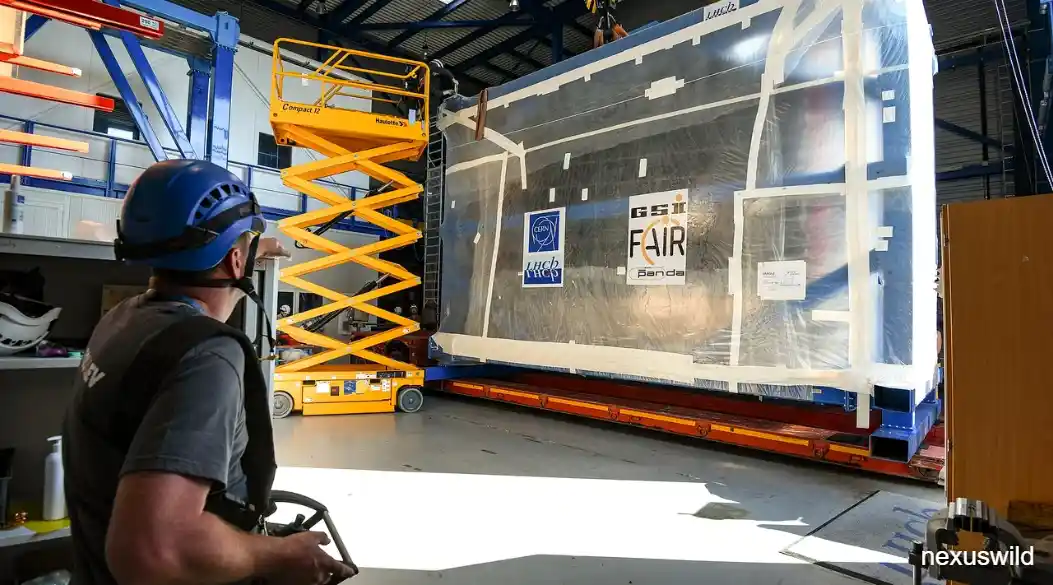
LHCb's Run 3 performance depends on a major upgrade completed during the Long Shutdown 2 of the Large Hadron Collider. The detector now reads out its full event rate rather than relying on a hardware trigger to discard most collisions. That allows it to record up to five times more data than in the previous running period.
Particle identification also improved. The ring-imaging Cherenkov detectors, calorimeters and muon systems work together to distinguish muons from pions, kaons and other particles that can mimic the signal. Machine-learning techniques then help separate genuine displaced vertices from random combinations of tracks and from background processes in which one particle is misidentified.
At the heart of the Vertex Locator, known as VELO, sits a silicon detector placed extremely close to the proton beams. CERN's outreach material describes 52 silicon elements positioned about five millimetres from the beam line, with vertex position precision on the scale of ten micrometres. That proximity is essential because B mesons travel only a short distance before decaying. Move the detector farther away and the displacement becomes harder to measure.
The VELO was built with a substantial United Kingdom contribution. The University of Manchester led construction, and the upgrade was a long engineering project involving universities and laboratories across several countries. That institutional story is not the reason the physics result matters, but it explains why the measurement is possible. A rare-decay search is as much a test of detector engineering as it is a test of theory.
From one in ten billion to three sigma
The phrase one in ten billion is memorable, but statistical evidence is not the same as a simple count. A three-sigma result means that, under the assumption that there is no signal, a fluctuation at least this large would occur roughly once in a few hundred comparable measurements, depending on the exact statistical treatment. Five sigma corresponds to odds of roughly one in several million. Particle physicists use that higher bar because they examine many channels and because systematic uncertainties can be subtle.
The combined 3.2-sigma result therefore sits in an intermediate category. It is strong enough that physicists take it seriously and weak enough that they do not claim discovery. The Run 3 sample alone reaches about three sigma, which is notable because those data were recorded after the upgrade and with a different detector configuration from the earlier runs. The agreement between the old and new samples strengthens the interpretation.
The measured rate also has to be interpreted relative to the B-s channel. Because the B-s decay is about thirty times more frequent and the B0 is produced more often, the experiment must model both production and detection carefully. The collaboration reports a yield ratio of roughly seven between the two samples after accounting for those effects. Small errors in that modelling could matter, which is why the analysis uses control channels and extensive simulation.
Physics World, in an independent summary, noted that only a few dozen B0 decays would be expected in the new data. That is the practical reality of this kind of experiment. The detector records billions of collisions so that a handful of rare events can be separated from backgrounds that are many times larger.
What the result says about the Standard Model
The most important sentence in the result is also the least dramatic: it agrees with the Standard Model. The measured branching fraction sits within the predicted range, and the B-s measurements and lifetime are similarly consistent. That means the loop processes that connect beauty quarks to muons behave as the theory says they should.
Agreement is valuable because this channel is sensitive to physics beyond the Standard Model. In many extensions, new heavy particles can enter the same quantum loops and shift the decay rate. The absence of a shift does not rule out all new physics, but it narrows the allowed parameter space. Models that predicted a large enhancement of B0 to two muons are now under pressure.
The result also complements other beauty-physics measurements. LHCb has spent years studying CP violation, rare decays and the properties of different B mesons. Those analyses collectively test the Cabibbo-Kobayashi-Maskawa framework, which describes how quarks change flavour. A single channel cannot overturn that framework, but a pattern of deviations across several channels could.
For now, the pattern remains consistent. That may be disappointing to anyone hoping for an immediate crack in the theory, but it is how precision physics usually advances. Each measurement removes a possibility and makes the remaining space for new ideas smaller and better defined.
The zeptoverse and the case for rare decays
University of Manchester described the work as a step toward the zeptoverse. A zeptometre is a trillionth of a billionth of a metre, and the scales probed by virtual particles in quantum loops can be far smaller than anything a collider can resolve directly. Rare decays act as an indirect microscope. Even if a new particle is too heavy to be produced at the Large Hadron Collider, its influence may appear in the rate of a process it helps mediate.
This is why physicists call channels like B0 to two muons golden. The final state is simple, the theory prediction is precise, and the sensitivity to new particles is high. The cost is that the measurement is extremely difficult. The gold is hidden behind a mountain of ordinary decays.
The zeptoverse language should not be taken to mean that scientists have directly imaged tiny distances. They have measured a rate that is sensitive to physics at those scales. That distinction is routine within particle physics but easy to lose in popular accounts. The honest framing is that the result constrains short-distance physics indirectly.
It is also worth remembering that indirect evidence can be misleading if the theory calculation is incomplete. The strength of this channel lies in the fact that the Standard Model prediction is unusually clean. That is what makes the agreement meaningful rather than merely decorative.
Why the B meson is a golden channel
The appeal of the decay can be understood in three layers. First, the initial particle is well understood. B mesons are produced in large numbers at LHCb and their production rates can be calibrated using more common decay modes. Second, the final state is easy to identify. Muons leave distinctive tracks through the detector and are less likely than hadrons to be confused with other particles. Third, the theory uncertainty is small enough that a precise measurement translates into a precise constraint.
The background remains the hard part. Two muons can come from many other processes, including sequential decays of different B mesons, misidentified hadrons and random track combinations. LHCb's analysis must model all of those. The displaced vertex helps, but it does not eliminate them.
Machine learning entered the analysis as a practical tool. Classifiers trained on simulated and control data help decide which candidate events look like genuine B decays. The University of Cambridge noted that such techniques helped suppress background to a level where the signal could emerge. This is now a standard part of high-energy physics, but it brings its own responsibilities: the training must be validated and the result must not depend on an arbitrary choice of algorithm.
The final measurement therefore represents a chain of trust. Detector calibration, simulation, background modelling, statistical treatment and theory prediction all have to hold. A result at three sigma is cautious precisely because each link in that chain contributes uncertainty.
What has not been proven
It would be wrong to say that physicists have discovered a new decay, even though the headline can be written that way. The collaboration calls it evidence. The paper had not completed peer review when the result was announced. More data are needed before the statistical significance reaches the discovery threshold.
It would also be wrong to say the result proves the Standard Model. It is consistent with it, within uncertainties. A theory is never proven by one measurement; it survives a growing set of attempts to falsify it. This measurement is one of those attempts.
Some press descriptions have said the decay occurs once in ten billion beauty particles. More precisely, it applies to the neutral B0 meson. Other beauty hadrons have different decay rates. The shorthand is acceptable in a headline but should not be used to compare unrelated particles.
The search began in the 1980s, and some accounts attribute the earliest work to the CLEO experiment at Cornell. That detail is less firmly corroborated than the general 1984 starting point. It is safer to say the quest dates to the mid-1980s. Likewise, claims about the exact number of companies involved in building the upgrade come from a university press release and should not be treated as independently verified.
Finally, the result says nothing about dark matter or neutrino mass directly. It constrains a particular class of possible new physics. Broader questions remain open.
What comes next for LHCb
The Large Hadron Collider will continue operating for years, and LHCb expects to collect substantially more data. With more collisions, the significance of the B0 signal should rise. The goal is to cross the five-sigma threshold and to reduce the uncertainty on the branching fraction enough to test increasingly specific theoretical models.
A second major upgrade is planned for the middle of the next decade in connection with the High Luminosity Large Hadron Collider. CERN describes that upgrade as capable of raising the data rate by roughly another factor of ten. If the schedule holds, rare-decay measurements that are now limited by statistics could become precision observables.
The B-s channel will benefit too. A more precise effective lifetime and branching fraction would further test the Standard Model prediction. LHCb will also continue to study other rare B decays, CP violation and lepton-flavour tests. Together those measurements form a programme that may eventually reveal a pattern.
The timeline matters because funding and technical decisions are being made now. Physics World noted that the United Kingdom's research council has withdrawn support for parts of the planned Upgrade II programme, according to its report. That does not change the current result, but it shows that long-term rare-decay physics depends on sustained institutional commitment.
Why this matters beyond particle physics
At first glance, a decay that happens once in ten billion times can seem remote from everyday life. Yet the tools developed to find it have wide consequences. Silicon vertex detectors, fast data acquisition, machine-learning classification and large-scale international collaboration all grew from this kind of research. The techniques feed into medical imaging, materials analysis and computing.
The intellectual consequence is broader still. The Standard Model is one of the most successful scientific theories ever built, but it is incomplete. Determining where it remains correct is as important as looking for where it fails. A clean agreement in a rare channel tells theorists which ideas to keep and which to discard.
There is also a human dimension. The result represents more than four decades of work by generations of scientists, engineers and technicians. A measurement that takes forty years to reach this point is a reminder that discovery is not always a sudden flash. Sometimes it is a long accumulation of better detectors, better analysis and better questions.
LHCb has now opened a new window on a process that had remained just beyond reach. The view through that window is, so far, familiar. That is not a disappointment. It is a sharper map of the territory, and it tells physicists exactly where to look next.
Nexuswild welcomes factual corrections. Email contact@nexuswild.com with evidence and the article URL.