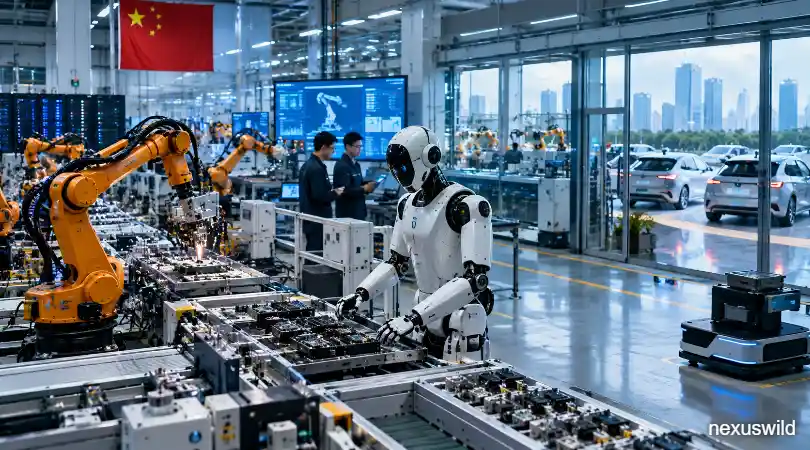

China Targets Technology Investment Bubbles While Expanding AI Adoption
China has announced new guidelines designed to strengthen its advanced technology sector while discouraging speculative investment, excessive capacity expansion and the rush to finance similar high-tech projects.
The guidance, issued by the Communist Party of China and the State Council on October 9, places artificial intelligence at the centre of the country's industrial development strategy. At the same time, it warns against blind investment, redundant projects and investment bubbles that could divert resources from productive economic activity. Reuters reported the policy announcement on October 9. <Cite refs={["turn245581news23","turn245581search0"]}/>
The approach reflects two priorities for Beijing: developing stronger domestic technological capabilities and ensuring that investment produces practical economic benefits. Rather than treating AI development solely as a race to build models and attract funding, the guidelines emphasise applying technology across manufacturing, transport, electronics and other parts of the real economy.
The announcement comes as governments and businesses worldwide compete to develop AI systems, expand computing infrastructure and automate industrial processes.
A push to prevent excessive investment
China's guidelines caution against what officials describe as blind investment and a rush by multiple companies or local authorities into the same emerging industries. The document also warns against investment bubbles and industrial hollowing-out, while calling for accountability when misguided investment causes major losses.
These concerns are relevant to technology sectors in which optimistic growth expectations can encourage rapid funding, overlapping projects and production capacity that exceeds sustainable demand.
When numerous companies pursue similar products without sufficiently differentiated technology or reliable customers, competition can intensify before businesses establish viable commercial models. The result can be lower prices, underused facilities and financial pressure on companies and investors.
The policy does not represent a blanket rejection of AI investment. Instead, it combines support for technological breakthroughs with a warning that capital should be allocated more carefully. Officials are also directed to prevent the improper use of government policies in the name of developing new productive forces. <Cite refs={["turn245581search0","turn245581search5"]}/>
AI moves deeper into traditional industries
A central element of the guidance is the full implementation of China's “AI Plus” initiative, which seeks to integrate artificial intelligence into established industries rather than limiting its development to specialist technology companies.
The guidelines call for AI to support industrial upgrading and encourage the development of intelligent products, including connected new-energy vehicles, AI-enabled phones and computers, and humanoid robots. They also emphasise improvements in AI theory, core technologies, computing power, algorithms and data resources. <Cite refs={["turn245581news23","turn245581search0"]}/>
For manufacturers, this direction could encourage investment in systems that improve production planning, quality inspection, predictive maintenance, logistics and resource management. These applications can potentially connect AI development to measurable operational outcomes, such as reducing equipment downtime or improving manufacturing efficiency.
However, the policy announcement does not establish that all such applications are already commercially successful. Their impact will depend on implementation, technical reliability, costs and whether businesses can integrate AI into existing operations.
Computing infrastructure and industrial pilot programmes
The guidelines also call for stronger support for computing resources and the establishment of pilot bases for industrial AI applications.
Computing capacity, algorithms and high-quality data are essential inputs for developing and operating AI systems. Expanding these resources can help businesses test applications and develop specialised models for different industrial settings.
Pilot programmes may also provide a way to assess whether proposed technologies deliver useful results before companies or public authorities commit to broader deployment. Such an approach could help distinguish projects with clear industrial applications from initiatives driven primarily by investment enthusiasm.
The wider policy direction is consistent with other Chinese initiatives aimed at linking AI models, data resources and practical manufacturing use cases. In April 2026, the Ministry of Industry and Information Technology and the National Data Administration announced a programme to develop high-quality industry datasets, specialised AI models and application scenarios across sectors including steel, automotive manufacturing, medical equipment, power equipment, consumer electronics and cybersecurity. <Cite refs={["turn245581search4","turn245581search7"]}/>
Implications for robotics, electric vehicles and suppliers
The policy identifies several sectors with potential implications for domestic and international businesses.
In electric vehicles, greater integration of AI could support connected-car systems, onboard computing and intelligent driving-related functions. In electronics, AI-enabled phones and computers could encourage demand for chips, sensors and software. Humanoid robotics could create opportunities for manufacturers of actuators, controllers, machine-vision systems and industrial components.
Suppliers of computing hardware, networking equipment and automation technology may also benefit if industrial adoption expands.
There are risks alongside those opportunities. Companies that rely on rapid expansion or government-supported demand may face greater pressure to demonstrate commercial viability. Projects with overlapping objectives or weak customer demand could encounter tougher investment decisions as authorities emphasise efficiency and accountability.
For international suppliers, the policy may influence the types of products and capabilities sought by Chinese customers. However, the actual effect will depend on how the guidance is implemented and on broader market conditions, trade restrictions and supply-chain relationships.
What businesses should watch next
The announcement sets a strategic direction, but the guidelines alone do not quantify future investment, specify a single implementation timetable for every sector or guarantee that speculative projects will disappear.
The next indicators will be practical: whether industrial AI pilot programmes expand, whether companies report measurable productivity improvements, and whether local authorities and investors become more selective about overlapping technology projects.
Businesses should also monitor subsequent implementation measures, procurement decisions and sector-specific standards to understand how the policy affects individual markets.
China's latest guidance therefore combines technological ambition with greater emphasis on investment discipline. The central test will be whether the country can broaden AI adoption across its industrial economy while directing funding towards technologies and projects capable of delivering sustainable economic value.
Nexuswild welcomes factual corrections. Email contact@nexuswild.com with evidence and the article URL.