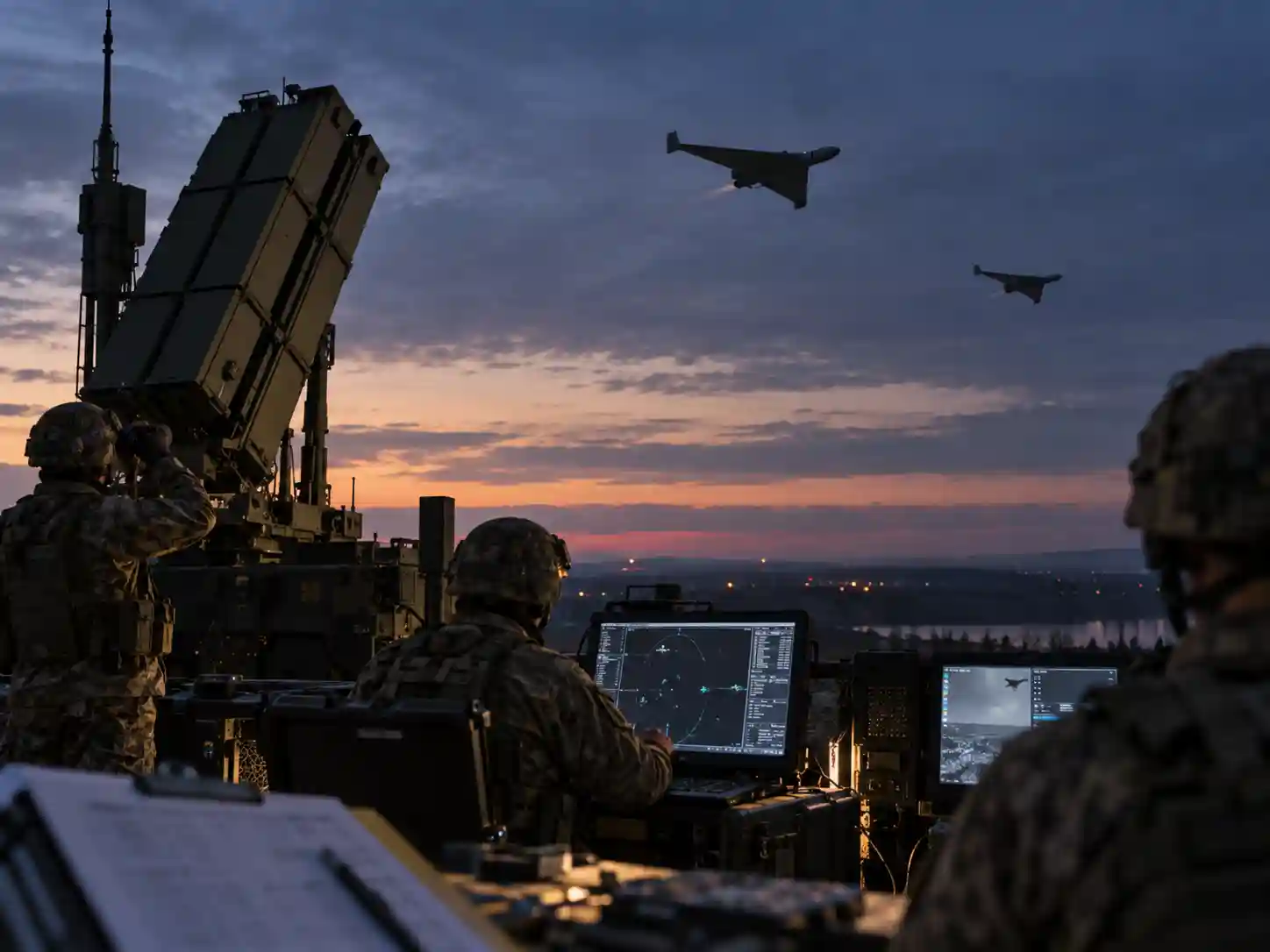

KYIV, Sept. 24, 2026 - Russia’s newer jet-powered attack drones are changing the economics of air defence in Ukraine.
Earlier Shahed-type one-way attack drones were dangerous because they combined long range, a meaningful warhead and relatively low production cost. Ukraine gradually built lower-cost ways to defeat them, including mobile gun teams, electronic warfare and interceptor drones.
Jet-powered variants challenge that model.
They fly faster, can operate at higher altitude and give defenders less time to detect, classify and engage them. The practical effect is not simply that the target becomes harder to hit. It can also force the defender to move from cheap weapons toward faster interceptors, combat aircraft or expensive surface-to-air missiles.
That shifts the central air-defence question from “can this target be destroyed?” to “what does each interception cost, and can the defender sustain that exchange at mass scale?”
A different threat profile
Ukrainian officials have publicly described newer Geran-series jet-powered drones as significantly faster than the earlier propeller-driven models.
Public statements in September put the Geran-4 at roughly 320 km/h and around 4 kilometres of altitude, while the larger Geran-5 has been described at roughly 450 to 600 km/h and up to around 6 kilometres.
These are wartime operational estimates rather than independently certified manufacturer specifications.
But the defensive consequence is straightforward.
A target moving at 450 km/h covers 100 kilometres in about 13 minutes.
If detection occurs late, an interceptor may have only a short period to climb, position itself and close the distance.
Altitude creates another problem.
The higher the drone flies, the fewer low-cost systems can reach it.
Why cheap mobile defence becomes less useful
Ukraine has relied heavily on inexpensive mobile defence because it helps preserve scarce missiles.
A gun team can engage a slow, low-flying drone if the aircraft passes close enough.
A portable missile can work if the target remains inside its engagement envelope.
A purpose-built interceptor drone can work if it can climb and catch the incoming aircraft.
Jet propulsion changes all three.
Higher speed reduces reaction time.
Higher altitude removes some guns and portable weapons from the engagement.
And an interceptor designed around slower Shahed-type drones may simply lack enough speed to overtake the target.
Ukraine’s Defence Ministry has therefore described jet-powered Shaheds as a serious air-defence challenge and made high-speed interception a priority.
Ukraine is building another defensive layer
The response is not to fire a premium missile at every drone.
Ukraine is trying to create a large low-cost interceptor layer.
In April 2026, the Ministry of Defence announced procurement of 8,000 Octopus interceptor drones.
The system was developed specifically to counter Shahed-type attack drones and includes automatic terminal guidance.
Ukraine also opened production to multiple licensed manufacturers.
That is an industrial approach rather than a limited experiment.
The logic is simple.
If a relatively inexpensive interceptor can destroy a drone, Ukraine can preserve more sophisticated surface-to-air missiles for ballistic missiles, cruise missiles and aircraft.
Interceptor production has become a new defence industry
Ukraine said in January that military units were receiving more than 1,500 anti-Shahed interceptor drones per day during the December-January period.
By September 22, the Defence Ministry said it had authorized 650 new unmanned aerial systems for use during 2026, including 42 new interceptor-drone systems.
That shows how quickly counter-drone defence has become an industry of its own.
Ukraine is no longer looking for one perfect interceptor.
It is building a portfolio of systems with different speed, range, altitude and guidance characteristics.
That mirrors what happened on the offensive side of drone warfare.
Once the technology became cheap enough, many manufacturers began iterating rapidly.
Air defence is now entering the same cycle.
Jet-powered targets demand more speed
On September 3, President Volodymyr Zelenskyy said Ukraine had manufacturers capable of building high-speed interceptors specifically for jet-powered Shahed-type threats.
He said prototypes had already been developed and ordered the defence sector to accelerate production.
On September 15, Zelenskyy said another Ukrainian solution had successfully intercepted a jet-powered Shahed during testing, although technical refinements were still needed.
This is important because Ukraine has not declared the problem solved.
It has declared the problem urgent.
The transition from successful prototype to reliable mass production is the real challenge.
The cost-exchange problem
Air defence is not only a question of technical performance.
It is an economic competition.
If an attacker launches hundreds of relatively cheap drones and the defender uses far more expensive missiles against them, the attacker can impose a financial burden even when most drones are destroyed.
That is why interceptor drones matter.
A specialized interceptor can use a simpler airframe, commercial electronics, smaller propulsion and cheaper guidance than a full-scale surface-to-air missile.
It does not need to defeat every type of airborne threat.
It only needs to defeat the drone class it was designed for.
That specialization can dramatically improve the cost exchange.
Jet engines also cost the attacker more
The economics are not completely one-sided.
A turbojet-powered drone is more complex than a simple piston-engine one-way aircraft.
The engine costs more.
Fuel consumption is higher.
The airframe may need to withstand greater loads.
Control and guidance can become more demanding.
So Russia also pays more to create speed.
The important strategic question is whether the extra cost to the attacker is smaller than the extra cost imposed on the defender.
If a moderately more expensive attack drone forces the defender to use a much more expensive interceptor, the attacker can still improve the exchange ratio.
The line between drone and cruise missile is blurring
A slow propeller-driven one-way attack drone is clearly different from a cruise missile.
A jet-powered autonomous aircraft moving at several hundred kilometres per hour and operating at multiple kilometres of altitude begins to overlap with cruise-missile characteristics.
The categories still matter technically.
Cruise missiles may be faster, more sophisticated and carry different warheads.
But from the perspective of an air-defence operator, the engagement problem begins to look similar.
The target is small, fast, difficult to engage and capable of striking fixed infrastructure at long range.
That is why Ukraine’s defensive response is becoming more layered.
Aircraft are becoming part of the drone-defence stack
Ukraine has said it is using combat aircraft and helicopters to help protect cities and infrastructure from attack drones.
Aircraft offer mobility.
A fighter can move across a large defensive sector much faster than a ground-based team.
Helicopters can engage some drones under the right conditions.
But this is expensive.
Aircraft consume fuel, maintenance hours and pilot time.
Every anti-drone sortie is a sortie unavailable for another mission.
Aircraft therefore make sense as part of a layered system, but not as the ideal mass answer to thousands of incoming drones.
Missile inventories remain the most sensitive resource
Advanced air-defence missiles are difficult to replace.
They require specialized seekers, propulsion systems, guidance electronics and complex manufacturing.
Ukraine and its partners have therefore tried to preserve high-end systems for threats that cheap layers cannot handle.
In February 2026, Ukraine’s Defence Ministry said international partners had committed major air-defence support, including funding for missiles, drones and anti-drone systems.
But funding is only part of the problem.
Factories need time to build missiles.
A war can consume them faster than production lines can replace them.
Every drone destroyed by a lower-cost interceptor can therefore preserve a high-end missile for a ballistic or cruise-missile target.
Private companies are joining air defence
Ukraine has also begun experimenting with privately organized air-defence groups.
The Defence Ministry said in June that 30 companies had joined a pilot program allowing authorized businesses to contribute to air-defence missions.
Several groups had already destroyed attack and reconnaissance drones.
The ministry also said one private group had downed a jet-powered Shahed-type drone.
This is strategically significant.
Factories, logistics hubs and infrastructure operators have direct incentives to protect their own sites.
A decentralized model can add defensive capacity without requiring a conventional air-defence battery at every location.
It is a wartime solution, but it may influence the future protection of critical infrastructure elsewhere.
Shvidun shows the current interceptor problem
The Ukrainian-made Shvidun interceptor illustrates the pace of development.
The Defence Ministry said in March that it weighs around 8 kilograms, has a wingspan close to 2 metres, can exceed 250 km/h and operate at altitudes up to 6 kilometres.
That is strong performance against many conventional attack drones.
It also shows why jet-powered targets require another step.
An interceptor that is fast enough for one generation of drone may be too slow for the next.
Air-defence drones are therefore moving into a continuous update cycle.
TALION shows how drone roles are merging
Ukraine authorized the TALION unmanned system in June as both an interceptor and a loitering munition.
It can attack aerial targets and also perform strike missions.
That flexibility matters because a mass-produced airframe does not have to sit unused when the aerial threat changes.
A configurable drone can provide air defence in one mission and offensive capability in another.
That can improve manufacturing economics and battlefield utilization.
The future air-defence drone may therefore be less like a single-purpose missile and more like a reusable software-defined platform.
Electronic warfare still matters
Electronic warfare remains one of the cheapest ways to disrupt drones.
If an aircraft depends heavily on satellite navigation or an external control link, jamming can reduce accuracy or cause mission failure.
But attack drones are becoming more autonomous.
Better inertial navigation, optical guidance and onboard processing can reduce dependence on external signals.
Higher speed also means a drone spends less time inside one electronic-warfare coverage zone.
That does not make jamming obsolete.
It means jamming alone is not enough.
A resilient air-defence architecture combines electronic attack with physical interception.
AI becomes more valuable as reaction time shrinks
High-speed drone defence creates a decision-time problem.
A human operator may have only seconds to classify a target, choose an interceptor and launch.
Automation can compress that cycle.
Computer vision can identify targets.
Software can predict flight paths.
Networked sensors can assign the nearest interceptor.
Autonomous terminal guidance can handle the last phase of the engagement.
This is where AI becomes militarily useful.
Not as a vague label, but as a way to shorten the sensor-to-shooter timeline.
The faster the incoming drone, the more valuable that automation becomes.
The industrial problem may be harder than the technical problem
Ukraine has repeatedly demonstrated that it can create effective drone prototypes.
The harder problem is quantity.
A system that works in a test does not solve a mass-attack problem.
It has to be produced in tens of thousands.
Operators have to be trained.
Launch sites have to be distributed.
Batteries and spare parts have to be available.
Command systems have to prevent several interceptors from chasing the same target.
Production has to stay ahead of consumption.
That is why modern air defence is increasingly an industrial problem.
The global lesson
The lesson extends far beyond Ukraine.
Traditional air defence was built mainly to defeat aircraft and missiles expensive enough to justify expensive interceptors.
Mass-produced drones break that assumption.
An attacker can launch a large number of comparatively cheap autonomous aircraft and force the defender to respond repeatedly.
Jet-powered variants show how the threat can then evolve upward in speed and altitude until yesterday’s cheapest countermeasure stops working.
That creates a continuous cycle.
The attacker adds speed, altitude, guidance and autonomy.
The defender adds faster interceptors, better sensors and automated targeting.
The attacker changes again.
What successful defence would look like
Ukraine does not need one perfect interceptor.
It needs a system that is affordable, reliable and available in enormous numbers.
A cheaper interceptor with a high enough success rate may be more useful than a highly sophisticated missile that cannot be produced at sufficient scale.
The objective is to reverse the economics.
Force the attacker to spend more on propulsion and guidance.
Destroy enough drones that mass raids become inefficient.
Preserve premium missiles for premium threats.
And keep critical infrastructure functioning.
The winner in this part of the air war may ultimately be the side with the better manufacturing system rather than the side with the most impressive individual weapon.
The strict conclusion
Russia’s jet-powered attack drones matter because they attack the economics of the defender.
Their speed and altitude reduce the effectiveness of some of the cheapest systems Ukraine developed against earlier Shahed-type drones.
That can push the defender toward aircraft, high-speed interceptors and expensive missiles.
Ukraine’s answer is to create another layer of air defence built around fast, lower-cost interceptor drones produced at industrial scale.
The country has already ordered thousands of interceptors, authorized dozens of new systems and made jet-powered Shahed defence a production priority.
The larger lesson is clear.
The drone war is no longer only about making the attacker cheaper than the missile used to stop it.
It is about building a defensive system whose cost, production rate and reaction speed can keep pace with the threat.
If Ukraine succeeds, the result will shape air-defence doctrine far beyond this war.
If it fails, jet-powered drones will have demonstrated one of the most disruptive principles in modern military economics: an inexpensive aircraft does not need to destroy an expensive air-defence system to defeat it.
It only needs to force that system to keep firing.
Reader questions
Frequently asked questions
Why are jet-powered Russian drones harder to intercept?
They can fly faster and at higher altitudes than conventional propeller-driven Shahed-type drones, reducing reaction time and putting some low-cost guns, mobile teams and slower interceptor drones outside an effective engagement envelope.
What jet-powered drones is Russia using?
Ukraine has publicly identified newer Geran-series jet-powered one-way attack drones, including Geran-4 and Geran-5 variants.
How is Ukraine responding?
Ukraine is accelerating production of high-speed interceptor drones, expanding private and military counter-drone units, using aircraft where necessary and preserving expensive missile systems for threats that cheaper layers cannot defeat.
How many Octopus interceptors has Ukraine ordered?
Ukraine’s Ministry of Defence announced procurement of 8,000 Octopus interceptor drones in April 2026.
Why are interceptor drones important for air-defense economics?
A low-cost interceptor can destroy an attack drone without consuming a much more expensive surface-to-air missile, improving the defender’s cost exchange and preserving scarce missile inventories.
What is the main global lesson from the new drone threat?
Air-defense systems need a large, low-cost interception layer that can be manufactured at scale. Relying only on expensive missiles is economically difficult against mass-produced attack drones.
Nexuswild welcomes factual corrections. Email [email protected] with evidence and the article URL.