
The spud in the simulant — the hook
On 19 November 2026, a paper in npj Microgravity reported that potatoes could complete their life cycle in lunar regolith simulant — provided the “soil” was amended with organic matter. The result was specific: one cultivar, five simulants, small pots, and a 30% vermicompost mixture that brought growth and yield to levels comparable with an Earth-soil control. It was not a harvest on the Moon. It was not even a harvest in real lunar dust. But it was a controlled test of a question that matters for any plan to keep people on the lunar surface for more than a few weeks: can a staple crop be grown in the material the Moon actually provides?
The paper’s authors, including Aymeric Goyer and David Handy of Oregon State University, were careful about what they had and had not shown. The Guardian reported that Goyer said, “We used what we harvested for lab analyses.” The tubers were not tasted. The Oregon State University release quoted Goyer saying, “We found that potatoes can complete their entire life cycle in simulated lunar soil when supplemented with organic matter.” That sentence contains the correct limit: simulated lunar soil.
This article follows that limit. It describes what the experiments measured, what the researchers inferred, and what remains unverified. The evidence is strong enough to make potatoes a serious candidate for lunar agriculture. It is not strong enough to put them on a mission menu.
Why potatoes are on the shortlist
Potatoes are not in these experiments because they are familiar. They are there because they score well against the constraints of space farming. The NASA Task Book, describing grant 80NSSC24K0755, says potato is “an ideal clonally propagated food crop for space exploration” because it provides more calories per land area than many other crops, grows on a wide variety of soil media, is nutritious and has a high satiety index. Goyer made the same point to The Guardian: “Potatoes provide more calories per land area than many other crops.”
The nutritional case is similarly practical. In The Guardian, Goyer said, “They are nutritious – they provide more potassium than a banana, are rich in vitamin C, have good proteins – and they have a high satiety index.” Those are comparative claims from the researcher, not a full dietary assessment, but they explain why potatoes would attract attention for long-duration missions.
The NASA Science article on space crops adds the systems argument. It says crops can supply whole-food nutrition and dietary variety while also absorbing carbon dioxide, producing oxygen and recycling water. NASA Science wrote: “Space crops will provide deep space crews with whole-food nutrition and increase dietary variety.” That is a projected life-support role, not a result of the potato trial, but it frames why the trial exists.
Popular Science describes the alternative: cargo room on spacecraft is limited and costly. In a habitat where every kilogram has to be launched, a crop that converts local material and waste into food is strategically useful. The Moon is not a garden, but a base that cannot resupply easily has to behave like one.
The Moon base this research would serve
The potato work is tied to a larger infrastructure plan. NASA’s Moon Base FAQs state: “NASA plans to build the Moon Base near the lunar South Pole.” The same page says the base will develop in phases: through 2029, then 2029 to 2032, then from 2032 onward, with infrastructure and habitats arriving step by step. Page last updated 7 November 2026, the FAQ describes a long-term presence rather than a single landing.
Near the South Pole, NASA says, water ice and other frozen materials may be scientifically useful, and the region preserves ancient terrain. Those resources are not food, but they are part of the same logic: a base that can use local materials has a better chance of enduring. NASA Science reported on 30 September 2026 that NASA, CSA and the German Aerospace Center signed a joint statement of intent for a Lunar Agriculture Module-Ground Test Demonstrator, an Earth-based effort to learn how crops perform under atmospheres and controlled environments similar to those expected at Moon Base.
BBC reporting adds the schedule and the scepticism. Artemis III, planned for summer 2027, will not land on the Moon; Artemis IV is currently targeted for 2028. China has announced a target of landing astronauts on the Moon by 2030. The BBC also notes concerns about lander development, refuelling and launch-pad repairs. These are plan dates, not guarantees. For the potato research, the relevant point is simpler: the demand for off-Earth food production is plausible, and the hardware to use it remains under development.
Building a lunar “soil” in a laboratory
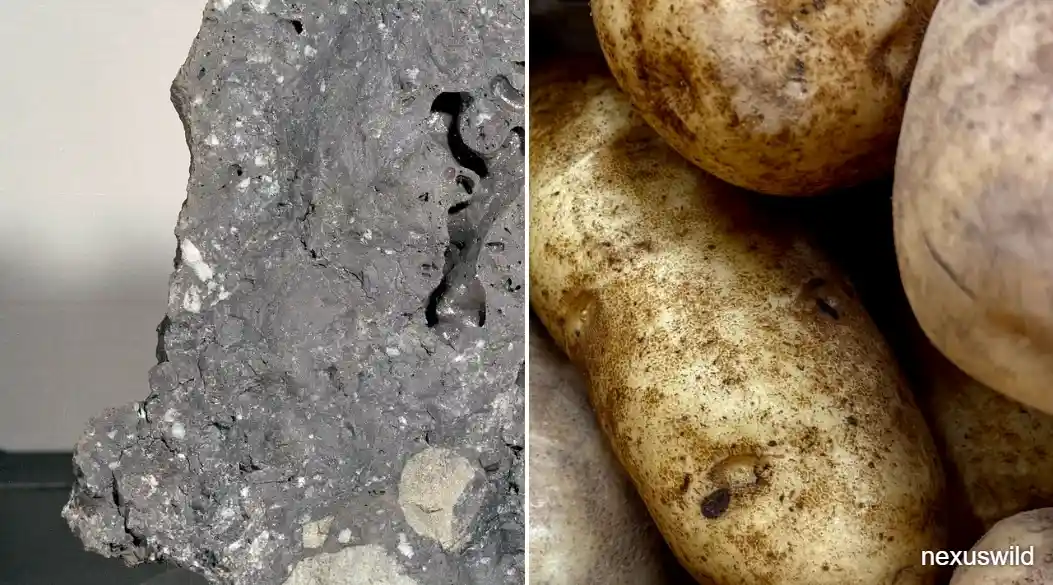
The npj Microgravity study did not use Apollo samples. It used five lunar regolith simulants: LHS-1E, LMS-1E, JSC-1A, OPRH4W30 and NUW-LHT-5M. The paper classifies JSC-1A and LMS-1E as mare simulants, and OPRH4W30, LHS-1E and NUW-LHT-5M as highland simulants. LHS-1E and LMS-1E came from Exolith Lab in Orlando; the other three came from NASA Johnson Space Center’s Simulant Development Lab.
That spread matters because lunar regolith varies across the Moon. A single “moon dirt” would have been a misleading test material. The researchers also included an Earth control: an Adkins-series sandy soil from Hermiston, Oregon, listed at 45.817318°N, 119.294922°W, a region known for high potato yields.
The experiments also supplied nutrients. All Experiment 1 treatments received Osmocote Plus 15-9-12 slow-release fertilizer at 5.68 cm³ per 1,000 cm³ of substrate. This is important for interpreting the result. The study was not asking whether potatoes can grow in bare regolith with nothing added. It was asking whether regolith can be turned into a workable substrate with organic matter and fertilizer. In The Guardian, Goyer said lunar regolith “does not contain any nitrogen, so no crop would grow without supplementing it.”
The simulant limitation cannot be overstated. The paper itself notes that simulants are not real lunar regolith and cites Arabidopsis work showing major differences between JSC-1A and Apollo lunar samples. Everything that follows is therefore evidence about analogue materials, not about scooped lunar soil.
The 30% vermicompost result
Experiment 1 focused on LMS-1E with three levels of vermicompost: 0%, 15% and 30%. Vermicompost is nutrient-rich organic material produced by earthworms breaking down organic matter. In a real mission, the appeal is circularity: food scraps and plant waste could become more growing medium rather than more trash.
The result was graded, not binary. Plants in unamended simulant were severely stunted. Those with 5% to 15% vermicompost showed only partial recovery, according to the Oregon State release. At 30% vermicompost, the paper reports growth and yield comparable to the Earth-soil control. The most striking measurement came from pure LMS-1E: roots of three of four plants fell below detectable mass, less than 0.01 g.
The OSU release quotes Handy explaining the proposed mechanism: “We believe the compost helps balance some of the toxicity we see in lunar regolith by reducing plant exposure to harmful compounds.” That is a hypothesis about binding and availability, not a demonstrated mission protocol.
There are practical limits. The Guardian reports that the tubers from the small pots weighed under 10 grams even in the Earth-soil control. Small containers constrain yield; they do not tell us what a field or large growth chamber would produce. The Guardian also reports a second study using larger pots that produced store-size potatoes, but the exact sizes and methods are UNVERIFIED in the accessible packet sources. The defensible claim is narrower: with organic amendment and fertilizer, one cultivar completed its cycle in simulant at yields comparable to its control under the tested conditions.
When the simulant fights back
Experiment 2 moved beyond a single material. It used 5% vermicompost, five biological replicates per soil type and 30 plants in total across the simulants. This design could ask a different question: does one amendment level work everywhere?
It did not. NUW-LHT-5M caused the most severe impairment. Emergence took about 24 days after planting, compared with 4 to 8 days for the other treatments. Only three of five NUW-LHT-5M plants were harvestable. That is a small number, but the direction is clear: highland and mare analogues do not behave identically, and even within the tested set there are outliers.
The molecular data reinforce that point. Transcriptomic sequencing produced 972,140,076 raw reads. Differentially expressed gene counts were 124 for OPRH4W30, 1,397 for LMS-1E, 958 for JSC-1A and 360 for LHS-1E. Without adding interpretation beyond the paper, these counts show that the plants responded differently depending on the substrate. Some of that response is stress biology, not simply “growth.”
This section is where the phrase “lunar soil” becomes least useful. The Moon does not offer one substrate. If a future base uses local material, it will need to know which material it has, what amendment it needs and how much yield penalty it can accept. The NUW-LHT-5M result says the penalty can be large.
What the tubers showed chemically
Growing a tuber is not the same as producing food. The researchers therefore examined tuber chemistry. The npj Microgravity paper reports that tuber metabolites changed only minimally, and that six of seven phenolic or glycoalkaloid compounds showed no significant changes. The OSU release specifically says there was no statistically significant increase in glycoalkaloids, naturally occurring potato toxins often associated with green discoloration beneath the skin. Solanine and chaconine did not increase significantly.
That is a useful safety-relevant signal. It is not a food-safety finding in the regulatory sense. “No significant increase” means the study did not detect a statistically significant rise under its conditions; it does not establish that every batch of tubers from every simulant, amendment level or container size would be safe. No human consumption test was reported. The Guardian is explicit that the harvested potatoes went to lab analyses rather than to a tasting panel.
The distinction matters because potatoes naturally contain glycoalkaloids, and the relevant question for astronauts would be chronic exposure, preparation, dose and individual tolerance. None of those are established by this packet. The verified result is chemical: the tested tubers did not show a significant rise in the measured toxins. The unverified result is dietary: whether people could eat them safely and regularly.
Heavy metals: the unresolved hazard
Heavy metals are the sharp edge of the regolith problem. The paper reports copper elevated in JSC-1A, zinc in JSC-1A, LMS-1E and OPRH4W30, and aluminium in LHS-1E and OPRH4W30. The authors describe accumulation as modest but warranting monitoring. That wording is appropriately cautious.
In The Guardian, Goyer explained why organic matter might help: “Without organic matter, potatoes take up too much heavy metals, which can become toxic for the plants. Organic matter helps make heavy metals less available to the plants, so plants do not over-accumulate them.” The OSU release quotes Handy similarly: “We believe the compost helps balance some of the toxicity we see in lunar regolith by reducing plant exposure to harmful compounds.”
Both statements concern plant exposure and uptake. They do not establish toxicological thresholds for crew consumption. The packet contains no verified dietary limit, no dose-response model and no feeding study. Heavy-metal toxicological thresholds for these tubers are therefore UNVERIFIED. Even if amendment reduces uptake, a mission would still need to measure each harvest, understand how elements are distributed in the tuber and decide what long-term exposure is acceptable.
This is not a reason to discard the approach. It is the reason the approach needs more testing. The same organic matter that makes the substrate workable may also change metal availability in complex ways. The study has identified the problem and a plausible mitigation; it has not closed the safety case.
Beyond the potato: a diversified space farm
A single crop is unlikely to sustain a crew. The packet includes several examples of why researchers are widening the set. UT News reported on 9 March 2026 that scientists at The University of Texas at Austin had grown and harvested chickpeas in simulated “moon dirt,” the first instance of that crop produced in that medium. The study, published in Scientific Reports and conducted with Texas A&M University, used Exolith simulant, vermicompost and the ‘Myles’ chickpea variety. Researchers coated seeds with arbuscular mycorrhizae and used a cotton-wick irrigation system to deliver water to the root zone.
The UT Austin release says mixtures of up to 75% moon dirt successfully produced harvestable chickpeas; higher percentages caused stress and early death. The fungi colonized and survived in the simulant, suggesting they might need to be introduced only once in a real growing setting. But the same release quotes first author Jessica Atkin: “We want to understand their feasibility as a food source.” How the chickpeas taste, their nutritional content and whether toxic metals were absorbed remain open questions.
Earlier work supplies another comparison. A 2023 Plant and Soil paper tested potato cv. Colomba on MMS-1 Mars regolith simulant, alone and with 30% green compost, in a cold glasshouse. It found MMS-1 nutrient-poor and unsuitable on its own, but compost improved its properties and plant performance; plants produced healthy tubers on all substrates. That was a Mars simulant and a different growing environment, not a lunar test, but it supports the broader principle that organic amendment can make regolith-like substrates more productive.
The Guardian reports that Handy said, “People are also working with tomatoes, lettuce and legumes like alfalfa.” A lunar farm, if it exists, will probably be a portfolio.
The next experiment — and what it must prove
The most concrete next step in the packet is a ten-variety potato study. The OSU release says a forthcoming paper will report experiments evaluating 10 potato varieties in lunar regolith simulants. The NASA Task Book describes Aim 2 as assessing the genetic potential of potato to grow on lunar highland and mare simulants by characterizing the performance of ten potato genotypes. FY2025 records say 13 genotypes were initially selected, which likely reflects a broader selection pool, but the packet does not fully reconcile the numbers.
These results are forthcoming and UNVERIFIED. Until they appear, the verified result applies to Modoc. One cultivar cannot establish that potatoes as a species are suited to lunar substrate. The ten-variety work matters because it could identify genotypes with better yield, stress tolerance or nutritional quality under simulant conditions.
What else must be proved? Real-regolith testing is the obvious gap, because the paper itself flags differences between simulant and Apollo material. Larger containers or realistic growth volumes are needed, since the small pots produced tubers under 10 grams even in the control. Repeated harvests would show whether a substrate remains workable across cycles. Actual sensory and safety evaluation would answer what the current study did not ask. And any mission design would have to close the loop on organic matter: where the initial compost comes from, how food scraps and plant waste are converted, and how contaminants are managed.
NASA Science’s joint statement for a Lunar Agriculture Module-Ground Test Demonstrator is an Earth-based step in that direction. It is not a lunar greenhouse. It is a way to learn how crops behave in controlled environments before committing them to a base.
Earth benefits and the bottom line
The researchers also argue that this work has terrestrial value. The Guardian reported Goyer’s argument that the research could help regions with low agricultural output, including inner cities and desert communities, by improving or remediating poor soils. That is a plausible application of the same substrate science, but it is an argued benefit, not a measured outcome in this packet.
The verified finding is narrow and real: in one peer-reviewed study, potatoes cv. Modoc completed their life cycle in five lunar regolith simulants with organic amendment, and a 30% vermicompost treatment produced growth and yield comparable to an Earth-soil control under the tested conditions. Tuber chemistry showed no significant rise in measured glycoalkaloids. Heavy-metal accumulation was modest but flagged for monitoring.
The uncertainties are equally important. The materials were simulants, not real lunar regolith. Only one cultivar was reported in the published trial. The pots were small. The tubers were not tasted. No significant glycoalkaloid rise is not proof of food safety. Heavy-metal toxicological thresholds are UNVERIFIED. Ten-variety results are forthcoming and UNVERIFIED. Real mission schedules, as BBC reporting shows, are uncertain too.
Potatoes are therefore a credible candidate crop, not a demonstrated lunar food source. The study moves the question from “can a plant survive in moon-like dirt?” to “which varieties, with which amendments, under which safety constraints, and at what yield?” That is a meaningful advance. It is also a reminder that feeding a Moon base will require the same discipline that got us here: measure carefully, state limits plainly, and do not let a promising pot experiment become a menu claim before the evidence catches up.
Nexuswild welcomes factual corrections. Email contact@nexuswild.com with evidence and the article URL.