
Automation is expanding its industrial robotics business through an agreement to acquire Austria-based AGILOX, a specialist in autonomous mobile robots (AMRs) used in factories, warehouses and production facilities. Announced on November 18, 2026, the acquisition will combine AGILOX's autonomous forklift technology with Rockwell's existing OTTO flatbed robot portfolio, creating a broader platform for automated material movement.
The financial terms of the transaction have not been disclosed. However, Rockwell expects the acquisition to more than double its autonomous mobile robot business, strengthening its position in industrial automation and production logistics. The deal will also connect OTTO's established North American presence with AGILOX's European customer network.
The announcement comes as manufacturers look for ways to improve factory productivity, reduce repetitive manual handling and make production operations more flexible. Autonomous robots are increasingly becoming part of this transition, allowing companies to transport materials between warehouses, assembly lines and production stations without relying entirely on traditional forklifts, manual carts or fixed conveyor systems.
For Rockwell, acquiring AGILOX represents more than an expansion of its robotics portfolio. It supports a broader strategy to connect artificial intelligence, industrial software and physical automation, helping manufacturers move from automated individual tasks towards increasingly autonomous factory operations.
Rockwell Expands Its Industrial Robotics Portfolio
Rockwell Automation signed a definitive agreement to acquire AGILOX on November 18, 2026. The Austrian company develops autonomous mobile robots that use artificial intelligence, intelligent navigation and proprietary swarm-networking technology to transport materials within manufacturing and warehouse environments.
The two companies bring complementary technologies to the proposed combination.
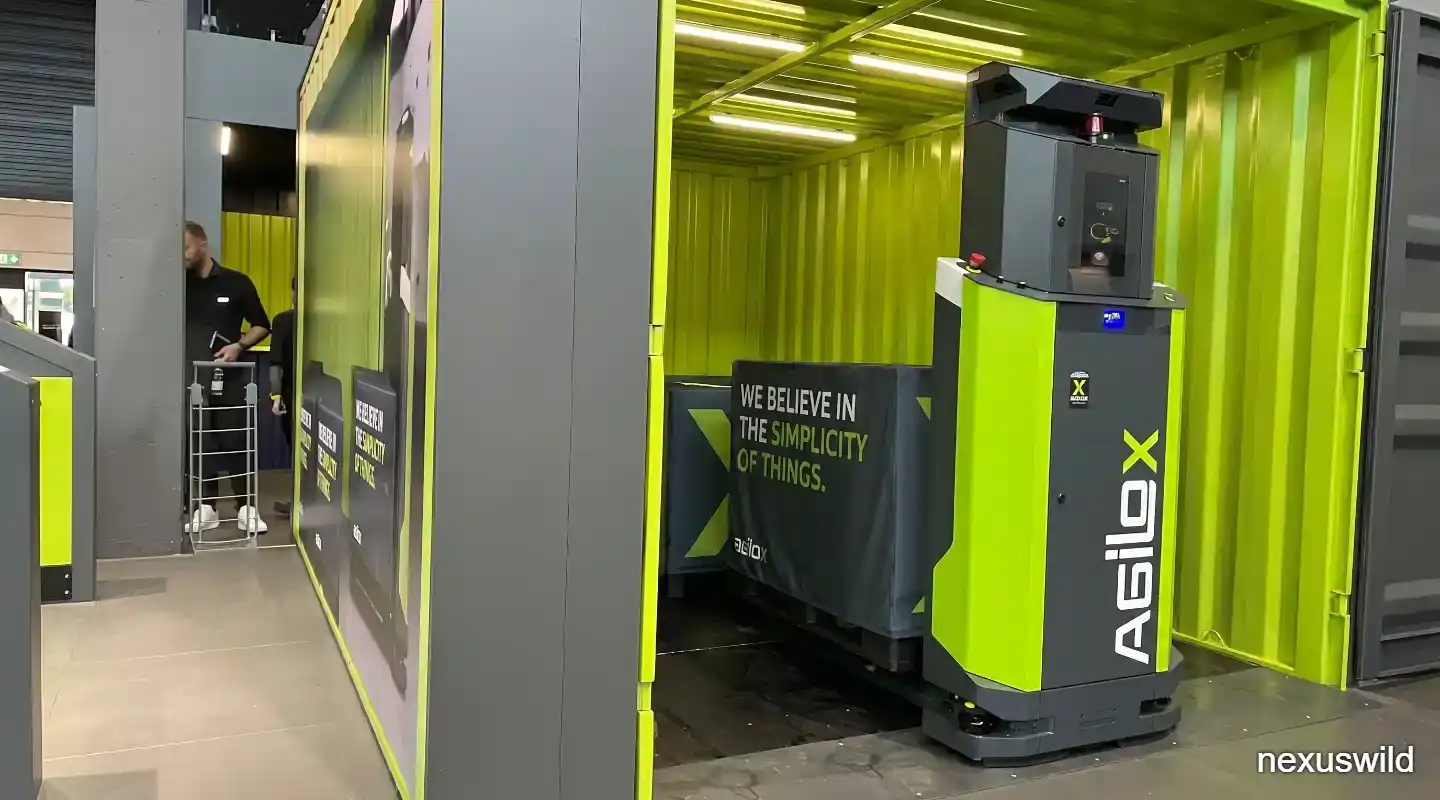
Rockwell's OTTO business specialises in flatbed autonomous mobile robots that move materials across industrial facilities. AGILOX, meanwhile, has developed forklift-style AMRs capable of transporting pallets and other load carriers, including heavier materials that require lifting and positioning.
Combining these capabilities would give Rockwell a wider range of autonomous material-handling options. Rather than relying on a single robot configuration, manufacturers could potentially select different machines depending on the weight, shape and movement requirements of their materials.
Rockwell says the acquisition will create a more comprehensive autonomous material movement offering and more than double its existing AMR business.
Once the transaction closes, AGILOX will report to Rockwell's Intelligent Devices operating segment. The acquisition is subject to customary closing conditions and regulatory approval, with completion expected in the second quarter of Rockwell's fiscal 2027.
The deal also represents an opportunity for AGILOX to expand beyond the scale it could achieve independently. Its co-chief executives and founders, Dirk Erlacher and David Niedermaier, have described Rockwell's global customer relationships and industrial technology capabilities as important advantages for the company's next stage of growth.
What Makes AGILOX's Autonomous Robots Different?
AGILOX has built its business around autonomous mobile robots designed for complex internal logistics operations.
Unlike conventional transport equipment that depends heavily on manually controlled movement, AMRs use sensors, navigation software and onboard computing to understand their surroundings and determine how to move through a facility.
AGILOX's technology includes its proprietary X-SWARM system. The platform enables robots to communicate with one another, exchange information about their positions and current tasks, and distribute work across the fleet.
The company's approach is designed to reduce dependence on a central master control computer. According to AGILOX, individual robots can communicate through a facility's Wi-Fi infrastructure and coordinate their movements as operating conditions change.
This capability matters in manufacturing environments where routes, storage areas and production requirements can change throughout the day.
For example, a factory might need to move pallets from a storage area to several assembly stations while avoiding workers, other robots and equipment operating in shared spaces. A coordinated fleet can distribute transportation tasks according to the available robots and their current operating conditions.
AGILOX also offers several robot configurations for different material-handling requirements.
Its OFL model can transport loads of up to 800 kilograms and lift materials to elevated stations. Its OCF autonomous counterbalanced forklift is designed for heavier transportation applications, with a maximum payload option of 1,500 kilograms.
The different models are built around a common software platform, allowing multiple vehicle types to operate within the same material-flow environment.
This flexibility is particularly valuable for companies that manage different production processes under one roof.
How Autonomous Mobile Robots Could Transform Factory Operations
Material movement is one of the most important but often overlooked activities in industrial production.
Factories need a continuous supply of raw materials, components, packaging and work-in-progress products. These items must travel between storage areas, workstations, assembly lines and finished-goods locations.
Even when the production process itself is automated, transporting materials between individual stages may still involve manual work.
Employees may spend significant time operating forklifts, pushing carts, moving pallets and walking between different sections of a facility. Delays in these activities can interrupt production even when machines and assembly equipment are functioning properly.
Autonomous mobile robots offer a way to automate these repetitive transportation tasks.
A robot can receive a movement request, travel to a designated collection point, transport the required material and deliver it to the correct destination. Fleet management software can coordinate multiple robots and connect their activities with broader production systems.
This can help manufacturers create a more consistent flow of materials between different production stages.
The potential benefits extend across several areas:
More consistent production supply: AMRs can support scheduled and demand-based material deliveries, helping production lines receive components when required.
Improved space utilisation: Autonomous robots can operate along dynamically selected routes, potentially reducing the need for large fixed transport systems and unnecessary staging areas.
Reduced repetitive manual handling: Employees can spend less time moving materials and more time performing assembly, quality inspection, maintenance and other higher-value activities.
Greater operational flexibility: Manufacturers can adjust robot routes and tasks as production layouts or inventory requirements change.
Better visibility: Connected fleet software can provide information about robot locations, transportation requests and material movements, helping managers identify bottlenecks.
These benefits do not mean every factory can immediately replace forklifts or conveyor systems with AMRs. The economics depend on the facility's layout, operating conditions, material requirements and the cost of integrating autonomous technology.
OTTO and AGILOX Create Complementary Capabilities
One of the most important strategic advantages of the acquisition is the combination of OTTO's flatbed robots and AGILOX's forklift-style machines.
The technologies address different transportation requirements.
OTTO robots can carry materials on flat platforms or move specialised loads through factory environments. The product portfolio includes different payload capacities, making the platform suitable for transporting components, containers and production materials.
AGILOX extends this offering by providing autonomous forklift capabilities. These machines can lift and transport pallets and other load carriers, addressing applications that require vertical material handling rather than simply moving a load along the floor.
Together, the portfolios could provide manufacturers with a wider selection of autonomous equipment for different internal logistics processes.
The geographical combination is equally significant.
OTTO has an established presence in North America, while AGILOX has developed a substantial footprint across Europe. Bringing the businesses together could help Rockwell serve customers across both regions through a broader distribution and partner network.
AGILOX already operates internationally, with subsidiaries in Europe, the United States and China. The company has deployed more than 2,500 robots and employs over 250 people worldwide.
Its investor Carlyle also reported that AGILOX serves more than 400 customers and works with over 40 partners across more than 35 countries.
This existing commercial network gives Rockwell an opportunity to expand its European robotics activities while introducing AGILOX technology to customers in other regions.
Why Manufacturers Are Moving Towards Autonomous Logistics
Industrial automation has traditionally concentrated on production machinery, robotic arms, programmable logic controllers and automated inspection systems.
However, manufacturers increasingly recognise that improving one production stage is not enough when materials still move slowly between different operations.
A highly automated assembly line can remain dependent on employees manually transporting components from warehouses or intermediate storage areas. If materials arrive late, machines may sit idle and production schedules can be disrupted.
This is where autonomous logistics becomes increasingly relevant.
AMRs can connect different areas of a facility and help make material transportation more closely aligned with production demand.
For example, a manufacturer could connect its production management software with a fleet-management platform. When an assembly line requires additional components, the system can generate a transportation request and assign an available robot.
Once the delivery is completed, the robot can receive another task rather than waiting for manual instructions.
The result is a more connected production environment in which material movement becomes part of the overall automation strategy.
Rockwell has already demonstrated this approach at its own 250,000-square-foot manufacturing facility in Twinsburg, Ohio.
The company deployed three OTTO 100 autonomous mobile robots to transport raw materials from kitting operations to four assembly lines. The robots worked with its FactoryTalk ProductionCentre manufacturing execution system and OTTO Fleet Manager through software interfaces.
According to Rockwell's case study, the deployment generated approximately $162,000 in annual savings, reduced work-in-process staging space by 50%, increased space utilisation by 70% and reduced production-line downtime by 20%.
Rockwell reported that the facility achieved a return on investment within 1.5 years.
These results relate to one specific internal deployment and should not be treated as guaranteed savings for every manufacturer. Nevertheless, they illustrate how autonomous material movement can affect productivity beyond simply reducing the number of manual transportation tasks.
<Cite refs={["turn715241search5","turn715241search6"]}/>
Artificial Intelligence Moves From Digital Systems Into Physical Operations
The acquisition also supports Rockwell's wider physical AI strategy.
Artificial intelligence is often discussed in the context of software applications, data analysis and generative models. However, AI is increasingly being incorporated into machines that interact directly with physical environments.
In autonomous mobile robots, AI and intelligent navigation systems help machines understand their surroundings, identify obstacles and respond to changes in their operating environment.
The combination of sensors, onboard computing, navigation software and fleet coordination allows robots to make transportation decisions rather than simply following fixed instructions.
This is particularly useful in factories where human workers, machines and transport equipment operate in shared spaces.
AGILOX's swarm technology and OTTO's autonomous navigation platform approach this challenge through different technical systems. The acquisition creates an opportunity for Rockwell to bring the capabilities together within its broader automation ecosystem.
For customers, the potential value is not limited to purchasing individual robots. It involves connecting autonomous equipment with production software, control systems and facility-wide operational information.
That integration could help manufacturers coordinate material deliveries with production schedules, inventory availability and changing operational requirements.
However, the acquisition announcement does not establish that both fleets will immediately operate through one unified control platform. Rockwell will need to determine how the technologies, software and customer support systems are integrated after completion.
Competitive Pressure in the Industrial Robotics Market
Rockwell's planned acquisition comes as industrial automation providers compete to develop more flexible material-handling solutions.
Manufacturers are increasingly evaluating AMRs as alternatives or complements to traditional automated guided vehicles, forklifts and conveyor systems.
Automated guided vehicles commonly rely on predefined navigation methods, although capabilities vary significantly between models. AMRs generally place greater emphasis on autonomous navigation, environmental sensing and adapting routes when operating conditions change.
That flexibility can make AMRs attractive in facilities where product flows, production layouts and transportation requirements change frequently.
Nevertheless, the market is competitive. Robotics manufacturers, automation suppliers and warehouse technology providers are all investing in navigation software, fleet coordination, sensors and autonomous material handling.
Rockwell's advantage is its established position in industrial control and automation. Its products already connect machines, operational technology and production software across manufacturing environments.
Adding AGILOX could strengthen the company's ability to offer customers a broader automation package rather than requiring them to purchase robotics, control technology and logistics software from entirely separate suppliers.
The acquisition could also help Rockwell compete more effectively for projects involving complete production-logistics systems, particularly in automotive, consumer packaged goods, life sciences and other industrial sectors.
Challenges That Could Slow AMR Adoption
Despite their advantages, autonomous mobile robots are not a universal solution for industrial transportation.
The first challenge is integration. AMR fleets need to communicate effectively with existing warehouse management systems, manufacturing execution systems and other production technologies. Poor integration can create delays, duplicate instructions or unnecessary manual intervention.
The second concern is safety. Robots often operate near employees, forklifts and production equipment. Manufacturers must ensure that machines can detect obstacles, respond reliably to changing conditions and operate within appropriate safety procedures.
The third challenge is operational reliability. Factories need dependable transportation throughout their production schedules. Battery management, network availability, floor conditions and unexpected obstacles can influence robot performance.
There are also financial considerations. Purchasing robots, installing software, modifying workflows and training employees require upfront investment. Businesses must evaluate the potential savings against the total cost of ownership.
Finally, manufacturers must consider interoperability. Large factories may already operate equipment from several robotics and automation suppliers. Ensuring that different fleets work together without creating isolated systems will remain an important requirement.
Research into warehouse and logistics robotics also identifies interoperability, scalability, robustness in changing environments and economic barriers as continuing challenges for wider adoption.
Rockwell's ability to connect AGILOX and OTTO with its broader industrial technology portfolio could help address some of these concerns, but actual results will depend on product integration and customer implementation.
What the Acquisition Means for AGILOX and Rockwell
For AGILOX, joining Rockwell offers access to a much larger international industrial automation network.
The company has grown from an Austrian robotics developer into an international AMR supplier, deploying thousands of robots across manufacturing, automotive, logistics, food and beverage and pharmaceutical operations.
Carlyle, which made a majority growth investment in AGILOX in 2021, said the company quadrupled its revenue during its ownership period through product development, international expansion and operational investment.
The sale represents the next stage of AGILOX's development under a strategic industrial buyer.
For Rockwell, the transaction offers an opportunity to strengthen the physical automation capabilities that complement its existing software and control systems.
The company employs approximately 27,000 people and serves customers in more than 100 countries. Its international presence could provide AGILOX with greater access to large manufacturers and industrial customers.
However, the acquisition's success will depend on retaining AGILOX's engineering expertise, supporting its existing customer base and ensuring that its products continue to develop.
The financial terms have not been disclosed, so investors cannot yet assess the purchase price against AGILOX's revenue, earnings or future growth potential.
Conclusion
Rockwell Automation's agreement to acquire AGILOX highlights the growing importance of autonomous material movement in modern manufacturing.
By combining AGILOX's AI-powered forklift robots with OTTO's flatbed AMR platform, Rockwell aims to build a more comprehensive offering for factories and warehouses. The strategic combination could help manufacturers automate repetitive transportation activities, improve production logistics and connect material movement more closely with manufacturing operations.
For industrial businesses, the wider opportunity is the transition from isolated automation systems towards connected facilities where machines, software and autonomous robots coordinate their activities.
Nevertheless, successful adoption will depend on reliable navigation, effective safety systems, integration with existing industrial software and a convincing financial return.
Rockwell's acquisition is not simply about adding another robotics supplier. It is an investment in the next stage of industrial automation, where artificial intelligence increasingly moves beyond digital applications and becomes part of the physical processes that keep factories operating.
Nexuswild welcomes factual corrections. Email contact@nexuswild.com with evidence and the article URL.