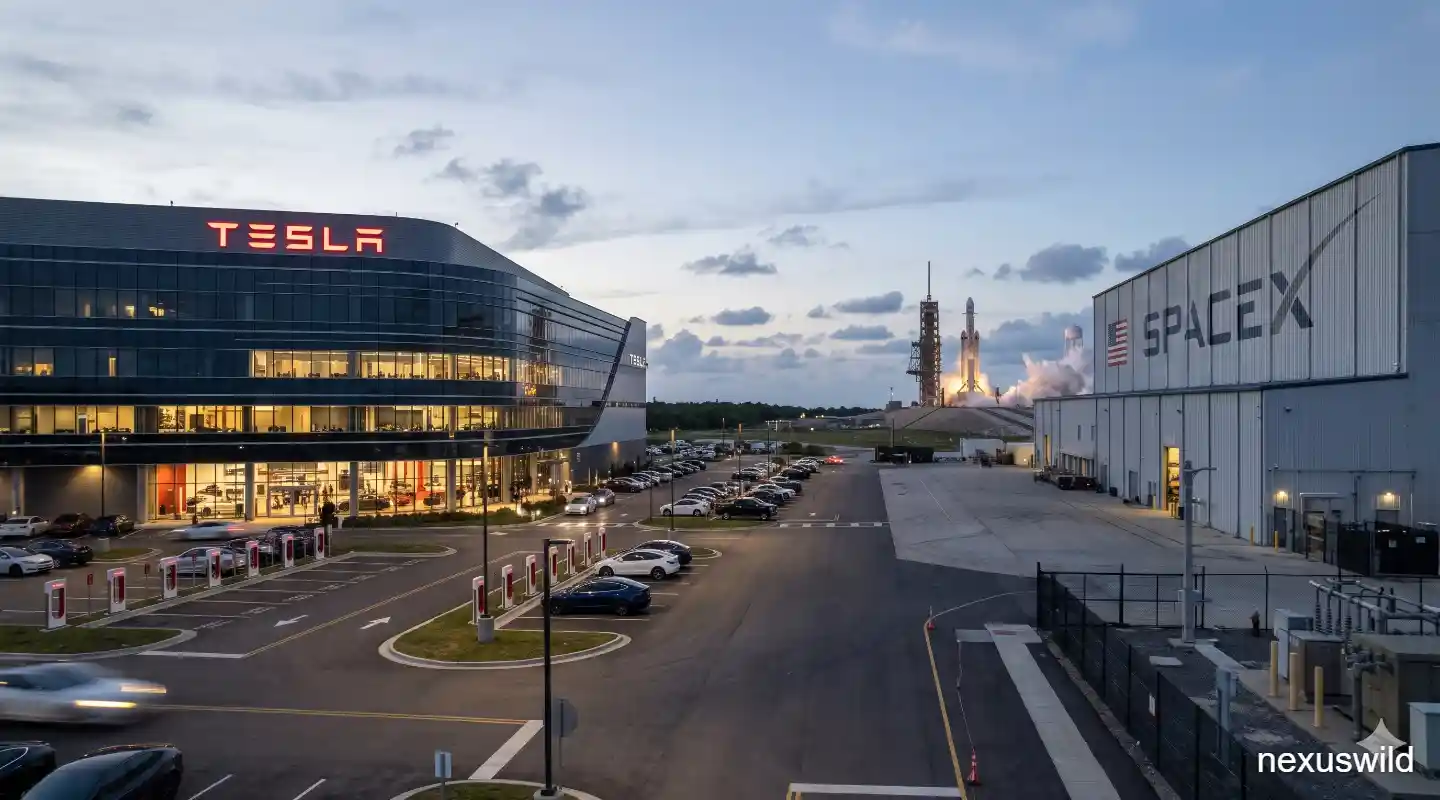

A potential corporate combination between Tesla and SpaceX is moving into a more formal negotiation stage, creating speculation about one of the largest business transactions in modern corporate history. Directors from both companies have been appointed to oversee discussions about a possible merger, bringing Elon Musk's electric vehicle, aerospace, artificial intelligence and robotics ambitions closer to a common corporate structure.
The development gained attention on November 24, 2026, after reports revealed that five directors had been selected to guide two special committees established to examine the proposed combination. The development follows earlier discussions initiated in October, when Musk confirmed that both companies had formed independent committees to evaluate the possibility of joining their businesses.
The potential transaction has been associated with an estimated combined value of approximately $3.5 trillion, although no final valuation, exchange ratio or definitive merger agreement has been announced.
For Tesla, the proposed combination could provide access to SpaceX's launch infrastructure, satellite communications capabilities and growing artificial intelligence ambitions. For SpaceX, closer integration with Tesla could create opportunities involving robotics, energy storage, advanced manufacturing and computing technology.
However, combining the two businesses would present significant financial, regulatory and corporate governance challenges. The companies operate in different industries, have different regulatory obligations and maintain important international business relationships.
The central question is whether bringing these operations together could create a more powerful technology group or introduce risks that outweigh the strategic advantages.
Five Directors Appointed to Lead Merger Negotiations
The appointment of five directors represents an important development in the discussions.
According to the Financial Times report cited by Reuters on November 24, two representatives from SpaceX and three from Tesla have been selected to guide the respective special committees.
The directors identified are:
SpaceX representatives:
- Roelof Botha
- Randy Glein
Tesla representatives:
- Robyn Denholm
- Kathleen Wilson-Thompson
- Jack Hartung
These directors are expected to help examine potential transaction terms, financial arrangements and the interests of shareholders in both companies.
The committees have also brought in financial advisers to evaluate the possible transaction. SpaceX is working with Morgan Stanley and Goldman Sachs, while Tesla has appointed Evercore.
The advisers are expected to examine the businesses' financial structures, identify areas of overlap and develop financial models that could help establish an appropriate exchange ratio in a potential all-stock transaction.
An exchange ratio would determine how much ownership in the combined company existing Tesla and SpaceX shareholders would receive.
Despite the appointments, negotiations remain ongoing. The companies have not disclosed a final transaction structure, and the reported discussions do not establish that a merger will definitely occur.
Reuters reported that it could not independently verify all the details of the Financial Times report, and neither company immediately responded to its requests for comment.
The appointment of dedicated representatives nevertheless suggests that the potential transaction has progressed beyond informal discussions into a more structured corporate review.
Why Elon Musk Wants to Bring Tesla and SpaceX Closer
The potential combination reflects Musk's wider ambition to connect businesses working across several advanced technology sectors.
Tesla is primarily associated with electric vehicles, battery technology, energy storage, autonomous driving and robotics. SpaceX operates in aerospace, satellite communications, rocket manufacturing and commercial space transportation.
Although their core products are different, both companies depend heavily on advanced engineering, software development, artificial intelligence and large-scale manufacturing.
Combining their resources could create opportunities across several interconnected industries.
For example, Tesla's expertise in battery systems, power electronics and automated manufacturing could potentially support future space-related infrastructure. SpaceX's launch capabilities and Starlink satellite network could contribute to communications and connectivity projects involving autonomous systems and remote infrastructure.
Artificial intelligence represents another important area of potential cooperation.
Tesla continues developing autonomous driving systems and its Optimus humanoid robot programme, while SpaceX is investing in computing infrastructure and technologies intended to support advanced AI applications.
A combined corporate structure could potentially improve coordination between engineering teams, manufacturing operations and long-term technology investments.
However, these possibilities remain strategic arguments rather than confirmed merger synergies. The committees will need to establish whether closer integration would create measurable financial benefits for shareholders.
The Potential $3.5 Trillion Corporate Giant
One of the most striking aspects of the proposed transaction is its possible financial scale.
The combined value of Tesla and SpaceX has been estimated at approximately $3.5 trillion, making the proposed combination potentially one of the largest mergers ever considered.
Earlier November reporting placed SpaceX's valuation at approximately $1.90 trillion and Tesla's market value at around $1.55 trillion.
These figures provide an indication of the potential scale of the transaction, but they should not be treated as agreed merger valuations.
The reported structure under consideration is an all-stock merger. Under such an arrangement, shareholders would exchange their existing ownership interests for shares in the combined business rather than receiving an entirely cash-based purchase price.
The most difficult financial question will be determining the relative value of both companies.
Tesla's valuation reflects expectations surrounding electric vehicles, autonomous driving, energy storage and robotics. SpaceX's valuation is linked to launch services, satellite connectivity, aerospace infrastructure and its broader technology ambitions.
These businesses have different revenue models, operating risks and investment requirements.
The financial advisers must therefore determine how much each company contributes to the combined organisation and how existing ownership interests should be adjusted.
An inappropriate exchange ratio could disadvantage shareholders of either company and create significant opposition to the transaction.
Artificial Intelligence and Robotics Could Become the Core of the Combined Business
Artificial intelligence may provide the strongest technological argument for bringing Tesla and SpaceX together.
Both companies are developing systems that require large amounts of computing power, specialised hardware and advanced software.
Tesla uses artificial intelligence in its driver-assistance technology, autonomous driving development and robotics research. Its Optimus programme is intended to develop humanoid robots capable of performing repetitive physical tasks.
SpaceX, meanwhile, has been exploring the relationship between aerospace infrastructure, satellite connectivity and large-scale computing requirements.
A closer corporate relationship could potentially improve access to computing resources, hardware development and specialised engineering capabilities.
One important development is Terafab, the chip manufacturing joint venture involving Tesla and SpaceX.
During SpaceX's October 20 earnings call, Musk discussed the project's ambitions to build advanced semiconductor manufacturing capacity for AI and robotics applications.
The project is targeting its first functional test chip around May or June 2027, with volume production aimed at the third quarter of 2028. Musk described the schedule as highly ambitious and acknowledged considerable uncertainty around achieving it.
Terafab illustrates how the companies are already pursuing projects that connect their technological requirements.
A broader corporate combination could potentially improve coordination between semiconductor manufacturing, robotics development and AI computing infrastructure.
However, semiconductor manufacturing requires enormous investment, specialist equipment and technical expertise. The proposed merger would not automatically guarantee that these projects become commercially successful.
SpaceX's Satellite Network and Tesla's Global Technology Ecosystem
Another potential benefit involves the relationship between satellite connectivity and Tesla's expanding technology ecosystem.
SpaceX operates Starlink, which provides satellite-based internet services to customers across numerous markets.
Tesla operates a global network of electric vehicles, charging infrastructure, software services and energy products.
The combination could create opportunities for improved connectivity in areas where conventional telecommunications networks are limited.
For example, satellite communications could potentially support connected vehicles, remote energy infrastructure and autonomous operations in locations with limited network coverage.
Tesla's energy storage technology could also become relevant to future space and computing infrastructure projects that require reliable power systems.
SpaceX's launch capabilities could provide a transportation platform for future satellite deployments and other commercial space activities.
The potential integration of these capabilities offers a broad strategic vision in which transportation, communications, energy and computing become parts of a connected technology ecosystem.
Nevertheless, both companies already maintain separate commercial partnerships and regulatory commitments. Any integration would need to respect existing contracts, technical restrictions and customer relationships.
Corporate Governance and Elon Musk's Role Create Major Questions
The proposed transaction also raises important questions about corporate governance.
Musk serves as the leading executive figure at both companies, creating a potential conflict of interest when decisions involve exchanging ownership interests between businesses he controls.
During SpaceX's third-quarter 2026 earnings call, Musk acknowledged that he was a conflicted party and said he could not participate in the discussions conducted by the special committees.
The use of separate committees is therefore important for demonstrating that the transaction is being considered in the interests of each company's shareholders.
Tesla investors will pay particularly close attention to how directors assess the proposed valuation and whether they believe the combination offers sufficient benefits to justify the risks.
Reported ownership and voting structures also create another complication.
Musk holds approximately 20% of Tesla's voting power, while his control of SpaceX is substantially greater because of its ownership and voting arrangements.
Depending on the final exchange ratio and governance structure, a combined company could potentially give Musk majority voting control.
That possibility could become a significant concern for minority shareholders who want independent oversight and meaningful influence over corporate decisions.
The companies will therefore need to demonstrate that the proposed transaction is negotiated transparently and that conflicts of interest are appropriately managed.
Regulatory Challenges Could Delay or Prevent the Transaction
Even if the boards reach an agreement, regulatory approval could become one of the biggest obstacles.
SpaceX has substantial relationships with the United States government through launch services, satellite communications and national security-related contracts.
Tesla, meanwhile, has major manufacturing and commercial operations in China.
Combining these businesses under one corporate structure could raise questions about sensitive technology, data access, information sharing and national security.
United States authorities could examine whether the proposed transaction creates risks involving defence-related technology and access to sensitive government information.
Chinese authorities could also examine how a corporate combination might affect Tesla's local operations, manufacturing activities and the handling of vehicle and customer data.
The challenge is particularly complicated because both countries have different regulatory priorities regarding data protection, national security and technology transfers.
Competition authorities may also examine whether the proposed combination creates market concentration or competitive concerns in relevant technology markets.
Additional reviews could be necessary depending on the final structure, the assets being transferred and the jurisdictions involved.
The companies may therefore need to develop safeguards separating sensitive operations, protecting confidential information and maintaining compliance with different national regulations.
What the Deal Could Mean for Investors and Shareholders
For investors, the potential merger presents both significant opportunities and considerable uncertainty.
Supporters may view the transaction as an opportunity to gain exposure to multiple high-growth sectors through a single corporate structure.
The combined business could potentially benefit from shared research, manufacturing capabilities, computing infrastructure and long-term investment planning.
However, critics may question whether the combination would create excessive complexity.
Tesla already operates in a highly competitive automotive industry, while SpaceX must manage expensive aerospace development programmes and extensive infrastructure requirements.
Bringing both organisations together could increase management responsibilities and create competing demands for capital.
Shareholders would also need to understand how financial performance from different business segments would be reported and evaluated.
A successful merger would require clear governance arrangements, transparent financial reporting and a credible investment strategy.
The companies may also face shareholder disagreements over valuation, management control and the allocation of future investment.
Ultimately, the transaction's value will depend on whether it improves long-term business performance rather than simply creating a larger corporate structure.
What Happens Next?
The immediate priority is for the two special committees to continue evaluating the potential transaction.
Their advisers must develop financial models, examine possible synergies and determine an appropriate ownership structure.
If the negotiations produce an acceptable proposal, the companies would need to proceed through their respective board approval processes.
Shareholder approval would also be necessary where required. Tesla's September 2026 regulatory filing specifically states that any potential transaction would require the affirmative recommendation of its special committee and, if agreed upon, the necessary shareholder approval.
SpaceX's September 2026 filing similarly states that its special committee has not made a final determination and that any combination would remain subject to further committee, board and controlling shareholder approval.
Earlier reporting suggested that an announcement could potentially arrive in December 2026, although the timeline could extend into early 2027.
That remains a reported possibility rather than a confirmed company deadline.
Investors will be watching for the first formal announcement containing the proposed valuation, exchange ratio, governance arrangements and regulatory strategy.
Until those details are available, the proposed combination remains a developing corporate transaction rather than a completed merger.
Conclusion
The appointment of five directors to guide Tesla and SpaceX merger discussions marks an important development in Elon Musk's broader corporate strategy.
A potential combination could bring together electric vehicles, aerospace, satellite communications, artificial intelligence, robotics and advanced manufacturing under a single business structure.
The estimated $3.5 trillion scale of the proposed transaction highlights its potential significance for global technology and financial markets.
However, significant questions remain surrounding valuation, shareholder interests, management control, regulatory approval and the practical benefits of combining two businesses with very different operations.
The involvement of independent committees and major financial advisers suggests that both companies are examining the proposal seriously, but there is no guarantee that negotiations will produce a definitive agreement.
The next phase will determine whether the potential benefits of integration are strong enough to justify the financial and regulatory complexity.
For investors and the wider technology industry, the Tesla–SpaceX discussions could become one of the most important corporate developments to watch as 2026 approaches its conclusion.
Nexuswild welcomes factual corrections. Email contact@nexuswild.com with evidence and the article URL.