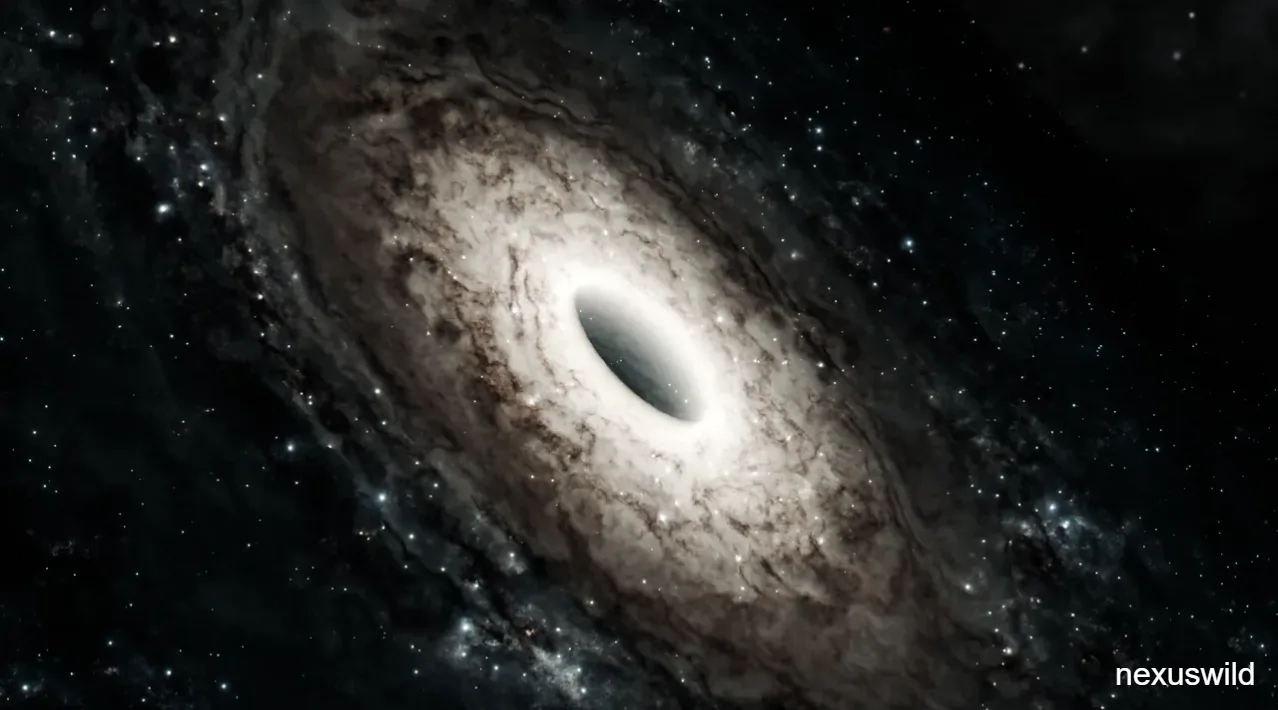

Astronomers have proposed a new explanation for a set of mysterious gas clouds observed near the center of the Milky Way. The study, reported by the Max Planck Institute for extraterrestrial Physics and published in Astronomy & Astrophysics, links the clouds to a pair of massive stars whose winds collide and form dense clumps. Over time, those clumps may lose energy and drift toward Sagittarius A*, the supermassive black hole at the galactic center.
The word "may" is central. The research presents a model that fits decades of observations, not a direct image of gas being handed from a binary system to a black hole. The clouds, known as G1, G2 and G2t, have been tracked because they pass close to Sagittarius A* and appear to change shape and speed. Their origin has remained debated since G2 was first identified in 2012.
The new work says the clouds could be part of a stream of material produced by IRS 16SW, a massive contact binary in the central parsec of the galaxy. If the model is correct, the system could help explain how relatively small amounts of gas reach the black hole and sustain its low level of activity.
The clouds that puzzled astronomers
G2 was discovered as a compact gas cloud on an orbit that would take it close to Sagittarius A*. Early expectations were that the black hole's tidal forces would stretch and disrupt it. Instead, the cloud survived its closest approach in 2014 and continued along a modified orbit. That behavior led to a long debate about whether G2 was a simple cloud, a dusty object with a hidden core, or material shaped by a more complex origin.
The Max Planck release says G2 contains several Earth masses of material and passed at a distance from the black hole measured in hundreds of astronomical units. At its closest approach, the cloud lost kinetic energy. That loss helps explain why its post-pericenter orbit differs from the path a free cloud would have followed.
G1 and G2t are related structures. The paper describes them as part of the G1-2-3 gas streamer, a sequence of clouds and knots on similar orbits. The arXiv record for the study is titled "The gas streamer G1-2-3 in the Galactic Center." The researchers argue that the stream is more informative than any single cloud, because repeated structures can point to a repeating source.
The clouds are observed in infrared light, especially through emission from hydrogen. Their compact size and rapid motion make them difficult to study, but adaptive optics on large telescopes has allowed astronomers to follow them over many years.
From G2 to the G1-2-3 streamer
The study builds on the idea that G1, G2 and G2t are related rather than independent objects. A single cloud might be explained as a chance occurrence. A streamer with several clumps on related orbits suggests a process that produces material repeatedly.
The arXiv metadata lists Stefan Gillessen as first author, with Frank Eisenhauer, J. Cuadra, Reinhard Genzel and many collaborators. The published paper is listed in Crossref and OpenAlex as Astronomy & Astrophysics volume 707, article A79, with DOI 10.1051/0004-6361/202555808. The MPE release dated April 8, 2026, presents the same research to the public.
The G1-2-3 streamer is not a continuous river of gas in the everyday sense. It is a set of clumps whose motions and compositions can be compared. By modeling their orbits, the team can work backward toward a possible source region. The candidate they identify is not near the black hole itself but among the massive stars that orbit in the central parsec.
This distinction matters because the galactic center contains both compact remnants and young massive stars. A cloud origin tied to stellar winds would connect the G objects to ordinary, if extreme, stellar physics rather than to an exotic single event.
Why IRS 16SW became the candidate
The new study points to IRS 16SW, a massive contact binary near the galactic center. A contact binary is a system in which two stars orbit so closely that their outer layers share a common envelope. Massive stars in such systems can drive strong winds, and when the stars are close, those winds can collide.
The MPE release explains that collisions between winds from the two stars can compress gas into dense clumps. Those clumps are the proposed seeds of the G clouds. The model is attractive because it can produce multiple fragments over time, matching the idea of a streamer rather than a one-off cloud.
The central parsec of the Milky Way contains a cluster of massive young stars, some in binary systems. That environment is dense and turbulent. A massive binary there would be subject to strong tidal forces from the black hole and neighboring stars. The new model uses that setting to explain how clumps formed near IRS 16SW could end up on orbits that carry them toward Sagittarius A*.
The identification is still a model result. It depends on whether the predicted clump properties and orbital paths match the observed G1-2-3 structures. The paper reports that the proposed origin is consistent with the measured features, but consistency is not the same as direct confirmation.
How colliding winds could make clumps
Winds from massive stars carry material outward at high speed. When two such winds meet, the gas is compressed and heated. In a binary system, the collision region can be unstable, producing knots and sheets of material. Some of that gas may cool and condense into denser clumps.
The MPE release describes this process as shock compression. A shock is a sudden change in gas properties that can raise density and temperature. In the IRS 16SW model, the colliding winds create conditions in which small regions become dense enough to survive as identifiable clouds.
Those clumps would not be solid objects. They would be concentrations of gas and dust, with masses compared by the study to a fraction of an Earth mass or several Earth masses for the larger structures. Their survival depends on whether they remain bound by self-gravity or pressure long enough to travel away from the binary.
The model also has to account for composition. The G clouds show infrared emission from gas and dust. A wind-derived origin could naturally supply both, because massive stars shed processed material into their surroundings. The study uses observed properties to test whether that picture works.
The energy loss that changes an orbit
One of the key observational clues is that G2 lost kinetic energy during its close passage near the black hole. A cloud on a purely ballistic orbit would behave differently unless internal forces or interactions changed its motion. The new model treats the energy loss as part of the clump's history and evolution.
The MPE release reports that G2 contained several Earth masses before its fly-by and lost kinetic energy during the encounter. The paper's modeling links this behavior to the proposed streamer structure. After losing energy, a clump can settle onto a somewhat different orbit, which helps explain why observations after pericenter did not match the simplest early predictions.
Over longer times, repeated clumps could provide a slow supply of material to Sagittarius A*. The release states that roughly one Earth mass of gas every ten years could be enough to sustain the black hole's observed activity. That is a small amount by astronomical standards and fits the black hole's relatively quiet state.
This is a supply argument, not a claim that the black hole is about to brighten dramatically. Sagittarius A* is far less active than the supermassive black holes in some galaxies. A modest, intermittent supply of gas may be adequate to explain its low luminosity.
Watching the galactic center in infrared
The galactic center is hidden from optical telescopes by thick dust in the plane of the Milky Way. Infrared light penetrates that dust more effectively, allowing astronomers to see stars and gas near Sagittarius A*. The G clouds are detected through infrared emission lines, including hydrogen recombination lines produced when gas is ionized.
Brackett-gamma emission is one of the diagnostics used in this field. It is a hydrogen line in the infrared and can trace ionized gas moving near the black hole. The new study uses such observations, together with adaptive-optics imaging and spectroscopy, to track the position and velocity of the streamer.
Adaptive optics corrects for the blurring caused by Earth's atmosphere. Instruments such as SINFONI and ERIS on the Very Large Telescope have been central to long-term monitoring of the galactic center. The MPE release describes how these instruments allowed the team to follow faint structures close to Sagittarius A*.
The observations are difficult because the clouds are faint, extended and moving. A measurement must separate their emission from the bright background of the central star cluster. Long time series are essential, since a single epoch may not reveal the orbit or the relationship between clumps.
SINFONI, ERIS and the Brackett-gamma line
SINFONI was an infrared integral-field spectrograph that produced images and spectra at the same time. It allowed astronomers to map gas and stars in the galactic center with fine spatial detail. ERIS is a newer infrared instrument that continues this type of work with improved capabilities. The MPE release notes the role of these instruments in the observations behind the new study.
Integral-field spectroscopy is valuable because a cloud is not a point source. Its different regions can have different velocities and brightnesses. By recording a spectrum at many positions across the cloud, researchers can reconstruct its structure and motion. Brackett-gamma emission helps identify the ionized gas component.
The team also compares the G clouds with the massive stars in the central parsec. Infrared spectroscopy can reveal stellar properties and help identify binary candidates such as IRS 16SW. The observational case therefore rests on both gas and stars.
An earlier MPE release marked first light for ERIS in 2022. That milestone is relevant as background because ERIS extends the observing capability that made long-term galactic-center studies possible. The new cloud study uses the continuing tradition of high-resolution infrared observations rather than a single discovery image.
What a steady food supply would mean
Black holes are often pictured as cosmic vacuum cleaners, but material must still lose angular momentum to fall in. Gas orbiting near Sagittarius A* cannot simply drop straight toward the event horizon. It needs a mechanism to remove energy or redistribute angular momentum.
The proposed streamer offers one such mechanism on a small scale. Dense clumps formed in stellar winds can lose energy during close passages and possibly feed the black hole over repeated orbits. The MPE release says an average inflow of about one Earth mass per ten years could account for the observed activity level.
That estimate is modest. It suggests that the black hole does not need a large gas cloud or a major tidal disruption event to remain mildly active. A recurring trickle from massive stars could be enough.
The idea also links the black hole's behavior to its stellar environment. The central parsec contains young massive stars whose winds inject gas into the region. If those stars are in close binaries, the winds can be shaped into clumps more efficiently. The black hole's activity would then be partly a consequence of the kinds of stars that formed near it.
The earlier search for young binaries
The new result sits alongside earlier work on young stars near Sagittarius A*. A 2023 ScienceDaily report described a study that analyzed more than a decade of data on 16 young supermassive stars orbiting the galactic center. That study found the stars appeared to be single rather than paired, challenging expectations that massive stars often form in pairs.
The 2023 result does not contradict the new model. It concerned a particular set of young stars and the question of whether they were born as binaries. IRS 16SW is a known massive binary candidate, and the new study concerns its winds. The two questions are related to the same stellar population but are not identical.
The earlier study suggested that the black hole environment may disrupt binaries or drive mergers and ejections. The new study suggests that at least one close binary can survive long enough to shape gas into clumps. Both findings point to a complex environment where stellar dynamics and wind physics interact.
This history is a reminder that the galactic center is not a static laboratory. Stars orbit, interact and shed material. Gas clouds respond to tidal forces and radiation. Any model of black hole feeding has to include that moving environment.
The long view of star disks and gas clouds
Astronomers have long studied the disks of young stars orbiting near the galactic center. Crossref records for a 2006 Astrophysical Journal paper describe two young star disks in the central parsec and their properties and dynamics. Those disks provide the context for understanding where massive stars like IRS 16SW formed and how they move.
Earlier work also includes the 2012 report of a gas cloud on its way toward the supermassive black hole at the Galactic Centre, indexed through Crossref with DOI 10.1038/nature10652. That paper introduced G2 to a wider audience and set the stage for years of monitoring. Later papers refined the cloud's orbit and behavior.
The current study is part of this cumulative record. Each new observation adds constraints, and each model must explain more than one object. The shift from studying a single cloud to interpreting a streamer reflects that process. A source model that explains several related clumps is stronger than one built for one unusual object.
The broader question is how gas moves from stellar scales down to the black hole's immediate environment. The proposed binary-wind source addresses an early step in that chain. What happens after a clump reaches the inner region remains a separate problem.
What the new model does not settle
The study does not provide a final answer to the origin of every G cloud. It proposes a source for the G1-2-3 streamer and argues that the model matches observations. Other interpretations may still be tested, and future data could revise the picture.
It also does not image gas crossing the event horizon. The claimed food supply is slow and indirect. A rate of one Earth mass per ten years is an estimate tied to the black hole's activity level, not a measured flow captured in a single observation.
There are uncertainties in the binary model as well. Wind collision zones are complex, and the production of long-lived clumps depends on details that are difficult to simulate and observe. The orbit of IRS 16SW and the subsequent paths of clumps must align with the measured streamer properties for the model to hold.
Even with those caveats, the research gives astronomers a testable story. It links a known massive binary, a set of observed gas clouds and the long-term activity of Sagittarius A* in one framework. Future infrared observations can look for additional clumps, refine their orbits and test whether the stream continues to behave as the model predicts. For now, the twin stars remain a plausible source rather than a proven engine.
Nexuswild welcomes factual corrections. Email contact@nexuswild.com with evidence and the article URL.