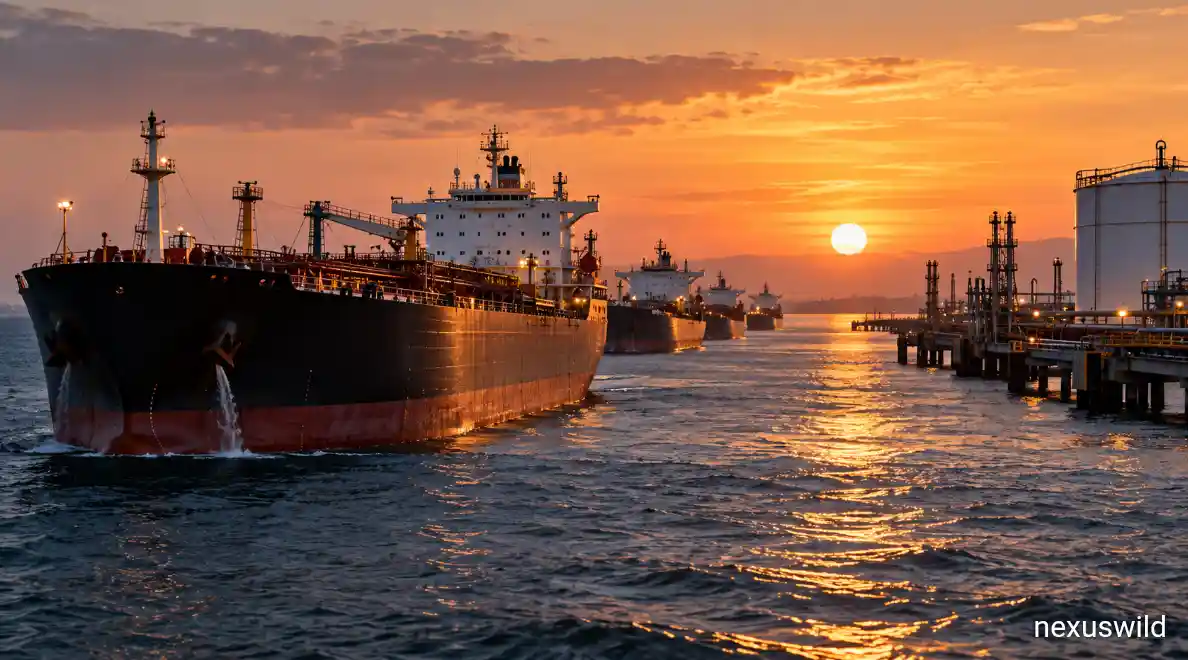

Vitol Chief Executive Russell Hardy has warned that the global oil market could face a $200-per-barrel scenario if the current flow of crude and refined fuels out of the Middle East breaks down, as a shortage of available tankers becomes the latest pressure point in an already strained energy market.
Speaking at the Energy Intelligence Forum in London on October 6, Hardy said roughly 12 million barrels per day of crude oil and 2 million barrels per day of refined products had been leaving the Middle East during the previous seven to 10 days.
Those flows are helping keep energy markets balanced as inventories remain heavily depleted.
Hardy said that without those exports, the market could face a scenario in which oil climbs toward $200 a barrel.
His warning was conditional. He did not forecast that oil will definitely reach $200.
The Crisis Has Shifted From Oil Supply to Shipping
Hardy described the latest phase of the energy disruption as increasingly a shipping crisis.
The conflict initially created fears over crude availability, followed by shortages of refined products such as diesel and jet fuel.
Now the challenge is increasingly getting those barrels to buyers.
Vitol said tanker availability has tightened sharply as vessels are tied up in longer and more complex Middle East trading routes.
That means oil can technically be available while still becoming difficult or expensive to transport.
Around 14 Million Barrels a Day Are Leaving the Middle East
Hardy said approximately 14 million barrels per day of crude and products have recently been leaving the region.
That includes about:
- 12 million barrels per day of crude oil;
- 2 million barrels per day of refined fuels.
Those volumes are significantly supporting global supply as the Northern Hemisphere approaches winter.
Hardy said maintaining those flows is critical because commercial inventories in Western markets have already been heavily drawn down.
Why $200 Oil Is Even Being Discussed
The $200 figure represents a severe disruption scenario.
If a major share of current Middle East exports were removed from the market while inventories remained low, buyers would have to compete aggressively for fewer available barrels.
That could push prices sharply higher.
Hardy said current flows are precisely what is preventing that outcome.
His comments therefore should not be interpreted as a prediction that Brent crude is heading directly to $200.
They are a warning about what could happen if logistics deteriorate significantly.
Tanker Availability Has Become a Major Constraint
A tanker shortage can affect oil markets in several ways.
When vessels take longer routes or spend more time waiting at transfer points, the same ship can complete fewer journeys each month.
That effectively reduces available global shipping capacity.
The Middle East conflict has also increased war-risk insurance costs, operating expenses and the amount shipowners charge for entering higher-risk areas.
As a result, freight rates have risen sharply.
Hardy said shipping costs had experienced an almost parabolic increase, making it difficult for traders to estimate transportation expenses within even a few dollars per barrel.
Ship-to-Ship Transfers Are Reducing Efficiency
One reason tanker availability has tightened is the increased use of ship-to-ship transfers.
Middle Eastern crude is being moved through more complicated logistics chains as exporters adapt to security risks around key maritime routes.
The Financial Times reported that around 12 million barrels per day of crude and 2 million barrels per day of refined fuels are moving through the Strait of Hormuz and into the Gulf of Oman using arrangements that include ship-to-ship transfers.
These transfers allow oil to continue moving but require additional vessels and time.
That makes the global tanker fleet less efficient.
Strait of Hormuz Remains Critical
The Strait of Hormuz remains one of the world's most important energy chokepoints.
A substantial share of global crude oil and liquefied natural gas exports moves through the narrow waterway connecting the Persian Gulf to the Gulf of Oman.
Middle East crude exports recovered strongly in September despite the conflict, exceeding pre-war levels on several days.
That recovery has prevented a much more severe oil-price spike.
However, tanker attacks and maritime security risks remain elevated.
Reuters reported at least seven tanker attacks around the region during the first week of October.
Brent Remains Near $100
Despite the risks, Brent crude was trading close to $100 a barrel on October 6 rather than anywhere near Hardy’s extreme scenario.
Reuters reported Brent around $100 while U.S. West Texas Intermediate traded near $89.
The relatively contained price compared with worst-case forecasts reflects the recovery in Middle Eastern exports and planned emergency stock releases.
The market is therefore balancing two competing forces:
improving physical flows and worsening shipping risk.
Stronger Exports Have Prevented a Larger Price Spike
Middle East oil exports have recovered significantly since the worst disruptions earlier in the conflict.
Reuters reported that regional crude exports exceeded pre-war levels during parts of September, aided by higher Saudi shipments.
That improvement is one of the main reasons Brent has not moved dramatically higher.
Hardy’s argument is that maintaining those flows matters more than simply looking at oil production.
Oil in storage or at a terminal cannot help consumers if there are insufficient ships available to transport it efficiently.
Refined Products Remain Especially Tight
The situation is even more difficult in refined fuels.
Hardy said tightness in products such as diesel is likely to persist through the winter.
The problem reflects both shipping constraints and reduced global refining capacity.
Russian refining infrastructure has been damaged, while Middle Eastern refineries have also experienced months of disrupted activity.
That has reduced the market's ability to convert crude oil into diesel, gasoline and jet fuel.
Diesel Markets Are Under Greater Pressure
Diesel prices have remained particularly elevated.
Reuters reported that European diesel futures recently carried a premium of about $70 per barrel relative to crude-market benchmarks.
That indicates severe tightness in the middle-distillate market.
Diesel is critical for trucking, industrial activity, agriculture and parts of the power sector.
A sustained shortage therefore has broader inflationary implications than crude prices alone.
G7 Emergency Stock Release Could Provide Relief
The Group of Seven has agreed to release around 100 million barrels of crude and diesel from emergency reserves in an effort to reduce market pressure.
The International Energy Agency is expected to determine additional details on the release during meetings on October 14 and 15.
The exact split between crude and diesel has not yet been finalized publicly.
The release could provide short-term relief, but it does not solve the tanker-capacity problem.
Emergency oil still needs to be transported to refiners and consumers.
Western Inventories Are Already Depleted
Another reason Vitol is concerned is the condition of global inventories.
Hardy said Western oil stocks have been largely drawn down.
Saudi Aramco CEO Amin Nasser separately said around 1 billion barrels had been pulled from global inventories during the broader crisis and that rebuilding those stocks could take up to two years.
Low inventories leave the market less able to absorb additional disruptions.
They also increase the importance of keeping Middle Eastern exports moving.
Oil Executives Want More Alternative Export Routes
The industry is increasingly arguing that the world needs more infrastructure capable of bypassing major maritime chokepoints.
Executives from TotalEnergies, BP and Chevron have discussed additional pipelines and export terminals that could move Middle Eastern crude toward the Mediterranean or other routes.
The shift reflects a broader change in thinking.
Energy companies are moving away from a purely “just-in-time” supply model toward a more resilient “just-in-case” approach.
That could mean higher infrastructure costs but greater protection against future disruptions.
Tanker Shortages Can Raise Oil Prices Even Without a Production Loss
One of the most important lessons from the current crisis is that production is only one part of the oil market.
A barrel must be:
produced,
stored,
transported,
refined,
and delivered.
A disruption anywhere along that chain can increase prices.
The current concern is that shipping capacity has become the weakest link.
This means oil prices could rise even if producing countries technically maintain output.
China Helped Stabilize the Market Earlier in the Year
Hardy also credited China with helping stabilize the global oil market during May and June.
China was able to draw down domestic inventories while global supply chains were under heavy pressure.
Other Asian economies had less flexibility because they lacked comparable stock buffers and remained heavily dependent on Middle Eastern supplies.
That difference highlights the importance of strategic reserves during major supply disruptions.
Tanker Attacks Remain a Major Risk
Maritime security continues to be one of the biggest uncertainties.
Reuters reported multiple tanker attacks around the Gulf in early October, even as export volumes recovered.
Each attack can increase insurance costs and discourage shipowners from entering risky areas.
A sharp deterioration in security could remove additional vessels from Middle East routes.
That is the scenario in which transportation capacity could tighten enough to create a much larger oil-price shock.
$200 Is a Risk Scenario, Not Vitol’s Base Forecast
The most important distinction in Hardy’s comments is that $200 oil is conditional.
Vitol is not saying Brent will reach $200 under current conditions.
Hardy said existing Middle East exports are helping prevent that outcome.
The warning applies to a scenario in which those flows are significantly disrupted while inventories remain low and tanker availability remains constrained.
That distinction should be preserved when reporting the comments.
Conclusion
Vitol CEO Russell Hardy has warned that the global oil market could face a $200-per-barrel scenario if current Middle East export flows cannot be sustained.
Approximately 12 million barrels per day of crude and 2 million barrels per day of refined products have recently been leaving the region, helping keep the market balanced despite depleted inventories.
The immediate problem has increasingly shifted from crude production to transportation.
A shortage of tankers, longer shipping routes, ship-to-ship transfers, elevated insurance costs and persistent security threats are reducing the effective capacity of the global shipping fleet.
For now, recovering Middle Eastern exports have kept Brent near $100 rather than the extreme levels described by Vitol.
But Hardy’s warning highlights how fragile the balance remains: if oil continues flowing, the market can manage the disruption; if shipping capacity breaks down, the price impact could be far more severe.
Nexuswild welcomes factual corrections. Email contact@nexuswild.com with evidence and the article URL.