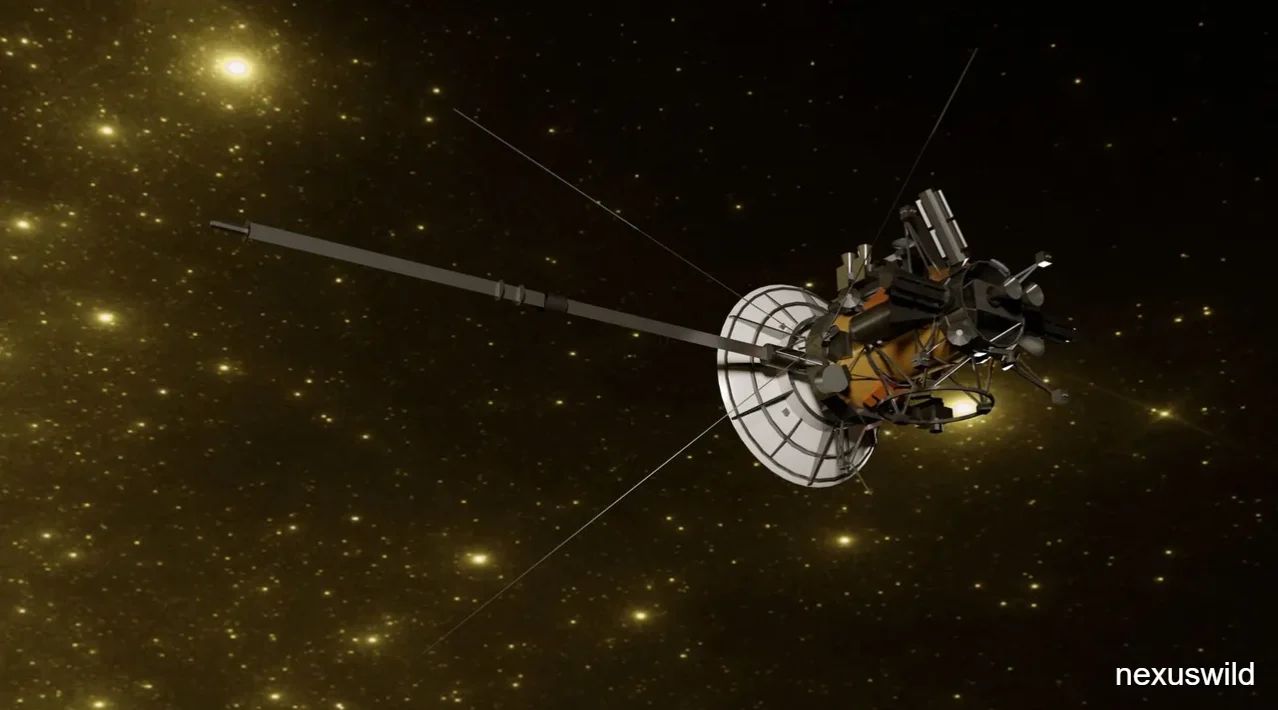

NASA says Voyager 1 has crossed a threshold that no human-made object has reached before. On November 18, 2026, the spacecraft was one light-day from Earth, meaning radio signals carrying its status needed a full day to cover the distance. The milestone is a measure of endurance as much as distance: Voyager 1 launched in 1977, entered interstellar space in 2012 and is still operating with instruments that were designed long before today's spacecraft computers.
The announcement comes with a technical caveat. NASA has not received science or engineering data from Voyager 1 since November 14, although the spacecraft's carrier signal continues to reach Earth. Engineers say the antenna, transmitter and attitude-control system appear to be working, and they suspect a problem in the way the flight data system formats information rather than a failure of the radio itself. The one-light-day marker therefore marks both an extraordinary navigation achievement and a moment when even routine spacecraft housekeeping has become difficult.
At that distance, mission control is not a conversation. A command sent from Earth takes about 24 hours to arrive, and any confirmation takes another 24 hours to return. That delay shapes every decision, from which instruments can be switched on to how engineers respond when a data stream changes. NASA's account of the milestone is also an account of managing a spacecraft whose power supply declines a few watts each year.
What the one-light-day marker means
A light-day is the distance light travels in vacuum in one day. NASA gives an approximate value of 16.1 billion miles, or 25.9 billion kilometres, and a more precise figure of 16,094,799,096 miles, or 25,902,068,356 kilometres. Voyager 1 reached that distance from Earth at 2:16:07 a.m. Pacific Standard Time on November 18, which was 5:16:07 a.m. Eastern Standard Time.
The marker is not the same as a light-year. A light-year is the distance light covers in a year, so a light-day is a much smaller unit suited to measuring the outer reaches of the solar system and the beginning of interstellar space. It is also not a fixed shell that a spacecraft physically crosses in the way it might cross the orbit of a planet. Earth moves around the Sun, and the Sun moves through the galaxy, so the exact distance between Earth and Voyager 1 changes slowly from day to day. NASA's milestone refers to a calculated separation between the two bodies at a stated time.
What makes the number striking is the object's age. Voyager 1 was launched in 1977, nearly 50 years before the milestone. It was built for a grand tour of the outer planets, not for a half-century of continuous operation in interstellar space. The fact that its position can still be calculated, its carrier tone can still be detected and its instruments can still be commanded reflects both the original engineering and the improvisation that has kept the mission alive.
NASA described Voyager 1 as the first human-made object to reach one light-day from Earth. Its twin, Voyager 2, crossed into interstellar space in 2018, several years after Voyager 1 did in 2012, but remains much closer to Earth. The two spacecraft are the only missions operating beyond the heliosphere, the vast bubble of solar wind and magnetic field that surrounds the planets.
How far Voyager 1 traveled by November 18
The precise distance NASA reported is useful because it turns an abstract unit into a navigational result. Voyager 1 was about 16.09 billion miles from Earth at the milestone, a figure that can be converted into 25.90 billion kilometres. These numbers include the changing geometry of Earth's orbit, which is why mission teams specify a time rather than presenting the light-day distance as a permanent property of the spacecraft.
Voyager 1 moves at roughly 38,000 miles per hour relative to the Sun, according to NASA's mission material. That speed sounds enormous by terrestrial standards, but it still took decades to accumulate the distance required for a one-light-day separation. Most of the early part of the mission was spent travelling between planets, using gravity assists from Jupiter and Saturn to reshape the trajectory. After its close encounter with Saturn in 1980, Voyager 1 continued outward on a path that carried it above the plane of the planetary system.
The spacecraft crossed the heliopause, the boundary where the solar wind gives way to the interstellar medium, in 2012. Voyager 2 followed in 2018. Crossing that boundary did not mean the probes had left the Sun's gravitational influence. It meant they had passed the region where the solar wind dominates the local plasma environment. They remain on long trajectories through a region that is still shaped, very weakly, by the Sun's gravity.
Distance also changes the character of the measurements. Voyager 1 no longer encounters planets, moons or dense rings. Its instruments sample particles, fields and radio emissions in a medium that is thin and difficult to study from anywhere else. A single spacecraft moving outward through that environment provides a time record that cannot be reproduced from Earth orbit.
A signal that takes a full day to arrive
At one light-day, a radio signal travelling at the speed of light needs about 24 hours to make the trip one way. A round trip takes roughly 48 hours. That latency is more than an inconvenience; it changes the basic logic of operating the spacecraft. Engineers cannot watch a maneuver unfold in real time and correct it midway. They must predict what the vehicle will do, send commands in advance and wait two days to learn whether the sequence worked.
NASA's Deep Space Network supplies the large antennas used to send commands and receive signals. The network has major facilities at Goldstone in California, Canberra in Australia and Madrid in Spain. Their separation around the globe allows controllers to maintain contact as Earth rotates, handing a spacecraft from one station to another. For a target as distant as Voyager 1, the received signal is extremely weak, and long integration times and careful scheduling are part of ordinary operations.
The carrier signal is the steady radio tone that lets controllers know the spacecraft is alive and pointing roughly the right way. It is not the same as a full stream of science or engineering telemetry. In the current situation, NASA says the carrier continues, but the data that would normally accompany it have not arrived since November 14. Engineers can still track the spacecraft; they just cannot yet read all of its status information.
A one-day uplink also affects safing behavior. If Voyager 1 detects a fault, it must protect itself without waiting for an instruction from Earth. The spacecraft has autonomous routines for pointing its antenna and conserving power, but those routines can only respond to conditions they are designed to recognize. This is why NASA's engineers described the antenna, transmitter and attitude control as apparently functional while continuing to investigate the data path separately.
The data problem engineers are chasing
The current issue appears to involve the format of the information Voyager 1 sends, not the ability of its radio to transmit. NASA's Voyager blog says the carrier signal is present and that the spacecraft's pointing appears stable. That combination points engineers toward the flight data system, the onboard hardware and software that collect instrument and subsystem readings and arrange them into a downlink.
A useful analogy is a postal service that still drives its trucks but prints addresses in a format the receiving office cannot read. The vehicle and the route may be fine, while the contents remain unusable. For Voyager, the distinction matters because a transmitter failure would be far harder to address than a formatting fault. If the transmitter and high-gain antenna are working, engineers have more options for changing how data are packaged or routed.
NASA has encountered a communications problem with Voyager 1 before. In 2024, the spacecraft stopped sending usable engineering updates after a fault involving its flight data subsystem memory. Engineers eventually restored those updates by moving the affected code to a different part of the memory. That history does not prove the new problem has the same cause, but it gives the team a record of how the system can fail and recover.
The investigation is complicated by the delay. A proposed change cannot be tested instantly. Commands must be reviewed, transmitted, received a day later and then checked through whatever downlink the spacecraft can manage. Engineers must also consider the risk of making changes to a system that is still producing a usable carrier signal. With a spacecraft this old, the safest path is often a slow sequence of small, reversible steps.
Power margins shape every decision
Voyager 1 does not have a solar array. At its distance from the Sun, sunlight is far too weak to generate useful power. Instead, it uses radioisotope thermoelectric generators, which convert heat from the decay of plutonium into electricity. Those generators have no moving parts and have proved remarkably durable, but their output falls gradually with time. NASA's mission material puts the decline at about four watts per year.
That steady loss explains why even small electrical choices matter. Heaters, receivers, instruments and onboard computers all compete for a shrinking budget. When power drops below a threshold, mission teams must turn off one subsystem or reduce its duty cycle. The goal is to preserve the ability to communicate while keeping as much science as possible for as long as possible.
In 2026, NASA carried out lower-power instrument swaps intended to extend the spacecraft's scientific life. According to the mission updates, certain instruments were left on while others were switched off in a deliberate rebalancing. The plasma wave system and magnetometer remained among the active instruments, while the cosmic ray subsystem and low-energy charged particle instrument were among those turned off. The exact configuration can change as engineers revise the plan, but the principle is constant: the power budget determines the observing program.
NASA has said that some instruments could continue operating until at least the summer of 2027 under the current plan. That is a projection, not a guarantee. A new fault, a faster-than-expected power decline or a change in the spacecraft's thermal environment could shorten it. The current data issue adds another uncertainty, because engineers need telemetry to make confident decisions about the vehicle's health.
Listening with the Deep Space Network
The Deep Space Network is the ground system that makes missions like Voyager possible. Its antennas are not ordinary satellite dishes. They are large, precisely controlled reflectors capable of detecting signals that have spread across billions of kilometres. By the time a Voyager transmission reaches Earth, only a tiny fraction of the original energy remains within the receiving antenna.
Goldstone, Canberra and Madrid are spaced roughly a third of the way around the planet. As Earth turns, one station can acquire a spacecraft as another loses it below the horizon. The handoff is scheduled around the target's position and the antenna's capabilities. For Voyager 1, the network must also compete with many other missions, so observing time is a carefully managed resource.
The same network sends the commands. A message uplinked to Voyager 1 must be transmitted at the right frequency and with enough power for the spacecraft's receiver to detect it after its long journey. The process is slow, but it is reliable when the spacecraft is healthy. The one-light-day milestone makes the round-trip delay easy to describe, yet the underlying timing precision is far finer: navigators need to know where both Earth and the spacecraft are, how the signal propagates and when a command should be sent.
When the carrier signal is present, controllers can still perform tracking measurements that refine the spacecraft's trajectory. Those measurements rely on the stable radio tone rather than on decoded data. This is one reason NASA can report the light-day milestone even while the engineering telemetry issue remains open. The spacecraft's position is known from its radio behavior and its long-studied trajectory.
Instruments still operating in interstellar space
Voyager 1's scientific value now comes from a small set of instruments that can still operate within the power budget. NASA's fact sheet lists a magnetometer, a plasma wave instrument, cosmic ray and charged particle detectors, and other sensors that were part of the original payload. Not all can run at once. The mission has gradually moved from the planetary encounter era to a lean observing program focused on the local interstellar medium.
The magnetometer measures the magnetic field around the spacecraft. The plasma wave system detects oscillations in electrically charged gas, which can reveal properties of the surrounding plasma. Particle instruments measure energetic particles whose populations change as the spacecraft moves farther from the heliopause. Together, these readings help scientists study a region that cannot be sampled directly by any other operating probe.
The instrument plan for 2026 reflects hard trade-offs. With the magnetometer and plasma wave system kept on, Voyager 1 can continue returning measurements relevant to interstellar magnetic fields and plasma. Turning off the cosmic ray and low-energy charged particle instruments preserves power, but it reduces the range of particle measurements available. NASA has described the changes as a way to extend operations rather than as a permanent end to those observations.
The current communications problem interrupts that plan. Even if the instruments are functioning, their readings are useful only if they can be formatted and sent home. Engineers are therefore working on the data chain as a whole, from the instruments through the flight data system to the transmitter and the ground receivers.
A 1977 spacecraft built for a longer mission
Voyager 1 was launched on September 5, 1977, and Voyager 2 earlier that summer. The spacecraft were designed to explore Jupiter and Saturn, with Voyager 2 continuing to Uranus and Neptune. Their computers were primitive by modern standards, their software was written for a very different mission, and their communications system was built for distances that were already extreme in the 1970s.
The fact that they are still mentioned as operating spacecraft is the result of careful design and later adaptation. Their radioisotope generators provided power independent of sunlight. Their high-gain antennas allowed narrow beams to be aimed at Earth across vast distances. Their onboard systems were built with enough redundancy to survive component failures. Just as importantly, the ground teams kept learning how to operate machines whose original mission had ended.
Voyager 1 passed Jupiter in 1979 and Saturn in 1980. Its Saturn encounter bent the trajectory out of the planetary plane and set it on the path toward interstellar space. Voyager 2 continued to Uranus in 1986 and Neptune in 1989. Those encounters produced the first detailed close-up views of the giant planets and their moons, and they remain a foundation of planetary science.
After the planetary phase, the Voyagers became long-duration observatories. Their speed, direction and basic design have not changed, but their role has. They now provide a moving reference point in a region where the Sun's influence is weak. A spacecraft launched before the personal computer era is measuring the boundary environment of the Sun's astrosphere, a task no one could have assigned it at launch.
The Golden Record as a time capsule
Each Voyager carries a golden record, a 12-inch gold-plated copper disk intended as a message from Earth. NASA describes the record as a time capsule containing sounds, images and greetings chosen to represent life on the planet. Among its contents are 55 spoken greetings in different languages. The disks were attached to the spacecraft with covers and instructions intended to survive for an extremely long time.
The record was not a scientific instrument. It was a cultural addition to a mission that was already pushing the limits of engineering. Its presence says something about how the Voyager mission was viewed: these were not only probes to Jupiter and Saturn, but objects that might travel far beyond the solar system. The golden disk gave the spacecraft a second identity as an artifact carrying a curated portrait of Earth.
NASA's Golden Record overview notes that the contents include natural sounds, music and spoken words, as well as encoded images. The selection process involved a committee and debate about what humanity should present to an unknown recipient. The result inevitably reflects the people who made it, including the languages and musical examples they chose to include.
At one light-day from Earth, the record remains attached to a spacecraft that is still reachable by radio. That does not mean it will be found or played. The chances of an encounter with another civilization are unknown and probably remote. The record's practical importance lies in what it reveals about the era that built Voyager: a belief that a machine could carry both measurements and a symbolic message across distances measured in light-days.
Voyager 2 and the outer heliosphere
Voyager 1 is the more distant spacecraft, but Voyager 2 is central to the same scientific story. Voyager 2 crossed into interstellar space in 2018, six years after Voyager 1. NASA says the two are the only spacecraft operating outside the heliosphere. Having two probes in that region gives scientists a broader picture than either could provide alone.
The heliosphere is shaped by the solar wind, the stream of charged particles flowing outward from the Sun. Its outer boundary, the heliopause, is where that flow meets the surrounding interstellar medium. Voyager 1 crossed the boundary at a different location and time from Voyager 2, and the two spacecraft have continued to move in different directions. Differences in their readings can therefore reflect both location and the changing solar cycle.
NASA's current-position material tracks the two spacecraft separately. Voyager 1 is moving in one direction relative to the planets, while Voyager 2 follows a different outward path. Their separation means that a phenomenon seen by one probe may not be seen by the other at the same time. That is a limitation, but also a way to distinguish local structures from changes that affect the whole heliosphere.
The twin spacecraft were built as a pair, and that pairing still matters. If one instrument set fails or one power budget becomes tighter, the other vehicle may continue a related measurement. The loss of one would also remove a second point of comparison. NASA's plans for both are shaped by the same declining power source, but the spacecraft are not identical in their instrument status or trajectory.
What comes next for the mission
In the near term, Voyager 1's priority is not a new flyby but a stable link. Engineers need to understand why science and engineering data stopped arriving on November 14 while the carrier persisted. NASA has said the antenna, transmitter and attitude-control system appear to be working, which narrows the investigation to the systems that prepare and manage data. Any fix must be tested through a link with a one-day delay.
If telemetry returns, the team can resume the careful management of instruments and power that has kept the spacecraft active for nearly five decades. If it does not, the carrier signal may still allow tracking for a time, but the scientific return would be reduced. Either outcome will be judged against a mission that has already far exceeded its original plan.
The light-day milestone is likely to remain the headline number. It gives a concrete scale to a journey that began when most people had no personal computers and no commercial Internet. Yet the more revealing detail may be the minutes and watts of present-day operations: a carrier tone measured across interstellar space, a shrinking electrical margin, engineers waiting a day for an answer and a 1977 flight data system that still has to cooperate.
NASA's estimate that some instruments can operate until at least summer 2027 offers a horizon, not a promise. Voyager 1 will keep moving regardless. Its distance from Earth will continue to grow, its radio signals will take slightly longer to arrive, and the golden record will travel with it. For now, the one-light-day mark is a way of saying how far an old machine has gone while its controllers try, once again, to keep the conversation open.
Nexuswild welcomes factual corrections. Email contact@nexuswild.com with evidence and the article URL.