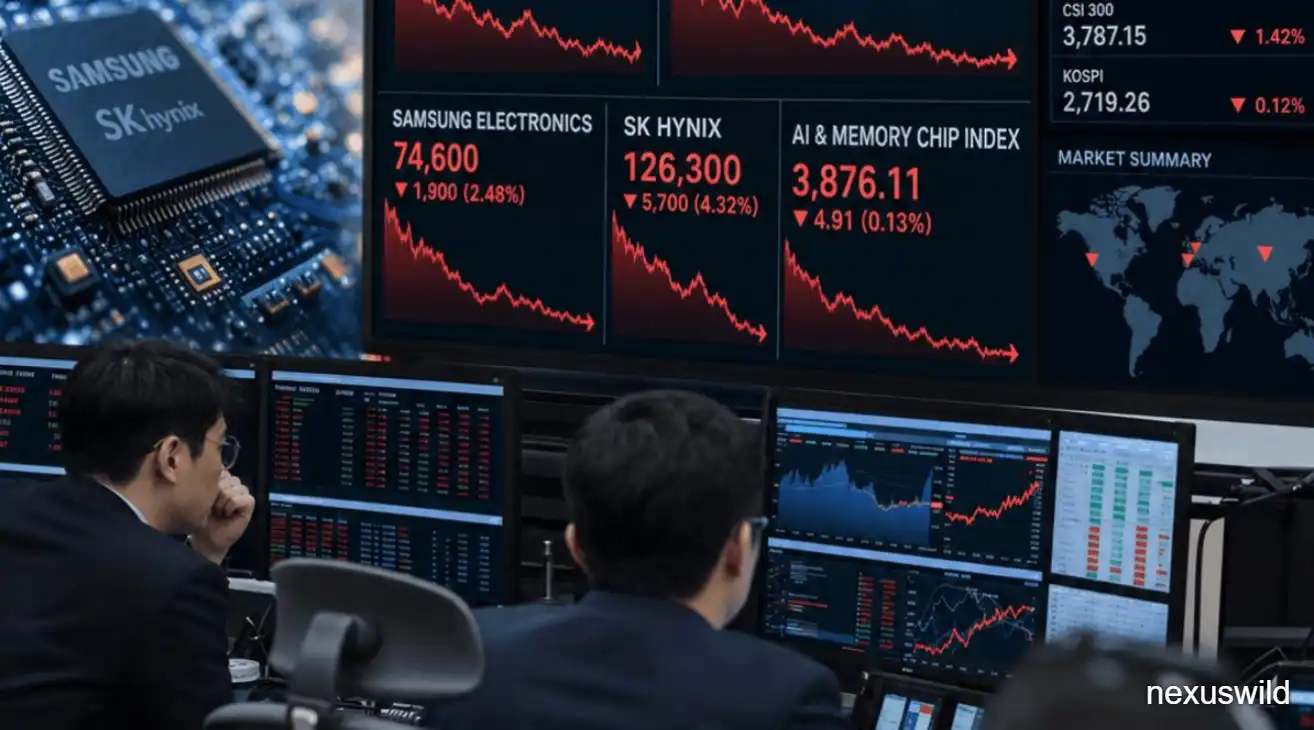

Asian equity markets declined sharply on October 12 as investors sold technology stocks ahead of TSMC’s quarterly earnings and key US inflation data. South Korea’s KOSPI plummeted 3.65%, with semiconductor shares leading the decline. Rising crude prices and bond yields fueled inflation concerns and financing costs. Investors seek evidence that AI demand translates into sustainable corporate earnings.
Asian stock markets faced renewed selling pressure on Monday, October 12, as investors reassessed technology-sector valuations and prepared for a week of critical corporate earnings and economic releases. South Korea’s benchmark KOSPI fell 3.65% to 6,384.24, extending its losing streak to four sessions, according to South Korea’s Yonhap News Agency.
The decline reflected weakness in technology shares amid concerns about inflation, higher oil prices, and semiconductor demand. Foreign investors sold South Korean shares net, while domestic individual investors bought into the decline.
The pressure comes at a pivotal moment for global technology markets. Investors have poured capital into AI-linked companies, including chipmakers, cloud-computing providers, and data-centre infrastructure businesses. The next round of earnings will determine whether the spending behind that expansion is producing sufficient revenue and profits to justify elevated valuations.
Semiconductor shares face a critical test
Attention turns to Taiwan Semiconductor Manufacturing Company, the world’s leading contract chipmaker and a key supplier to the global semiconductor industry.
TSMC is scheduled to release its third-quarter 2026 results on October 15. Its official investor-relations calendar lists the earnings conference for 2 p.m. Taiwan time. The company’s published guidance indicates third-quarter revenue of $44.6 billion to $45.8 billion, compared with $40.2 billion in the second quarter.
That guidance provides investors with a benchmark for evaluating the strength of demand for advanced chips. TSMC manufactures processors used in smartphones, high-performance computing systems, and AI accelerators. Its results can offer insight into spending across several parts of the technology supply chain.
Revenue growth alone won't settle the market’s questions. Investors will also examine profitability, manufacturing capacity, capital expenditure, and management’s outlook for future demand. If strong sales are accompanied by rising costs or a less optimistic forecast, the market response could differ from what the headline revenue figure suggests.
TSMC’s results may influence sentiment toward other semiconductor companies, including chip designers, memory manufacturers, and suppliers of advanced manufacturing equipment. However, individual companies have different product mixes, customers, and cost structures, so their performance won't necessarily move in line with TSMC.
Investors scrutinise AI spending and valuations
The broader debate centres on whether investment in AI infrastructure can deliver returns that justify the cost. Technology companies have committed substantial resources to data centers, advanced processors, networking equipment, and electricity infrastructure.
These projects can support long-term growth but require considerable upfront spending. Returns depend on customers adopting AI services, businesses paying for those services, and providers managing operating costs effectively.
Investors are paying closer attention to cash flow, operating margins, and the time required for infrastructure investments to generate returns. Companies with ambitious expansion plans face greater scrutiny if borrowing costs remain elevated.
The distinction between demand for AI products and profitability is crucial. Strong orders for chips or data-center equipment can benefit suppliers, but they do not automatically guarantee an attractive return for every company investing in AI.
For the market, this creates a demanding environment for quarterly results. Companies must demonstrate not only growing demand but also aligned spending plans, margins, and future revenue expectations.
Inflation and oil prices complicate the outlook.
Macroeconomic developments add another source of uncertainty. Investors await US inflation data that could influence expectations for Federal Reserve policy, bond yields, and the cost of financing business expansion.
Higher inflation makes it harder for central banks to lower interest rates. If borrowing costs remain high, companies planning capital-intensive projects face more expensive financing, while investors reassess the valuations of businesses with expected profits further in the future.
Oil prices have added to concerns. Reuters reported Brent crude climbed to approximately $106.95 a barrel on Monday, driven by geopolitical tensions in the Middle East. US crude also rose, reaching around $93.82 a barrel in the report.
Sustained increases in energy prices raise transportation and manufacturing costs, feeding into broader inflation. For economies and companies reliant on imported energy, the effect may be particularly significant.
The interaction between oil prices, inflation, and bond yields matters for technology companies and traditional energy-intensive industries. Higher costs pressure operating margins, while higher interest rates increase the expense of funding new infrastructure.
What investors will watch next
The coming days will provide several tests for market sentiment. TSMC’s October 15 earnings release will offer an updated view of semiconductor demand, production costs, and the outlook for AI-related business. US inflation figures will help investors assess whether price pressures are easing or remain a constraint on monetary policy.
Market participants will also monitor whether the technology sell-off spreads beyond semiconductor stocks and whether foreign investors continue reducing exposure to Asian equities.
A single trading session cannot establish a lasting change in the market’s direction. The latest decline demonstrates how sensitive technology shares have become to changes in earnings expectations, financing conditions, and geopolitical risks.
For investors, the central question is whether corporate results can support current valuations while businesses continue spending heavily on AI infrastructure. The answer will depend on reported financial performance and forward guidance, rather than demand projections alone.
Nexuswild welcomes factual corrections. Email contact@nexuswild.com with evidence and the article URL.