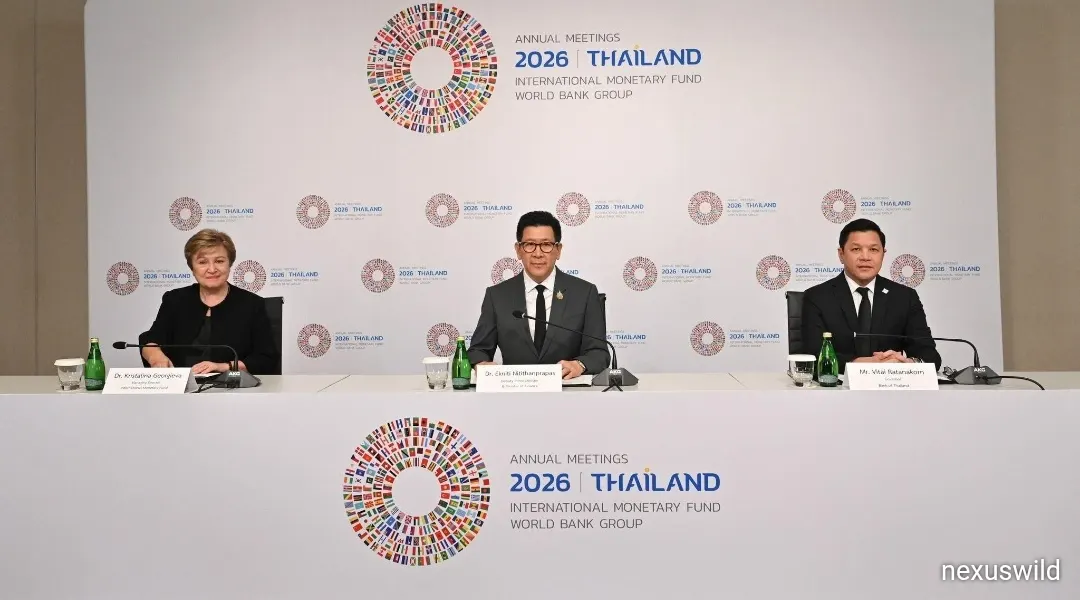

IMF–World Bank Meetings Open in Bangkok Amid Debt and Inflation Risks
Global finance officials gathered in Bangkok on October 12 for the annual meetings of the International Monetary Fund (IMF) and World Bank Group, facing a difficult combination of high public debt, elevated energy costs, inflation risks and uneven economic growth.
The meetings, running through October 18, bring together finance ministers, central bank governors, development officials and business representatives to discuss global economic stability and development priorities. This year’s discussions are taking place as geopolitical conflict disrupts energy markets and higher borrowing costs put pressure on governments already struggling with large debt burdens.
Despite these pressures, the global economy has proved more resilient than some policymakers expected. The IMF’s July forecast put global growth at 3% for 2026, while Managing Director Kristalina Georgieva said on October 12 that investment in artificial intelligence infrastructure was helping sustain growth even as energy supply disruptions weighed on activity. The IMF was due to publish an updated global outlook during the meetings.
The central challenge for policymakers is how to preserve that resilience without allowing debt, inflation and economic inequality to deepen.
Public debt leaves governments with less room to respond
Public borrowing is one of the most pressing issues on the agenda. According to reporting by Reuters ahead of the meetings, the IMF estimates that global public debt is at its highest level since the Second World War and could exceed 100% of global gross domestic product before 2030.
High debt does not create the same problem for every country. Governments with strong domestic financial markets and credible fiscal institutions may have more options for refinancing their obligations. Countries with weaker credit ratings or limited access to affordable financing can face much sharper increases in debt-servicing costs when global interest rates rise.
The pressure is especially severe for developing economies. Reuters reported that developing countries face approximately $400 billion in external debt payments in 2026, while interest payments already average more than 10% of government revenue.
Those obligations can leave less money available for public infrastructure, healthcare, education and measures to support households during economic shocks. Governments may have to raise revenue, reduce spending, negotiate debt restructuring or seek external financial assistance.
Debt sustainability is therefore not simply a question of the amount governments owe. It also depends on economic growth, tax collection, the cost and maturity of borrowing, and whether public spending generates sufficient long-term economic returns.
Energy prices threaten to reignite inflation
Energy market disruption is adding another layer of uncertainty. Higher oil and diesel prices raise transport and production costs, while expensive fertilizer can increase the cost of agricultural production and put additional pressure on food prices.
World Bank President Ajay Banga warned ahead of the meetings that fuel costs, fertilizer prices and the risk of a strong El Niño weather event were compounding the challenges facing the global economy. The combined effects could be more damaging than any one shock in isolation, particularly for countries with limited fiscal capacity.
For central banks, renewed price pressure creates a difficult policy choice. Keeping interest rates high for longer may help restrain inflation but can also increase borrowing costs for households, businesses and governments. Cutting rates too early, on the other hand, could risk allowing inflation expectations to rise again.
Businesses are also exposed. Manufacturers, freight operators and agricultural supply chains may face higher input costs, while companies with limited pricing power could see profit margins narrow. Whether those costs are passed on to consumers will depend on competition, demand and the duration of the disruption.
Energy-importing developing countries are particularly vulnerable because they must pay more for essential imports while managing debt repayments and domestic spending needs.
AI investment supports growth—but the benefits are uneven
Artificial intelligence has emerged as a contrasting force in the global outlook. Investment in data centres, computing infrastructure, semiconductors and related hardware is generating demand across technology supply chains.
Speaking in Bangkok on October 12, Georgieva said AI-related investment was helping keep global growth near 3%. She also warned that the technology could substantially change labour markets, education systems and the way governments collect taxes. IMF research cited at the meeting suggested that AI could affect around 40% of jobs globally, rising to as much as 60% in advanced economies. <Cite refs={["turn166061view1"]}/>
Asian economies involved in producing the hardware needed for AI infrastructure may benefit from stronger exports and investment. However, countries without the necessary digital infrastructure, skills or access to capital risk capturing fewer of those gains.
Singapore President Tharman Shanmugaratnam warned that governments needed to address declining demand for some entry-level jobs and prevent AI from widening the economic divide between advanced and developing countries. Banga, meanwhile, highlighted the potential for smaller-scale AI applications to improve productivity in areas such as farming, healthcare and education. <Cite refs={["turn166061view1"]}/>
The policy question is not only how much investment AI attracts, but whether its productivity gains translate into broader employment opportunities and more resilient public finances.
What the meetings could mean for markets and policy
Investors will be watching the meetings for signals about the global growth outlook, debt sustainability, monetary policy and support for countries under financial pressure. Any reassessment of inflation or interest-rate expectations could affect bond yields, currencies and financing costs.
For governments, the challenge is to balance fiscal discipline with the need to protect vulnerable households and invest in future growth. Debt restructuring, more effective tax collection, targeted public spending and better access to development finance are among the issues likely to feature in discussions.
The meetings also provide an opportunity to coordinate responses to overlapping shocks rather than addressing energy, debt and climate risks separately. But agreement on priorities does not automatically translate into financing or policy action, and countries will continue to face different constraints.
The next developments to watch include the IMF’s updated World Economic Outlook, discussions on sovereign debt and financial stability, and any new commitments to support vulnerable economies.
The Bangkok meetings begin against a backdrop of resilience, but not security. AI investment is helping sustain activity, while high debt and energy pressures are narrowing governments’ room to manoeuvre. The outcome will be judged by whether policymakers can turn those discussions into practical steps that support growth without leaving the most financially vulnerable countries further behind.
Nexuswild welcomes factual corrections. Email contact@nexuswild.com with evidence and the article URL.