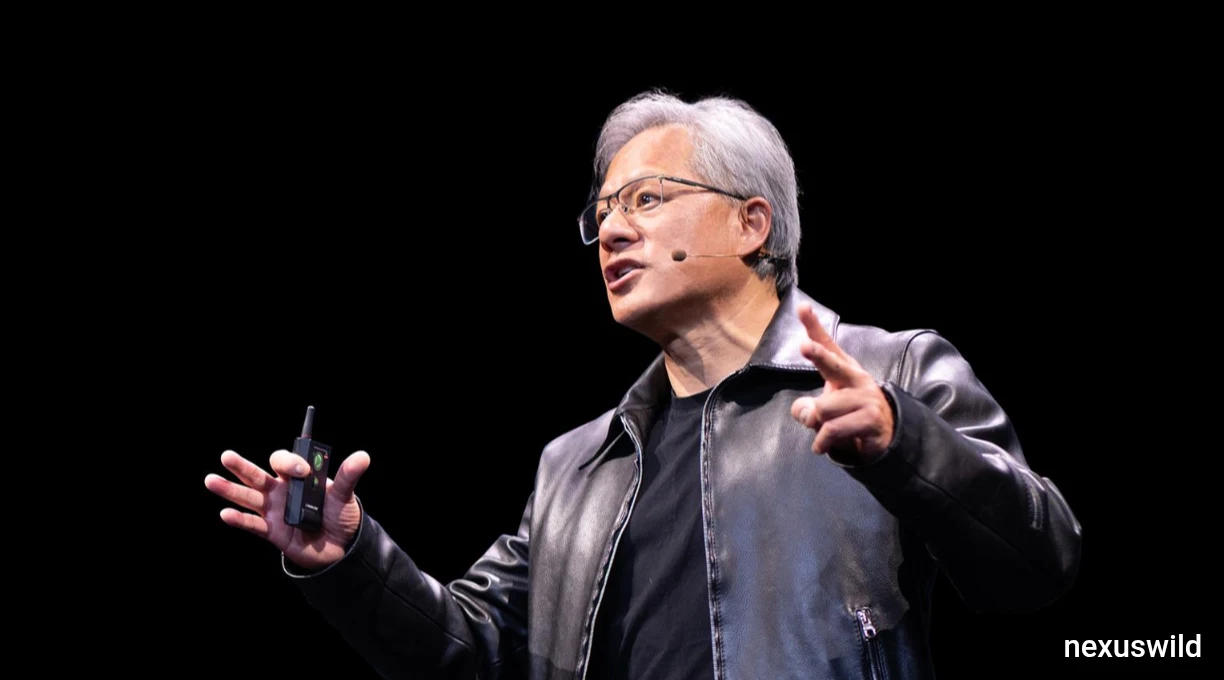

Nvidia is entering a major period of corporate transition after co-founder Jensen Huang resigned as president and chief executive officer, ending a leadership period that helped transform the company into one of the most influential businesses in the global technology industry. The company’s board appointed Chief Financial Officer Colette Kress as interim CEO while beginning the search for a permanent successor.
The announcement, made on November 12, 2026, represents a significant development for the semiconductor industry at a time when demand for artificial intelligence infrastructure continues to influence investment decisions, technology strategies and financial markets.
Huang also resigned from Nvidia’s board, with the changes taking effect immediately. The board appointed Harvey C. Jones, a long-serving director, as its first-ever chair. Nvidia stated that Kress would continue in her CFO role while serving as interim chief executive.
The company has not provided a detailed public explanation for Huang’s departure in its leadership announcement. It has also said that its operations, customer commitments and product roadmap are expected to continue without interruption. Nevertheless, the transition raises questions about leadership continuity at a company whose strategic direction has been closely associated with its founder.
A Leadership Change at a Critical Moment
Huang co-founded Nvidia in 1993 and led its transformation from a graphics-processing technology company into a central supplier of computing infrastructure for artificial intelligence.
The company’s graphics processing units, or GPUs, have become essential components in the development and operation of advanced AI systems. These processors are used to train large artificial intelligence models, process complex workloads and support data-centre operations.
As businesses increasingly integrate AI into products and services, demand for high-performance computing has expanded. Technology companies, cloud service providers, research institutions and other organisations have invested heavily in infrastructure capable of supporting increasingly demanding workloads.
Nvidia has benefited from this shift through its processors, networking technologies and broader computing platforms. Its influence extends beyond chip manufacturing into software, developer tools and integrated systems designed for AI applications.
Huang’s leadership played a central role in shaping this strategy. His departure therefore represents more than a routine executive change. It creates a transition at a company that has become strategically important to the global technology supply chain.
The immediate challenge for Nvidia will be to demonstrate that its long-term strategy can remain consistent under different leadership.
Colette Kress Takes Interim Leadership
Colette Kress, who joined Nvidia in September 2013, has served as executive vice president and chief financial officer. Her responsibilities have included overseeing the company's finance organisation during a period of substantial expansion.
Her appointment provides the company with an interim leader who has extensive knowledge of its financial position, business operations and corporate strategy.
Before joining Nvidia, Kress held finance positions at major technology companies, including Cisco and Microsoft. Her experience in large technology organisations may help provide continuity during the transition.
However, the interim appointment does not automatically settle the company's longer-term leadership question. Nvidia's board has confirmed that it will consider both internal and external candidates for the permanent position.
The eventual appointment will be closely watched by investors, employees, customers and industry partners. The next CEO will need to maintain Nvidia's competitive position while managing a complex technology environment shaped by rapid innovation, global competition and changing demand.
The leadership team will also face pressure to preserve confidence among customers that depend on Nvidia's hardware and software platforms for their AI infrastructure.
Why the Transition Matters to the AI Industry
Nvidia's position in the AI ecosystem makes its leadership change relevant well beyond the company itself.
The development of advanced AI systems depends on access to powerful processors, high-speed networking, specialised software and large-scale data-centre capacity. Nvidia supplies important parts of this infrastructure, making its business performance and strategic decisions relevant to a wide range of technology companies.
Cloud service providers use advanced computing systems to offer AI services to businesses and developers. Large technology companies invest in specialised infrastructure to develop their own AI models. Smaller AI businesses depend on access to computing resources to train, test and deploy their products.
A change in leadership at Nvidia could therefore attract attention across the entire ecosystem, even if the company maintains its existing operational plans.
The key question is whether the next permanent CEO will continue the current strategy or introduce changes to investment priorities, partnerships, product development and market expansion.
At present, there is no confirmed indication that Nvidia plans to make a major strategic shift. Its announcement emphasised continuity in customer commitments and technology development. Any suggestion that the company will immediately change its product roadmap would therefore be premature.
Semiconductor Competition Remains Intense
The semiconductor industry is facing growing competition as companies seek to capture a larger share of the expanding AI computing market.
Nvidia competes with established chipmakers and technology companies developing alternative processors for data centres and AI workloads. Competitors are investing in specialised accelerators, advanced manufacturing technologies and software ecosystems intended to reduce dependence on a single supplier.
Some major technology companies are also designing their own chips to support internal AI operations. This approach can help them manage computing costs, improve performance for specific workloads and gain greater control over their infrastructure.
For Nvidia, maintaining its competitive advantage will require continued investment in research, product development and software integration.
Its strength is not based only on processor performance. Customers also consider the wider ecosystem, including software compatibility, developer support, networking capabilities and the availability of complete computing systems.
A new CEO will need to preserve these advantages while responding to competitors that are attempting to offer alternative solutions.
Investors Will Watch Strategy and Financial Performance
Leadership uncertainty can influence how investors assess a company's future prospects, particularly when its growth has been closely associated with a founder.
Investors will be looking for evidence that the management transition will not disrupt Nvidia's financial performance, customer relationships or long-term investment plans.
The company is scheduled to report its third-quarter fiscal 2027 financial results on November 17, according to its announcement. The results and management commentary will provide an important opportunity for investors to assess the company's current business conditions and outlook.
Key areas of attention are likely to include demand for AI processors, data-centre revenue, supply-chain capacity, product availability and spending by major technology customers.
Investors may also look for information about the board's CEO search process and the responsibilities of the interim leadership team.
However, the leadership change should not be treated as proof that Nvidia's underlying business model has weakened. Its market position will continue to depend on product performance, customer demand, execution and competition.
Global Supply Chains and Technology Policy
Nvidia's business also operates within a complex international semiconductor supply chain. The production of advanced processors requires specialised design capabilities, manufacturing facilities, packaging technologies, equipment suppliers and international logistics networks.
Changes in the semiconductor market can affect businesses across several regions and industries.
The AI investment cycle has also increased the importance of technology policy, export controls and national security considerations. Governments are paying closer attention to advanced computing technologies because of their potential economic and strategic applications.
Nvidia's board previously announced an independent investigation after reports raised national security concerns involving Huang. The board stated that it had no reason to believe that national security or company secrets had been compromised and said the inquiry would examine available information.
It is important to distinguish this earlier investigation from the formal resignation announcement. Nvidia's November 12 leadership statement did not specify the reason for Huang's departure. The company has not publicly established a connection between the investigation and the resignation in that announcement.
The distinction matters for investors and industry observers because unverified explanations can create confusion about corporate governance, regulatory exposure and the company's future.
The Search for a Permanent CEO
The appointment of a permanent chief executive will be one of Nvidia's most important corporate decisions in the coming months.
The board must identify a candidate capable of managing a business that operates at the centre of the global AI infrastructure market. The role requires experience in technology strategy, international operations, financial management, customer relationships and large-scale research and development.
An internal candidate could offer continuity and familiarity with Nvidia's business model. An external appointment could bring a different perspective and experience from another major technology organisation.
Neither option guarantees a smooth transition. The board will need to consider how the next leader can maintain the company's existing strengths while preparing for changes in AI computing demand and semiconductor competition.
The selection process will also influence how employees, partners and investors view the company's long-term direction.
What Comes Next for Nvidia?
Nvidia's immediate priority is likely to be maintaining operational stability while the board conducts its leadership search. The company has indicated that its customer commitments and product roadmap are expected to continue without interruption.
The November 17 earnings announcement will be an important near-term milestone. Beyond the financial figures, investors will be interested in management's comments about demand, supply, product development and the transition in leadership.
Over the longer term, Nvidia will face the same central challenge confronting the wider semiconductor industry: sustaining growth while the AI market becomes more competitive and customers demand greater computing performance and efficiency.
The next CEO will inherit a company with considerable influence over the development of AI infrastructure. Maintaining that position will require strong execution, continued innovation and confidence from customers and investors.
Huang's departure marks the end of a defining leadership era for Nvidia. It does not, by itself, determine the company's future. The board's succession decision, the performance of the interim leadership team and Nvidia's ability to maintain its technological advantage will shape the next chapter of the business.
For the global AI industry, the transition is an important reminder that leadership, corporate governance and technology strategy can have consequences far beyond an individual company. As Nvidia moves into its next phase, the semiconductor market will be watching closely.
Nexuswild welcomes factual corrections. Email contact@nexuswild.com with evidence and the article URL.