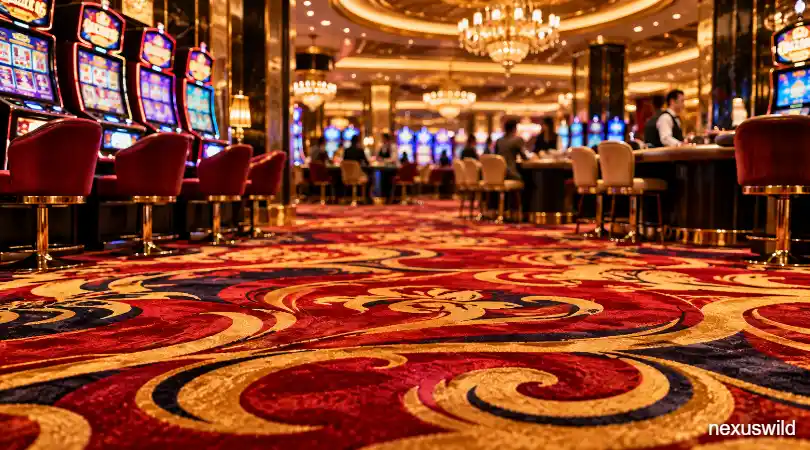

Bright reds, deep blues, oversized florals, geometric forms and densely layered patterns often stretch across thousands of square metres beneath gaming machines and tables. The visual language can appear so unusual that casino carpets have generated decades of popular theories about hidden psychological manipulation.
The evidence is considerably more practical and nuanced.
Casinos use patterned carpet partly because gaming floors are unusually demanding commercial environments. They operate for long hours, experience intense foot and chair traffic, handle frequent food and beverage service, and need flooring that can remain visually consistent between maintenance cycles.
The carpet also forms part of a much larger interior-design system involving architecture, lighting, acoustics, signs, circulation routes and branding.
Environmental-psychology research suggests those combined surroundings can influence how people perceive a casino and how pleasant or stimulating it feels. But there is little scientific evidence showing that an elaborate carpet pattern by itself can make someone gamble longer or override decision-making.
Casino Carpets Have a Practical Job
One of the simplest reasons for complex casino carpet is operational.
A solid, light-coloured floor can make dirt, stains and traffic lanes conspicuous. A multicoloured pattern breaks up the visual field, making everyday wear less immediately noticeable between cleaning and maintenance cycles.
Commercial flooring specialists describe casino gaming floors as particularly demanding because of continuous pedestrian traffic, rolling chairs, service carts and concentrated loads around gaming equipment. Dense commercial carpet systems are therefore specified for appearance retention and dimensional stability under heavy use.
That practical requirement encourages designs very different from residential carpet.
Large-scale patterns and multiple colours can disguise small variations in wear while allowing an operator to maintain a consistent appearance across an enormous floor.
Real Casino Projects Confirm How Large These Installations Can Be
Casino carpets are often custom-made rather than selected from ordinary retail collections.
For example, flooring manufacturer Brintons says approximately 4,800 square yards of custom Axminster carpet was developed for the gaming floor at Jake's 58 Hotel & Casino in New York. The design used a custom 14-colour palette tied to the property's interior concept.
At Mandalay Bay in Las Vegas, Couristan documents an installation of more than 25,000 square yards of custom Axminster carpet across a 135,000-square-foot casino environment.
Those examples demonstrate the physical scale of casino flooring projects.
They do not, however, establish a universal cost.
Publicly accessible project descriptions frequently disclose the area covered, materials and design concept but not the price paid specifically for the carpet. Broad claims that casinos routinely spend a particular number of millions of dollars on carpet therefore should not be repeated unless supported by project-specific contracts or financial records.
Bold Patterns Can Support a Property's Identity
Casino flooring also functions as interior branding.
A large gaming floor contains relatively few uninterrupted surfaces. Slot machines, tables, chairs, digital displays and crowds occupy much of a visitor's visual field.
The carpet remains one of the few design elements that can run continuously underneath all of them.
That gives designers an opportunity to connect otherwise fragmented spaces using a common palette or visual theme.
At Jake's 58, for example, the custom carpet was designed around the idea of connectivity, with bright linear forms inspired by communications infrastructure. Other casino projects use flooring motifs linked to local culture, architecture or a resort's wider theme.
The purpose in such cases is straightforward: create an interior that feels specific to the property rather than interchangeable with another gaming venue.
Can Carpet Influence Mood?
Physical surroundings can influence emotional responses, but the research does not support treating carpet as an isolated psychological switch.
Studies of casino environments have generally examined combinations of design variables rather than flooring alone.
Research published in Environment and Behavior compared contrasting casino-design approaches and found differences in participants' reported pleasure and psychological restoration. A later study involving 484 participants examined factors including lighting, colour, crowding, layout symmetry and machine clustering and found that responses depended on the broader design and individual characteristics.
That supports a relatively modest conclusion: interior environments can affect how stimulating, comfortable or pleasant a space feels.
It does not demonstrate that one particular carpet colour or motif produces a predictable gambling response.
Evidence for Direct Behavioral Effects Is Much Weaker
Laboratory research has found that some combinations of casino-related sensory cues can alter decision behaviour.
One experiment involving 80 non-gamblers tested casino sounds together with red lighting. Participants exposed to the simulated casino conditions showed different reaction-time patterns after wins and losses than participants in the control environment. The researchers interpreted the results cautiously and noted methodological limitations.
The important point is that this study examined sound and lighting together, not carpeting.
Another servicescape study of 513 casino customers in Macau found that factors such as ambience, navigation, seating comfort, décor and cleanliness were associated with customer satisfaction and intentions to revisit.
Again, carpet was part of a broader physical setting rather than a separately tested mechanism.
There is therefore no solid basis for claiming that swirling carpet motifs can hypnotise customers, suppress rational thought or independently cause people to gamble more.
Carpet Can Contribute to Wayfinding
Patterned flooring can have another role: helping people read large interior spaces.
General research on indoor wayfinding shows that floor-plan configuration, landmarks, signs, maps and environmental cues all affect navigation in complex buildings. A review of 84 studies identified those factors as central to how people orient themselves indoors.
Commercial-carpet guidance also notes that flooring can provide directional cues or visually distinguish different functional areas.
In a casino resort, designers can use changes in carpet, hard flooring or pattern scale to distinguish a gaming zone from a lobby, restaurant, hotel corridor or circulation route.
That does not mean every complex casino carpet is deliberately designed to confuse visitors.
Modern hospitality projects often invest heavily in signage and environmental graphics precisely because large casino-resorts must remain navigable. The design package for Durango Station in Las Vegas, for example, included dedicated signage, wayfinding and environmental graphics across the resort.
The Famous “Casino Maze” Is Only One Design Philosophy
Casino interiors have changed substantially over time.
One influential older approach placed gaming machines at the centre of the environment and favoured dense layouts, limited sightlines and relatively enclosed spaces.
A competing design philosophy emphasised clearer spaces, recognisable themes and more comfortable, visually restorative surroundings.
Environmental-psychology researchers have compared these approaches rather than finding one universal casino layout. In experimental studies, the more spacious and themed environments were generally rated as more pleasurable and restorative.
This is important because popular accounts often assume every casino is designed around deliberate disorientation.
In practice, contemporary casinos can contain clear main paths, prominent landmarks, restaurants, hotel entrances and structured wayfinding systems alongside visually busy gaming areas.
Carpet Also Changes the Sound of the Room
Casinos contain substantial mechanical and electronic noise.
Gaming machines, music, conversations, chairs and foot traffic can all contribute to the acoustic environment.
Carpet helps absorb airborne and impact sound. The Carpet and Rug Institute notes that properly specified commercial carpeting can reduce reflected sound and footfall noise, with performance depending on construction and any underlying cushion.
That acoustic role matters in a large gaming hall.
Hard flooring across the entire space would reflect considerably more high-frequency sound and increase the acoustic impact of footsteps and moving chairs.
Carpet therefore allows casinos to combine a visually energetic environment with some degree of sound absorption.
Lighting, Sound and Flooring Work Together
A carpet pattern is rarely selected independently of the rest of the interior.
Designers consider how its colours will appear under artificial illumination, how the pattern relates to gaming equipment and furniture, and how it connects visually with ceilings, walls and signage.
Casino research supports looking at this combination of features as a servicescape rather than trying to assign every behavioural response to one object.
Lighting can change perceived brightness and atmosphere.
Sound influences arousal and noise levels.
Furniture affects comfort and movement.
Signs and landmarks assist navigation.
Flooring contributes colour, texture, acoustic absorption, visual continuity and zoning.
The resulting experience comes from their interaction.
That makes claims such as “the carpet is designed to keep gamblers from leaving” too simplistic to be supported by existing evidence.
Pattern Complexity Can Attract Attention Without Controlling It
Bold patterns are inherently visually noticeable, particularly when they contrast strongly with surrounding furniture.
Research outside casinos shows that salient visual cues and colour differences can contribute to spatial memory and navigation. Some studies also find that environmental complexity changes how people process spaces.
But attention is not the same as behavioural control.
A person may notice a bright patterned floor, use a colour transition as a landmark or perceive the space as lively without experiencing any measurable change in willingness to gamble.
Scientific evidence does not support jumping from “visual features influence perception” to “the pattern makes customers spend money.”
Casino Carpet Must Also Meet Commercial Safety Requirements
Design freedom is constrained by practical standards.
Commercial flooring has to remain stable under heavy traffic, accommodate rolling loads and comply with applicable fire and accessibility requirements.
In the United States, federal standards regulate the surface flammability of carpets and rugs, while accessibility rules require carpeting on accessible routes to be securely attached and sufficiently firm.
Installation method also matters.
Commercial guidance recommends systems suited to wheeled traffic and large floor areas, particularly where chairs and service equipment are constantly moving.
The extravagant appearance of a casino carpet therefore sits on top of a highly functional flooring specification.
Why Casinos Keep Choosing Custom Patterns
Several explanations for bold casino carpet are well supported.
Pattern helps conceal everyday wear and small stains. Commercial carpet reduces noise. Custom designs strengthen a property's visual identity. Flooring can help define zones and contribute to navigation. And a highly decorated surface fits the broader entertainment-focused atmosphere many casino resorts are trying to create.
Psychology plays a role at the level of the overall environment.
Research shows that casino ambience and design can influence emotions, satisfaction and some aspects of behaviour under experimental conditions.
But the stronger claims frequently attached to casino carpeting are not supported.
There is no credible evidence that an elaborate floral or geometric floor can literally manipulate a person's mind, eliminate awareness of time or independently compel gambling.
Conclusion
Casino carpets look unusual because they are asked to do much more than cover the floor.
They must withstand extremely heavy use, hide the visual effects of traffic and spills, reduce noise, connect enormous interiors and contribute to a property's identity.
Real projects show the scale involved: individual gaming floors can require thousands or tens of thousands of square yards of custom carpet. Publicly available evidence, however, does not support attaching a universal multimillion-dollar price tag to those installations.
Environmental psychology also offers a more restrained explanation than popular casino myths.
Lighting, sound, layout, colour, décor and navigation can collectively affect how people experience a gaming environment. Research has linked casino servicescapes with differences in pleasure, satisfaction and behavioural intentions.
What the research has not established is that bold carpet patterns by themselves control gambling behaviour.
The better explanation is a combination of business and design: casinos need flooring tough enough for intensive hospitality operations and visually distinctive enough to function as part of a carefully coordinated entertainment environment.
Nexuswild welcomes factual corrections. Email contact@nexuswild.com with evidence and the article URL.