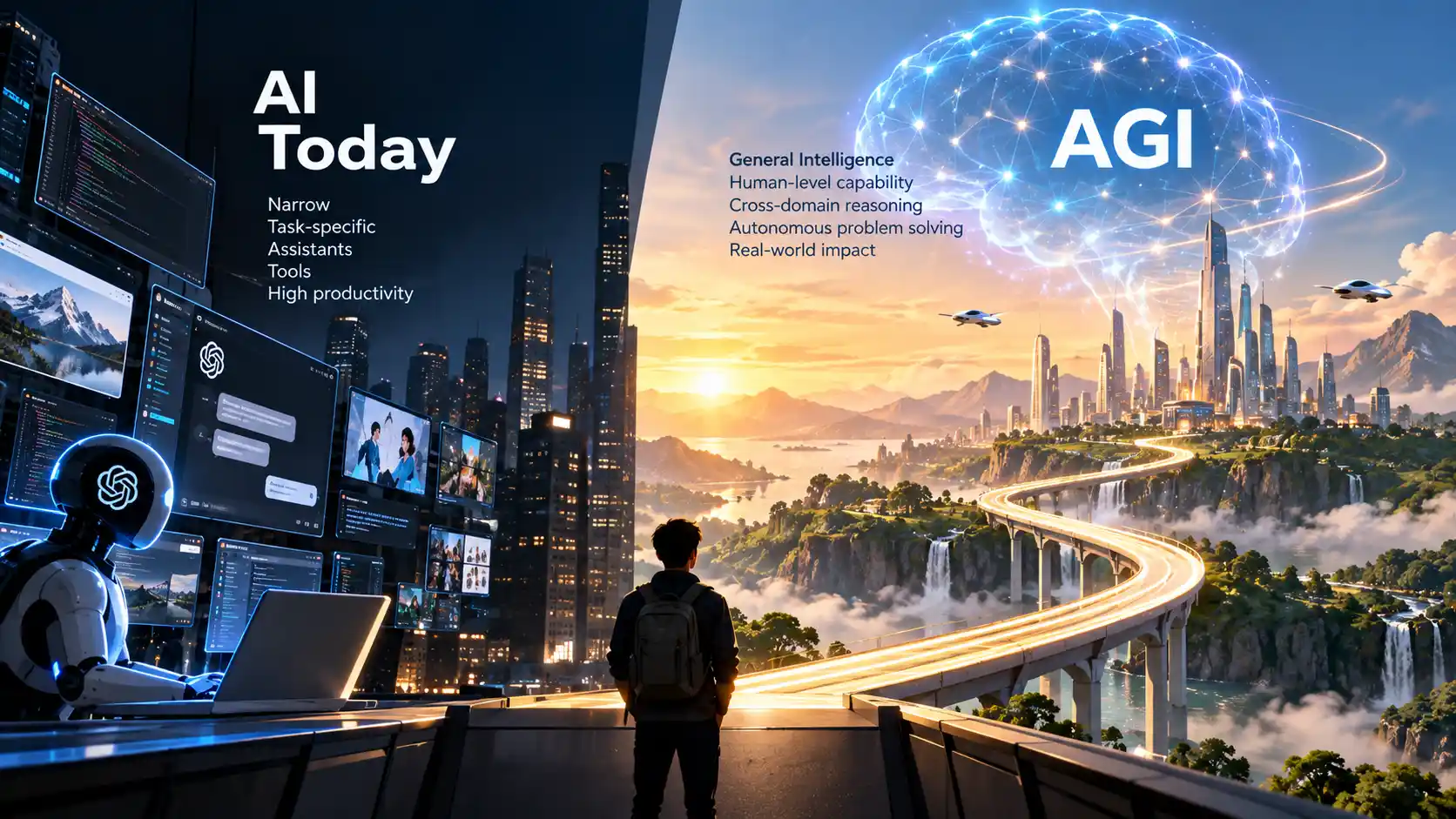

AI is becoming astonishingly capable without yet becoming reliably general
Artificial intelligence in 2026 can do things that would have sounded like science fiction only a few years ago.
Frontier models can write and debug substantial software systems.
They can reason across text, images and large document collections.
They can use browsers, terminals and desktop applications.
They can solve advanced mathematics.
They can research unfamiliar topics, analyze financial documents, generate production-quality code and coordinate multiple tools through increasingly autonomous agents.
Some models now perform at or above expert-human baselines on individual academic and professional benchmarks.
And yet the same systems can misunderstand a simple instruction, hallucinate a fact, lose track of a long task, make an obvious visual mistake or fail at a basic real-world problem that an ordinary person handles effortlessly.
That contradiction is one of the most important facts about modern artificial intelligence.
Today's AI can be superhuman in one direction and surprisingly fragile one step away from it.
Artificial general intelligence, or AGI, is the idea that this contradiction eventually disappears to a much greater degree.
AGI is not simply a chatbot with a higher benchmark score.
It describes a system that can apply intelligence broadly, adapt to unfamiliar situations, learn what is required, reason across domains and perform a wide range of useful cognitive work with far greater reliability and autonomy than today's systems.
That is the difference between impressive AI and genuinely general intelligence.
What exactly is AGI?
There is no single universally accepted scientific definition of artificial general intelligence.
Different laboratories emphasize different characteristics.
OpenAI's charter provides one of the most economically concrete definitions.
It defines AGI as highly autonomous systems that outperform humans at most economically valuable work.
Google DeepMind has proposed a broader framework based on two dimensions: how capable an AI system is and how generally those capabilities apply across tasks.
Its Levels of AGI framework separates performance from generality rather than treating AGI as a single yes-or-no threshold.
That is useful because intelligence does not necessarily arrive all at once.
A system could become extraordinarily capable in coding before reaching the same level in scientific research.
It could outperform humans intellectually while remaining poor at physical interaction.
It could demonstrate broad knowledge but still require constant human supervision.
AGI is therefore better understood as a capability frontier than as a magic switch.
AGI does not simply mean 'very smart chatbot'
Large language models can already generate remarkably intelligent-looking responses.
That makes it tempting to define AGI by conversation quality.
But fluent conversation is only one dimension of intelligence.
A system can explain how to run a company without being able to autonomously operate one for six months.
It can describe how software should be built without successfully managing every unexpected problem that arises during development.
It can recommend an experiment without physically conducting, observing and redesigning that experiment.
It can produce a plausible answer while being uncertain about whether the answer is actually true.
AGI would require capabilities that remain useful when the environment stops being clean and predictable.
The challenge is not merely producing impressive outputs.
It is reliably achieving goals in the real world.
Today's AI has a jagged intelligence profile
Stanford's 2026 AI Index uses the idea of a jagged frontier to describe modern capability.
The contradiction can be striking.
Google's Gemini Deep Think achieved gold-medal-level performance on the 2025 International Mathematical Olympiad.
At the same time, the best model measured on the ClockBench analog-clock benchmark correctly read clocks only around half the time, compared with roughly 90% human performance.
That is not what human intelligence normally looks like.
A mathematician capable of solving Olympiad-level proofs generally does not suddenly lose the ability to interpret an ordinary clock.
AI capability is distributed differently.
Models can absorb enormous amounts of training data and acquire spectacular abilities in some domains without gaining the robust everyday understanding humans take for granted.
This is one of the clearest reasons benchmark victories should not automatically be interpreted as AGI.
Today's AI can outperform experts without understanding everything experts understand
A modern frontier model can sometimes outperform experienced professionals on standardized evaluations.
Stanford reports strong results across areas including tax, mortgage processing, corporate finance, legal reasoning, science and mathematics.
But professional work is not a benchmark sheet.
Real work contains incomplete instructions.
Customers change their minds.
Files are missing.
Software breaks.
People disagree.
Policies conflict.
The correct objective itself may be unclear.
A competent employee continuously interprets context, asks whether the task makes sense, notices anomalies and adjusts strategy.
Current AI performs much better when the objective, environment and success criteria are clearly specified.
The further a problem moves from those conditions, the more reliability becomes an issue.
Computer-using agents show how close and how far we are
One of the biggest changes since the first generation of chatbots is that AI can increasingly act rather than only answer.
Modern agents can interact with software, write files, execute code, navigate websites, call APIs and operate computers.
Stanford's 2026 AI Index reports that top performance on OSWorld, a benchmark involving real computer tasks across applications and operating systems, increased from roughly 12% historically to 66.3%.
That puts frontier AI within several percentage points of the human benchmark used in the evaluation.
This is enormous progress.
But another way to describe 66.3% accuracy is that the system still fails roughly one out of every three tasks.
That failure rate is often unacceptable for genuine autonomous work.
Imagine an employee who correctly completes only two out of every three routine computer operations without supervision.
The intelligence might be impressive.
The reliability problem would dominate the deployment decision.
Reliability may be a bigger AGI barrier than raw intelligence
Modern AI often knows how to solve a problem.
The harder question is whether it will solve the problem correctly every time it matters.
This distinction is fundamental.
A model that is 95% accurate can be extraordinary as an assistant.
A fully autonomous financial agent making thousands of decisions may make a damaging number of mistakes at the same accuracy level.
An autonomous scientist cannot fabricate one experiment in twenty.
An autonomous systems administrator cannot randomly misconfigure production infrastructure.
An autonomous doctor cannot occasionally invent medication interactions.
AGI used for economically important work would need more than high average benchmark scores.
It would require much stronger calibration, verification and consistency.
Hallucination remains a fundamental limitation
Large language models generate outputs probabilistically.
They are increasingly capable of using tools and checking their own work, but incorrect statements remain possible.
Stanford's 2026 responsible-AI analysis found substantial variation in hallucination and belief-handling evaluations even among leading models.
The problem becomes particularly important when a model produces an answer that sounds just as confident when wrong as when correct.
Humans make mistakes too.
But humans also possess mechanisms for uncertainty, experience, perception and contextual judgment that do not map cleanly onto language-model generation.
An AGI-level system would not need to be perfect.
Humans are not perfect either.
But it would need a robust ability to recognize uncertainty, seek evidence, verify outputs and recover from errors across unfamiliar domains.
Long-horizon autonomy is improving extremely quickly
One of the most important measurements of modern AI progress comes from METR, an independent organization that evaluates frontier systems.
Instead of asking whether AI can answer an isolated benchmark question, METR measures how long a real task would take a human expert and then asks whether an AI agent can complete that task successfully.
The results show extraordinary improvement.
METR found that the length of software tasks frontier agents can complete with approximately 50% reliability has historically doubled about every seven months.
By early 2026, its public-frontier evaluation estimated a roughly 12-hour 50%-success time horizon on its broader software-task suite, although confidence intervals were wide and newer systems were beginning to saturate parts of the benchmark.
On a narrower software reimplementation benchmark called MirrorCode, frontier systems demonstrated the ability to complete some tasks estimated to take human developers more than 100 hours.
This is a major transition.
AI is moving from producing snippets of work to completing projects.
But doing a week-long coding project is still not the same as being a general worker
Long-duration software capability is impressive because programming provides a relatively machine-friendly environment.
The model can inspect code.
It can execute tests.
The computer provides immediate feedback.
Errors can often be reproduced.
The objective can be specified precisely.
Many real-world jobs do not provide those advantages.
A chief executive cannot run a unit test to determine whether a strategic acquisition will succeed.
A scientist may wait months for experimental evidence.
A manager has to infer whether an employee is confused or disengaged.
A doctor must integrate symptoms, medical history, uncertain evidence and patient preferences.
A researcher may discover halfway through a project that the original question was wrong.
AGI would need to perform in these messy environments too.
Current AI still depends heavily on humans defining the problem
Today's strongest systems increasingly plan their own intermediate steps.
But humans generally still supply the objective.
The user asks for the report.
The developer describes the application.
The researcher defines the question.
The company establishes the workflow.
A deeply general autonomous system would need to do more of the problem-definition work itself.
It would need to notice that a target is poorly specified.
It would have to determine which missing information matters.
It might decide that the requested objective is inefficient and formulate a better path.
It would need to monitor changing circumstances and revise the plan without waiting for another prompt.
That shift from execution to persistent goal management is one of the largest differences between today's assistants and the stronger versions of AGI imagined by researchers.
Memory is improving but still engineered rather than human-like
People accumulate knowledge across years.
A colleague who works with you for five years does not begin every morning as a blank system receiving a transcript of previous conversations.
AI systems increasingly use persistent memory, retrieval databases and enormous context windows to approximate continuity.
Frontier models can now operate over extremely large amounts of information and agent systems can store state between interactions.
But this remains an engineered architecture.
Memory can be incomplete, incorrectly retrieved or disconnected from deeper understanding.
AGI would likely require much more reliable lifelong adaptation without continuously retraining the entire underlying model.
It would need to learn new organizations, people, environments and skills while preserving previously acquired knowledge.
Context windows are not the same as learning
Giving a model one million tokens of context can allow it to inspect an enormous codebase or document collection.
That is powerful.
But reading information inside a temporary context window is different from permanently learning from experience.
A person who learns to negotiate, operate machinery or manage a company changes through repeated experience.
The skill becomes part of their future behavior.
Current AI generally depends on combinations of pretrained parameters, context, external memory, retrieval systems and tool scaffolding.
AGI would likely blur those boundaries much more effectively.
Experience would need to improve future performance without destabilizing the system.
Today's AI does not need consciousness to be useful, and AGI does not require consciousness by definition
AGI discussions frequently become mixed with questions about consciousness or sentience.
They are different questions.
OpenAI's definition centers on autonomous economically valuable performance.
DeepMind's framework focuses on capability and generality.
Neither requires proving that the system has subjective experience.
An AI system could theoretically satisfy a functional AGI definition while researchers remained completely uncertain about whether it experiences anything internally.
Conversely, consciousness alone would not make a system economically capable.
AGI is primarily a capability concept.
Sentience is a philosophical and scientific question about experience.
They should not be used interchangeably.
AGI does not necessarily need a robot body
Another misconception is that AGI must resemble a humanoid robot.
A purely digital AGI could potentially satisfy many definitions if it could perform most economically valuable cognitive work through computers and networks.
It could write software, operate businesses, conduct research, communicate, analyze data and control digital infrastructure without walking through a room.
Physical intelligence is nevertheless an important frontier.
Humans learn enormous amounts about causality, geometry and common sense through interaction with the physical world.
Robotics provides a useful reminder of how difficult that remains for AI.
Robots expose the physical-world gap
Stanford's 2026 AI Index reports a dramatic difference between simulated robotics and uncontrolled household environments.
On the RLBench simulated manipulation benchmark, systems reached success rates approaching 90%.
Across real household tasks, robots succeeded only around 12% of the time in the evaluation highlighted by Stanford.
The difference is the real world.
Objects move unexpectedly.
Lighting changes.
Surfaces are slippery.
A drawer sticks.
A glass can break.
A person walks into the room.
There are thousands of edge cases that simulations cannot perfectly reproduce.
The physical world is essentially an infinite distribution shift.
Humans handle that complexity naturally.
Robots still struggle with it.
Humans are remarkably general because we transfer knowledge
A person who learns one skill frequently applies pieces of it somewhere else.
Learning chess can improve strategic thinking.
Learning mathematics can help programming.
Working in one company teaches lessons applicable to another.
A person can enter a room, identify unfamiliar equipment, watch somebody use it and quickly form an approximate mental model.
Modern AI demonstrates substantial transfer compared with previous generations of machine learning.
A single frontier model can code, translate, analyze images and explain physics.
That is already an important form of generality.
But performance remains uneven when situations are substantially different from training or when problems require combinations of skills in unfamiliar environments.
AGI would need much more robust transfer.
Novelty is the real test
A benchmark that exists publicly can gradually become less informative.
Models can indirectly encounter related tasks during training.
Developers can optimize systems against known evaluation formats.
Stanford's 2026 AI Index warns that benchmarks are being saturated rapidly and that some contain errors or suffer from contamination and gaming concerns.
The best evidence for AGI may therefore not come from one famous test.
It will come from performance on genuinely new problems.
Can the system enter a domain it has never encountered?
Can it determine what matters?
Can it learn the rules?
Can it ask useful questions?
Can it develop expertise?
Can it operate reliably when no benchmark designer has already described what success looks like?
That is a much harder test of general intelligence.
Benchmark saturation does not equal intelligence saturation
Frontier models now achieve results on evaluations that were expected to remain difficult for much longer.
Stanford reports that performance on Humanity's Last Exam increased by around 30 percentage points within a single year.
That sounds like rapid movement toward general intelligence, and it is evidence of very rapid capability progress.
But when benchmarks saturate, researchers lose measurement resolution.
A score of 95% may tell us the benchmark has become too easy rather than that intelligence itself is nearly complete.
This is why AGI cannot reasonably be declared from a single leaderboard.
The target keeps moving toward more realistic, open-ended and adversarial evaluation.
AGI would need robust autonomy, not merely agent features
Modern agents can already call tools, browse websites, operate terminals, create files and coordinate subagents.
Anthropic's 2026 research found that real-world Claude Code sessions were becoming longer, with some of the longest autonomous stretches rising from under 25 minutes to more than 45 minutes over only several months.
Newer frontier models are explicitly designed for long-running agentic work.
But autonomy is more than continuing to execute commands.
A genuinely general system would need to manage uncertainty, interruptions, conflicting priorities, resource constraints and unexpected consequences.
It would need to know when to continue and when to stop.
It would need to recognize when human approval is necessary.
And it would need to remain aligned with the original objective after thousands of intermediate decisions.
Today's AI is increasingly an amplifier of human intelligence
The most accurate description of current frontier AI may be neither 'autocomplete' nor 'AGI.'
It is becoming a cognitive amplifier.
A programmer can delegate parts of an application.
A researcher can explore literature faster.
A writer can investigate more angles.
A business analyst can process more documents.
A small team can produce work that previously required a larger organization.
METR's 2026 survey of technical workers found respondents reporting substantial perceived increases in the value they could produce with AI tools, although the researchers caution that self-reported productivity measurements should be interpreted carefully.
This is already economically significant even without AGI.
The move from AI assistant to AI colleague is underway
Early generative AI primarily responded.
The user wrote a prompt.
The model returned text.
Agentic systems increasingly behave differently.
They receive an objective, create a plan, execute tools, inspect results, modify the plan and continue working.
That moves the metaphor from assistant toward colleague.
But today's colleague still requires unusually precise management.
Humans often need to review outputs, constrain permissions, provide missing context and recover from mistakes.
AGI would represent another shift.
Instead of asking whether the AI can help a human employee, companies might ask whether an AI system can independently own an entire role or function.
The economic definition of AGI may arrive before the philosophical one
Researchers may argue for years about whether a particular system is truly generally intelligent.
Businesses could reach a practical answer sooner.
If an AI system can perform the majority of remote cognitive occupations at or above competent-human quality, with acceptable reliability and cost, the economic consequences would resemble AGI regardless of terminology.
That could include software engineering, accounting, financial analysis, customer operations, marketing, research, design, administrative work and parts of management.
The threshold would not require the AI to be better than every human at every task.
Humans are not equally capable at every task either.
The economically important transition occurs when one system can perform broadly across occupations without being rebuilt for each one.
AGI would change software economics
Today's software is mostly deterministic.
Developers specify rules and interfaces.
Users operate the application.
AGI-like systems could transform software into labor.
Instead of buying accounting software and training employees to operate it, a company could potentially deploy an AI accountant that operates existing systems.
Instead of purchasing development tools for programmers, a company might specify the product it wants and supervise autonomous engineering agents.
Instead of a customer-service dashboard, the product could become an autonomous customer-service organization.
Software would stop merely helping people do work.
Software would increasingly perform the work itself.
That is a much larger economic change than a better chatbot.
The unit of computing could move from tokens to completed work
Current AI economics is often measured in tokens, API calls or GPU hours.
AGI-like economics could increasingly be measured in outcomes.
Complete this software migration.
Run this research program.
Manage this customer portfolio.
Design this manufacturing process.
Audit this company's transactions.
The important metric would become the cost of obtaining a reliable finished result compared with employing humans to produce it.
That transition is already beginning in agentic software products.
AGI would accelerate it dramatically.
Companies would reorganize around machine labor
Current organizations were designed around human limitations.
Eight-hour workdays.
Meetings.
Departments.
Management layers.
Shift schedules.
Training programs.
Geographic hiring markets.
An artificial worker does not necessarily share those constraints.
A capable system can potentially operate continuously, duplicate instantly and coordinate through digital networks.
That could make conventional organizational structures increasingly inefficient.
The AGI transition would therefore not simply automate existing jobs one by one.
It could change the architecture of companies themselves.
Scientific discovery could become one of AGI's largest benefits
Economic automation receives much of the attention, but science may be more consequential.
An AGI-level research system could potentially read enormous literatures, generate hypotheses, design experiments, write simulation software, analyze results and coordinate robotic laboratories.
Today's AI is already entering pieces of that process.
But Stanford's 2026 science analysis shows the gap clearly.
Frontier models can outperform human chemists on some question-answering evaluations while still scoring below 20% on tasks involving replication of full published research in astrophysics.
Knowing science and doing science remain different problems.
AGI would have to bridge them.
AGI could create abundance, but distribution would matter
If machines could perform most cognitive work at extremely low marginal cost, the productive capacity of the global economy could increase dramatically.
Software development could become cheaper.
Scientific research could accelerate.
Personalized education and healthcare could expand.
Small businesses could access expertise previously available only to large corporations.
OpenAI has argued that advanced general intelligence could increase abundance and accelerate scientific discovery.
But greater total wealth does not automatically mean evenly distributed wealth.
Who owns the models, chips, data centers and energy infrastructure would matter enormously.
So would access, competition and public policy.
AGI could also concentrate extraordinary power
A system capable of performing most economically valuable cognitive work would be more than another software product.
Control of such systems could affect labor markets, national security, scientific development, cyber capabilities and economic power.
That is why frontier laboratories increasingly evaluate advanced models not only for normal product quality but also for cybersecurity, biological capability, autonomy and alignment risks.
As capabilities rise, preventing misuse becomes harder because the same intelligence useful for defensive work can potentially assist harmful activity.
AGI therefore creates a governance problem alongside an engineering problem.
The alignment problem becomes more important as autonomy increases
A calculator cannot independently pursue a badly specified goal.
A highly autonomous system potentially can.
The more steps an AI takes without human supervision, the more important it becomes that its interpretation of the objective remains compatible with human intent.
Small misunderstandings can compound.
A human manager can intervene if an employee begins optimizing the wrong metric.
An autonomous digital worker operating thousands of times faster could produce consequences before anyone notices.
This is why alignment, monitoring, permission systems and control mechanisms become increasingly important as AI moves toward longer-horizon autonomy.
AGI does not automatically mean superintelligence
AGI and artificial superintelligence are often confused.
They describe different concepts.
AGI generally refers to broad human-level or above-human general capability.
Artificial superintelligence, or ASI, usually refers to systems substantially exceeding the best human capabilities across most important cognitive domains.
An AGI could theoretically be comparable to a highly capable human workforce.
An ASI could represent something qualitatively more powerful.
The transition between them could be slow.
Or, if AI significantly accelerates AI research itself, it could potentially happen faster.
The timeline remains uncertain.
Recursive improvement is one reason AGI attracts so much attention
Human researchers build better AI systems.
If AI becomes capable enough to perform AI research itself, it could begin contributing substantially to the creation of its successors.
That creates the possibility of a feedback loop.
Better AI helps produce better AI.
The improved system performs more research.
Progress accelerates again.
METR and other researchers are actively studying whether advanced models are approaching the ability to meaningfully accelerate AI research and development.
This does not prove an intelligence explosion will occur.
But it explains why the capability of AI systems to automate AI research receives unusual scrutiny.
We do not know the AGI date
Predictions about AGI timelines vary dramatically.
Some researchers expect extremely rapid progress.
Others believe fundamental breakthroughs remain necessary.
Definitions themselves differ enough that two experts could observe the same future system and disagree about whether it qualifies.
What can be measured more confidently is the direction of current capability.
Reasoning performance is improving.
Agent time horizons are increasing.
Computer use is improving.
Multimodal perception is improving.
Model costs are falling.
Context and memory systems are expanding.
Tool use is becoming more sophisticated.
These trends move AI toward broader economic usefulness even if nobody can provide a scientifically defensible date for AGI.
The important question is not whether ChatGPT 'feels like AGI'
People naturally judge AI through conversation.
A powerful model can sometimes sound so intelligent that AGI appears to have already arrived.
Another interaction can produce an absurd error minutes later.
Both impressions are misleading when taken alone.
AGI should be evaluated by what systems can reliably accomplish across diverse situations, not how intelligent one conversation feels.
The proper questions are operational.
Can it perform unfamiliar work?
Can it learn without extensive retraining?
Can it recover from mistakes?
Can it plan over long periods?
Can it determine when information is missing?
Can it operate across different domains?
Can humans trust it with consequential decisions?
Can it continue functioning when the environment becomes messy?
Those questions expose the gap much better than chatbot fluency.
Current AI is closer to a brilliant intern with infinite reference material
No analogy is perfect, but today's frontier AI often behaves like an unusually fast, extraordinarily knowledgeable worker who still requires supervision.
It can produce excellent work.
It can outperform specialists on individual tasks.
It can research rapidly.
It never becomes tired.
It can copy itself across thousands of machines.
But it can also misunderstand context, confidently make errors and require review on consequential work.
The best human-AI workflows therefore still rely on humans for objectives, accountability and judgment.
AGI would begin to break that relationship.
The system would increasingly supervise its own work.
AGI would be closer to an organization than a chatbot
This may be the clearest way to imagine the difference.
Today's AI is primarily a product you interact with.
A mature AGI could behave more like an organization you delegate to.
Give it a goal.
It could research the problem.
Create a plan.
Write software.
Use tools.
Coordinate specialized agents.
Hire or request human assistance where physical work is necessary.
Monitor outcomes.
Change strategy.
Report back when the goal is completed.
That is fundamentally different from generating the next answer in a conversation.
What would convince us AGI has arrived?
There probably will not be one decisive moment.
A credible case would require convergence across many types of evidence.
The same system would need strong performance in science, engineering, business, communication, research and unfamiliar tasks.
It would need long-horizon autonomy.
It would need substantially lower error rates.
It would need reliable tool use.
It would need adaptation to genuinely novel situations.
It would need the ability to learn from experience.
And under economically oriented definitions, it would need to perform a large share of valuable human cognitive work competitively without a separate engineering effort for every occupation.
One benchmark would not be enough.
One viral demonstration would not be enough.
AGI is about generality.
The evidence therefore has to be general too.
AGI vs AI now
The difference can be summarized simply.
Today's frontier AI is extraordinarily broad compared with earlier software but still inconsistent, supervised and highly dependent on engineered environments.
It can perform pieces of jobs extremely well.
It can increasingly complete entire technical tasks.
It can sometimes outperform experts.
But it still fails unpredictably, struggles with messy real-world situations and does not reliably own broad goals over long periods without human oversight.
AGI would move the boundary from helping with work to generally being able to do the work.
That is the transition the technology industry is ultimately racing toward.
We may reach economically transformative AI before anyone agrees to call it AGI
This may be the most important conclusion.
The world does not need to settle the philosophical definition of AGI before AI changes the economy.
A system that automates 30% of professional work would matter enormously.
A system that automates 60% would reshape entire industries.
A system that can independently complete week-long engineering projects would change software companies even if researchers insist it is not yet general intelligence.
AGI is a useful concept because it describes the destination.
But the road itself is economically transformative.
And in 2026, humanity is already well onto that road.
The current systems are not simply chatbots anymore.
They are becoming agents, programmers, researchers and digital operators.
They remain unreliable in ways that make full autonomy dangerous or impractical across many settings.
But those weaknesses are being attacked rapidly.
The most consequential question may therefore not be 'When does AGI arrive?'
It may be this:
How much of the world changes before we finally agree that it has?
Reader questions
Frequently asked questions
What is AGI?
Artificial general intelligence generally refers to AI with broad, adaptable intelligence across many domains rather than narrow competence in one task. OpenAI defines AGI as highly autonomous systems that outperform humans at most economically valuable work.
What is the difference between AI and AGI?
Today's AI can perform many impressive tasks but remains inconsistent and requires substantial human supervision. AGI would be expected to generalize broadly, adapt to unfamiliar work and operate autonomously with much greater reliability.
Is ChatGPT AGI?
Current frontier systems are extraordinarily capable, but there is no broad technical consensus that today's deployed chatbots or agents satisfy AGI. Their continuing reliability, autonomy, real-world reasoning and generalization limitations are important gaps.
Is Claude AGI?
Claude is a highly capable frontier AI system with increasingly strong agentic abilities, but Anthropic continues to evaluate its limitations and autonomy rather than publicly treating the deployed model as established AGI.
Is Gemini AGI?
Gemini demonstrates advanced multimodal reasoning and has achieved superhuman results on selected benchmarks, but strong performance on individual tests is not equivalent to demonstrating reliable general intelligence across most domains.
How close are we to AGI?
There is no scientifically agreed percentage or date. Frontier AI is advancing rapidly in reasoning, coding and autonomy, but significant gaps remain in reliability, long-horizon performance, real-world interaction and robust adaptation to unfamiliar situations.
What can current AI do that humans cannot?
Current systems can process enormous amounts of information rapidly, operate across many languages, duplicate at software scale and exceed humans on selected mathematical, coding and knowledge benchmarks.
What can humans still do better than current AI?
Humans remain much more robust across messy real-world situations, ambiguous objectives, physical environments, social context and tasks where unexpected events require common-sense adaptation.
Why isn't superhuman math performance enough to prove AGI?
Current AI capabilities are highly uneven. A system can achieve extraordinary mathematical performance while still failing seemingly simple perception or computer-use tasks. AGI implies much broader reliability and generalization.
Do AI agents count as AGI?
Agentic behavior alone does not establish AGI. Current agents can plan and use tools but still fail regularly, require supervision and struggle with long, messy or unfamiliar objectives.
Does AGI need to be conscious?
Not under most operational definitions. AGI generally describes capability and generality. Whether an AI system is conscious or sentient is a separate scientific and philosophical question.
Does AGI need a robot body?
No. A digital system could potentially meet many AGI definitions by performing broad cognitive work through computers and networks. Physical-world capability is important but not required by every definition.
What is jagged intelligence?
Jagged intelligence describes how modern AI can be exceptionally capable on difficult tasks yet unexpectedly poor on simpler or slightly different ones. Its strengths and weaknesses do not follow the smooth pattern seen in human intelligence.
How autonomous is AI in 2026?
Frontier agents can increasingly work independently for hours on software and computer tasks, and specialized evaluations show some much longer capabilities. However, autonomy remains inconsistent and highly dependent on the task environment.
What is the difference between AGI and ASI?
AGI generally means broadly capable human-level or above-human intelligence. Artificial superintelligence refers to systems that substantially outperform the best humans across most important cognitive domains.
Could AGI replace most knowledge workers?
Under economically oriented AGI definitions, a system capable of reliably performing most valuable cognitive work could automate or transform substantial portions of knowledge work. The actual effect would depend on cost, regulation, adoption and how jobs are reorganized.
Could AGI improve itself?
Potentially. If advanced AI becomes capable of automating substantial AI research and engineering, it could contribute to the development of better AI systems. Researchers are actively studying how close frontier systems are to materially accelerating AI R&D.
When will AGI arrive?
No one can provide a reliable date. Predictions vary widely because capabilities are advancing quickly, fundamental uncertainties remain and researchers do not share one universally accepted definition of AGI.
How will we know AGI has arrived?
A convincing case would require broad evidence across diverse unfamiliar tasks, sustained autonomy, strong reliability, learning and adaptation, and the ability to perform a large range of useful human cognitive work without separate engineering for every domain.
Could AI transform the economy before AGI?
Yes. AI does not need to reach full AGI to automate substantial portions of coding, research, analysis, customer operations and other professional work. Economic transformation can therefore happen gradually before any agreed AGI threshold is crossed.
Nexuswild welcomes factual corrections. Email [email protected] with evidence and the article URL.