
Amazon to Acquire Decart’s AI Optimization Technology and Engineering Team to Strengthen Trainium Chips
Amazon has signed an agreement to acquire the proprietary technology behind the Decart Optimization Stack (DOS), together with plans to bring the Israeli AI startup's founders, researchers and engineers into the company. Announced on November 23, 2026, the transaction represents another major move by Amazon to strengthen its artificial intelligence infrastructure and improve the competitiveness of its custom-designed processors.
The acquisition focuses on a critical but sometimes overlooked part of the AI industry: the software that determines how efficiently artificial intelligence workloads use computing hardware.
As demand for AI training and inference continues to increase, companies are investing heavily in graphics processing units, specialised accelerators, data centres and electricity infrastructure. However, buying more powerful processors is not the only way to improve AI performance. Optimising the software that runs on those processors can also increase throughput, reduce computing costs and improve hardware utilisation.
Decart has developed software intended to make AI workloads run more efficiently across different hardware platforms, including processors from Nvidia, Amazon and Google.
For Amazon Web Services (AWS), the technology could strengthen its Trainium ecosystem and make it more attractive to developers and enterprise customers looking for alternatives to Nvidia-based infrastructure.
Amazon has not officially disclosed the acquisition price. Bloomberg reported that the transaction is valued at approximately $7.5 billion, citing a person familiar with the matter. The reported amount is significantly higher than Decart's valuation of nearly $4 billion following its May 2026 funding round.
The transaction remains subject to customary closing conditions, including regulatory clearance.
Amazon Confirms Agreement to Acquire Decart's Optimization Technology
Amazon announced that it had signed an agreement to purchase the proprietary technology behind Decart Optimization Stack.
The agreement also covers the planned onboarding of Decart's three co-founders:
- Dean Leitersdorf, co-founder and chief executive officer.
- Orian Leitersdorf, co-founder.
- Moshe Shalev, co-founder.
Decart's AI researchers and engineering team are also expected to join Amazon.
The arrangement is significant because it combines technology acquisition with the recruitment of a specialised engineering organisation.
Rather than focusing exclusively on acquiring an established consumer-facing AI product, Amazon is bringing in capabilities that could improve the underlying performance of its computing infrastructure.
Amazon said it began working with Decart in 2025. According to the company, the collaboration demonstrated strong results in optimising performance on Trainium processors through a full-stack approach involving both software and hardware.
Amazon's announcement emphasised the importance of improving inference performance, custom silicon efficiency and the economics of running AI models.
The company has not disclosed the complete financial structure, exact asset-transfer conditions or an expected closing date.
What Is the Decart Optimization Stack?
The Decart Optimization Stack, commonly referred to as DOS, is software designed to improve the execution of artificial intelligence workloads across different computing platforms.
AI applications require substantial processing resources. However, the performance of a processor depends on more than its theoretical computing capacity.
The software layer must efficiently translate model operations into instructions that the underlying hardware can execute.
This involves several technical components, including compilers, kernels, memory management, execution scheduling and hardware-specific optimisation.
A poorly optimised workload can leave computing resources underutilised even when expensive accelerators are available.
DOS aims to address this challenge by helping AI models and workloads operate more efficiently across different processor architectures.
This is particularly relevant for organisations that want to use multiple types of AI hardware instead of depending entirely on one manufacturer.
Reuters reported that Decart's software helps companies run AI systems faster and switch more easily between hardware from Nvidia, Amazon and Google.
The broader objective is to reduce the engineering effort required to adapt AI applications to different computing environments.
For Amazon, acquiring this technology could improve the experience of developers building and deploying models on AWS infrastructure.
Why Kernel and Compiler Optimisation Matter in AI Computing
To understand the strategic importance of the acquisition, it is necessary to understand the role of kernels and compilers in modern AI systems.
A kernel is a specialised computational routine that performs a particular operation on a processor.
AI workloads rely on thousands or millions of operations involving matrix multiplication, attention mechanisms, tensor processing and other mathematical functions.
Running these operations efficiently requires software that understands the characteristics of the underlying hardware.
Kernel optimisation can improve performance by combining operations, reducing unnecessary memory transfers and making better use of parallel processing resources.
One example is kernel fusion.
Instead of executing several operations as separate steps, a compiler or optimisation system can combine them into a more efficient execution sequence.
This can reduce intermediate memory access, lower processing overhead and improve the utilisation of accelerator hardware.
Compilers also play an important role.
They translate higher-level model operations into instructions that a particular processor architecture can execute.
Different AI accelerators have different architectures, memory systems, instruction sets and software environments.
Consequently, a model optimised for one processor may not achieve the same performance when transferred to another.
An optimisation stack that can adapt workloads across multiple architectures can reduce this portability challenge.
This is why software optimisation has become an increasingly important competitive factor in the AI semiconductor industry.
The company that offers the fastest processor is not necessarily the one that delivers the lowest cost per completed AI task.
Actual performance also depends on the software ecosystem, memory efficiency, workload compatibility and developer experience.
Amazon's Trainium Strategy Gains Another Software Advantage
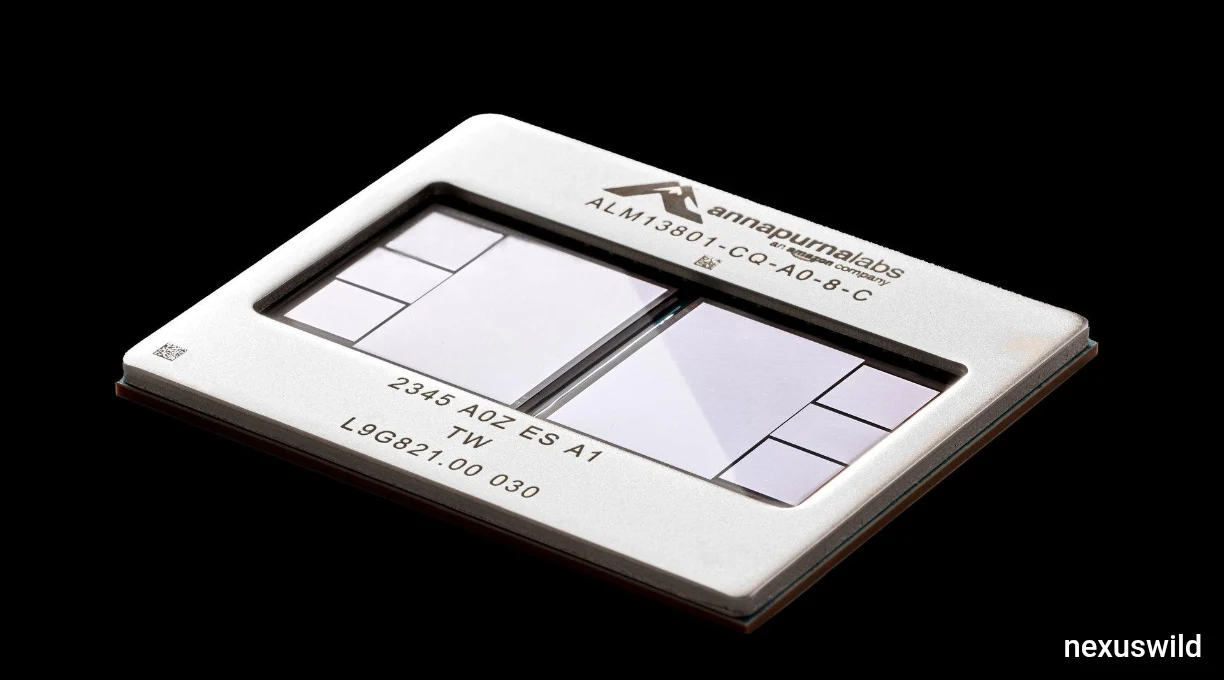
Amazon has been developing its own AI computing processors under the Trainium brand.
These accelerators are intended to support demanding AI training and inference workloads through AWS.
Trainium is strategically important because it gives Amazon greater control over the hardware used within its cloud infrastructure.
Instead of relying exclusively on external semiconductor suppliers, Amazon can develop processors tailored to its own data centres and cloud services.
However, custom silicon faces a major challenge: developers need software tools that allow them to use the hardware effectively.
Nvidia's competitive advantage is not limited to its GPUs. Its CUDA software ecosystem, libraries, development tools and established developer community have created significant switching costs.
A competing accelerator must offer more than competitive hardware specifications.
It also needs reliable software, accessible programming tools, model compatibility and strong performance across real-world workloads.
This is where Decart's technology could become valuable.
By improving the software optimisation layer, Amazon could make Trainium easier to use and more attractive to customers that currently depend on Nvidia-based infrastructure.
The acquisition therefore supports a broader strategy: building a more complete AI computing platform that combines custom processors, software optimisation and cloud infrastructure.
Why AI Inference Efficiency Is Becoming a Major Priority
AI training has historically received much of the attention in discussions about advanced computing infrastructure.
Training involves processing large datasets and updating model parameters to develop an AI system.
However, inference is becoming an equally important part of the industry's economics.
Inference refers to the process of running an already-trained model to generate predictions, responses, images, videos or other outputs.
Every time a user interacts with an AI assistant, an inference workload is executed.
As AI applications become integrated into enterprise software, search products, coding tools, customer support systems and autonomous agents, the volume of inference workloads is expected to grow.
This creates a major cost challenge.
Companies must provide computing resources continuously while balancing response speed, service reliability and operating expenses.
Improving inference efficiency can help cloud providers serve more requests using existing infrastructure.
It may also reduce the cost of running AI applications for customers.
Amazon's official announcement specifically highlights the potential to optimise inference and custom silicon performance so customers can train and run AI models faster and at lower cost.
The acquisition is therefore aligned with a shift in the AI infrastructure market from simply expanding processor capacity towards extracting more useful work from every available accelerator.
The Importance of Multi-Hardware Compatibility
One of Decart's important technical characteristics is its focus on optimisation across different processor platforms.
The AI hardware market is becoming increasingly diverse.
Nvidia remains a major supplier of AI accelerators, while Amazon and Google continue investing in their own custom silicon.
Other semiconductor companies are also developing specialised processors for training, inference and particular AI workloads.
For enterprise customers, using multiple hardware platforms can offer several advantages.
It may reduce dependence on a single supplier, improve negotiating flexibility and allow organisations to select processors according to workload requirements.
However, moving workloads between different accelerator architectures is not always straightforward.
Each hardware platform may require different optimisation techniques, programming tools and software dependencies.
This creates additional engineering work for AI developers.
A software stack that simplifies cross-platform execution could help reduce those barriers.
For Amazon, the strategic question is whether it will continue supporting broad hardware compatibility while improving Trainium-specific performance.
Maintaining compatibility with third-party accelerators could preserve the wider usefulness of the technology.
At the same time, deeper integration with Trainium could give AWS an advantage within its own infrastructure ecosystem.
The eventual product direction and commercial availability of the acquired technology remain important developments to watch.
The Reported $7.5 Billion Deal and Decart's Previous Valuation
The reported financial value is one of the most striking aspects of the transaction.
Amazon has not publicly disclosed how much it will pay for the technology and related assets.
Bloomberg reported an acquisition value of approximately $7.5 billion, citing a person familiar with the transaction.
That figure is considerably higher than Decart's reported valuation of nearly $4 billion following its May 2026 funding round.
The difference illustrates how valuable specialised AI infrastructure capabilities have become as major technology companies compete for software expertise and experienced engineering teams.
However, the $7.5 billion figure should be treated as a reported transaction value rather than a confirmed official purchase price.
Israeli business publication Calcalist separately reported that the consideration would involve cash and stock paid through multiple instalments.
That reporting also described conditions linked to performance and retention. Amazon's public announcement has not confirmed those detailed payment arrangements.
It is therefore important not to present the reported payment structure as an established contractual fact.
The transaction's final disclosed financial details, if subsequently published, will provide a clearer picture of how Amazon values the acquired technology and talent.
Decart's $300 Million Funding Round and Nvidia's Involvement
Decart attracted significant investor attention before the Amazon agreement.
In May 2026, the company raised $300 million in a funding round led by Radical Ventures, with Nvidia participating as an investor.
The round placed Decart's reported valuation at nearly $4 billion.
The investment was notable because Decart's technology helps developers optimise AI workloads across multiple hardware platforms, including products from companies competing with Nvidia.
This reflects an important distinction between investing in an AI software company and controlling the entire hardware ecosystem in which its products operate.
Nvidia's participation demonstrated investor interest in software that can improve AI computing efficiency, even when that software supports competing processors.
For Amazon, the acquisition could provide more direct control over a technology platform that has already worked with its Trainium ecosystem.
The transaction also illustrates how the value of AI infrastructure companies is increasingly connected to their ability to solve practical engineering problems rather than simply develop another generative AI model.
Anthropic's Earlier Interest and the Competition for AI Talent
Decart had reportedly attracted interest from other major AI companies before Amazon signed its agreement.
Reuters reported, citing Bloomberg, that Anthropic had explored acquiring the company before deciding against proceeding after due diligence.
Reports also described earlier discussions involving Nvidia.
The reported $6 billion figure associated with Anthropic's discussions should be treated as media reporting rather than a confirmed offer or completed transaction.
The wider development highlights the growing competition for specialised AI engineers, compiler developers and researchers with experience in large-scale computing systems.
AI companies are increasingly recognising that improving infrastructure efficiency can provide significant strategic benefits.
Recruiting an experienced engineering team can accelerate development more quickly than building every capability internally.
For Amazon, bringing Decart's founders and researchers into its organisation could help strengthen its AI infrastructure roadmap.
However, hiring a team does not automatically guarantee that its technology will integrate smoothly into a larger organisation or deliver the expected performance improvements.
Execution, retention and integration will remain important factors.
Amazon's Custom Silicon Competition With Nvidia
Amazon's investment in Decart comes at a time when cloud providers are trying to reduce their dependence on external AI chip suppliers.
Nvidia has established a powerful position in the AI accelerator market through its GPUs and software ecosystem.
Its CUDA platform has become deeply integrated into AI development workflows.
This creates a significant challenge for alternative chip providers.
Even if a competing processor offers attractive hardware specifications, developers may hesitate to migrate if their existing software and models require substantial changes.
Amazon's Trainium strategy seeks to address this problem by combining custom processors with cloud services and software development tools.
The acquisition of Decart could strengthen the software component of that strategy.
Improved compiler and kernel optimisation could help AWS customers achieve better performance from Trainium hardware without requiring extensive manual engineering.
This could make Trainium more attractive for selected workloads, particularly where cost efficiency and large-scale deployment are important.
However, the acquisition does not mean that Amazon has eliminated Nvidia's software advantage.
CUDA's developer ecosystem, libraries, tools and existing adoption remain substantial competitive advantages.
Amazon must demonstrate that its alternative software environment can provide comparable reliability, usability and performance across important AI workloads.
AWS Re:Invent Could Provide Important Strategic Context
The timing of the agreement is notable because AWS re:Invent is scheduled to begin on November 30, 2026.
The annual cloud computing conference is an important platform for Amazon to present developments across its cloud infrastructure, AI services, custom processors and developer ecosystem.
The Decart acquisition could become relevant to the broader discussion around Trainium and AI computing efficiency.
Industry observers will be watching for additional information about how the technology could be integrated into AWS products.
Important areas to monitor include:
- Trainium software compatibility.
- Improvements in inference throughput.
- Compiler and kernel optimisation capabilities.
- Support for different AI model architectures.
- Developer access to optimisation tools.
- Enterprise deployment options.
- Pricing and performance comparisons across accelerator platforms.
However, Amazon has not confirmed that the Decart technology will be commercially launched or demonstrated at re:Invent.
The conference should therefore be treated as a relevant upcoming industry event, not as a confirmed announcement date for the acquired technology.
What the Acquisition Could Mean for Enterprise AI Customers
For businesses deploying AI systems, computing cost is becoming an important part of technology strategy.
Enterprises increasingly use AI for document processing, customer service, software development, data analysis, search and automated workflows.
These applications can generate significant inference workloads.
The economics of deployment depend on several factors, including model size, token generation speed, accelerator utilisation, memory consumption and infrastructure pricing.
Better optimisation can potentially improve the amount of useful work completed by each processor.
For AWS customers, stronger Trainium performance could create additional infrastructure choices.
Businesses may be able to evaluate whether particular workloads can run more economically on Amazon's custom accelerators.
The benefits will depend on actual application requirements.
Some models and workloads may be better suited to particular GPU or accelerator architectures.
Others may require software libraries or specialised functionality that is more mature on competing platforms.
Enterprises will therefore continue evaluating total cost of ownership, performance, compatibility and operational reliability rather than selecting processors based on acquisition announcements alone.
Risks and Challenges Facing Amazon's Decart Strategy
Despite the strategic potential, the acquisition comes with several challenges.
Technology integration: Integrating Decart's software into Amazon's existing infrastructure could require significant engineering work.
Team retention: The value of the acquisition depends partly on retaining the founders and specialised researchers who developed the technology.
Hardware compatibility: Maintaining support across multiple accelerator platforms while prioritising Trainium could involve difficult product decisions.
Developer adoption: So
Nexuswild welcomes factual corrections. Email contact@nexuswild.com with evidence and the article URL.