
CortexSpark Ventures Launches ₹1,000 Crore Deep-Tech Fund to Back Around 20 Indian Startups
India's deep-technology investment landscape is gaining another institutional capital provider after CortexSpark Ventures announced the launch of its debut investment vehicle, Viksit Bharat Fund-I, on November 24, 2026.
The fund is targeting a corpus of ₹1,000 crore, approximately $108 million, with an additional ₹400 crore greenshoe option that could increase its potential capacity to ₹1,400 crore.
Registered with the Securities and Exchange Board of India (SEBI) as a Category II Alternative Investment Fund under the name CortexSpark Ventures Alpha Fund, the vehicle intends to invest in approximately 20 Indian startups developing proprietary technologies across strategically important industries.
The investment strategy covers six sectors: space technology, defence technology, embodied artificial intelligence and robotics, enterprise AI, medtech and bio-AI, and energy and advanced materials.
The firm is led by managing partners Vinay Peshwa and Sanjay Khanduri. Its investment committee is chaired by Manoj Kohli, the former chief executive and managing director of Bharti Airtel and former country head of SoftBank Group in India.
The fund is also bringing scientific expertise into its investment process through advisers including Dr. N. Vedachalam, former director of ISRO's Liquid Propulsion Systems Centre, and Professor Ashutosh Sharma, former secretary of India's Department of Science and Technology.
CortexSpark intends to combine scientific assessment, commercial due diligence and AI-enabled investment processes to identify startups with defensible intellectual property and pathways towards commercialisation.
The launch comes as India seeks to expand its capabilities in advanced manufacturing, aerospace, defence, robotics, artificial intelligence and other research-intensive industries.
CortexSpark Ventures Introduces Viksit Bharat Fund-I
CortexSpark Ventures has entered India's venture capital market with the launch of Viksit Bharat Fund-I, its first dedicated deep-tech investment vehicle.
The fund has a target base corpus of ₹1,000 crore and an additional ₹400 crore greenshoe option.
If the additional option is fully exercised, the potential fund size could reach ₹1,400 crore.
However, the distinction between a target corpus and capital actually raised is important.
The announcement establishes the fund's fundraising ambition and investment strategy. It does not mean that ₹1,000 crore has already been collected from investors or committed to portfolio companies.
The fund's stated objective is to support businesses developing original technology with the potential to address complex industrial and scientific challenges.
Unlike conventional software startups that may scale through relatively low-cost digital distribution, deep-tech companies often require substantial expenditure on research, specialised equipment, prototypes, testing, regulatory approvals and manufacturing infrastructure.
These requirements can create financing gaps between early-stage research and commercial deployment.
CortexSpark's investment strategy is designed to address part of that gap by providing institutional venture capital alongside technical and commercial support.
₹1,000 Crore Target With a ₹400 Crore Greenshoe Option
The financial structure gives the fund an initial fundraising target of ₹1,000 crore, with an additional ₹400 crore option.
The base target is approximately $108 million using the conversion quoted in launch coverage.
The additional greenshoe option could increase the potential corpus to approximately $150 million, depending on the exchange rate and whether the option is fully exercised.
The firm plans to invest in approximately 20 companies, with reported average investment sizes of $4 million to $5 million.
This suggests that the fund is targeting meaningful institutional ownership positions rather than distributing very small amounts across a large number of startups.
At an indicative average investment of $4.5 million, 20 companies would require approximately $90 million in direct investment capital.
That is broadly consistent with a fund targeting approximately $108 million, although actual portfolio construction will also need to account for follow-on investments, management expenses, reserves and other fund obligations.
The reported cheque range should therefore be understood as an investment strategy, not a guaranteed amount for every company.
The additional ₹400 crore greenshoe option could provide greater flexibility if fundraising demand and investment opportunities justify a larger vehicle.
Six Strategic Sectors Form the Fund's Investment Thesis
Viksit Bharat Fund-I is organised around six investment themes.
These sectors have been selected because they involve technical complexity, proprietary intellectual property and opportunities to develop products for Indian and international markets.
- Space Technology
Space technology is one of India's emerging deep-tech investment opportunities.
The sector includes satellite manufacturing, launch systems, propulsion, spacecraft components, Earth observation and downstream data applications.
India's private space ecosystem has expanded following reforms that created greater opportunities for private companies to participate in space-related activities.
Startups are developing technologies across satellite communications, remote sensing, launch infrastructure, space components and geospatial intelligence.
However, space businesses face substantial technical and commercial challenges.
Building hardware requires testing, certification, launch access, specialised engineering and significant capital.
Revenue models may also take time to mature because customers often include government agencies, defence organisations and large commercial operators.
CortexSpark's interest in space technology reflects the opportunity to support companies developing differentiated products rather than simply offering software services around existing satellite infrastructure.
- Defence Technology
Defence technology is another important investment area.
The sector includes autonomous systems, intelligence, surveillance and reconnaissance platforms, electro-optical and infrared systems, advanced sensors and specialised defence equipment.
India has been encouraging domestic development of defence products and reducing dependence on imported technologies in strategically important categories.
This creates potential opportunities for startups developing indigenous systems and components.
However, defence technology companies face specific challenges.
Products may require extensive testing, certification, security assessments and approval from government procurement organisations.
Commercial cycles can also be significantly longer than those in conventional software markets.
A startup may develop a technically advanced product but still require substantial time to secure trials, establish manufacturing capacity and obtain procurement contracts.
For investors, technical differentiation and access to actual customers are therefore essential considerations.
CortexSpark's proposed focus on defence technology suggests an interest in companies that can move beyond prototypes towards validated and commercially deployable systems.
- Embodied AI and Robotics
Embodied AI refers to artificial intelligence systems that interact with the physical world through machines, robots and autonomous equipment.
Unlike conventional software AI, these systems must interpret their surroundings, make decisions and execute physical actions.
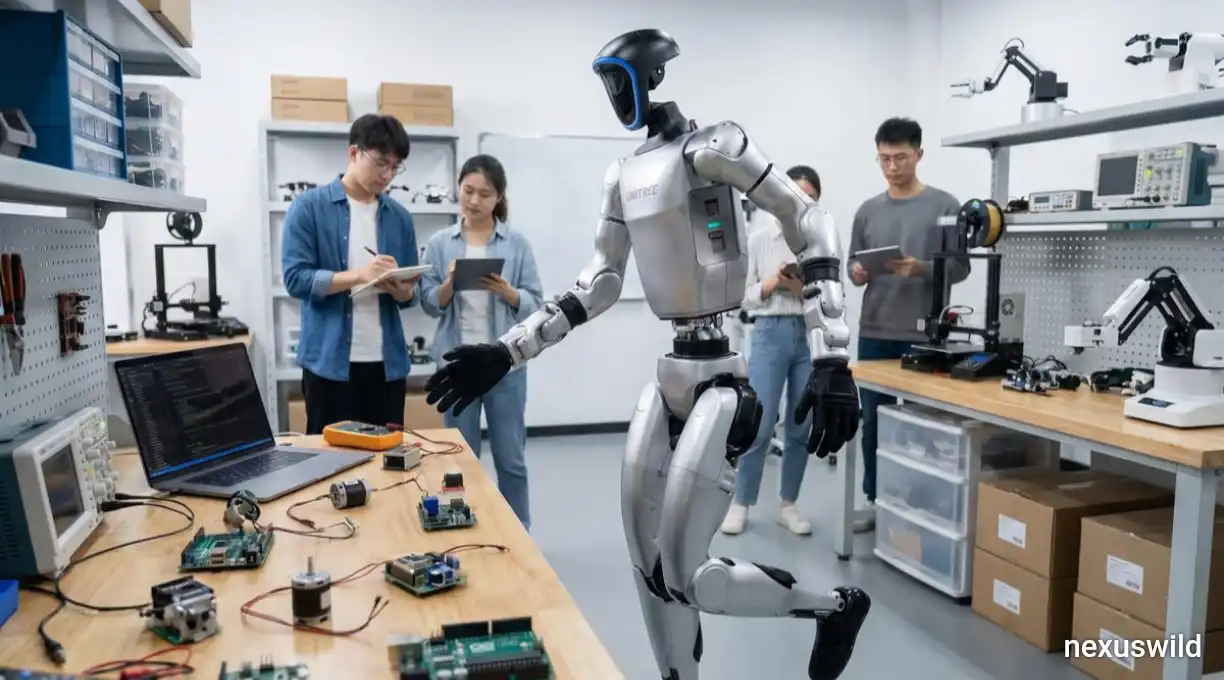
The investment category includes industrial robotics, autonomous machines, marine robotics, robotic manipulation and other physical AI applications.
Robotics startups often need to combine several specialised technologies:
- Computer vision and perception.
- AI-based planning and decision-making.
- Sensors and control systems.
- Motors, actuators and mechanical engineering.
- Real-time computing.
- Safety and reliability systems.
The commercial opportunity extends across manufacturing, logistics, agriculture, healthcare, infrastructure and industrial automation.
However, scaling robotics businesses can be difficult because hardware production, installation, maintenance and customer support introduce costs that software companies may not face.
A successful robotics startup must demonstrate not only that its technology works but also that it can operate reliably and economically in real-world environments.
CortexSpark's inclusion of embodied AI and robotics reflects the growing investment interest in AI systems that move beyond screens and operate in physical environments.
- Enterprise Artificial Intelligence
Enterprise AI is another major investment theme.
The category includes agentic systems, cybersecurity platforms, industry-specific AI applications and tools designed to automate complex business processes.
Businesses are increasingly exploring AI for software development, financial operations, customer support, data processing and internal workflows.
However, enterprise adoption requires more than a functioning AI model.
Companies need systems that can integrate with existing software, protect sensitive information, meet regulatory requirements and operate reliably.
This creates opportunities for startups developing specialised AI infrastructure and applications.
Potential areas include enterprise agents, security automation, workflow orchestration, data governance and industry-specific AI systems.
The fund's focus on defensible intellectual property suggests that it intends to distinguish between companies developing meaningful technical capabilities and those offering relatively easy-to-replicate application layers.
For enterprise AI startups, durable advantages may come from proprietary data, specialised models, difficult integrations, technical infrastructure and measurable customer value.
- MedTech and Bio-AI
Healthcare technology combines scientific research, medical engineering, software and regulatory requirements.
CortexSpark's medtech and bio-AI investment theme includes diagnostics, medical devices, biotechnology, cell and gene therapy, and clinical infrastructure.
India has a large healthcare market and a growing base of scientific and engineering talent.
Startups are developing technologies that could improve disease detection, diagnostics, medical equipment, healthcare delivery and biotechnology research.
Bio-AI is also creating opportunities to apply computational methods to biological research and clinical development.
However, this sector carries substantial technical and regulatory risks.
Medical products may require clinical validation, regulatory approvals and evidence of safety and effectiveness before commercial deployment.
Biotechnology companies may also require long development cycles and significant capital before generating meaningful revenue.
For investors, scientific credibility, intellectual property protection, clinical evidence and regulatory strategy are critical.
The fund's inclusion of this category indicates an interest in research-intensive healthcare businesses rather than only consumer-facing health applications.
- Energy and Advanced Materials
The sixth investment category focuses on energy technology and advanced materials.
Potential areas include hydrogen systems, energy storage, filtration, critical materials and specialised industrial applications.
Energy storage is particularly relevant as electricity demand increases and renewable energy deployment expands.
Advanced batteries, improved materials and more efficient industrial processes could support applications across transportation, manufacturing and power infrastructure.
Hydrogen technologies may also create opportunities in industrial applications and energy systems, although commercial economics vary considerably across production and storage methods.
Advanced materials businesses often require specialised laboratories, testing infrastructure and manufacturing capabilities.
Their technologies must demonstrate performance advantages, production consistency and cost competitiveness.
For investors, the main challenge is converting scientific breakthroughs into commercially viable products.
CortexSpark's investment thesis is designed to target companies where proprietary technology could create defensible positions in strategic industrial markets.
Investment Strategy Targets Approximately 20 Startups
The fund plans to build a portfolio of approximately 20 Indian deep-tech startups.
Reported average investment sizes are between $4 million and $5 million per company.
This suggests a strategy focused on companies with meaningful technical development and commercialisation requirements.
A larger investment can provide startups with the resources needed to move from research and prototypes towards product validation, manufacturing preparation and initial market expansion.
However, the number of companies and cheque sizes are plans rather than completed investments.
The final portfolio could differ depending on fundraising progress, valuation conditions, investment opportunities and the fund's internal allocation decisions.
The firm has indicated that it will prioritise companies with several characteristics:
Defensible intellectual property: Businesses should own or control technology that creates a meaningful competitive barrier.
Strong technical foundations: Products should be supported by credible engineering, scientific research or differentiated technical capabilities.
Experienced founders: Teams should have the expertise required to manage difficult technical and commercial development cycles.
Commercialisation potential: Startups should demonstrate credible pathways towards customers, revenue and scalable operations.
Strategic relevance: Technologies should address meaningful industrial, scientific or infrastructure requirements.
This approach is intended to reduce the risk of investing in businesses whose technical achievements cannot translate into sustainable commercial products.
Vinay Peshwa and Sanjay Khanduri Lead the Venture Firm
CortexSpark Ventures is led by managing partners Vinay Peshwa and Sanjay Khanduri.
The leadership combines technology development experience with financial markets, investment management and business-building backgrounds.
Vinay Peshwa
Vinay Peshwa is an IIT Kanpur alumnus with experience across software, banking technology, entrepreneurship and startup investing.
He was involved in the development of Infosys Finacle, a major banking technology platform.
His background also includes angel investment activity, particularly in artificial intelligence and deep-tech companies.
The experience is relevant to CortexSpark's investment strategy because many of the targeted businesses require an understanding of both complex technology and enterprise commercialisation.
Sanjay Khanduri
Sanjay Khanduri has an academic background associated with IIT (BHU), IIM Lucknow and Wharton.
His professional experience includes capital markets, alternative investments and financial services.
He has previously been associated with Citigroup, Infosys and Standard Chartered.
His experience provides a financial and investment-management perspective to the firm's approach.
Together, the managing partners are positioning CortexSpark as a specialised investment platform that combines technical evaluation with commercial and financial discipline.
Manoj Kohli to Chair the Investment Committee
The fund's Investment Committee will be chaired by Manoj Kohli.
Kohli previously served as chief executive and managing director of Bharti Airtel and held a leadership role as country head of SoftBank Group in India.
His experience includes telecommunications, business expansion, technology investments and corporate leadership.
The Investment Committee role is important because deep-tech investment decisions involve risks that cannot be assessed through conventional financial metrics alone.
A company may possess impressive scientific research but lack a commercially viable product.
Another startup may have strong early revenue but insufficient intellectual property protection.
Investment decisions must balance technology readiness, market demand, capital requirements, competitive positioning and potential returns.
Kohli's commercial and operating experience could provide an additional perspective when evaluating these factors.
However, the presence of a prominent committee chair should not be interpreted as a guarantee of investment performance.
The fund's returns will ultimately depend on the quality of its investment decisions and the performance of its portfolio companies.
Scientific Advisers Bring ISRO and IIT Kanpur Experience
CortexSpark is also building a scientific advisory bench to support the evaluation of technically complex businesses.
Two prominent names associated with the advisory structure are Dr. N. Vedachalam and Professor Ashutosh Sharma.
Dr. N. Vedachalam
Dr. N. Vedachalam is a former director of ISRO's Liquid Propulsion Systems Centre.
His experience includes India's propulsion development activities and contributions to space missions.
His background is particularly relevant to startups working on propulsion, aerospace engineering, satellite systems and other technically demanding space applications.
Professor Ashutosh Sharma
Professor Ashutosh Sharma previously served as secretary of the Department of Science and Technology.
He is also associated with IIT Kanpur as an Institute Chair Professor.
His experience includes scientific research, technology development and India's wider research and innovation ecosystem.
His expertise could help evaluate companies working in advanced materials, scientific engineering and research-led technologies.
The participation of scientific advisers is relevant because deep-tech investment requires an understanding of technology readiness, research quality, engineering constraints and commercial feasibility.
However, advisory participation should be distinguished from formal investment approval and operational management.
The Investment Committee remains the relevant decision-making body described in the fund structure.
CortexSparkOS: Applying Artificial Intelligence to Venture Capital
One of the distinctive elements of CortexSpark's strategy is its planned AI-enabled investment platform, CortexSparkOS.
The company describes its broader approach as venture investing powered by artificial intelligence, supported by human expertise and scientific judgement.
CortexSparkOS is being developed to support several investment activities:
Deal sourcing: Identifying startups, founders and technology opportunities across the firm's target sectors.
Screening: Organising information about companies and assessing whether they match the fund's investment criteria.
Due diligence: Supporting the collection and analysis of technical, commercial and financial information.
Portfolio monitoring: Helping track the progress of companies after investment.
The platform is intended to improve the efficiency of the fund's investment workflow.
For example, AI-based tools could help organise technical documents, identify relevant research, compare companies and monitor changes in markets.
This could be particularly useful in sectors where investment opportunities are distributed across specialised scientific communities, research institutions and industrial networks.
However, AI-generated analysis should not replace independent technical verification or human investment judgement.
Nexuswild welcomes factual corrections. Email contact@nexuswild.com with evidence and the article URL.