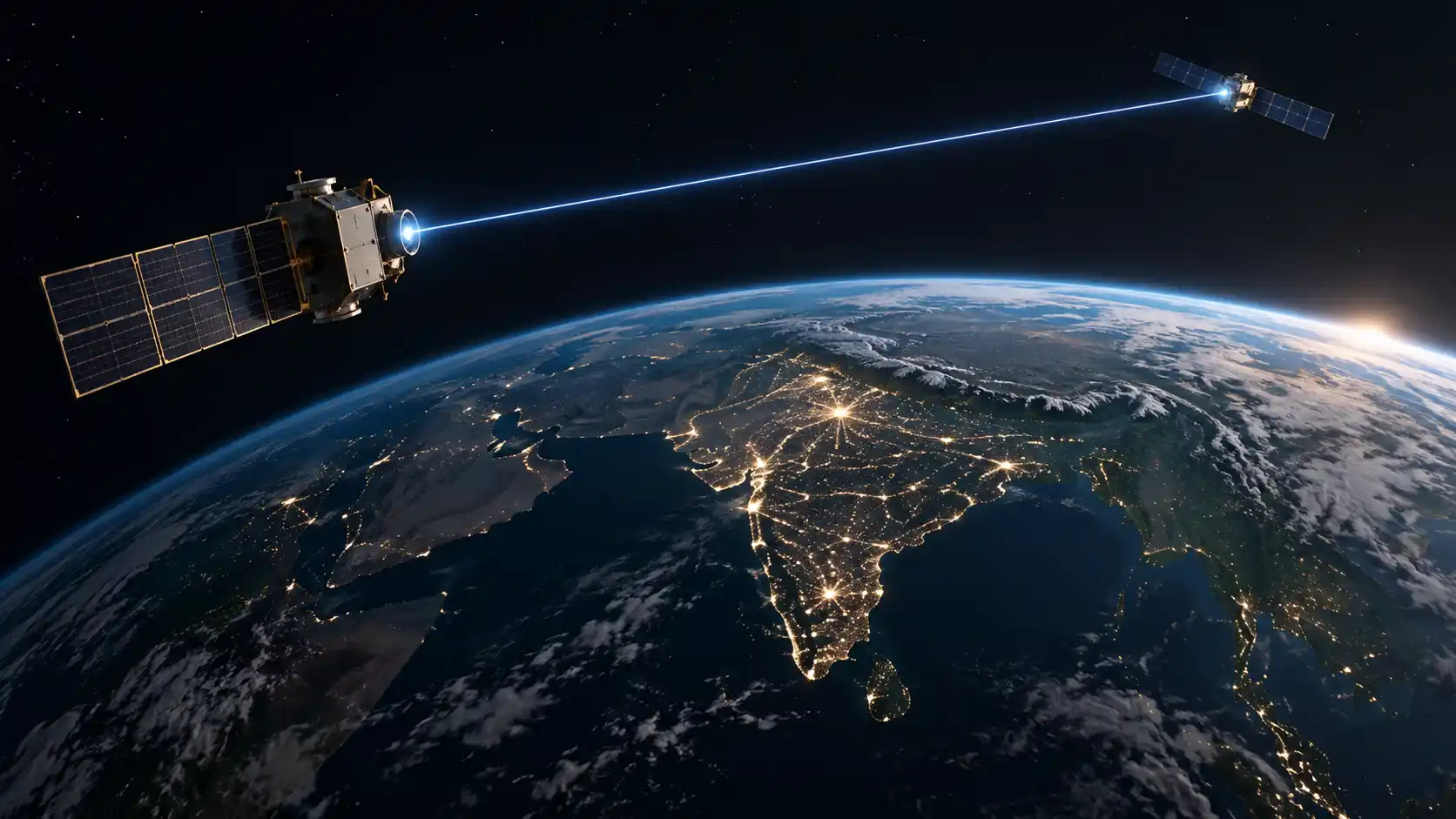

Bengaluru-based deep-tech company Astrogate Labs is developing India's first indigenous Optical Inter-Satellite Link (OISL) terminal, a laser-based system that would let satellites communicate directly with one another rather than relying solely on radio signals routed through ground stations. The company unveiled this capability alongside a live demonstration of its AstroLink Micro terminal at the Bengaluru Space Expo, held September 7 to 9, 2026, at the Bangalore International Exhibition Centre, building on laser communication hardware it has already supplied to India's space agency, ISRO.
Who Is Astrogate Labs?
Astrogate Labs was founded in 2017 by Nitish Singh and Aditya Kedlaya, both IIT alumni and former engineers at Team Indus, alongside co-founders Jayaraman Yogeshwaran and Subhajit Chakraborty. The company, headquartered in Bengaluru with an additional office in Durham, England, designs and manufactures Free Space Optical Communication (FSOC) terminals for space and defence applications, developing its own Pointing, Acquisition and Tracking (PAT) systems and optical modems in-house rather than relying on third-party subsystems. According to funding data compiled by Inc42 and CB Insights, the company has raised a total of approximately 1.3 million dollars across several early-stage rounds, with its most recent round, led by Piper Serica Angel Fund, closing in February and March 2025.
How Laser-Based Satellite Communication Works
Traditional satellite communication relies on radio-frequency (RF) signals, which travel through allocated portions of the electromagnetic spectrum that are increasingly congested as more satellites and ground systems compete for limited bandwidth. Optical, or laser-based, communication instead uses highly directional beams of light to carry data, a method broadly known as Free Space Optical Communication. Because a laser beam is far narrower and more tightly focused than a typical RF signal, it can carry substantially more data through less spectrum, while also being inherently harder to intercept, since a receiver must be precisely positioned within the narrow beam path to pick up the signal.
This precision, however, is also the technology's central engineering challenge. Two communicating terminals, whether one is on the ground and one in orbit, or both are satellites travelling at orbital speeds of several kilometres per second, must locate each other, lock onto each other's beam, and maintain that alignment continuously as both move. This is the function of a PAT system, which finds the other terminal, acquires a stable connection, and tracks it to keep the link intact. For links between a satellite and the ground specifically, atmospheric conditions add a further complication: cloud cover, turbulence and weather can disrupt or block a laser signal in ways that traditional RF links, which penetrate weather more easily, generally do not experience to the same degree. Links between two satellites in orbit, known as inter-satellite links, avoid this atmospheric problem since both terminals operate in the vacuum of space, but they still require the same exacting pointing and tracking precision between two fast-moving objects.
Astrogate Labs' Technology and Developments
Astrogate's work has progressed in stages since its founding. Company statements describe its space-to-ground laser communication terminals as having reached Technology Readiness Level 8, a standard engineering scale indicating a system is complete and qualified for flight rather than still in prototype or testing form. Astrogate says it has supplied an indigenously developed satellite-to-ground laser communication terminal to ISRO, which the company describes as making it the only Indian company to have delivered this specific technology to India's national space agency.
At the Bengaluru Space Expo, Astrogate demonstrated AstroLink Micro, a 10 Gbps space-to-ground laser communication terminal, alongside unveiling its OISL terminal effort, which is aimed specifically at satellite-to-satellite links. According to co-founder and CTO Jayaraman Yogeshwaran, the core building blocks of the OISL terminal, including its PAT system, optical modem, stabilised coarse tracking gimbals and overall system integration, were originally developed and validated for Astrogate's space-to-ground terminals and are now being carried over to the inter-satellite link design. "That inheritance is what puts flight readiness within reach by 2027," Yogeshwaran said.
Key Missions, Tests and Partnerships
Beyond its ISRO-supplied ground terminal, Astrogate has also completed cross-compatibility testing with the University of Western Australia's TeraNet mobile optical ground station, confirming that its terminal design can interoperate with international ground infrastructure rather than only Astrogate's own equipment. Founder and CEO Nitish Singh described the company's trajectory in comments made at the expo: "Some time back, laser communication from India was a research question. Today it is a product we deliver, with ISRO as a customer. OISL is the harder problem, and it is the one that decides who builds the connectivity layer for future LEO constellations. We are building it, with technology owned end to end in India." The OISL terminal itself remains under development, with Astrogate targeting flight readiness, not a confirmed launch or in-orbit demonstration, by 2027.
Benefits of Optical Space Communication
Astrogate has said it is targeting three specific markets for its OISL terminal:
- Satellite Backhaul: Moving data between satellites in a constellation before it reaches the ground.
- Sovereign Defence Constellations: Providing secure, hard-to-intercept links that are particularly valuable for military operations.
- Orbital Compute: An emerging category involving data processing performed directly in space.
As satellite constellations generate increasing volumes of imaging, communication and sensor data, optical links offer a path to move that data through a network of satellites at high speed and with reduced exposure to spectrum congestion, compared with conventional RF-based approaches.
Challenges and Technical Limitations
Despite these advantages, optical communication carries real technical limitations. Precise pointing and tracking between fast-moving satellites, or between a satellite and a ground station, remains inherently more demanding than the wider tolerances RF systems allow. Ground-based optical links remain vulnerable to weather and atmospheric interference in ways that inter-satellite links are not, meaning a fully optical network would still likely depend on RF or a distributed network of ground stations in varied locations to ensure reliable data downlink. As with any newly developed system, moving from a demonstrated, flight-qualified space-to-ground terminal to a fully flight-ready inter-satellite link, as Astrogate is now attempting, involves additional engineering validation that has not yet been completed, based on the company's own stated 2027 target rather than a confirmed current capability.
India's Growing Private Space Ecosystem
Astrogate's development work forms part of a broader expansion of private spacetech companies in India following the opening of the sector to greater private participation in recent years, a shift that has been supported by bodies including IN-SPACe, the government authority responsible for promoting and regulating private space activities in India. For context on the scale such optical networks can reach once mature, SpaceX's Starlink constellation has reported operating more than 13,000 bidirectional laser links functioning as an optical mesh in orbit, according to the company's 2025 progress report, illustrating the kind of large-scale inter-satellite optical network architecture that Astrogate's much earlier-stage OISL effort is working toward with an India-built system.
Conclusion
Astrogate Labs has moved from an early-stage laser communication research effort to a company with a flight-qualified, ISRO-supplied ground terminal and a working 10 Gbps demonstration unit, and it is now attempting the more technically demanding step of building an indigenous satellite-to-satellite optical link, targeting flight readiness in 2027. Its progress reflects the broader potential of optical communication to address bandwidth and spectrum constraints facing modern satellite constellations, while also illustrating the real engineering challenges, precise tracking, system complexity and, for ground links, weather sensitivity, that remain part of bringing this technology to full operational use. Whether Astrogate meets its 2027 flight-readiness target, and how its technology is ultimately adopted across commercial, scientific or defence satellite networks, remains to be seen based on future testing and deployment milestones the company has not yet reported.
Further reading and useful links
Reader questions
Frequently asked questions
What is Astrogate Labs developing?
Astrogate Labs is developing India's first indigenous Optical Inter-Satellite Link (OISL) terminal, a laser-based system allowing satellites to communicate directly with each other in orbit.
Has Astrogate Labs supplied technology to ISRO?
Yes, Astrogate has supplied an indigenously developed satellite-to-ground laser communication terminal to ISRO, making it the only Indian company to deliver this technology to the space agency.
When is Astrogate targeting flight readiness for its OISL terminal?
Astrogate Labs is targeting flight readiness for its inter-satellite laser link terminal by 2027.
What are the advantages of laser-based satellite communication?
Laser communication offers significantly higher data transmission speeds, uses less congested spectrum than traditional radio frequencies, and provides enhanced security because narrow beams are harder to intercept.
Nexuswild welcomes factual corrections. Email [email protected] with evidence and the article URL.