
The trucking industry is approaching a turning point as autonomous driving technology and electric vehicles begin moving from testing environments into everyday freight operations. Logistics companies are looking for ways to reduce transportation costs, improve delivery efficiency and manage growing pressure from fuel expenses, driver shortages and environmental regulations.
Swedish transportation technology company Einride is positioning itself at the centre of this transition. The company is expanding its customer network, introducing driverless electric trucks into commercial operations and developing artificial intelligence systems designed to make freight transportation more efficient.
In its third-quarter business update released on November 18, 2026, Einride reported that it had added eight new customers since June, bringing its total customer base to more than 40 businesses. Its contracted annual recurring revenue (CARR) increased 76% to approximately $167 million, compared with $95 million at the end of June.
The company also reported third-quarter revenue of $18.3 million, representing a 27% increase from the previous quarter on a constant-currency basis.
These developments suggest that demand for Einride's electric and autonomous freight services is expanding. Its driverless trucks are now operating in commercial environments in Germany and the United States, while new agreements are creating additional opportunities for deployment.
However, the company still faces challenges. Autonomous vehicle technology requires substantial investment, regulatory approval and consistent operating performance before it can become a widely adopted alternative to traditional trucking.
For Einride, the next stage is not simply proving that trucks can drive without human intervention. It is demonstrating that autonomous freight can operate safely, reliably and profitably on a much larger scale.
Einride Expands Its Customer Base as Commercial Demand Grows
One of the strongest indicators of Einride's progress is the growth of its customer network.
Between June and November 2026, the company added eight new customers, increasing its total customer base to more than 40 businesses.
Its customers and commercial relationships span industries such as retail, food and beverages, manufacturing, industrial production and logistics.
Companies associated with its customer network include Amazon, PepsiCo, Mars, Carlsberg, Heineken, GE Appliances and DP World.
This diversified customer base gives Einride opportunities to provide transportation services across different types of supply chains rather than depending on a single industry.
Its business model combines electric trucks, autonomous driving technology, digital freight management and charging infrastructure.
Through its Freight-as-a-Service model, businesses can access transportation capacity without having to purchase and manage every vehicle themselves.
Einride helps coordinate the trucks, charging requirements, freight movements and operational technology, allowing customers to focus on their core activities.
This approach is particularly attractive to companies operating large distribution networks, where transportation efficiency can have a significant effect on overall operating costs.
The addition of new customers also creates opportunities to expand existing contracts as businesses become more comfortable using electric and automated freight services.
Nevertheless, customer numbers alone do not establish commercial success. The important question is whether these relationships generate recurring revenue, higher vehicle utilisation and sustainable operating margins.
Contracted Revenue Jumps 76% to $167 Million
Einride's latest business update shows a substantial increase in the value of its customer contracts.
Contracted annual recurring revenue reached approximately $167 million in November 2026, compared with $95 million at the end of June.
That represents an increase of $72 million, or approximately 76%.
CARR measures the annualised value of qualifying contracted business. It provides an indication of future commercial demand, but it should not be confused with revenue already recognised in the company's financial statements.
The improvement suggests that more customers are committing to Einride's transportation and technology services.
The company has also reaffirmed its second-half 2026 revenue guidance of $39 million to $42 million on a constant-currency basis.
For December 2026, management expects its annualised revenue run rate to reach approximately $85 million to $95 million.
Looking further ahead, Einride is targeting approximately $250 million in annualised run-rate revenue by December 2027. More than 65% of that target is expected to be supported by contracted annual recurring revenue.
These projections indicate management's confidence in the commercial pipeline. However, achieving them will depend on the company's ability to deploy sufficient vehicles, expand customer operations and deliver contracted services on schedule.
Lidl Deployment Brings Driverless Electric Trucks to German Roads
One of Einride's most important developments is its collaboration with German supermarket retailer Lidl.
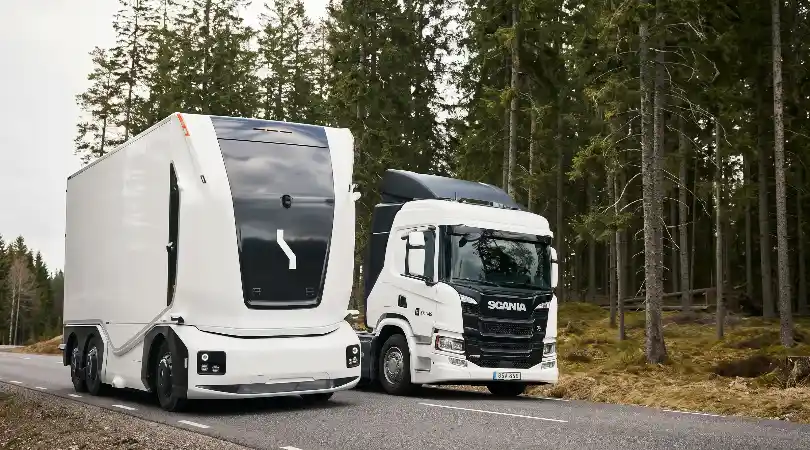
In September 2026, the two companies introduced a cab-less autonomous electric truck into daily commercial operations on a public road in Germany.
The project operates under a special permit issued by Germany's Federal Motor Transport Authority, known as the Kraftfahrt-Bundesamt (KBA).
The truck transports goods from Lidl's logistics centre in Edermünde to a nearby retail store.
The vehicle has space for 15 European pallets and can operate up to three times daily on the designated route.
During the four-month project, the companies expect it to transport more than 3,000 pallets.
The deployment is particularly significant because the truck operates without a driver or safety operator onboard during its authorised daily operations.
The project uses SAE Level 4 autonomous driving technology, meaning the vehicle can perform driving tasks independently within its approved operating conditions.
It is not unrestricted autonomous driving. The system operates within a defined route and regulatory framework, with the necessary permissions and operational safeguards in place.
For Lidl, the project provides an opportunity to evaluate autonomous transportation within an established supply chain.
For Einride, it offers a real-world demonstration of how driverless electric trucks can be integrated into retail distribution.
Successful results could provide a reference for future deployments with other retailers and logistics companies.
Lorenz Snacks and EASE Logistics Expand Autonomous Operations
Einride is also expanding its driverless transportation activities through partnerships with businesses in Germany and the United States.
In Germany, the company announced a five-year deployment agreement with snack manufacturer Lorenz Snacks.
The project involves four autonomous electric vehicles operating at the company's facility in Neunburg vorm Wald.
The trucks are expected to transport an average of approximately 1,200 pallets per day.
This type of operation is particularly suitable for automation because industrial facilities often have established transportation routes, predictable schedules and repeated loading and unloading activities.
In the United States, Einride has partnered with EASE Logistics to introduce two cab-less autonomous electric trucks in daily freight operations in Marysville, Ohio.
These deployments demonstrate that the technology is moving beyond controlled demonstrations and into commercial supply-chain activities.
The applications also show that autonomous trucking does not need to begin with complicated long-distance highway journeys.
Repeated transportation between factories, warehouses and nearby distribution facilities can provide a practical starting point for testing the technology.
As operating experience increases, companies may be able to expand autonomous services into additional logistics corridors, subject to regulatory permissions.
Driverless Operations Reach 8,500 Hours
Einride reported that its autonomous vehicles had completed approximately 8,500 hours of contracted driverless operations by November 13, 2026.
This compares with approximately 5,400 hours at the end of June.
The increase represents meaningful progress in the company's commercial deployment programme.
It indicates that autonomous vehicles are receiving more operating exposure in real customer environments rather than remaining limited to occasional testing activities.
Einride also reported that it had obtained permits to operate without a safety driver in four countries and five US states.
These permissions are important because autonomous vehicle regulations differ between jurisdictions.
A company cannot automatically transfer approval from one country or state to another. Each deployment must meet the relevant legal, technical and safety requirements.
The accumulated operating hours provide useful experience, although they do not by themselves establish a particular safety record or prove that the technology is ready for unrestricted highway operations.
For Einride, gathering real-world operating data will be essential to improving autonomous driving performance and building confidence among customers and regulators.
Electric Trucks and Artificial Intelligence Strengthen the Business Model
Einride's growth strategy combines two developments transforming the transportation industry: vehicle electrification and autonomous driving.
Electric trucks can reduce exposure to diesel fuel prices and potentially lower operating costs, particularly on predictable routes with suitable charging infrastructure.
Autonomous technology offers another potential benefit by automating driving tasks and improving vehicle utilisation.
The company is also investing in software to coordinate its transportation network.
Its Saga AI platform manages freight planning and uses operational information to help improve logistics decisions.
According to Einride, Saga AI is trained on data from more than 20 million miles of customer operations.
This information can support route planning, vehicle allocation and freight scheduling.
The company is also working with NVIDIA to develop the next generation of its autonomous driving system, Einride Driver.
The collaboration uses NVIDIA's Hyperion autonomous vehicle platform and incorporates the NVIDIA Halos safety system.
In October 2026, Einride announced plans to evaluate NVIDIA's Alpamayo AI technology using its own operational driving data.
A live road evaluation is planned for the second half of 2027.
The partnership demonstrates how specialised transportation companies are increasingly relying on advanced AI computing and software platforms to improve vehicle autonomy.
For Einride, combining its freight data with NVIDIA's technology could support further development of autonomous driving capabilities.
Tesla Semi Agreement Could Expand Electric Freight Capacity
Vehicle availability will be another important factor in Einride's future expansion.
In August 2026, the company announced plans to add 500 Tesla Semi electric trucks to its fleet over approximately 24 months.
The deployment is expected to take place in phases, with most of the planned vehicles targeted for delivery during 2027.
The agreement could significantly increase Einride's electric freight capacity and allow it to serve larger transportation contracts.
However, the Tesla Semi programme is primarily an electric truck expansion initiative. The vehicles should not automatically be classified as autonomous or driverless.
Einride's business includes conventional electric trucks as well as specially developed autonomous vehicles.
Keeping these categories separate is important when measuring actual progress in autonomous transportation.
A larger electric fleet could nevertheless support the company's broader business by increasing transportation capacity and providing more opportunities to integrate its digital freight management systems.
Financial Performance Shows Growth but Profitability Remains a Challenge
Einride's third-quarter performance indicates improving commercial activity, although the company is still investing heavily in expansion.
Revenue reached SEK 185.9 million, equivalent to approximately $18.3 million, compared with SEK 146.7 million in the second quarter. This represents 27% sequential growth on a constant-currency basis.
The company attributed the improvement to higher transportation capacity among existing customers and additional customer deployments.
However, its adjusted EBITDA remained negative at approximately SEK 206.9 million, equivalent to $20.3 million, on a constant-currency basis.
Its cash position also declined from SEK 748 million at the end of June to SEK 533 million at September 30, 2026.
These figures highlight the financial demands of building an autonomous transportation business.
Einride must invest in vehicles, charging infrastructure, software development, engineering and operational support before it can generate sufficient revenue from a larger commercial network.
To manage these requirements, the company intends to use asset-backed and third-party financing to fund fleet expansion instead of relying entirely on its own equity capital.
Management continues to target cash flow break-even in 2028, when it expects to operate approximately 1,500 to 2,000 vehicles.
Reaching this milestone will depend on higher fleet utilisation, improved operating efficiency and continued customer growth.
Competition in the Autonomous Trucking Industry Intensifies
Einride is entering a market where several technology companies are developing autonomous freight solutions.
Aurora Innovation is working on autonomous long-haul trucking, while Kodiak AI is developing driverless systems for commercial transportation and industrial applications.
Waabi is also investing in artificial intelligence and autonomous driving technology for freight transportation.
These businesses are competing to demonstrate that driverless trucks can operate safely and economically under real transportation conditions.
Einride has a different commercial approach because it combines autonomous vehicles with electric freight services and digital fleet management.
This integrated model may appeal to customers who prefer purchasing a complete transportation solution rather than sourcing vehicles, software and charging infrastructure separately.
However, competition will depend on more than technological capability.
Companies must demonstrate consistent delivery performance, regulatory compliance, competitive pricing and the financial strength to support large fleets.
The industry is likely to expand gradually as autonomous operations move from selected routes towards wider commercial networks. Future Outlook: Einride Targets $250 Million in Annualised Revenue Einride's next major objective is to increase its commercial scale while improving its financial performance.
The company expects to reach approximately $250 million in annualised run-rate revenue by December 2027, with more than 65% of this target supported by contracted customer business.
Its longer-term ambition is to exceed $2 billion in annualised run-rate revenue by 2030.
A major part of this strategy involves introducing highway autonomy from the first half of 2028.
Einride believes that its next-generation autonomous technology could eventually automate up to 80% of its freight network.
The company also intends to license Saga AI and Einride Driver to vehicle manufacturers and other fleet operators.
Licensing could create a new revenue stream without requiring Einride to purchase and operate every truck itself.
However, these figures represent forward-looking management targets rather than guaranteed outcomes.
The speed of expansion will depend on regulatory approvals, vehicle production, customer commitments, financing availability and the ability to demonstrate reliable autonomous performance.
For investors and logistics operators, the most important indicators will be contracted revenue, actual vehicle deployments, driverless operating hours and progress towards cash flow break-even.
Conclusion
Einride's latest business update highlights the growing commercial interest in autonomous and electric freight transportation.
The addition of eight customers, bringing its total to more than 40, and the 76% increase in contracted annual recurring revenue to $167 million demonstrate that its business is expanding.
Its deployments with Lidl, Lorenz Snacks and EASE Logistics also show how driverless electric trucks are beginning to handle everyday commercial transportation tasks in Europe and the United States.
Partnerships with NVIDIA and Tesla provide further opportunities to strengthen its technology and expand fleet capacity.
However, the company still faces substantial challenges, particularly operating losses, financing requirements, regulatory restrictions and the need to prove that driverless transportation can work reliably at scale.
For Einride, the next stage will be about turning commercial interest into consistent operating revenue and sustainable profitability.
As logistics companies search for more efficient ways to move goods, autonomous trucking could become an increasingly important part of the global transportation industry.
Nexuswild welcomes factual corrections. Email contact@nexuswild.com with evidence and the article URL.