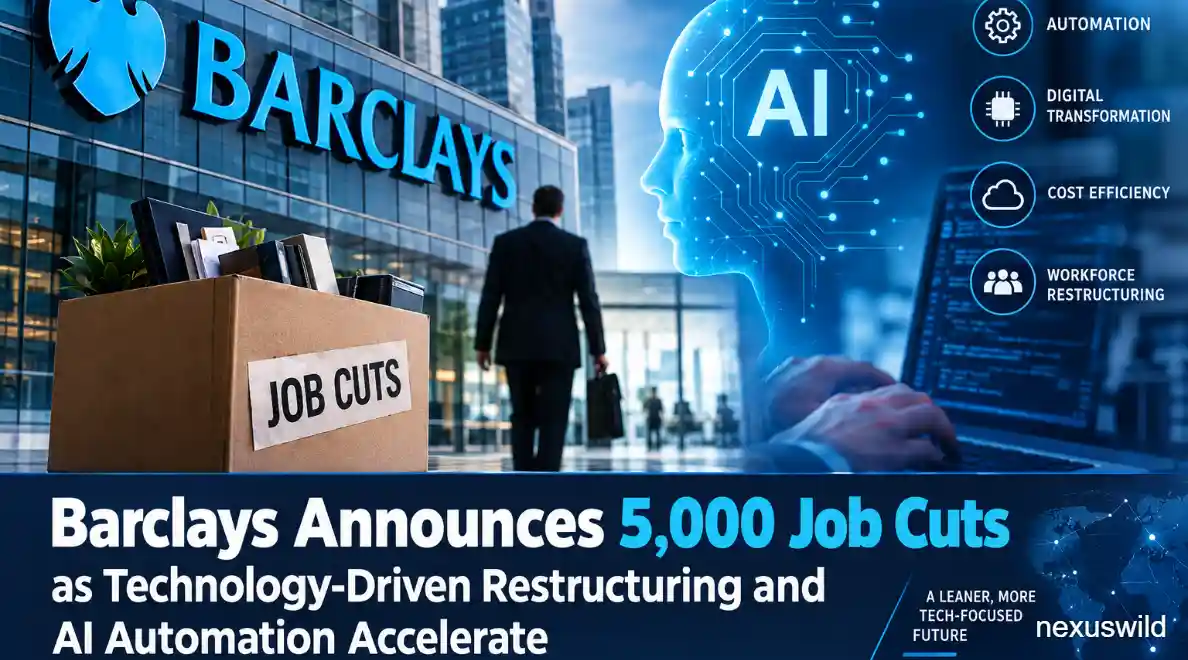

Barclays Plans 5,000 Job Cuts as AI Reshapes Banking Operations
British banking group Barclays has announced plans to remove 5,000 jobs during 2026 as it speeds up changes to its organisation and increases the use of technology including artificial intelligence (AI) to lower expenses and make operations better.
The news, shared on October 22 2026 came along with the banks quarter financial reports. The planned job cuts are 5% of its total employees with around 1,000 already removed in the first half of the year. Barclays expects the rest of the cuts to be done by the end of December.
This move shows a growing problem for the financial services industry: banks are putting money into tools and AI while also thinking about how many workers they need to run their businesses.
According to Reuters 60% of the job cuts at Barclays will be in support roles, like software development and other tech-related jobs. The Chief Financial Officer, Anna Cross said the cuts are because of simplifying the organisation and making things more efficient with technology.
The announcement does not mean AI is the reason for all the 5,000 job losses. Barclays says the changes are part of a long-term effort to make operations simpler, lower fixed costs and update technology.
The timing is also interesting because the bank reported quarterly profits. Barclays made £2.3 billion in -tax profit for the third quarter, which is 12% more than the same time last year even though it was less than what analysts expected.
Combining profits with major job cuts has started a conversation about how companies should balance making more from productivity giving returns to shareholders and keeping employees as automation becomes more common.
Source: Reuters, October 22 2026
How the 5,000 Job Cuts Will Happen
Barclays plan to reduce its workforce is part of its ongoing effort to lower costs and make operations more efficient.
The bank has already removed about 1,000 jobs. Another 4,000 are expected to be cut by the end of the quarter according to statements from Cross reported by Reuters.
The job cuts are expected to affect parts of the company with support and functional roles making up a big part. These can include technology development, internal operations and other activities that help the banks customer-facing and investment banking businesses.
Support roles are being looked at closely by institutions because many of their tasks involve a lot of information repeated work and complex software.
Automation can help handle some of these tasks with manual work. AI tools may also help employees with software development, documentation, getting information and some analysis.
However the effect is different for every job. Some tasks are easier to automate than others while positions that involve making decisions dealing with regulations working with customers and managing risk still need human help.
Barclays has not said that every worker cut will be replaced by an AI system. The broader changes include structures and the use of technology developed over several years.
This is important because job cuts can come from reasons, including automation, repeated roles, shifts in business needs cost targets and a move towards different skills.
The banks announcement shows clearly how investing in technology is now connected to planning the workforce at an international bank.
AI Is Part of a Larger Tech Plan
Barclays Chief Executive Officer, C.S. Venkatakrishnan has said that artificial intelligence is one part of the banks technology changes.
As Reuters reported he called AI the "icing on the cake" of a plan that includes technology and organisational improvements. His words show that the bank believes upgrading its systems is necessary before it can get the benefits of AI.
This is a point to understand the changes.
AI does not work on its own without a companys technology. Its value depends on data quality, software setup, security and how it is used.
For a bank modernising can mean combining systems getting rid of repeated tasks making information easier to access and helping different programs work better together.
Once that is done AI can help with tasks like writing internal documents looking at information helping with software development and helping employees find records.
Some of these uses can save time. Others may change what skills employees need of removing work entirely.
Venkatakrishnan has said that Barclays plans to use AI while also investing in the technology needed to support it.
The banks way of working shows a trend: companies are now seeing AI as part of long-term plans to change how they work, not just as a new tool added to old ways.
The impact on jobs will depend on how these systemsre used, which tasks can be done reliably and whether businesses use the savings to cut staff make more or train current workers.
Barclays Reports £2.3 Billion in Third-Quarter Pre-Tax Profit
The news about cutting jobs came with results showing that Barclays third-quarter pre-tax profit went up 12% compared to the same time last year to £2.3 billion.
The increase shows that the bank stayed profitable during July to September. However the result was less than what analysts expected because of weaker performance in fixed-income trading.
Barclays investment bank made £3.1 billion in the quarter, which was lower than the expected £3.3 billion according to Reuters.
Income from stock trading rose 47% while income from fixed-income trading dropped 19% to £1 billion. The drop was due to activity in interest rates and credit products during a busy time.
Venkatakrishnan said fixed-income trading needed attention pointing to the trading environment and poor results in those areas.
These numbers are important to understand the banks plan. Higher profits don’t mean every part of the business is doing well or that the bank has no reason to cut costs.
Financial institutions always check their costs, income and how well they make money. A company can have rising profits. Still want to improve in some parts or get ready for future competition.
Barclays also said it spent £201 million on cost-saving actions in the third quarter. These steps are part of its effort to lower costs, including jobs-related costs.
The bank has said it wants more savings in 2027, which shows that keeping costs under control and making operations simpler is still a main goal.
For workers the numbers show the link between how a company does financially and the security of jobs. A good quarter doesn't always stop job cuts when managers think technology or changes can help make the company more efficient.
Source: Reuters via Investing.com
Why Banking Is Especially at Risk from Automation
Banks handle a lot of data use software and process transactions that have to meet strict deadlines and rules. These facts create chances for tools to make things better.
AI and automation can help with banking tasks but their usefulness changes depending on the job and the bank.
1. Software development
AI writing tools can help programmers suggest code explain software, write documentation and find errors. These tools might take time for some coding work.
Financial software needs high standards for security, reliability, testing and following the law. People who write and check code are still needed to make sure changes don't bring problems.
2. Administrative work
Banks deal with a lot of paperwork, reports and regular messages. Technology can help sort documents get information and make repetitive tasks easier.
When these steps are the same tech can cut down on work.. Odd cases, incomplete records and tough situations can still need people to check and decide.
3. Customer service
Chatbots and automated systems can answer questions guide customers with routine tasks and help employees find info faster.
Financial services also involve sensitive choices, complaints and situations where customers need personal help. Banks must make sure they are accurate keep privacy be fair and have people available when needed.
4. Risk and compliance help
AI tools can help employees look at documents find patterns and rank info for more checking.
These uses can make things better. Banks can't just trust an automated answer. Risk assessments, checking for money laundering and other required tasks need checking, records and responsibility.
The main point is not whether AI can do banking work. It's about how companies change their work to use these tools while keeping safety, service quality and following the rules.
Support and Tech Workers Are Facing Uncertainty
The focus on cutting jobs in support roles and developer jobs is important for white-collar workers.
Technology workers have often been seen as people who benefit from changes because companies need programmers, data experts and security people to build and keep modern systems. AI is changing this by helping with some tasks that were done by people before.
This doesn't mean there is no need for tech skills. Banks still need workers who know about systems, security, data rules, design and legal tasks.
Instead the skills needed may change. Employees may now be expected to watch over AI work check the results find mistakes manage data quality and use automated tools in systems.
The change can be hard for workers whose jobsre mostly in tasks that companies can automate or combine.
For those affected the possible results include not knowing if they will keep their jobs pressure to learn skills and competition for roles in other parts of the company or, in the financial services industry.
Employers face a problem. Cutting down on workers can reduce costs for a time but if the process is not handled well it can also lead to losing important knowledge that the company has built up over time. This can add work to the people who stay and make it hard to get the right skills when they are needed.
Whether technology helps a company in the run depends a lot on how well the company handles the people involved during the changes.
Union Criticism Brings Up Questions About Learning New Skills
The news has caused some upset from Unite, a trade union in the UK that helps workers in different areas, including finance.
Sharon Graham, the leader of Unite spoke out against the job cuts. Said employers should focus on helping workers learn new skills as technology changes the way work is done. Of using AI as a reason to get rid of experienced workers they should find better ways.
The unions reaction shows a worry about how the benefits from machines are shared. If technology helps people do work faster companies can choose what to do with the time.
They can hire people offer more services make things better move people to different jobs or try a mix of these. What happens depends on what the company wants the business situation. If there are jobs available.
Learning skills can help workers take on new jobs but it doesn't always work. How well it works depends on what skillsre taught, how much time people have, if there are jobs and if the company really wants to keep or move the trained workers.
There are also limits to what you can say based on a companys announcement. Barclays said the job cuts are part of a change that includes investing in technology and simplifying the company. So it's not correct to say all the job cuts are because of AI.
At the time the banks words show that using technology to be more productive is affecting the decisions they make about their staff.
The bigger question is how companies can update their work while giving workers a chance to change with the times.
Source: The Guardian, October 22 2026
Barclays Shows a Trend Across the Financial Industry
Barclays is not the only bank thinking about changing its staff as AI and digital systems get better.
Other banks have also. Talked about changes to their workers linked to automation cutting costs and reorganising. For example Standard Chartered has said it will reduce back-office jobs over the years as it uses technology.
Reuters has also talked about job cuts and changes in companies from areas, including tech and finance as businesses put more money into AI and ways to work better.
These changes show that the effect of AI on jobs is not for tech companies. Banks, shops and other big companies are looking at how automation changes the way they work.
Still each situation is different. Some companies cut workers because there is need for their work or because costs are going up. Others change after they invest in tools that change how work is done. In cases more than one reason is involved.
For banks the need to update is especially hard because technology has to help with more than working faster. It also has to help with safety how well the system works, protecting customers and following rules.
A bank cannot just look at how many hoursre saved. It also has to think about if the system's reliable if the decisions are accurate if data is safe and what happens if something goes wrong.
So the money made from AI will depend on how the technology is used, not just on using it.
What the Changes Mean for the Future of Banking
Barclays news brings up issues that will shape how the banking industry changes in the future.
First using AI is starting to connect with planning for workers. Banks are looking at how software, automated tasks and new structures can change how many people are needed.
Second investing in technology does not mean every worker will be off. Some jobs may get more productive while others may be combined or removed. New jobs may appear,. Workers won't automatically move into them.
Third the long-term money is still important. Cutting costs can help make money but the benefits have to be compared with the cost of the technology, training, security and risks.
Finally being clear is important. Workers investors and customers will want to know how automation affects service, who's responsible and how the company manages risks.
For people working having skills that can change and understanding how AI fits into their job may help them handle changes. For companies talking clearly about changes and offering training or new jobs can help them manage the shift.
The bigger question is whether better productivity will come with helping people and creating jobs or if companies will mainly focus on making costs lower by cutting workers.
There is no one answer for every company. The effect will change based on the jobs involved how well things are done and what the leaders decide.
##
Barclays plan to cut about 5,000 jobs by the end of 2026 is another step in how banking, automation and jobs are connected. About 1,000 jobs are already. More cuts are coming before the year ends. This change will affect a part of the banks workers around the world.
The news came as Barclays said its profit for the quarter went up by 12% to £2.3 billion. However the result was not as good as what people expected because of trading in some areas.
The bank says the job cuts are part of an effort to make the company simpler lower costs and use years of technology work. AI is a part of this plan but it is not the only reason for the cuts.
For the finance industry this shows both the good and the problems of using AI to be more productive. Automation can help with some steps. Make work easier but it also brings up questions about job safety, learning, control and how the benefits are shared.
What happens in the term will depend on whether the technology helps make the company work better in a lasting way while the bank keeps good services and the skills to run a complex financial company.
As banks keep changing the main issue will be not just how much work can be done by machines but how companies handle the change, for the people whose jobs are changing.
Nexuswild welcomes factual corrections. Email contact@nexuswild.com with evidence and the article URL.