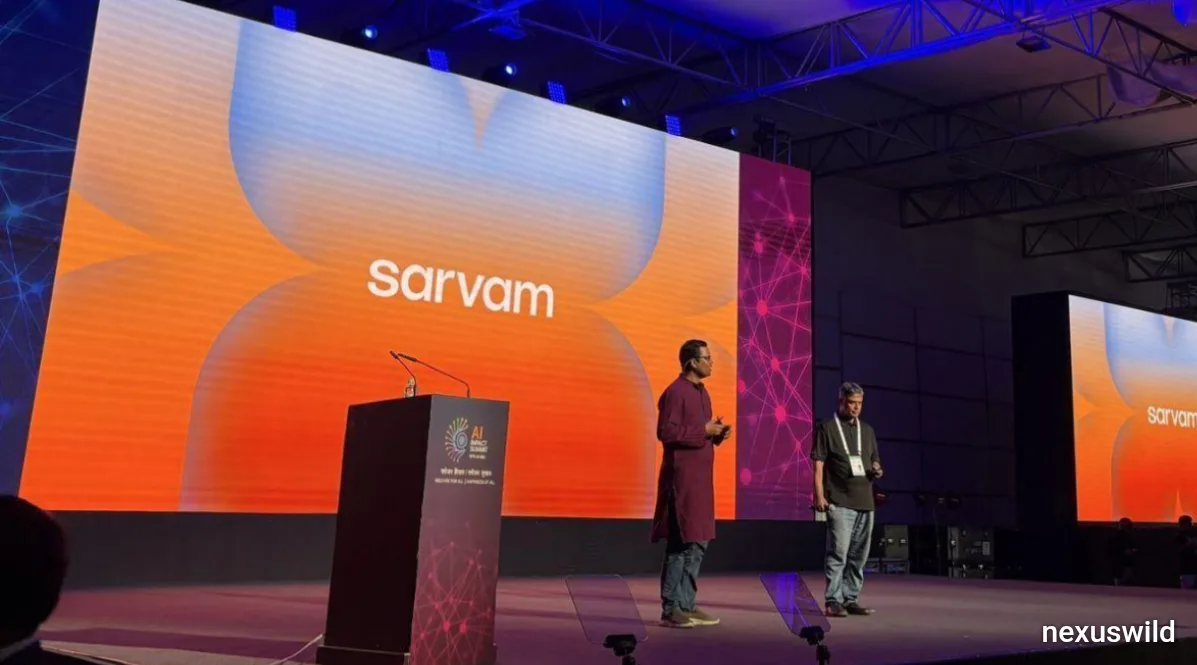

Entire and Sarvam have announced a partnership intended to keep software repositories and selected AI coding-agent inference within India. The integration brings Sarvam models to Entire’s Trails workflow in preview, targeting organisations that need tighter control over where proprietary source code is stored and processed.
Entire, the developer platform founded by former GitHub CEO Thomas Dohmke, announced a partnership with Indian artificial intelligence company Sarvam on November 25, 2026. The collaboration combines Entire’s distributed Git hosting infrastructure with Sarvam’s locally developed and served AI models to create an India-focused environment for agent-assisted software development.
The central proposition is data residency across two important parts of the development process: repository hosting and AI inference. Developers can select India as the primary region for their projects and repositories on Entire, then configure Sarvam models for AI-agent runs within the platform.
The companies are positioning the integration as an option for businesses that want to use AI coding tools without routinely sending sensitive source code to overseas hosting or inference services.
What the Entire-Sarvam partnership introduces
The partnership connects Entire’s Git forge with Sarvam’s AI infrastructure. A Git forge is a platform for hosting and managing software repositories, branches and code changes. It performs a role similar to established developer platforms, while Entire is building its product around workflows in which human developers and AI agents work together.
Under the announced arrangement, developers can create or migrate private repositories to Entire and select India as their primary region. When they configure Sarvam models for agent runs, the companies say the associated AI inference is also served within India.
That distinction matters. Keeping a repository in an Indian hosting region does not, by itself, guarantee that every external service connected to a development workflow will process data locally. The India-residency proposition depends on the project and repository configuration, the selected model provider and the other services an organisation uses.
Entire says its India region allows developers to host private repositories locally, while Sarvam’s models are available in preview for agent runs on Trails. The announcement is therefore a product integration and preview availability milestone—not evidence that every enterprise deployment is already generally available.
Trails: An agent-focused alternative to traditional pull requests
A major part of the announcement is the integration of Sarvam models into Trails, Entire’s workflow for managing software changes.
In conventional development workflows, a pull request is used to propose code changes, invite reviews and decide whether those changes should be merged into a project. Trails is designed to bring more of the development process into one connected record.
It combines the developer’s original instructions, code changes, agent sessions and review evidence. AI agents can inspect changes, identify potential issues and work through review findings, while a human developer remains responsible for validating the result before it is merged.
This approach is intended to make the reasoning and activity behind a code change easier to inspect. Rather than treating an AI-generated code contribution as an isolated patch, the workflow attempts to preserve the context of what the developer requested, what the agent did and what the review process found.
For engineering teams, that context can be important when investigating defects, auditing changes or understanding how an automated agent reached a particular implementation.
Sarvam’s models are available in preview within this workflow. Moneycontrol reported that Entire would support Sarvam’s 105-billion-parameter model for code review. Entire’s India onboarding guide identifies Sarvam-105B as an available model option for agent runs.
The model’s parameter count is not, by itself, proof of coding quality. Enterprises will still need to assess accuracy, latency, cost, security behaviour and performance on their own repositories and programming tasks.
Why India-based inference matters to regulated businesses
AI coding assistants can process more than the code snippets a developer explicitly submits. Depending on how a tool is configured, an agent may need access to repository files, code context, developer instructions, error logs and review findings.
For organisations handling sensitive software, the location and handling of that information can become a procurement and compliance issue.
Banks, insurance companies, healthcare providers, government contractors and large IT services firms may operate under contractual, regulatory or internal security requirements that restrict how certain information can be transferred, stored or processed.
An India-hosted repository combined with locally served model inference could reduce one obstacle to deploying AI coding agents in those environments. It gives technology teams a route to evaluate agent-assisted development without automatically relying on a foreign-hosted repository and an overseas model endpoint.
However, data residency should not be confused with complete regulatory compliance. Organisations must separately assess identity and access management, encryption, audit logs, retention policies, incident response, model-provider terms, subcontractors and the handling of data by connected development tools.
The practical question for an enterprise is not simply whether a vendor offers an Indian region. It is whether the complete workflow—including integrations and operational controls—meets the organisation’s security and legal requirements.
Entire reports 355 Git pushes per second in India
Entire also highlighted the performance of its Git infrastructure using ForgeMark, its open-source benchmarking tool.
The company reported that its India test handled 355 pushes per second when multiple agents pushed to and cloned from a repository concurrently. It compared that result with 29 pushes per second for Cursor Origin, 10 for GitLab and four for GitHub.
These figures suggest that Entire is targeting workloads in which many automated agents interact with the same repository. Such workloads can create a different performance profile from conventional development, where a smaller number of human developers push code intermittently.
But the benchmark needs context. The figures are reported by Entire using its own tool and test setup. They should not be treated as an independent ranking of overall Git hosting performance.
Push throughput is only one measure of a developer platform. Repository size, concurrency settings, network conditions, cloning performance, reliability, access controls, integrations, migration complexity and the quality of the review workflow also matter. A high push rate does not establish that a platform is faster or better for every engineering team.
For enterprise buyers, ForgeMark can be a starting point for technical evaluation. It is not a substitute for testing the platform under representative workloads and comparing the results with existing infrastructure.
Infosys and Open Healthcare Network among early adopters
Entire has named Infosys and Open Healthcare Network among the organisations adopting its Git forge in India.
The two names are significant because they point to different potential user environments: a large IT services organisation and an open-source healthcare network. Both operate in settings where software development workflows can involve complex collaboration and sensitive technical context.
Moneycontrol reported that Infosys was assessing how its teams might adapt software development processes for agent-assisted engineering, with feedback being used to shape Entire’s product.
That should not be interpreted as evidence that Infosys has deployed the platform across its entire engineering workforce or committed to a large-scale commercial rollout. The announcement does not disclose contract values, deployment volumes or detailed adoption metrics for either organisation.
The early-adopter references nevertheless provide a signal that Entire is seeking feedback from real software-development environments rather than positioning the product solely as a developer demonstration.
What the partnership means for India's sovereign AI ecosystem
India’s AI infrastructure strategy is increasingly moving beyond foundation models and chat applications towards the systems needed to deploy AI in business operations.
Developer infrastructure is one such layer. Coding agents need access to repositories, build systems, testing environments, review workflows and deployment pipelines. The model is only one part of that system.
The Entire-Sarvam arrangement connects an Indian model provider with a developer platform that offers regional repository hosting and an agent-oriented review process. It is an example of how domestic AI capabilities could be integrated into specialised enterprise software rather than used only through general-purpose chat interfaces.
For Sarvam, the partnership offers a route into a technical workflow where model performance can be evaluated against practical software engineering tasks. For Entire, it adds a locally served model option and strengthens its proposition for customers that prioritise Indian data residency.
The partnership does not, by itself, establish that Indian models are already competitive with every leading global coding model. That assessment requires task-level evaluations covering code generation, debugging, repository understanding, vulnerability detection and the ability to follow complex engineering instructions.
The challenges that will determine enterprise adoption
The opportunity is clear, but enterprise adoption will depend on more than data location.
Model quality and reliability: Coding agents must produce correct, maintainable and secure code. Enterprises will need evidence from their own test suites and repositories, including performance on less common languages, legacy systems and complex architectures.
Security and governance: Local inference can reduce cross-border data exposure, but it does not eliminate prompt-injection risks, insecure code generation, excessive agent permissions or accidental disclosure through integrations. Human review and strict access controls remain essential.
Migration and ecosystem compatibility: Moving repositories to a new Git forge can involve more than transferring source code. Teams must consider developer permissions, CI/CD pipelines, issue tracking, code review history, automation and third-party integrations. Compatibility with existing tools may influence adoption as much as benchmark performance.
Operational resilience: Regulated organisations will examine uptime, backup arrangements, disaster recovery, incident response, support commitments and service-level agreements before moving critical repositories.
Total cost: A locally served model may offer cost advantages for some workloads, but buyers need to compare the complete cost of inference, hosting, agent execution, storage, migration and ongoing operations.
What to watch next
The next meaningful milestones will be broader availability of Sarvam models within Trails, independent and reproducible performance testing, and evidence of sustained enterprise usage.
Customers will also want clearer documentation on regional data handling, backup and replication policies, telemetry, third-party integrations and the boundaries of the India-hosted environment.
For Sarvam, coding-agent evaluations will provide a practical test of how its models perform in a demanding enterprise workflow. For Entire, the challenge will be turning its agent-native development approach into a reliable platform that integrates with the tools engineering teams already depend on.
The partnership is a notable step in India's sovereign software infrastructure story. Its long-term significance, however, will be determined by model quality, security controls, developer experience and actual enterprise deployment—not by the announcement or a single throughput benchmark alone.
Nexuswild welcomes factual corrections. Email contact@nexuswild.com with evidence and the article URL.