
Held from November 17 to 19 under the theme “AI & Beyond”, the summit is positioning Bengaluru as a meeting point for discussions on artificial intelligence, semiconductors, robotics, biotechnology, financial technology and the next generation of digital infrastructure. The event is organised by the Government of Karnataka’s Department of Electronics, Information Technology, Biotechnology and Science & Technology, with Software Technology Parks of India (STPI) serving as co-host.
The official summit platform lists more than 1,000 technology startups from 100 cities, over 700 speakers and an international exhibition involving technology companies, institutions and country delegations. Sweden is the designated Country Partner, with Italy, Australia and Poland among the supporting countries identified in pre-event reporting.
The programme's most prominent physical showcase is a 50,000-square-foot AI and Robotics Pavilion. Alongside the exhibition, the summit features investor-connect programmes, startup pitching opportunities, specialist conference stages and bilateral technology discussions, including an India-USA Tech Conclave scheduled for November 18.
The gathering comes as India seeks to move beyond its established strengths in IT services and software outsourcing towards a broader position in product development, deep technology, semiconductor design, applied artificial intelligence and advanced manufacturing. The summit offers a platform for that ambition, although its commercial significance will ultimately depend on the partnerships, contracts, investments and deployments that emerge from the meetings.
A 29th edition built around artificial intelligence
The Bengaluru Tech Summit has developed into a recurring platform for the state's technology and innovation ecosystem. Its 2026 edition places artificial intelligence at the centre of the programme while extending the conversation to the infrastructure and industries needed to turn AI research into usable products and services.
The phrase “AI & Beyond” reflects a programme that is not limited to generative AI applications. The summit's published conference structure includes dedicated discussions on electronics and semiconductors, health and biotechnology, deep-tech startups, consumer technology, global innovation partnerships and emerging technologies.
That breadth matters because the commercial adoption of AI depends on more than access to models or software tools. It also requires computing infrastructure, reliable data systems, semiconductor supply chains, skilled engineers, cybersecurity, sector-specific research and customers willing to integrate new systems into their operations.
The summit's conference stages are designed to bring these different parts of the ecosystem into the same venue. The Circuit Stage focuses on electronics, semiconductors and electronic-system design and manufacturing. The Life Stage covers health, biotechnology and AI-related innovation. Startup-focused stages provide space for companies working on deep-tech and consumer applications, while international stages are intended to encourage cross-border exchange.
This structure gives the event a wider purpose than a conventional technology exhibition. It is intended to connect research, policy, enterprise demand and startup development. Whether those conversations translate into measurable business outcomes will be clearer after the summit concludes and participating organisations disclose any concrete agreements.
International participation and the role of Sweden
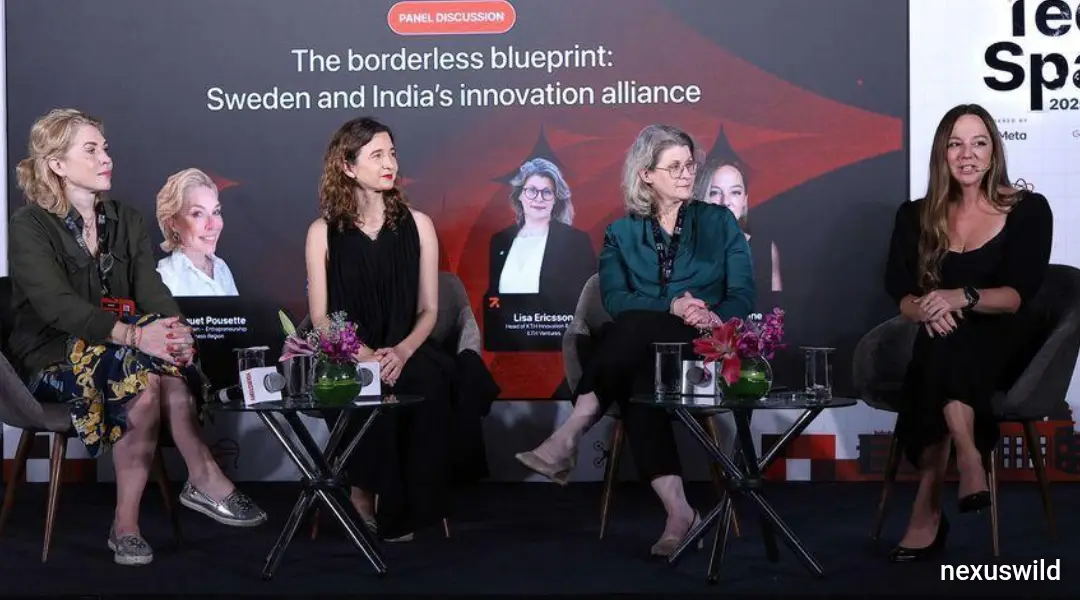
International participation is one of the summit's central features. Sweden has been designated the Country Partner for the 2026 edition, while Italy, Australia and Poland are identified as supporting countries in pre-event coverage.
The summit's official website advertises participation from more than 75 countries. A separate pre-event report referred to delegations from more than 65 countries. These figures appear to reflect different published estimates or reporting points, so they should not be treated as a single final attendance count.
Country partnerships and international pavilions can serve several practical purposes. They allow overseas companies to present products and services, introduce their technology ecosystems to Indian buyers, identify local partners and explore routes into the Indian market. For Indian startups, they can provide access to potential distributors, research institutions, investors and customers outside the domestic market.
Sweden's role provides a formal focus for one part of that international engagement. However, the presence of a country pavilion or delegation should not automatically be interpreted as a government-to-government investment agreement. The commercial value depends on the quality of meetings, the follow-up process and whether organisations proceed to pilot projects, procurement arrangements or research partnerships.
For Karnataka, international participation also supports its effort to present Bengaluru as a location for technology research, product development and global business operations. The summit gives state agencies and local companies an opportunity to explain the region's capabilities to international visitors.
The 50,000-square-foot AI and Robotics Pavilion
The AI and Robotics Pavilion is among the headline attractions of BTS 2026. The official pavilion page describes a 50,000-square-foot exhibition area focused on physical AI, robotics and autonomous systems, with 101 AI and robotics showcases.
The demonstrations are intended to make emerging technologies visible beyond presentations and product brochures. The pavilion's published showcase areas include humanoid robots, drones and aerial robotics, industrial robots, collaborative robots, autonomous mobility platforms, quadruped robots and aquatic robotic systems.
This emphasis on physical AI is significant. Much of the public discussion around artificial intelligence has focused on chatbots, image generation and software-based automation. Physical AI extends the conversation to machines that perceive their surroundings, interpret information and take actions in the real world.
In industrial settings, such systems could support repetitive assembly tasks, warehouse operations, inspection, material handling and selected forms of quality control. In logistics, autonomous systems may help move goods through controlled environments. Drones and other aerial platforms can support inspection, mapping and monitoring, subject to applicable safety and regulatory requirements.
Humanoid robots attract attention because of their potential to operate in environments originally designed for people. Yet demonstrations should not be confused with evidence of broad commercial readiness. Performance in a controlled exhibition environment does not establish that a robot can work safely, reliably and economically across an entire factory, warehouse or public setting.
For investors and enterprise buyers, the important questions are practical: What tasks can the system perform? How consistently can it perform them? What does deployment cost? How much human supervision is required? Can it integrate with existing equipment and software? What safety standards apply?
The pavilion offers a venue for companies to demonstrate their answers to these questions. Its business value will depend on whether visitors move beyond demonstrations towards technical evaluations, pilot deployments and procurement discussions.
Startups and the challenge of commercialisation
The summit's startup programme is another major part of its identity. The official event platform lists more than 1,000 startups from 100 cities, giving the event a national reach beyond Bengaluru's established technology clusters.
For early-stage companies, large technology gatherings can offer exposure to investors, potential customers, corporate partners and public-sector institutions. A founder may use a pitching session to introduce a product, an investor meeting to discuss financing, or an exhibition booth to test demand with prospective buyers.
However, visibility is not the same as commercial traction. A startup's long-term prospects depend on whether it can solve a clearly defined problem, demonstrate product reliability, secure paying customers, manage operating costs and compete against established providers.
This distinction is particularly important in deep technology. Companies developing robotics, semiconductor technologies, medical devices, industrial automation and advanced materials often face longer development cycles than software startups. They may need specialist laboratories, testing facilities, regulatory approvals, manufacturing partners and substantial capital before reaching commercial scale.
The summit's startup and investor-connect formats can help bring these requirements into discussions. They may also help founders identify customers willing to participate in early deployments. But no investment outcome should be assumed simply because a company is listed as a participant or receives exhibition space.
The event also gives established companies an opportunity to examine products developed by smaller firms. Corporate-startup relationships can involve procurement, joint development, distribution, technology licensing or investment. Each arrangement has different commercial and legal implications, and any specific deal should be reported only when the parties confirm it.
Semiconductor and electronics discussions
Semiconductors and electronic-system design are central to the summit's broader technology agenda. The Circuit Stage is dedicated to electronics, semiconductors and ESDM, or electronic-system design and manufacturing.
India's interest in this area reflects the importance of chips and electronic components across almost every major technology sector. Data centres, telecommunications equipment, electric vehicles, industrial automation, medical devices and consumer electronics all depend on semiconductor technologies.
The development of a stronger domestic semiconductor ecosystem is not limited to building fabrication plants. It also involves chip design, verification, packaging, testing, equipment, materials, power electronics and a skilled engineering workforce.
Events such as BTS can connect companies working across these layers with potential customers, suppliers, research institutions and public agencies. They can also provide a platform to discuss supply-chain resilience and the role of Indian engineering firms in global electronics markets.
Nevertheless, conference discussions do not themselves create semiconductor manufacturing capacity. Establishing and operating advanced facilities requires large capital commitments, specialised equipment, dependable utilities, technical expertise and sustained customer demand. Any claims about new factories, investment commitments or production timelines should therefore be verified against formal company or government announcements.
The summit's value in this field is best understood as ecosystem-building: bringing relevant participants together, making capabilities visible and creating opportunities for follow-up collaboration.
Health, biotechnology and AI applications
The Life Stage brings health, biotechnology and AI-related innovation into the programme. These areas are increasingly connected as researchers and companies explore how data analysis, automation and computational tools can support medical research and healthcare delivery.
Potential applications include medical-image analysis, laboratory automation, drug discovery support, clinical workflow tools, remote monitoring and biotechnology research. The practical requirements differ considerably across these use cases. A hospital workflow product, for example, faces different validation and privacy requirements from an industrial biotechnology platform.
Healthcare technology also carries a higher responsibility for safety, evidence and accountability. An AI-enabled product intended to influence diagnosis or treatment cannot be assessed solely on the basis of a demonstration. Its performance must be evaluated in the relevant clinical context, with attention to patient privacy, reliability, bias and regulatory requirements.
The summit's health and biotech discussions can help bring researchers, startups, healthcare organisations and investors into contact. Such engagement may be useful for identifying research collaborators and potential pilot settings, but it should not be reported as proof that an experimental product is clinically validated or approved.
India-USA Tech Conclave and international market access
The India-USA Tech Conclave is scheduled for November 18 in collaboration with the US-India Business Council. Pre-event reporting identifies subjects including quantum technology, critical minerals, safe and secure AI, cybersecurity and bilateral technology cooperation.
These subjects reflect the growing importance of technology policy in international economic relations. Artificial intelligence, advanced computing and semiconductor supply chains are increasingly linked to national security, industrial strategy and trade policy.
For businesses, bilateral forums can provide a structured setting to understand market requirements, identify potential partners and discuss areas where cooperation may be commercially or strategically useful. For startups, access to overseas markets can expand the potential customer base, but it also brings challenges involving compliance, intellectual property, data protection, procurement standards and local competition.
The conclave should be treated as a platform for dialogue and business engagement. Unless participants announce a signed agreement or a specific funding commitment, the event itself should not be described as having produced a bilateral deal.
Beyond Bengaluru and regional technology development
A recurring policy theme surrounding the summit is Karnataka's effort to extend technology activity beyond Bengaluru. The “Beyond Bengaluru” approach is intended to encourage investment, employment, innovation infrastructure and startup activity in other parts of the state.
Bengaluru has a deep concentration of technology companies, research institutions, skilled workers and venture investors. That concentration is a major advantage, but it also creates pressure on transport, housing, office space and urban infrastructure. Developing additional technology centres could distribute some of the economic activity while allowing more regions to participate in the state's digital economy.
For the strategy to work, regional hubs need more than promotional branding. They require reliable power and connectivity, suitable commercial and industrial space, education and training institutions, access to finance, local business networks and links to customers.
The needs of a biotechnology cluster may differ from those of an electronics manufacturing centre or a software services hub. Regional development policies therefore need to be built around local capabilities rather than assuming every city can reproduce Bengaluru's technology model.
The supplied briefing refers to Kalaburagi as a potential bioeconomy hub. That specific claim requires a traceable official announcement before it can be treated as a confirmed summit initiative. The broader regional-development objective can be discussed without presenting an unverified project as an established commitment.
What the summit could mean for investors and businesses
For investors, BTS 2026 provides an opportunity to survey companies across multiple technology sectors in one place. Startup showcases and pitching sessions can help identify emerging businesses, while conference discussions can provide context on policy priorities and market demand.
But a summit appearance is only an initial screening signal. Investors still need to evaluate a company's technology, intellectual-property position, management team, customer references, financial performance, regulatory exposure and ability to scale. In deep-tech sectors, they may also need to assess manufacturing readiness and the time required to reach commercial revenue.
For large enterprises, the exhibition can function as a technology-discovery platform. Companies may use it to identify vendors for automation, cybersecurity, AI infrastructure, analytics and specialised engineering. The most useful discussions are likely to be those that connect a product demonstration to a clearly defined operational requirement.
For startups, the strongest outcome may not be immediate funding. It could be a customer evaluation, a research partnership, a distribution relationship or access to a technical facility. These outcomes can create a path towards revenue and product validation, although they may take months or years to materialise.
For Karnataka, the summit is also a platform to promote the state's technology workforce, institutions and business environment. The long-term test will be whether the event helps generate durable activity, including new research collaborations, startup growth, investment, jobs and export opportunities.
The gap between announcements and measurable outcomes
Large technology events often publish ambitious participation figures and extensive programmes. Those numbers help communicate scale, but they do not independently demonstrate economic impact.
The official summit website advertises more than 1,000 startups, over 700 speakers, more than 75 countries, 25,000-plus delegates and 60,000-plus business visitors. Other pre-event reports have used different estimates for some attendance categories. These are published event figures and expectations, not necessarily final audited attendance results.
The same caution applies to business outcomes. Investor meetings are not equivalent to funding rounds. Expressions of interest are not signed contracts. Demonstration projects are not full-scale deployments. Memorandums of understanding may establish a framework for cooperation without guaranteeing that a project will be completed.
A credible assessment of BTS 2026 will require follow-up information: the number and value of confirmed investments, contracts, procurement agreements, research collaborations, startup funding rounds and projects that progress beyond initial discussions.
It will also be important to distinguish new commitments from previously announced initiatives that are simply being showcased at the event. Clear attribution and transparent timelines will help readers understand what has actually changed as a result of the summit.
What to watch through November 19
The summit continues through November 19, leaving several programme elements still to take place after its opening day. The India-USA Tech Conclave is scheduled for November 18, while the Future Makers Conclave is planned for November 19.
The remaining programme provides opportunities for participating companies and institutions to announce partnerships, present technology demonstrations and discuss market-access plans. The Future Makers Conclave is also linked to the tenth anniversary of Karnataka's ELEVATE initiative, which supports early-stage startups.
The most consequential developments to monitor are not simply the number of visitors or speeches delivered. They include whether investors an
Nexuswild welcomes factual corrections. Email contact@nexuswild.com with evidence and the article URL.