
Google has introduced Gemini 4 Neon, a new reasoning model designed to balance advanced intelligence, execution speed and inference costs across complex software engineering, analytical research, enterprise workflows and defensive cybersecurity.
Announced on November 18, 2026, Gemini 4 Neon expands Google's Gemini 4 portfolio with a model positioned between the faster Gemini 4 Hydrogen and the more demanding Gemini 4 Carbon. The new release reflects Google's increasingly segmented approach to foundation models, where different systems are designed to handle different combinations of reasoning depth, latency, cost and workload complexity.
Neon supports a unified context window of up to 1,048,576 tokens, commonly described as one million tokens. It can process text, images, audio, video and documents such as PDFs within the same context, allowing developers and enterprise users to work with large collections of information without dividing every task into numerous smaller requests.
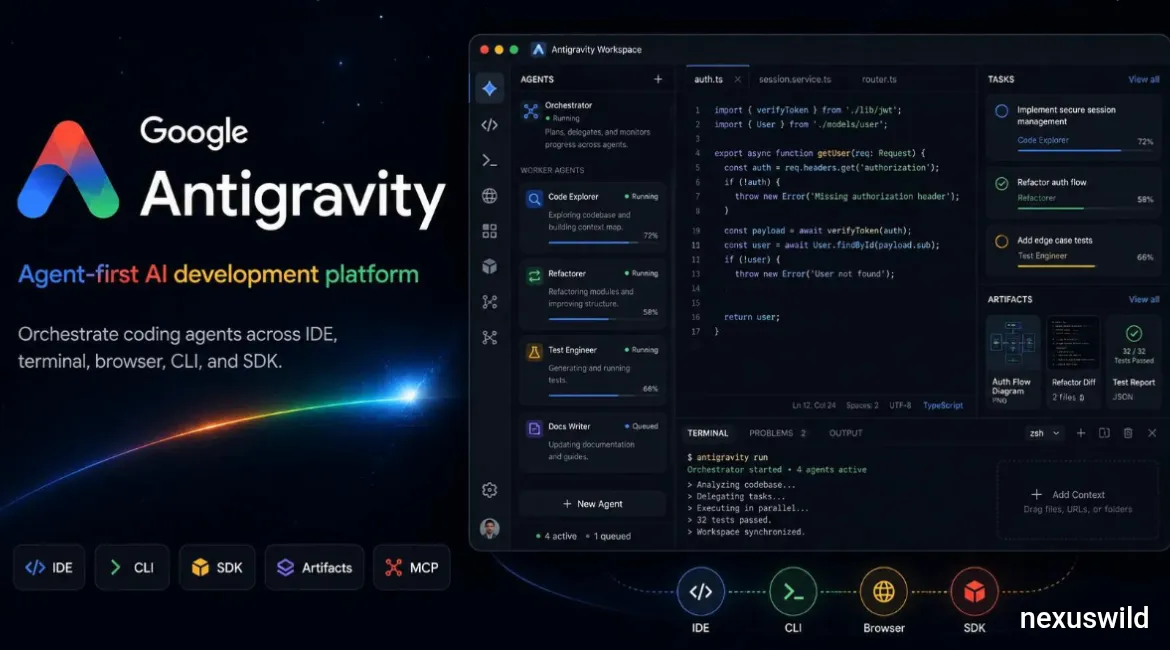
The model is available through the paid Gemini API tier, Google AI Studio, Android Studio, Gemini for business, Google Antigravity and the Gemini app for eligible Google AI Pro and Ultra subscribers. Cybersecurity-specific access is being extended separately to trusted defenders through Google's Fairwind Program.
Its launch is particularly relevant to developers and enterprises evaluating the cost of long-context reasoning, repository-level coding, autonomous agents and AI-assisted vulnerability remediation.
What makes Gemini 4 Neon different?
Gemini 4 Neon is adapted from Gemini 4 Carbon rather than being presented as an entirely separate model architecture.
Google describes Carbon as its model for the most demanding, long-horizon projects, while Hydrogen is intended for faster everyday execution. Neon occupies the middle position: a model intended to deliver substantial reasoning capability at a lower cost and with faster execution for recurring complex tasks.
This positioning matters because enterprise AI workloads are not all equally demanding.
A developer debugging a large repository may need extensive contextual reasoning, but not necessarily the maximum reasoning depth available. An enterprise analyst may need to compare thousands of pages, spreadsheets and reports. A security team may need an AI system to identify vulnerabilities, validate whether they are exploitable and propose code-level fixes.
Running every request through the most expensive model can make such workflows unnecessarily costly.
Neon is designed to address that trade-off. Its configurable thinking levels allow users to choose between lower-cost execution and more intensive reasoning depending on the complexity of the task.
The model provides four reasoning settings:
- Low
- Medium
- High
- Extra High (Xhigh)
High is the default setting identified in Google's announcement. Xhigh provides deeper reasoning for particularly difficult engineering, analytical and scientific tasks.
The practical implication is that developers can potentially reserve the most expensive reasoning behaviour for difficult tasks rather than applying it to every operation in an agent workflow.
However, additional reasoning is not automatically equivalent to better business outcomes. The value depends on whether the improvement in task accuracy justifies the additional processing time and token consumption.
One-million-token context window for large engineering and research workloads
One of the model's most important specifications is its unified one-million-token context window.
A context window determines how much information a model can process within a single request or conversation. A larger window can be particularly useful when a task requires the model to consider multiple documents, code files, research papers, reports and other supporting materials together.
Gemini 4 Neon's unified context window supports up to 1,048,576 tokens across input and output.
The model accepts:
- Text and structured text inputs
- Images
- Audio
- Video
- PDF documents
This makes it suitable for workflows that combine different information formats.
For example, an engineering team could provide source-code files, technical documentation, error logs and architectural diagrams as part of a broader debugging task. A research team could examine scientific papers, tables, figures and recorded material within one analysis workflow.
A financial analyst could potentially combine spreadsheets, PDFs and charts to generate a structured report, while an enterprise agent could process large collections of internal documents before producing a consolidated result.
Google's model card identifies a default synchronous output limit of up to 64,000 tokens, with background long-decode generation supporting outputs of up to one million tokens.
These specifications should not be confused. A one-million-token context window does not mean that every ordinary API response can synchronously generate one million tokens. Long-decode generation is a separate capability with its own execution behaviour.
The larger context window also does not eliminate the need for retrieval systems, document filtering or careful prompt design. Feeding an entire repository or document archive into a model may be technically possible in some circumstances, but selecting relevant information remains important for efficiency and answer quality.
Gemini 4 Neon API pricing and usage economics
Pricing is one of the strongest commercial elements of the release.
Google has set Gemini 4 Neon's standard paid API rates at:
API usage| Price per 1 million tokens Input tokens| $3.00 Output tokens| $15.00 Cached input tokens| $0.15 Batch input tokens| $1.50 Batch output tokens| $7.50 Flex input tokens| $1.50 Flex output tokens| $7.50
Output pricing includes reasoning or thinking tokens. Developers therefore need to account for internal reasoning consumption when estimating the cost of complex model calls.
The cached input price of $0.15 represents a 95% reduction from the standard input rate.
There is an important implementation detail: Google's pricing documentation identifies this as implicit context caching. Developers should not assume that every caching feature available on other models or platforms is supported by Neon.
The Batch and Flex rates are also lower than standard pricing. They can be useful for workloads where immediate execution is not essential and the applicable service conditions are acceptable.
Gemini 4 Neon is not available on the free Gemini API tier. Access through the API requires a paid project.
The distinction between the API and consumer subscription channels is important. Availability through the Gemini app for eligible Pro and Ultra subscribers does not mean those users receive unlimited access or that their usage is equivalent to unrestricted API access.
How Neon compares with Gemini 4 Carbon and Hydrogen
The release strengthens Google's tiered model strategy.
Gemini 4 Hydrogen is positioned for faster everyday workloads, Gemini 4 Neon targets more demanding recurring tasks, and Gemini 4 Carbon is intended for the most complex long-horizon reasoning projects.
The pricing relationship between Neon and Carbon is particularly interesting because Carbon has a temporary promotional rate.
Standard API pricing comparison
Model| Input per 1M tokens| Output per 1M tokens Gemini 4 Hydrogen| See current model pricing| See current model pricing Gemini 4 Neon| $3| $15 Gemini 4 Carbon through Nov. 30| $2| $10 Gemini 4 Carbon from Dec. 1| $4| $20
Carbon's promotional pricing of $2 per million input tokens and $10 per million output tokens applies through November 30, 2026. Its standard rates increase to $4 and $20 respectively on December 1.
This produces two different comparisons.
During the remainder of November, Neon is 50% more expensive per token than Carbon's promotional rate.
Beginning December 1, Neon becomes 25% cheaper than Carbon's revised standard input and output rates.
This gives developers a reason to evaluate the model based on the actual deployment date and workload rather than simply comparing headline prices.
The lower token price does not automatically mean a lower total task cost. Models can consume different numbers of tokens, require different numbers of tool calls and take different amounts of time to complete the same task.
The relevant metric for production deployments is therefore cost per successfully completed task, not only price per million tokens.
Benchmark performance: strong results across coding, reasoning and long context
Google's launch announcement and Gemini 4 Neon model card report results across software engineering, knowledge work, scientific reasoning, multimodal understanding and cybersecurity.
Some of the most notable published results include:
Benchmark| Gemini 4 Neon result Artificial Analysis Intelligence Index v5.0.1, Xhigh| 61 Vals Index v2.2| 70.9% GraphWalks, 256K–1M context| 95.2% CursorBench 4.1| 65.4% Terminal-Bench 4.1| 65.2% FrontierCode 2.0| 46.2% AutomationBench| 56.3% RiemannBench| 84.0% Terminal-Bench Science 0.1| 70.5% HLE-Diamond| 71.3% CWE-Bench v2| 70.7% SEC-bench Pro| 90.5% WebExploitBench v1.2| 51.3%
These figures come from Google's published evaluation materials. They should not be interpreted as one universal measure of model quality.
Different benchmarks test different capabilities. GraphWalks evaluates long-context retrieval and reasoning, while coding benchmarks assess software engineering performance under particular evaluation conditions. Security benchmarks measure specific vulnerability-related tasks.
A model can lead one benchmark and trail another.
For example, the Google model card lists Neon at 65.2% on Terminal-Bench 4.1, while Claude Opus 5.5 is listed at 65.8%. On FrontierCode 2.0, Neon records 46.2%, compared with 47.3% for Claude Opus 5.5.
On Chartography, GPT-6.2 Sol records 75.1%, compared with Neon's 73.5%.
These comparisons demonstrate why the phrase best AI model should be avoided without specifying the workload and evaluation method.
Google's model card also notes that some competitor results are based on provider-reported evaluations. The benchmark methodology and test conditions therefore matter when comparing model families.
Independent Artificial Analysis measurements
Artificial Analysis provides another useful view of Gemini 4 Neon's performance.
Its Intelligence Index v5.0.1 evaluation records:
Reasoning setting| Intelligence Index| Cost per index task Low| 44| Approximately $0.75 Medium| 55| Approximately $1.90 High| 60| Approximately $3.74 Xhigh| 61| Approximately $6.44
These are independent evaluation measurements, not Google's published API rates.
The results show that increasing reasoning depth from High to Xhigh improves the Intelligence Index by one point, from 60 to 61, while the measured task cost increases from approximately $3.74 to $6.44.
That difference is commercially relevant.
For workloads where the additional point of benchmark performance does not materially improve the final outcome, High may offer a more attractive balance of cost and performance.
For difficult engineering or scientific tasks where deeper reasoning changes the probability of success, Xhigh may justify the additional expense.
The measurements also show that reasoning settings affect completion time. Artificial Analysis reported approximately 14.8 minutes per Intelligence Index task at High and 21.5 minutes at Xhigh.
Consequently, the best setting will depend on the application's latency requirements, accuracy requirements and cost constraints.
Cybersecurity: a major part of the Neon strategy
One of the most commercially significant parts of the launch is Google's emphasis on defensive cybersecurity.
AI-assisted security is becoming increasingly important as software repositories grow, development cycles accelerate and organisations face expanding vulnerability exposure.
Security teams need tools that can identify weaknesses, validate their severity, determine whether a vulnerability can be exploited and help developers implement corrective patches.
Google says Gemini 4 Neon is designed to support this process.
Its published security evaluations include:
- 90.5% on SEC-bench Pro.
- 51.3% on WebExploitBench v1.2.
- 70.7% on CWE-Bench v2.
- Strong performance on ExploitGym.
- 76% on the hard tier of AutoBaxBench.
On CWE-Bench v2, Google reports a 3.4-percentage-point improvement over Gemini 4 Carbon.
These evaluations are relevant because vulnerability discovery and vulnerability remediation are different technical tasks.
Identifying a potentially vulnerable code pattern is only the first step. A useful defensive system must also understand the surrounding application, determine whether the issue is exploitable, identify the underlying cause and produce a patch that does not introduce new weaknesses.
Google's stated objective is to make Neon useful across this broader code-hardening lifecycle.
However, benchmark success should not be confused with the ability to independently secure a production environment. Human review, testing, security controls and deployment approval remain important.
Gray Swan benchmark and indirect prompt-injection resistance
Google also highlighted Neon's performance against indirect prompt-injection attacks.
Indirect prompt injection occurs when malicious instructions are embedded inside content that an AI system is asked to read or process.
Such instructions may appear in webpages, emails, documents, code repositories or other external material.
An AI agent that fails to distinguish untrusted content from legitimate instructions could potentially be manipulated into taking unintended actions.
Google says Gemini 4 Neon achieved a 0.0% attack success rate on Gray Swan's indirect prompt-injection benchmark when real-time safeguards were enabled at the highest thinking level.
This means the model resisted every attack in that particular evaluation under the stated conditions.
It does not establish that Neon is immune to prompt injection, adversarial content or future attack techniques.
The distinction is important for enterprise deployment. Security teams should assess the complete system, including tools, permissions, data access, external integrations and human approval requirements.
A secure foundation model cannot by itself guarantee that an agent built around it is secure.
Fairwind Program extends access to trusted cybersecurity defenders
Google is also extending a cybersecurity-focused version of Neon through its Fairwind Program.
According to the launch announcement, trusted defenders will begin receiving access over the days following the announcement.
The programme is designed to make advanced defensive AI capabilities available to eligible security professionals working on vulnerability discovery, validation and remediation.
This is a controlled access arrangement rather than a general public release of a separate cybersecurity product.
The distinction matters for developers and security companies interested in integrating Neon into commercial security platforms.
General Gemini API availability should not be confused with access to the specialised cyber deployment.
Organisations seeking the latter will need to follow Google's Fairwind access process through their cloud account team.
Availability across Google's ecosystem
Gemini 4 Neon is being introduced across several Google products and development environments.
Google AI Studio and Gemini API
Developers can access Neon through Google AI Studio and the paid Gemini API tier.
This allows teams to build applications, integrate model calls into existing software and experiment with different reasoning settings.
Android Studio
Google has also included Neon in its Android Studio rollout, expanding access for developers building Android applications.
Google Antigravity
Neon is available in Google Antigravity, Google's AI-assisted development environment, for eligible subscribers and enterprise users.
The supplied briefing mentions a 512K context limit in Antigravity. That exact product-specific limit should be checked against the current Antigravity documentation before publication; the model's documented unified context window is one million tokens.
Gemini app
Google AI Pro and Ultra subscribers can select Gemini 4 Neon through the model selector in the Gemini app.
This brings the model beyond API developers and enterprise teams to eligible consumer subscribers.
Gemini for business
Enterprise customers can access Neon through Gemini for business, including the API and model-selection experience.
Access, quotas and commercial conditions can differ across these products. A model's presence in several Google services does not mean that every channel offers identical usage limits.
Why the launch matters for developers and enterprises
Gemini 4 Neon reflects a broader change in the economics of advanced AI systems.
As organisations move beyond simple chatbot interactions, the most valuable workloads increasingly involve multi-step execution.
Examples include:
- Analysing large code repositories.
- Debugging complex applications.
- Reviewing extensive technical documentation.
- Automating enterprise reporting.
- Processing multimodal business information.
- Conducting defensive security assessments.
- Coordinating multiple specialised AI agents.
These workloads can generate substantial inference costs if every operation uses a high-end model.
Google's strategy is to provide different models for different levels of complexity.
Neon can potentially serve as the main reasoning model for recurring engineering and analytical work, while more demanding tasks can be escalated to Carbon and simpler tasks routed to Hydrogen.
Such model routing can reduce unnecessary expenditure if the system selects the appropriate model reliably.
However, a lower per-token price does not guarantee lower total operating costs. Developers still need to measure output volume, reasoning-token consumption, tool usage, latency, error rates and the amount of human correction required.
The economic value of Neon will therefore depend on real-world application performance rather than launch benchmarks alone.
Competitive implications for frontier AI providers
The release adds another competitor to an already crowded market for advanced reasoning and coding models.
Google is competing not only through raw benchmark performance but also through pricing, context capacity, developer infrastructure and integration with existing products.
Its $3/$15 standard pricing places Neon in a defined position between faster models and more expensive frontier systems.
The one-million-token context window is relevant for applications that need to process large information collections, while the configurable reasoning levels provide a mechanism for managing cost and task complexity.
Its cybersecurity positioning also gives Google an opportunity to attract enterprise security teams looking to integrate AI into defensive workflows.
Nevertheless, no single benchmark establishes commercial superiority over competitors. Organisations evaluating Neon should test it against their own repositories, security datasets, document collections and operational requirements.
The strongest model for a particular organisation may not be the one with the highest aggregate benchmark score.
Limitations and deployment considerations
Gemini 4 Neon remains subject to several important limitations.
Google's model card identifies March 2026 as the model's knowledge cutoff. This means that users should not assume the model independently knows every development occurring after th
Nexuswild welcomes factual corrections. Email contact@nexuswild.com with evidence and the article URL.