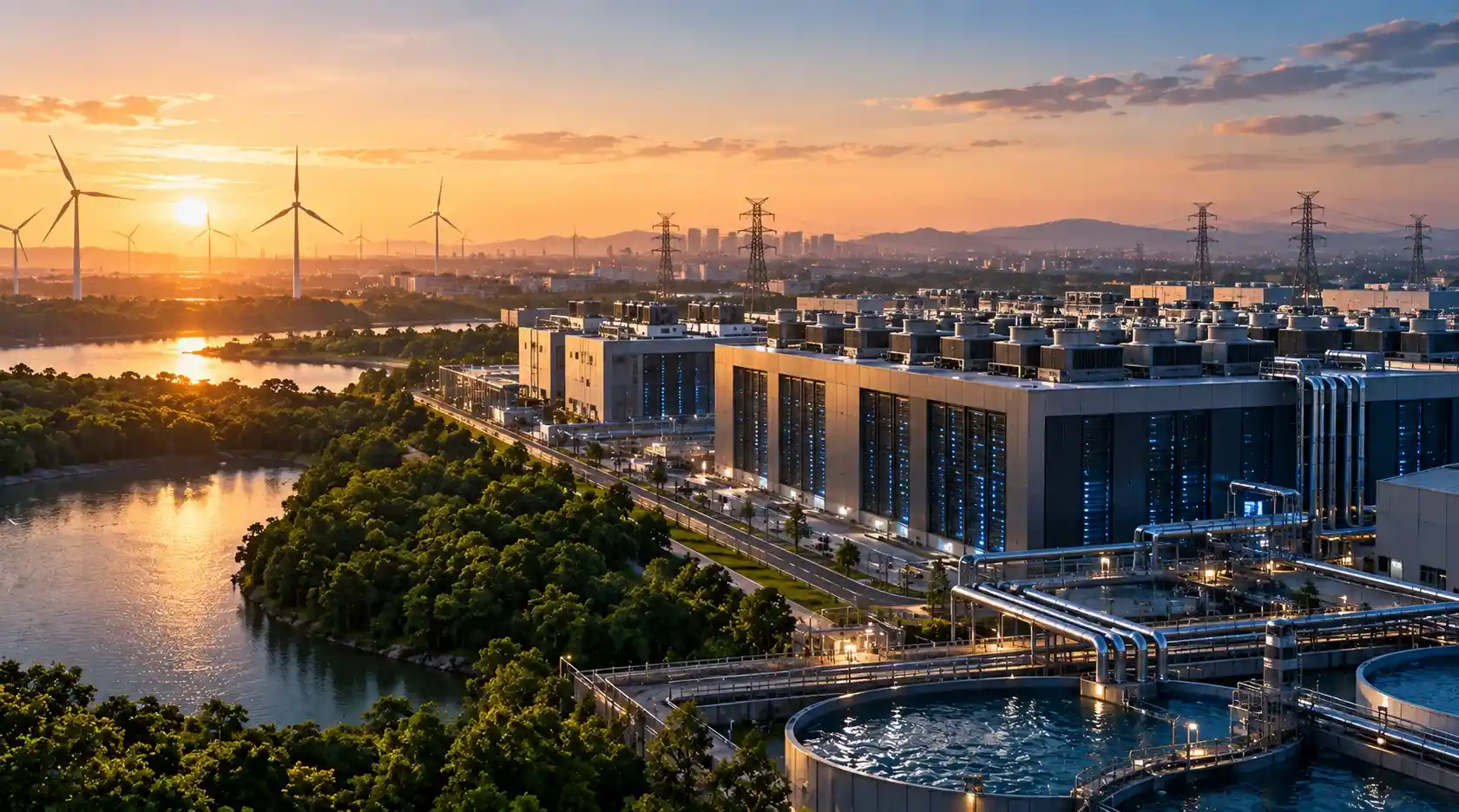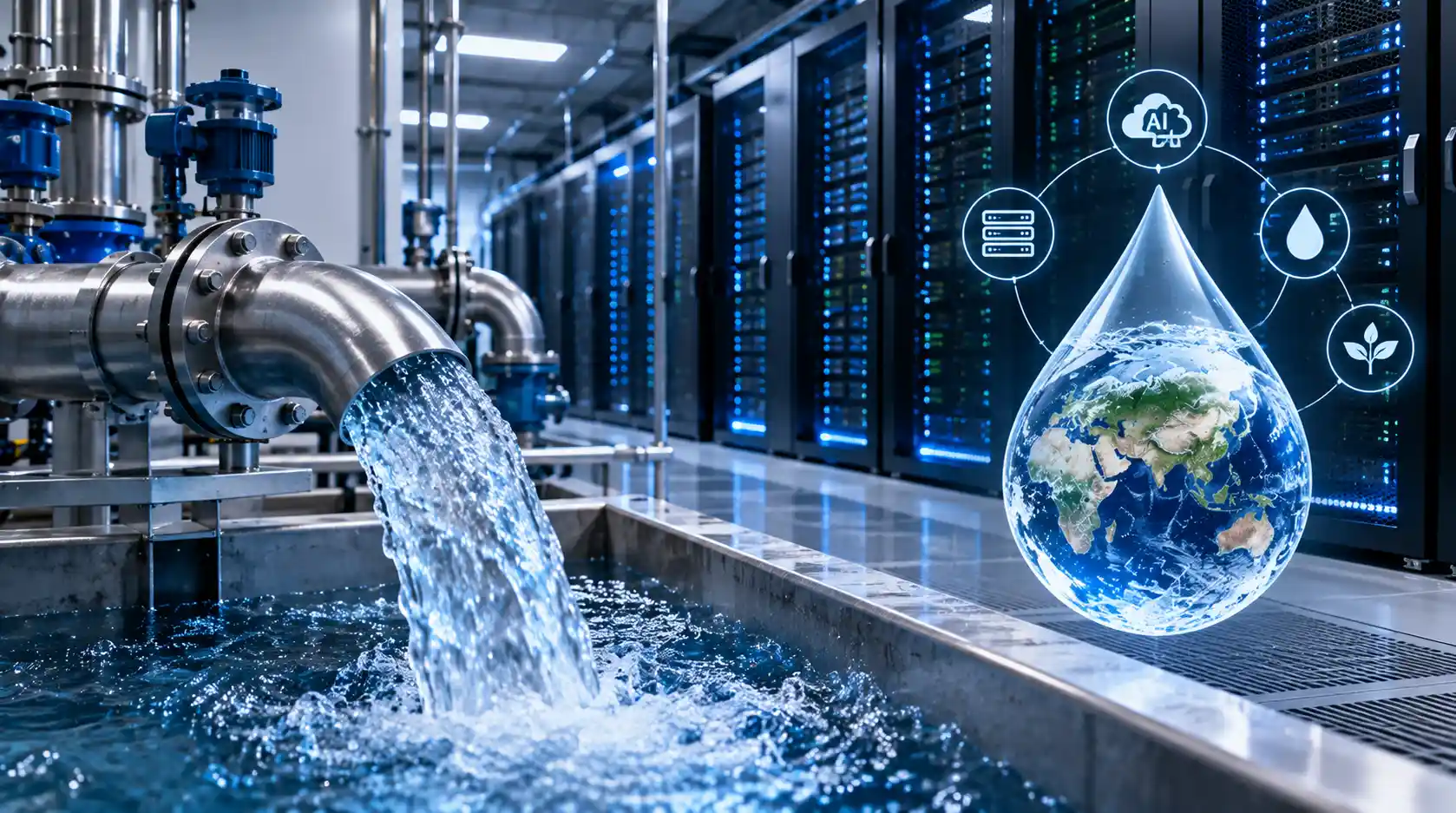

The internet has a water bill
Every search query, cloud backup, video stream, banking transaction and artificial-intelligence prompt ultimately runs on physical machines.
Those machines generate heat.
Removing that heat takes energy, and in many data centers it also takes water.
The result is one of the least visible environmental costs of the digital economy.
The International Energy Agency estimates that global data-center water consumption is currently around 560 billion litres per year.
Converted into a daily figure, that is approximately 1.53 billion litres every 24 hours.
That does not mean servers themselves literally absorb 1.53 billion litres of water each day.
The figure represents a broader data-center water footprint that includes direct cooling, water consumed while generating the electricity used by data centers and a smaller share associated with semiconductor manufacturing.
And the number is growing quickly.
Under the IEA's base case, global data-center water consumption could reach approximately 1.2 trillion litres annually by 2030.
That would equal roughly 3.29 billion litres every day.
In other words, the daily water footprint of the world's computing infrastructure could more than double within this decade.
How much water do the world's data centers consume per day?
Using the IEA estimate of 560 billion litres per year:
560 billion litres / 365 days = approximately 1.53 billion litres per day.
The 2030 projection works out as:
1.2 trillion litres / 365 days = approximately 3.29 billion litres per day.
These numbers are global estimates, not measurements from one centralized water meter.
Thousands of data centers operate under different climates, cooling technologies, electrical grids and disclosure standards.
The exact global total therefore carries uncertainty.
But the estimates provide an important sense of scale.
Where does the 1.53 billion litres actually go?
A 2026 review of data-center resource consumption breaks the estimated 560-billion-litre annual footprint into three broad categories.
Around 373 billion litres were associated with indirect water consumption from electricity and energy.
Approximately 140 billion litres were consumed directly at data centers.
Around 47 billion litres were associated with manufacturing servers and semiconductor equipment.
Converted into daily averages, that is approximately:
- 1.02 billion litres per day associated with electricity and energy.
- 384 million litres per day from direct data-center water consumption.
- 129 million litres per day associated with server and semiconductor manufacturing.
Together they add up to approximately 1.53 billion litres per day.
This decomposition explains why looking only at cooling towers substantially understates the water footprint of digital infrastructure.
Direct cooling: roughly 384 million litres a day
The most visible use of water happens at the data center itself.
Servers convert most of the electricity they consume into heat.
That heat has to be removed continuously because processors, memory, storage and networking equipment operate inside carefully controlled temperature ranges.
Some facilities rely heavily on air cooling.
Others use chilled-water systems, evaporative cooling, cooling towers or combinations of those technologies.
High-density AI racks are also accelerating adoption of direct-to-chip liquid cooling, where coolant runs much closer to GPUs and other processors.
Liquid cooling does not automatically mean that all of the liquid is continually consumed.
Many direct-to-chip systems use closed loops in which coolant circulates repeatedly.
The biggest consumptive losses often occur when heat is ultimately rejected through evaporation elsewhere in the cooling system.
That distinction is critical.
Why evaporative cooling uses so much water
Evaporation is an extremely effective way to remove heat.
When water changes from liquid to vapor, it carries thermal energy away.
Cooling towers use this physical process to reject heat from facilities.
But water that evaporates is no longer immediately available to the local water system.
That is classified as consumption.
Additional water may also leave a cooling system through blowdown, a process in which concentrated minerals and impurities are removed from circulating water.
This is why two data centers with the same computing capacity can have radically different direct water footprints.
A facility in a cool climate using outside-air economization may consume far less water than one using evaporative cooling in a hot region.
The biggest hidden water use happens at power plants
The largest portion of the estimated global footprint does not necessarily occur inside data-center campuses.
It can occur at the power plants supplying them.
Thermal electricity generation often requires cooling water.
Coal, natural gas and nuclear power plants can withdraw large amounts of water to condense steam and manage heat.
The exact water consumed for each kilowatt-hour varies enormously with power-plant design and cooling technology.
Wind and solar photovoltaic generation generally have much lower operational water requirements than conventional thermal power plants, although manufacturing and upstream activities have their own footprints.
This means the water footprint of a server depends partly on where its electricity comes from.
The same computing workload can therefore have different water consequences in different regions.
Data centers already consume almost 500 TWh of electricity
The water problem is tightly connected to the electricity problem.
The International Energy Agency's updated 2026 outlook estimates that global data centers consumed around 485 terawatt-hours of electricity in 2025.
That is expected to rise toward approximately 950 TWh by 2030.
AI-focused data-center electricity use is projected to grow considerably faster than overall data-center electricity demand.
Servers remain the dominant electricity consumer inside modern facilities.
The IEA estimates that servers account for around 60% of electricity demand in a modern data center, while storage, networking, cooling and other infrastructure consume the remainder.
The hotter and more power-dense the servers become, the more difficult thermal management becomes.
AI servers are changing the cooling equation
Traditional servers built around CPUs may consume hundreds of watts per processor.
Modern AI systems can place large numbers of high-power GPUs or specialized accelerators into a single rack.
That can produce thermal densities far beyond what conventional air cooling was designed to handle efficiently.
The AI industry is therefore moving toward liquid-cooled infrastructure.
NVIDIA-class rack systems, custom accelerators and other high-density architectures increasingly use direct-to-chip cooling.
Hyperscale facilities dedicated to AI can exceed 100 megawatts of power capacity.
The IEA estimates that a 100 MW hyperscale facility in the United States can consume approximately 2 million litres of water per day when direct and indirect water use are considered.
That is only one data center.
Future AI campuses are being proposed at multiples of that electrical capacity.
A 100 MW data center can use about 2 million litres a day
A typical 100 MW hyperscale facility provides a useful physical reference.
According to IEA analysis, a U.S. facility of that scale can consume around 2 million litres of water per day in total.
More than 60% can be indirect water consumption associated with electricity generation.
The precise number depends on weather, workload, cooling design and power source.
A facility connected to a low-water electricity system and using water-efficient cooling could perform significantly better.
Another located in a hot region and supplied by water-intensive thermal generation could perform worse.
This variability is why national or company averages cannot be blindly applied to every facility.
AI alone could consume more than a billion litres per day by 2027
One of the most widely cited AI-water studies, subsequently published in Communications of the ACM, estimates that global AI demand could consume approximately 0.38 to 0.60 billion cubic metres of water annually by 2027.
That is water consumption rather than total withdrawal.
Converted into litres per day, the range is approximately 1.04 billion to 1.64 billion litres every day.
The same research estimates AI-related water withdrawals of approximately 4.2 to 6.6 billion cubic metres annually.
Converted to daily terms, that is approximately 11.5 billion to 18.1 billion litres withdrawn each day.
Consumption and withdrawal should not be confused.
Water withdrawal measures how much water is taken from a source.
Water consumption measures the portion not returned to the original source because it evaporates, is incorporated into another process or is otherwise unavailable for immediate reuse.
A system can withdraw a very large amount of cooling water while returning most of it.
Water withdrawal is not the same as water consumption
This distinction is one of the biggest reasons data-center water numbers appear contradictory.
If a facility withdraws 10 million litres and returns 9 million litres to the watershed, its withdrawal is 10 million litres but its consumption is roughly 1 million litres.
A different study might report only the 10-million-litre figure.
Another might report only the 1-million-litre figure.
Both can be correct.
Company sustainability disclosures also differ in whether they report water withdrawal, freshwater withdrawal, consumption, replenishment or some combination of those metrics.
Any comparison that ignores those accounting boundaries can be misleading.
AI's water footprint is not one number per prompt
Claims such as 'one AI question uses a bottle of water' are often repeated without context.
There is no universal amount of water consumed by every AI prompt.
The footprint changes with the model, amount of computation, hardware efficiency, batch size, data-center location, weather, cooling design and electricity source.
Earlier academic estimates suggested that a group of roughly 10 to 50 medium-length responses from older large-language-model infrastructure could correspond to about 500 millilitres of water under certain conditions.
Newer real-world measurements can be dramatically lower at the prompt level.
Google's 2025 study of Gemini serving estimated approximately 0.26 millilitres of direct on-site water consumption for its median text prompt under Google's stated methodology.
The difference illustrates how dangerous it is to turn one model-specific estimate into a universal rule for all AI.
Google shows how enormous company-level water demand has become
Google's latest environmental disclosure provides another view of the scale.
The company says its water-stewardship projects replenished approximately 7.7 billion gallons of water during 2025.
That represented roughly 78% of Google's total freshwater consumption for the year.
Google also reported that 87% of its freshwater withdrawal came from sources categorized as having low or medium risk of depletion or scarcity.
These figures cover Google's operational footprint rather than being a clean measure of server cooling alone, so they should not be directly compared with a single data-center WUE metric.
But they demonstrate why water has become a board-level infrastructure issue for hyperscalers.
Microsoft is redesigning data centers to eliminate cooling-water evaporation
Microsoft has also been trying to reduce the direct water burden of its expanding data-center fleet.
Its FY2024 sustainability reporting recorded total operational water consumption of approximately 5.807 million cubic metres and withdrawal of approximately 10.377 million cubic metres.
Microsoft says newer direct-to-chip cooling designs can save more than 125 million litres of water annually per facility compared with previous designs in relevant deployments.
The company has also announced new data-center designs using closed-loop water systems intended to avoid continual water evaporation for cooling after the initial loop is filled.
This illustrates an important future direction.
AI racks may become more liquid cooled while simultaneously reducing freshwater consumption if those liquid systems operate as closed loops and reject heat without evaporating potable water.
AWS says its water efficiency has improved sharply
Amazon Web Services reports a global data-center Water Usage Effectiveness figure of 0.12 litres of water withdrawn per kilowatt-hour of IT load for 2025.
AWS says that represents a 20% improvement from 2024 and a 52% improvement since 2021.
Its newer data-center architecture combines air cooling and configurable liquid-to-chip cooling.
AWS says its In-Row Heat Exchanger captures heat directly from high-density AI hardware and could reduce water use by approximately 9% compared with evaporatively cooled facilities when fully deployed in applicable environments.
In 2026 AWS also began giving customers access to estimated water-withdrawal data associated with their AWS workloads by region and service.
That is notable because enterprise cloud customers historically had little visibility into the water associated with their computing usage.
Water Usage Effectiveness is becoming the new PUE
The data-center industry has traditionally focused on Power Usage Effectiveness, or PUE.
PUE measures how much total facility electricity is required compared with the electricity delivered to IT equipment.
A PUE approaching 1.0 indicates that relatively little energy is being spent outside computing hardware.
Water Usage Effectiveness, or WUE, attempts to do something similar for water.
It is commonly expressed as litres of water per kilowatt-hour of IT energy.
A lower WUE means less direct water demand for the same amount of computing.
But WUE usually describes on-site water and may exclude water consumed while generating electricity.
A data center can therefore have an excellent WUE while still having a significant indirect water footprint if its electricity comes from water-intensive power generation.
Energy efficiency and water efficiency can conflict
The engineering problem becomes more complicated because reducing water use can sometimes increase electricity consumption.
Evaporative cooling can be extremely energy efficient.
Switching to completely dry cooling can save water but require more fans, compressors or other mechanical equipment during hot weather.
That can increase electricity demand.
If the electricity comes from thermal generation, some water consumption may simply move from the data center to the power plant.
Operators therefore have to optimize energy and water together rather than treating them as unrelated sustainability metrics.
Geography matters as much as total litres
One billion litres consumed in a water-abundant region does not create the same environmental pressure as one billion litres consumed in a severely water-stressed basin.
This is why global totals tell only part of the story.
Data centers require reliable power, fiber connectivity, land and access to customers.
Those requirements can cause facilities to cluster around cities and existing technology hubs.
Some of those regions are already struggling with drought or competing municipal and agricultural water demand.
A 2026 Water Research review noted that a large share of recently developed data-center infrastructure is located in water-stressed regions.
The sustainability question is therefore not simply 'How much water does AI use?'
It is also 'Where is that water being consumed?'
India faces the same infrastructure trade-off
India's data-center market is expanding rapidly as cloud companies, banks, streaming platforms, e-commerce firms, government services and AI workloads increase domestic computing demand.
Mumbai, Chennai, Hyderabad and Bengaluru have become important data-center clusters.
Several of India's major technology hubs also face recurring water stress.
Grant Thornton Bharat estimates that Indian data-center capacity could grow toward approximately 6.5 GW by 2030 and has highlighted water availability as an increasingly important infrastructure constraint.
The challenge is particularly important because decisions about cooling systems made while facilities are being designed can shape water consumption for decades.
Reclaimed wastewater, closed-loop cooling and careful siting can substantially change the outcome.
Using drinking water is not technically necessary everywhere
Data centers do not always need potable freshwater for every cooling application.
Operators are increasingly turning to reclaimed wastewater, treated municipal effluent and other non-potable sources.
This can reduce competition with drinking-water systems.
The strategy is already being used in several global data-center markets.
However, reclaimed water requires pipelines, treatment systems and reliable municipal infrastructure.
Not every location has those resources available.
Closed-loop liquid cooling could change the numbers
The next generation of cooling technology may look counterintuitive.
More servers will probably have liquid flowing directly through or near them.
Yet those servers may consume less water overall.
In a closed-loop direct-to-chip system, coolant absorbs heat from processors and circulates through heat exchangers repeatedly.
The same liquid can remain inside the system rather than being continually evaporated.
The remaining question becomes how the facility ultimately rejects that heat to the environment.
If dry coolers are used, direct freshwater consumption can approach very low levels.
If cooling towers are used, evaporation remains part of the system.
Data centers may become more water-aware in real time
The future may also involve dynamically routing computing workloads according to environmental conditions.
Cloud operators already distribute workloads across global regions for performance, cost and reliability.
The same principle could be applied to water.
Flexible AI workloads could theoretically be shifted toward facilities experiencing cooler weather, abundant renewable electricity or lower water stress.
Training workloads that do not require immediate response times are particularly suitable for this kind of scheduling.
A model could be trained at a different hour or location if doing so substantially reduces cooling or electricity-related water consumption.
This concept is often described as water-aware computing.
Why the 2030 number matters
The global data-center industry is not merely adding more servers.
It is adding increasingly power-dense servers.
The IEA projects global data-center electricity demand at around 950 TWh by 2030, roughly double its 2025 level.
Its water-consumption base case rises from around 560 billion litres annually to approximately 1.2 trillion litres.
That translates from approximately 1.53 billion litres per day today to approximately 3.29 billion litres every day by 2030.
The increase is not inevitable at exactly that magnitude.
Better cooling, cleaner electricity, closed-loop systems, reclaimed water, more efficient chips and smarter workload management can change the trajectory.
But efficiency improvements are competing against explosive growth in computing demand.
The server does not see the water, but the watershed does
Digital services are often described as weightless.
The cloud sounds almost immaterial.
In reality, every byte ultimately runs through physical infrastructure.
The processors require electricity.
Electricity creates heat.
Heat has to go somewhere.
And in large parts of today's computing system, moving that heat ultimately involves water.
The best current global estimate suggests that the data-center system consumes around 1.53 billion litres every day when cooling, electricity-related use and equipment manufacturing are considered.
Direct on-site consumption accounts for only around 384 million litres of that total.
Most of the footprint sits outside the server room.
By 2030, the broader global figure could exceed 3.2 billion litres every day.
That makes water one of the defining physical constraints of the AI and cloud-computing boom.
The next generation of computing will therefore be judged not only by how many tokens, queries or calculations it can process per second.
It will increasingly be judged by how much electricity, carbon and water it needs to do so.
Reader questions
Frequently asked questions
How much water do data centers use globally every day?
The IEA estimates global data-center water consumption at around 560 billion litres annually. Dividing that by 365 gives approximately 1.53 billion litres per day across direct cooling, electricity-related consumption and other associated infrastructure.
How much water do servers directly use every day?
Servers themselves do not directly consume water. Cooling infrastructure serving data centers is estimated to account for about 140 billion litres annually in one global breakdown, equivalent to roughly 384 million litres per day.
Why do servers need water?
Servers generate heat while computing. Some data centers use evaporative cooling or chilled-water systems to remove that heat. Water is also consumed indirectly by power plants generating electricity for the servers.
How much water will data centers use in 2030?
The IEA base case projects around 1.2 trillion litres of annual global data-center water consumption by 2030, equal to approximately 3.29 billion litres per day.
How much water does a 100 MW data center use?
IEA analysis estimates that a 100 MW hyperscale data center in the United States can consume around 2 million litres per day in total, with more than 60% potentially associated indirectly with electricity generation.
How much water does AI consume per day?
A published projection estimates global AI water consumption could reach approximately 0.38 to 0.60 billion cubic metres annually by 2027, equivalent to roughly 1.04 to 1.64 billion litres per day. This is a modeled projection, not a measured current global total.
How much water does AI withdraw?
Research projects global AI-related water withdrawal of approximately 4.2 to 6.6 billion cubic metres annually in 2027, equivalent to roughly 11.5 to 18.1 billion litres per day. Most withdrawn water can be returned, so withdrawal is much larger than consumption.
What is the difference between water withdrawal and water consumption?
Water withdrawal is the total amount taken from a source. Water consumption is the portion that is not returned to that source, typically because it evaporates or is incorporated into another process.
Does liquid cooling use more water than air cooling?
Not necessarily. Closed-loop direct-to-chip liquid cooling can circulate the same coolant repeatedly and use very little new water. Total consumption depends on how the captured heat is ultimately rejected.
Do all data centers use drinking water?
No. Facilities can use potable water, groundwater, reclaimed wastewater or other non-potable sources depending on local infrastructure and cooling design.
What is Water Usage Effectiveness or WUE?
Water Usage Effectiveness is a data-center efficiency metric commonly expressed as litres of water used or withdrawn per kilowatt-hour of IT energy. Lower values generally indicate better on-site water efficiency.
What is AWS data-center WUE?
AWS reports a global data-center Water Usage Effectiveness of 0.12 litres of water withdrawn per kilowatt-hour of IT load for 2025, a 52% improvement from 2021.
How much water does a Gemini AI prompt use?
Google reported approximately 0.26 millilitres of direct on-site cooling water for its median Gemini Apps text prompt under its published methodology. That figure should not be generalized to every AI model or data center.
Why do estimates of AI water use vary so much?
Results depend on model size, hardware efficiency, electricity source, cooling technology, weather, location and whether the calculation includes only on-site cooling or also electricity generation and manufacturing.
Can data centers operate without consuming freshwater for cooling?
Yes. Closed-loop liquid systems, dry cooling, outside-air cooling and reclaimed-water systems can dramatically reduce or sometimes eliminate routine freshwater evaporation for cooling, although energy and climate trade-offs remain.
Why is data-center water use a problem in India?
India's data-center capacity is growing rapidly while several major technology hubs already experience water stress. The impact therefore depends not only on total consumption but on where facilities are located and what water sources and cooling systems they use.
Nexuswild welcomes factual corrections. Email [email protected] with evidence and the article URL.