
Gujarat Adds EVs and Off-Road Vehicles to Government Fleet Policy
The Gujarat government has revised its official vehicle procurement policy, adding dedicated categories for field inspections, enforcement operations and off-road duties. The amendment, announced on October 12, 2026, expands the range of vehicles available to government departments and explicitly includes electric vehicles for certain field assignments.
The revision builds on the state’s April 11, 2023, procurement framework, which prescribed vehicle categories largely according to the designation and responsibilities of government officials. The new provisions introduce Category F for field inspection and enforcement vehicles and Category F1 for officers whose work requires specialised off-road capability.
The change reflects a practical distinction in government operations: vehicles used for administrative travel may not be suitable for inspecting infrastructure, conducting enforcement work or reaching remote locations. The revised framework allows vehicle selection to take those operational requirements into account.
Category F includes electric vehicles
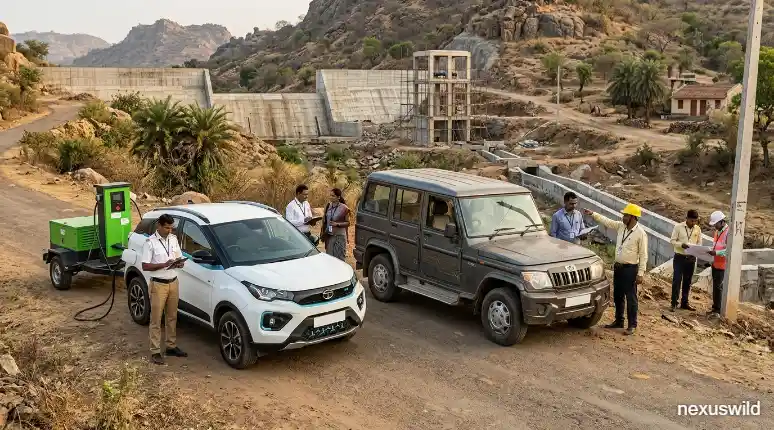
Category F is intended for field inspection and enforcement duties. The approved list includes the Mahindra Scorpio N Z4 4X4, Mahindra Thar Roxx MX5, Mahindra Bolero Neo N10 (O), Kia Carens Clavis HTE (O), Maruti Suzuki Ertiga ZXI Plus and Toyota Rumion V.
Two electric vehicles are also included: the Mahindra XUV400 EL Pro 39.4 kWh and the Tata Nexon EV Creative 45. Their inclusion gives departments an electric option for certain field-related duties rather than limiting EV choices to conventional government office use.
The distinction is relevant to India’s broader transition towards electric mobility. Government fleets can provide a use case for EVs, particularly where vehicles follow predictable routes and can be charged at suitable facilities. However, field operations can involve longer distances, irregular schedules and locations where charging access is limited. Departments will need to consider the nature of their assignments and the availability of charging facilities when deciding whether an electric model is appropriate.
The policy amendment establishes eligible choices; it does not mean that every department must purchase an EV or that orders for the newly listed models have already been placed.
Category F1 targets remote and difficult terrain
The second category, F1, is designed for officials whose work requires off-road capability. It covers duties across several departments, including Home; Forest and Environment; Industries and Mines; Narmada, Water Resources, Water Supply and Kalpsar; Panchayats and Rural Housing; Ports and Transport; Roads and Buildings; and Revenue.
Category F1 includes the vehicles approved under Category F, alongside four additional specialised models: the Tata Yodha Pickup, Isuzu V-Cross 4WD Z, Mahindra Bolero Pick-Up 4WD and Mahindra Bolero Camper Gold RX 4WD.
These vehicles are intended for work in locations such as forest areas, mining zones, remote regions, construction sites and places where unpaved roads can make ordinary passenger vehicles less practical.
For officials inspecting public works, monitoring natural resources or carrying out field enforcement, vehicle suitability can affect how efficiently teams reach project sites and complete their assignments. The revised list gives departments a clearer set of options for those conditions.
The policy does not guarantee improved field performance on its own. Outcomes will also depend on vehicle availability, maintenance, driver training, operating costs and how departments allocate their fleets.
Existing procurement framework remains in place
The new categories add to the existing vehicle framework rather than replacing it entirely. Under the earlier policy, categories covered ministers and senior officials, guests with special status, heads of institutions, district-level officers, department heads and government office staff. The 2026 amendment adds a more function-oriented approach for field and off-road work.
Procurement safeguards also remain important. Reporting on the revised framework states that prescribed vehicles are to be purchased through the Government e-Marketplace (GeM) at prevailing market prices, while purchases outside the prescribed categories require appropriate approval and justification. These requirements matter because expanding the list of permitted models does not remove the need for public-sector financial discipline. Departments must still consider procurement rules, budget availability and the operational case for a particular vehicle.
What the policy could mean for automakers and EV adoption
The expanded list creates an opportunity for manufacturers whose vehicles are included in the approved categories. Eligibility can make a model available for consideration in departmental procurement, but it does not guarantee a sale, a contract or a specific order volume.
For electric-vehicle manufacturers, the addition of the XUV400 EL Pro and Nexon EV Creative 45 to Category F is a notable development because it broadens the potential use cases for EVs in government service. If departments choose these models for suitable assignments, the experience could help demonstrate how electric vehicles perform in routine field operations.
Any wider impact on charging infrastructure will depend on actual adoption. Greater EV use by departments could create a stronger case for charging facilities at government premises and operational bases, but the amendment itself does not announce new charging investments or a deployment timetable.
The next developments to watch are departmental procurement decisions, tender announcements, the number and type of vehicles purchased, and whether the state issues further implementation guidance.
For now, Gujarat’s revised policy gives government departments a broader and more specialised vehicle framework. Its practical impact will depend on how the new categories are used, whether procurement follows, and how effectively departments match vehicle choices to the demands of their work.
Nexuswild welcomes factual corrections. Email contact@nexuswild.com with evidence and the article URL.