
Health inspections in the United States are not conducted by the federal government. They are carried out by state and local health departments, which typically build their rules around the FDA Food Code—a model code the FDA publishes as guidance rather than as directly enforceable federal law. Each state, county, or city decides which edition to adopt and can modify specific requirements, meaning a restaurant's legal procedures come from its local jurisdiction, not from Washington.
A kitchen that only tightens up before an inspector's visit is managing an event, not a system. A kitchen that runs the same checks every day, whether or not the health department is coming, is managing risk. The internal audit is what makes this continuous compliance possible.
Receiving and Supplier Checks
The audit starts before food enters the building. Staff receiving deliveries must:
- Confirm shipments come from approved suppliers.
- Check that packaging is fully intact.
- Verify temperatures on refrigerated and frozen items with a calibrated thermometer rather than trusting the delivery truck's display.
- Reject and log any product that arrives above a safe temperature, has damaged packaging, or shows signs of pest activity.
Storage, Holding and Separation
Most potentially hazardous food falls under the Food Code's designation of TCS food (items that need time and temperature control to stay safe).
- Temperature Control: Under the current FDA Food Code, cold holding is set at 41°F (5°C) or below, and hot holding at 135°F (57°C) or above. Because some jurisdictions still enforce older thresholds, operators must confirm the exact figures their local code requires.
- Separation: Raw meat, poultry, and seafood must be stored separately from ready-to-eat food—generally below it in a cooler—to prevent contaminated drips from reaching items that will not be cooked again.
- Rotation: Opened or prepared TCS food must be date-marked, and stock rotated on a first-in, first-out basis to ensure old product does not linger past its safe window.
Cooking, Cooling and Reheating
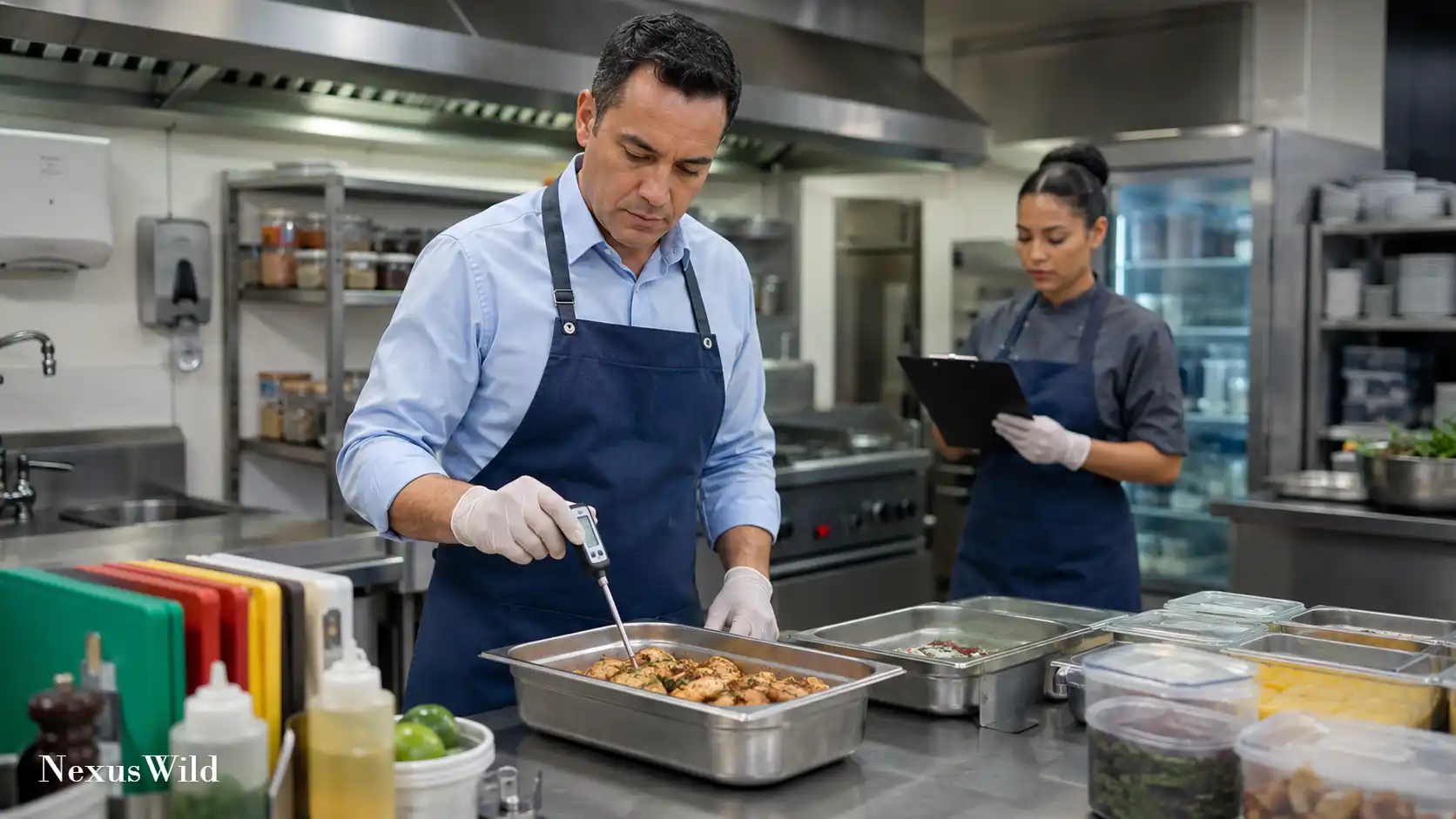
Minimum internal cooking temperatures scale with risk. Poultry and stuffed items generally require the highest temperatures, ground meats sit in the middle, and whole cuts of intact meat, fish, or eggs served immediately can safely be cooked to lower temperatures for a specified time. A calibrated probe thermometer, checked in the thickest part of the food, is the only reliable way to confirm these targets are met.
Cooling is tightly controlled: food typically must drop from hot-holding temperature to 70°F within two hours, then to 41°F or below within four more hours. Reheating food for hot holding generally requires bringing it back up to a high temperature within a limited window, not simply warming it through.
Preventing Cross-Contamination and Managing Allergens
Separate cutting boards, utensils, and prep surfaces for raw proteins and ready-to-eat food—often distinguished by color coding—reduce the risk of transferring pathogens. Equipment and surfaces should be cleaned and sanitized between tasks, not just at the end of a shift.
Allergen management requires identifying the major allergens present in menu items, preventing shared equipment or utensils between allergen-containing and allergen-free dishes, and training staff to answer customer questions accurately rather than guessing.
Hygiene, Illness and Cleaning
Handwashing at designated sinks and at the right moments (after handling raw food, using the restroom, touching the face, or switching tasks) remains one of the most effective controls a kitchen has.
Written policies on employee illness matter just as much. Staff with vomiting, diarrhea, jaundice, or diagnosed infections tied to certain pathogens must be excluded from food handling or reported to a supervisor, following the restaurant's documented policy rather than informal judgment calls. Food-contact surfaces require both cleaning to remove visible soil and sanitizing to reduce pathogens to a safe level, using sanitizer at the correct concentration for the method in use.
Pest Control, Equipment and Calibration
Regular pest monitoring, sealed entry points, and documentation of professional pest-control visits belong in the same daily-check category as temperature logs. Refrigeration units require functioning internal thermometers, and food thermometers themselves must be calibrated regularly—commonly checked against an ice-water bath or boiling water. A thermometer that reads incorrectly renders every other control unreliable.
HACCP and Documentation
Hazard Analysis and Critical Control Point (HACCP) systems identify and monitor specific points in a food process where hazards can be controlled. They are required for categories like seafood and juice processing, and for higher-risk retail operations like reduced-oxygen packaging. While not universally required for every restaurant, many operators voluntarily apply HACCP-style thinking to high-risk processes.
Consistently expected documentation includes temperature logs, cleaning schedules, receiving records, and written corrective actions showing what staff did when a check failed, such as discarding food or adjusting equipment.
What an Inspector Actually Looks At
When a state or local inspector arrives, they typically:
- Measure food temperatures directly with their own thermometer rather than relying on equipment displays.
- Observe handwashing and glove use.
- Check date marking and storage separation.
- Look for evidence of pest activity.
- Review whatever logs and documentation the establishment keeps.
None of these controls work as a one-time cleanup. Bacteria do not check the calendar, and a walk-in cooler that drifts out of range on a random Tuesday is exactly as dangerous as one that drifts on inspection day. Restaurants that treat their own audit process as a continuous habit, not a pre-visit scramble, are the ones that consistently pass inspections because they have already caught and corrected the problems an inspector would otherwise find.
Further reading and useful links
Reader questions
Frequently asked questions
Who sets the food safety rules for restaurants in the United States?
Food safety rules are enforced by state and local health departments. These agencies typically base their regulations on the FDA Food Code, adopting and occasionally modifying specific editions to serve as local law.
What are the safe temperature zones for holding TCS food?
Under the current FDA Food Code, potentially hazardous food (TCS food) must be held at 41°F (5°C) or below for cold storage, and 135°F (57°C) or above for hot holding, though specific requirements can vary slightly by local jurisdiction.
Is a HACCP system required for all restaurants?
No. HACCP systems are required for specific high-risk processes like seafood and juice processing or reduced-oxygen packaging. However, many restaurants voluntarily use HACCP principles to manage their highest-risk operations.
Nexuswild welcomes factual corrections. Email contact@nexuswild.com with evidence and the article URL.