
When Bengaluru-based startup Astrobase Space Technologies pulled back the curtain to reveal an 800-kilonewton liquid rocket engine named EVEREST, it marked a quiet yet monumental shift for the nation's aerospace sector. Developed by a team blending fresh entrepreneurial energy with veterans of the Indian Space Research Organisation (ISRO), this engine represents India's entry into one of the most elite engineering clubs in aerospace history. By building a Full-Flow Staged Combustion (FFSC) engine, the country has positioned itself alongside only the United States, Russia, and China in mastering this elite propulsion architecture.
What India Is Developing
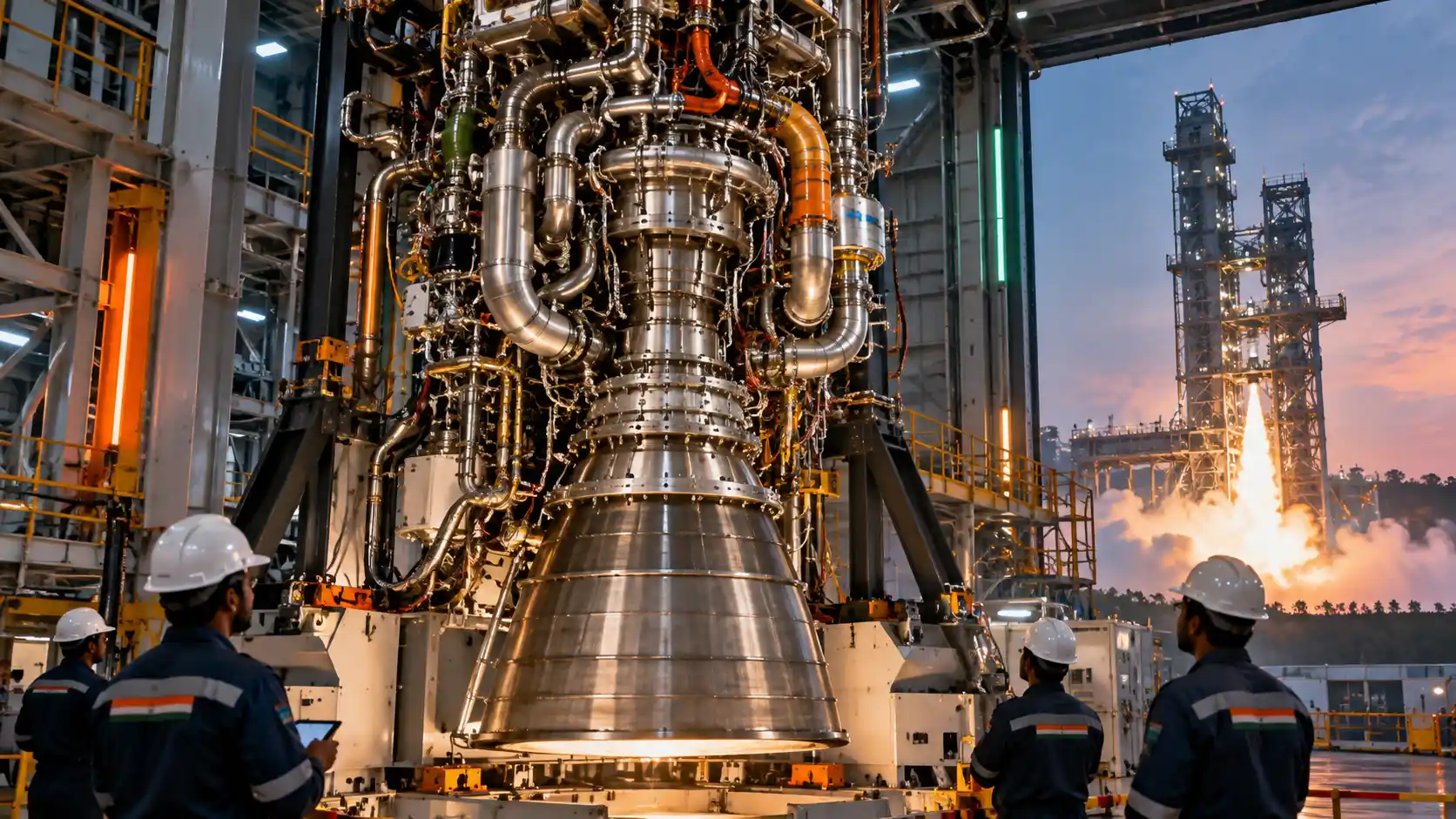
The hardware centerpiece of this breakthrough is the EVEREST engine, an 80-tonne-class propulsion system designed to run on liquid oxygen (LOX) and methane. Unlike traditional rocket engines that rely on kerosene or complex storable propellants, this fuel combination is tailor-made for the next generation of reusable launch vehicles. The project progressed rapidly, bringing major engine components together into a fully integrated, full-scale assembly by mid-2026. This milestone leverages large-scale metal 3D printing at a dedicated facility in Bengaluru, with over 70 percent of the engine indigenously designed and built. It signals a maturing domestic manufacturing ecosystem operating under the progressive policy framework of IN-SPACe.
How FFSC Rocket Engine Technology Works
To understand why engineers view the Full-Flow Staged Combustion engine as the pinnacle of liquid propulsion, you have to look inside the plumbing of a rocket. In a standard gas-generator engine, a portion of the propellants is diverted to power the turbopumps and then dumped overboard as exhaust, wasting precious energy. Staged combustion improves this by routing propellants through pre-burners, but FFSC takes it a step further by splitting both fuel and oxidizer through separate, dedicated pre-burners. This means every single drop of fuel and liquid oxygen eventually makes its way into the main combustion chamber, leaving zero waste and maximizing thermodynamic efficiency.
Latest Testing and Development
Moving from theoretical physics to physical hardware is where most propulsion programs stumble. The development roadmap for EVEREST began shortly after the company's founding, moving steadily through rigorous physical milestones. A sub-scale version of the engine passed its first hot-fire test successfully, validating complex internal fluid dynamics and combustion stability. Following that, high-speed turbopump cold-flow testing proved that the internal pumps could handle extreme power loads - roughly five megawatts - while moving dense, high-pressure liquid oxygen. The program is now progressing through subsystem evaluations ahead of full-scale hot-fire tests at a private 21.5-acre test facility located in Andhra Pradesh.
Why the Technology Matters
The primary reason aerospace engineers obsess over FFSC designs is their exceptional chamber pressure and specific impulse capabilities, which typically exceed 340 seconds for advanced systems. High chamber pressure translates directly into more thrust per kilogram of engine weight, allowing rockets to haul heavier payloads into orbit without needing disproportionately massive fuel tanks. Furthermore, because methane burns far cleaner than traditional rocket kerosene, it leaves virtually zero soot deposits inside the engine core. This cleanliness drastically cuts down the time and labor required for post-flight inspections, paving the way for rapid turnaround times between flights.
India’s Future Space Applications
Mastering Indian rocket propulsion of this caliber is a foundational requirement for building commercially viable, fully reusable launch systems. While ISRO continues to pioneer heavy-lift vehicles like the LVM3, private ventures are increasingly targeting the burgeoning global market for frequent, low-cost satellite deployments. An 800 kN engine class is ideally suited for powering medium-lift boosters capable of carrying substantial cargo to low Earth orbit. With targeted orbital flight tests aimed for late 2028, these propulsion advancements could eventually support large satellite constellations, commercial logistics, and deep-space exploration infrastructure.
Technical Challenges
Building an FFSC engine is notoriously difficult because of the punishing physical environments inside the hardware. The oxygen-rich pre-burner side, in particular, exposes metals to high-pressure, high-temperature oxygen that makes standard alloys dangerously reactive and prone to rapid combustion. Overcoming these metallurgical hurdles required advanced coatings, proprietary internal geometries, and precision additive manufacturing. Designing turbopumps capable of managing multi-megawatt power levels without structural fatigue remains one of the steepest climbs in modern engineering.
Expert and Official Views
Rajeev Jyoti, Scientist and Director at the Technical Directorate of IN-SPACe, noted that supporting such private-sector initiatives is vital for broadening the country's technological base. While acknowledging that advanced propulsion still faces a demanding testing road ahead, officials emphasize that this ecosystem growth strengthens India's overall strategic readiness. Neeraj Khandelwal, co-founder and CEO of Astrobase, emphasized that their timeline is engineered backward from an ambitious December 2028 launch target, backed by mentoring relationships with veteran propulsion scientists like co-founder Devakumar Thammisetty.
Conclusion
The engineering strides being made with advanced propulsion programs highlight a broader transformation across the subcontinent's scientific landscape. By tackling the most complex liquid rocket architecture known to engineering, domestic talent is proving its capability to design, fabricate, and test world-class space hardware at home. As full-scale hot-fire tests approach, the aerospace community will be watching closely to see how this cutting-edge technology transitions from the test stand to the launchpad.
Further reading and useful links
Reader questions
Frequently asked questions
What is the EVEREST engine developed by Astrobase Space Technologies?
EVEREST is an 800-kilonewton Full-Flow Staged Combustion (FFSC) liquid rocket engine running on liquid oxygen and methane, designed for next-generation reusable launch vehicles.
Why is Full-Flow Staged Combustion (FFSC) technology significant?
FFSC is considered the pinnacle of liquid propulsion because it routes both fuel and oxidizer through separate pre-burners into the main chamber with zero waste, maximizing thermodynamic efficiency and chamber pressure.
Which countries have mastered FFSC rocket engine architecture?
Prior to India's private sector development, mastership of FFSC technology was limited to the United States, Russia, and China.
When is Astrobase targeting its first orbital flight test?
Astrobase Space Technologies is targeting orbital flight tests for its launch system in late 2028.
Nexuswild welcomes factual corrections. Email [email protected] with evidence and the article URL.