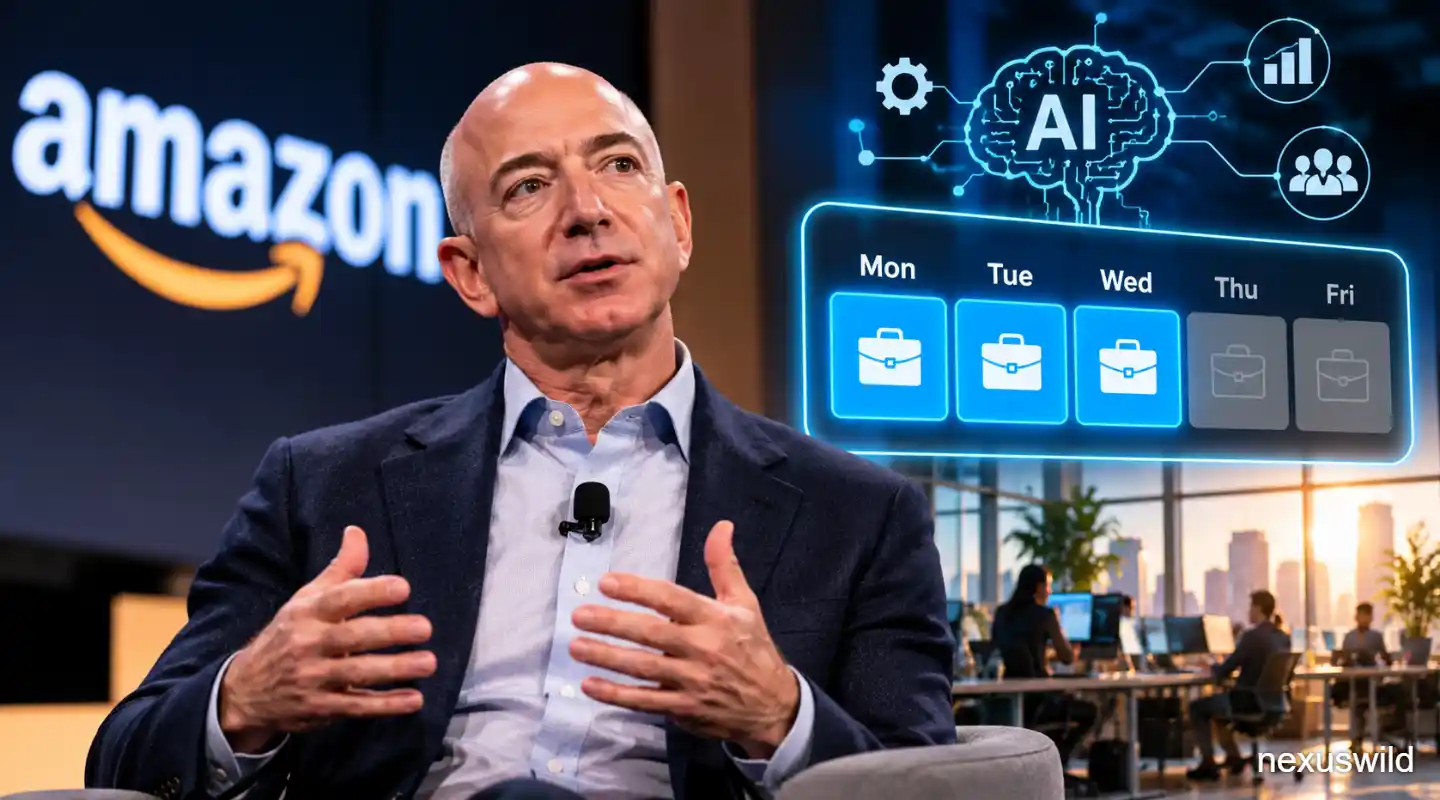

Amazon founder Jeff Bezos says artificial intelligence could generate productivity gains large enough to allow some Americans to work only three days a week while still supporting their families.
Bezos made the prediction during an interview aired Wednesday, arguing that AI could increase economic productivity rather than simply eliminate large numbers of jobs. He suggested that higher productivity could eventually give some workers the option of earning enough from fewer working days to support their households.
The comments come as businesses are rapidly increasing their investment in AI while questions about automation, employment and the distribution of productivity gains remain unresolved.
Bezos’ Three-Day Workweek Prediction
Bezos said some workers could eventually reach a point where they decide they can support their families while working three days a week.
His argument is based on the idea that AI could substantially increase the amount of economic output produced by each worker. If productivity rises sufficiently, businesses could potentially produce more goods and services with fewer hours of human labor.
Bezos also suggested that some two-income households could eventually decide that only one income is necessary, allowing one person to leave the workforce.
He did not provide a specific timetable, productivity target or economic model showing when such a shift could occur. The three-day workweek therefore remains a future scenario rather than a forecast with a defined implementation date.
Why AI Productivity Matters
The central issue behind Bezos' argument is productivity.
AI systems can automate or accelerate tasks involving software development, research, data analysis, customer service, content processing and other knowledge-based work. If those tools allow workers to accomplish more in less time, companies could potentially increase output without increasing working hours at the same rate.
The economic consequences, however, depend on how those productivity gains are distributed among workers, businesses and consumers.
Higher productivity does not automatically mean shorter working hours. Companies could instead use the additional capacity to expand production, increase profits, lower prices or pursue new business opportunities.
Bezos Rejects a Simple Job-Loss Scenario
Bezos also pushed back against predictions that AI will primarily produce mass unemployment.
He said he understands why many people are concerned about AI-driven job losses but disagrees with the view that widespread unemployment is the inevitable outcome. Instead, he argued that productivity improvements could eventually produce labor shortages because people would have less need to work multiple jobs.
The argument is notable because it presents AI as a technology that could change how much people need to work rather than simply determining how many jobs remain available.
That outcome is far from guaranteed. The effect of AI on employment will depend on adoption rates, the creation of new occupations, worker retraining, wage changes and how companies reorganize work.
Amazon Layoffs Add a Different Dimension
Bezos' comments come at a time when Amazon has been reducing its corporate workforce.
Amazon has cut roughly 30,000 corporate roles since late 2025, with additional reductions reported in October 2026. Bezos attributed the earlier workforce reductions to the company's rapid expansion during the COVID-19 pandemic, when online shopping surged and Amazon substantially increased its headcount.
The layoffs illustrate the complexity of the AI-and-employment debate. Productivity improvements can allow companies to accomplish more with fewer employees in some functions, even while the broader economy may create new demand for workers in other areas.
Amazon has said its more recent workforce changes are intended to align its structure with business priorities.
AI Investment Continues to Accelerate
Bezos also described the current AI investment boom as potentially resembling an industrial bubble while arguing that the underlying technology is real.
His position is that even if some AI investments eventually fail or lose money, the infrastructure and inventions created during the investment cycle could continue to benefit the economy.
That distinction is important because an investment bubble and the usefulness of a technology are not necessarily the same thing. Companies can overinvest in particular applications while the underlying technology continues to improve and find new uses.
What a Shorter Workweek Would Require
For a three-day workweek to become broadly practical, productivity gains would need to translate into higher effective incomes or lower costs without simply reducing workers' earnings.
Businesses would also need to redesign jobs around output rather than time spent at work. Some occupations may be easier to automate or compress into shorter schedules than others.
Industries requiring physical presence, continuous coverage or direct human interaction could face different constraints from software and other knowledge-based sectors.
There is also a distribution question. Even if AI substantially increases total economic output, the benefits could be concentrated among particular companies, workers or asset owners rather than being shared evenly across the workforce.
The Unresolved Question
Bezos' three-day workweek scenario is ultimately a prediction about how society might respond to higher productivity, not a confirmed change in U.S. employment practices.
The technology may make it possible for some workers to produce more in fewer hours, but whether that results in shorter workweeks will depend on business decisions, wages, labor-market conditions and how the economic gains from AI are distributed.
For now, the most immediate question is not whether Americans will soon work three days a week, but whether AI productivity gains will translate into higher output, new jobs, reduced working hours or some combination of all three.
Conclusion
Jeff Bezos believes AI could eventually generate enough productivity growth for some Americans to support their families while working only three days a week. His prediction offers a different perspective on the employment debate, shifting the focus from potential job losses to how society might use greater productivity.
But the three-day workweek remains a future possibility rather than an established economic trend. The scale of AI's productivity gains and how those gains are shared will determine whether shorter working hours become a realistic option for a significant portion of the workforce.
Nexuswild welcomes factual corrections. Email contact@nexuswild.com with evidence and the article URL.