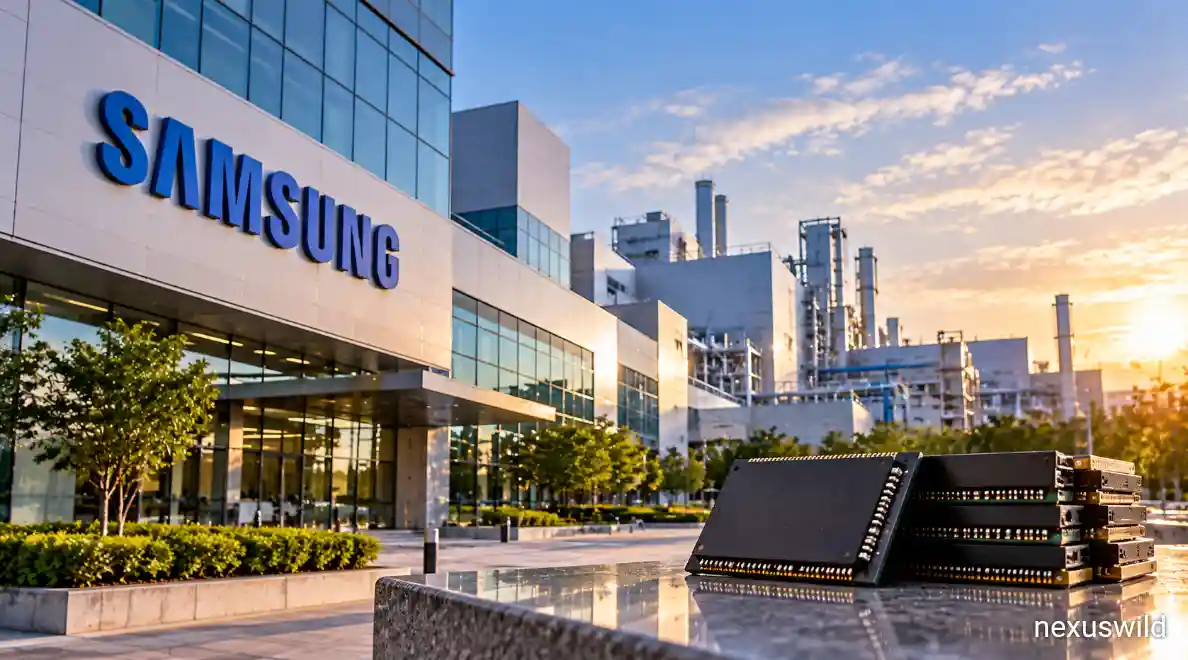

Samsung Electronics expects to post a record quarterly operating profit of 107.4 trillion won, or about $80.2 billion, for the third quarter of 2026, as surging artificial-intelligence infrastructure spending continues to tighten global memory supply and lift chip prices.
The South Korean technology group said consolidated sales for the July-to-September quarter are expected to reach approximately 195 trillion won, while operating profit is projected at 107.4 trillion won.
If confirmed when Samsung releases its full results later this month, the operating profit would represent a sharp increase from 12.17 trillion won in the third quarter of 2025 and would also exceed the company’s previous quarterly record.
The preliminary figures do not yet include a detailed breakdown by business division, so the exact contribution from Samsung’s semiconductor, smartphone, display and appliance operations will only become clear with the full earnings report.
Operating Profit Is Expected to Rise More Than Sevenfold
Samsung’s third-quarter operating-profit estimate represents an increase of roughly 782.5% from a year earlier.
That is close to a ninefold increase.
Sales are expected to rise from 86.06 trillion won in the third quarter of 2025 to around 195 trillion won in Q3 2026, more than doubling year over year.
Compared with the second quarter of 2026, when Samsung recorded sales of 171.5 trillion won and operating profit of 89.49 trillion won, the new guidance points to another sequential increase.
The company's official guidance range is:
- sales of 194 trillion to 196 trillion won;
- operating profit of 107.3 trillion to 107.5 trillion won.
Samsung publishes the midpoint because Korean disclosure rules do not allow earnings guidance to be released as a range in the headline estimate.
AI Demand Is Driving the Memory Boom
The main force behind Samsung’s earnings surge is the global expansion of AI computing infrastructure.
Large cloud companies and AI developers are buying increasing quantities of:
- high-bandwidth memory;
- server DRAM;
- enterprise SSDs;
- NAND flash;
- advanced processors; and
- networking components.
Samsung said after its second-quarter results that demand for memory products used in AI servers remained exceptionally strong and that the industry continued to face limited supply.
That imbalance has helped drive memory prices higher, improving profitability for major suppliers.
High-Bandwidth Memory Is Becoming Increasingly Important
High-bandwidth memory, or HBM, is one of the most strategically important products in the current AI semiconductor cycle.
HBM stacks multiple memory dies vertically, allowing processors to access much larger amounts of data at extremely high speeds.
This is particularly important for AI accelerators, where data must move rapidly between the processor and memory.
Samsung has been increasing its HBM output as demand from AI customers expands.
The company said its memory business scaled up sales of HBM4 during the second quarter and shipped samples of next-generation HBM4E products to major customers.
Samsung Is Trying to Close the HBM Gap
Samsung is one of the world’s largest memory-chip manufacturers, but it has faced intense competition in advanced HBM from SK Hynix.
The AI boom has made HBM one of the semiconductor industry’s most valuable product categories.
Samsung has therefore been working to expand its presence with newer-generation products and increase qualification with major AI-chip customers.
Current market reporting indicates that Samsung has increased HBM shipments substantially during 2026, helping it narrow the competitive gap in the segment.
The company has not yet disclosed the exact HBM contribution to third-quarter profit.
Server Memory Is Also Benefiting
The AI boom extends far beyond HBM.
Data centers also require enormous quantities of conventional DRAM and storage.
Samsung said server products reached a record share of its memory sales mix during the second quarter.
Demand for server DRAM, enterprise solid-state drives and HBM is expected to continue growing as cloud companies expand AI infrastructure.
That broad demand is important because it allows Samsung to benefit from AI investment across several memory categories rather than relying on a single product.
Memory Supply Remains Tight
The industry remains constrained by supply.
Major chipmakers have shifted manufacturing capacity toward higher-margin AI and server products, reducing the amount available for traditional consumer electronics.
At the same time, building additional semiconductor manufacturing capacity can take years.
Samsung said in July that demand growth in server DRAM, enterprise SSDs and HBM was likely to accelerate during the second half of 2026, keeping the memory market undersupplied.
That shortage has helped sustain higher prices.
Higher Memory Prices Are Boosting Earnings
Memory semiconductors are highly cyclical.
When supply exceeds demand, prices can fall rapidly and profitability can collapse.
When supply becomes tight, however, prices can rise sharply.
The current AI investment cycle has produced the second scenario.
Demand from AI data centers has expanded faster than available production, particularly for high-performance memory.
That has allowed Samsung and other memory producers to improve pricing and margins substantially.
Samsung’s Previous Quarter Was Already a Record
The third-quarter guidance follows an exceptionally strong second quarter.
Samsung reported 89.49 trillion won in operating profit in Q2 2026, while consolidated sales reached 171.5 trillion won.
Its memory business delivered another record quarter during that period, driven by AI-related server products and higher industry pricing.
The latest guidance suggests that the earnings momentum accelerated further during the third quarter.
Revenue Is Expected to Reach About $146 Billion
The projected 195 trillion won in quarterly sales converts to roughly $145 billion to $146 billion, depending on exchange rates.
That means the frequently cited $80 billion figure refers to operating profit, not Samsung’s total sales.
This distinction is important because revenue and operating profit measure different things.
Revenue represents the total amount generated from sales.
Operating profit is what remains after operating expenses are deducted, before items such as taxes and some financing costs.
Smartphone Business Faces a Different Environment
The AI-memory boom is benefiting Samsung’s semiconductor operations, but other businesses face greater pressure.
Higher memory and component prices increase costs for smartphones, PCs and other consumer electronics.
Current market reporting indicates that Samsung’s mobile business faced significantly weaker profitability during the third quarter as component costs rose.
This illustrates an unusual feature of the current semiconductor cycle.
The same memory-price increases that benefit Samsung’s chip division can increase costs for Samsung’s own electronics businesses.
Foundry Business Remains Under Pressure
Samsung’s foundry division also faces challenges.
The company competes with TSMC in manufacturing advanced chips designed by outside companies.
While AI demand is supporting the broader semiconductor industry, Samsung’s foundry business has struggled with utilization levels and competition at the most advanced process nodes.
Current reporting indicates the foundry unit remained loss-making during the quarter.
Samsung has continued investing in advanced process technology in an effort to improve competitiveness.
AI Spending Is Reshaping the Semiconductor Industry
Samsung’s earnings forecast is another sign of the scale of the global AI infrastructure buildout.
Cloud providers and technology companies are spending heavily on:
- AI accelerators;
- memory;
- networking equipment;
- data centers;
- electricity infrastructure; and
- cooling systems.
That investment has pushed semiconductor demand toward products designed for high-performance computing.
Memory has become particularly important because increasingly large AI models require more data to move rapidly between processors.
Samsung, SK Hynix and Micron Are Key Beneficiaries
The global memory market is concentrated among a small group of major manufacturers.
Samsung, SK Hynix and Micron Technology account for most global DRAM production.
All three have benefited from rising AI-related demand.
HBM has become particularly important because AI accelerators require much more high-speed memory than traditional computing systems.
That has increased the strategic value of advanced memory production.
AI Demand Is Affecting Conventional Memory Too
The impact is not limited to specialized HBM.
AI data centers also consume conventional DRAM and NAND storage.
At the same time, manufacturers are allocating more production capacity toward premium server products.
That can tighten supply for PCs and smartphones.
As a result, memory prices across multiple product categories have risen.
This broader pricing effect has contributed significantly to Samsung’s profit growth.
Supply Expansion Takes Time
Memory producers are expanding capacity, but new semiconductor fabrication facilities require large capital investments and long construction periods.
There is also a technical limitation.
Advanced HBM requires sophisticated packaging and manufacturing processes, which means additional wafer capacity alone is not enough.
Industry supply therefore cannot immediately respond to sudden increases in demand.
That lag has helped maintain favorable pricing for memory manufacturers during 2026.
AI Boom Also Creates Risks
The current earnings environment is unusually strong, but it is not guaranteed to continue at the same pace.
Memory is historically one of the most cyclical parts of the semiconductor industry.
A slowdown in AI infrastructure investment could weaken demand.
Additional manufacturing capacity could eventually reduce shortages.
Competition from other suppliers, including Chinese memory manufacturers, could also place pressure on pricing.
Investors are therefore watching whether AI-driven demand can remain strong enough to absorb future supply increases.
Investors Remain Focused on Sustainability of the Boom
Samsung shares did not rise significantly following the preliminary results despite the extraordinary profit forecast.
That reflects growing debate over how long the current AI-driven semiconductor cycle can continue.
Strong current earnings do not necessarily guarantee equally strong future growth.
Markets are increasingly focused on whether large technology companies continue expanding AI capital spending at the same pace.
Full Results Are Due October 29
Samsung’s October 8 announcement is preliminary earnings guidance rather than a complete financial report.
The company is scheduled to publish detailed third-quarter results on October 29, 2026.
The full report should provide more information on:
- semiconductor revenue;
- memory profitability;
- HBM shipments;
- foundry losses;
- smartphone earnings;
- capital expenditure;
- shareholder returns; and
- Samsung’s outlook for the fourth quarter.
Those details will make it possible to determine precisely how much of the record profit came from the memory business.
Conclusion
Samsung Electronics expects to report approximately 107.4 trillion won, or about $80.2 billion, in third-quarter 2026 operating profit, a record for the company and roughly 782% higher than a year earlier.
Quarterly sales are projected at about 195 trillion won, or roughly $145 billion to $146 billion.
The main driver is the global AI infrastructure boom, which has increased demand for high-bandwidth memory, server DRAM and enterprise storage while keeping semiconductor supply tight.
Samsung’s memory business had already recorded exceptionally strong results in the second quarter, with HBM4 sales expanding and server products accounting for a record share of its memory mix.
The October 8 guidance does not yet provide a business-by-business breakdown, so the precise contribution from memory chips will only be confirmed when Samsung publishes its full third-quarter results on October 29.
For factual accuracy, the key headline number is $80 billion in projected operating profit, not revenue.
Nexuswild welcomes factual corrections. Email contact@nexuswild.com with evidence and the article URL.