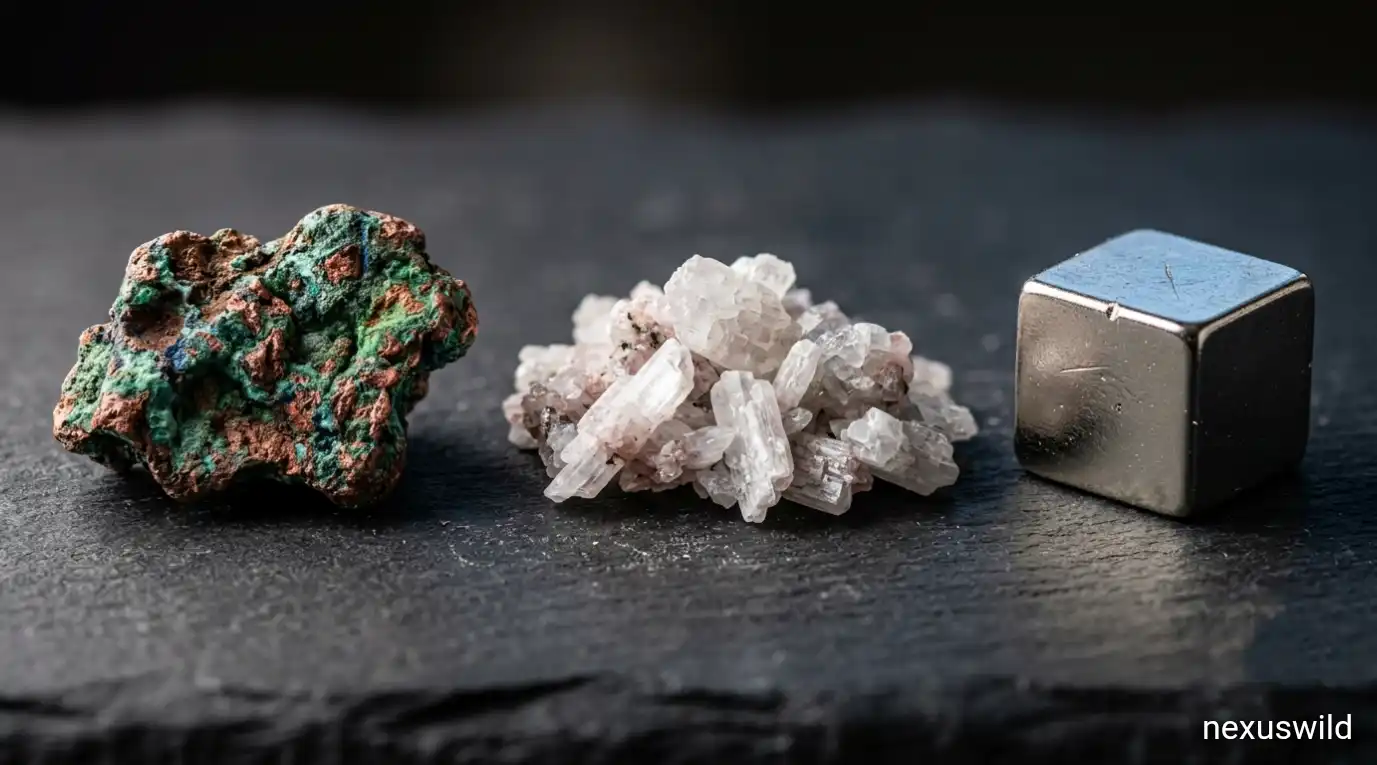

Software and chips get the attention, but the physical supply chain underneath them runs on a short list of materials. Lithium stores power, copper moves it, and rare earths turn it into motion. When any of the three is scarce or politically contested, the effects reach phones, electric vehicles, data centres and defence systems.
Lithium: the battery metal
Lithium is the clearest case of a material tied to one technology. The US Geological Survey (USGS) estimates batteries accounted for about 88% of global lithium use in 2025.
Production rose about 31% that year, to roughly 290,000 tons, led by Australia (92,000 tons), China (62,000), Chile (56,000) and Argentina (23,000). Consumption grew 20%, to 263,000 tons.
Prices tell a more cautious story. USGS says battery-grade lithium carbonate averaged $9,000 a ton in 2025 in real terms, down from $11,800 in 2024. Prices stayed low early in the year on oversupply fears and then rose in the second half, helped by EV sales growth in China and Europe and demand for battery storage. Lithium has therefore been a story of swings, not steady scarcity.
Copper: the wiring of the digital economy
Copper conducts electricity better than almost any affordable metal, so it appears in power cables, motors, transformers, circuit boards and the electrical systems of data centres. Its role is less glamorous than lithium's but broader.
USGS estimates world mine production at about 23 million tons in 2025, with Chile (5.3 million), Congo (3.2 million) and Peru (2.7 million) leading. The bottleneck is refining. China produced about 14 million of the 29 million tons of refined copper, according to the same estimates.
Supply may struggle to keep up. The International Energy Agency (IEA) said in its 2026 outlook that the copper supply gap in 2035 narrows from around 30% to 25% of requirements in its base case. That is still a large shortfall, and the figure is a projection under specific assumptions, not a forecast of prices.
The link between copper and AI is intuitive: data centres need power and cooling. I could not find a reliable, independently sourced estimate of how much copper AI will use, so I am not offering one.
Rare earths: small quantities, large leverage
Rare earths are 17 elements used in very small amounts. USGS says the leading global use is magnets, which sit inside electric motors, wind turbines, hard drives, speakers and many defence systems.
World mine production was about 390,000 tons in 2025, according to USGS, and China produced about 270,000 tons, roughly 69%. The IEA says China accounts for more than 90% of global supply for several processed materials, including rare earths. Mining is not the only choke point. Separating and refining the elements is where concentration is highest.
Why politics matters
China has used export licensing as a trade tool. USGS notes that controls China introduced in April 2025 remain in effect, although China has begun issuing general licences to selected exporters.
In late 2025, China suspended a tighter round of restrictions after talks with the United States. Rinnovabili reported on September 25 that the US-China trade truce, which preserves access to rare earth exports, was extended to January 10, 2027, a shorter reprieve than many had expected. That report did not give an exact announcement date, and licensing requirements for seven medium and heavy rare earths from April 2025 were never suspended.
Analysts quoted by Brookings called the original truce fragile. That is an opinion, but it matches the pattern of short, renewable extensions.
What the response looks like
Governments are trying to build alternatives, and progress is slow. The IEA estimates that announced capacity outside the leading producer would reach nearly 50,000 tons of mining and under 40,000 tons of refining and separation by 2035. In the United States, the Pentagon bought $400 million of preferred shares in MP Materials, and the Commerce Department backed USA Rare Earth with up to $277 million in direct funding and a $1.3 billion loan, per Rinnovabili. A 2010 GAO estimate put the time to rebuild a domestic supply chain at up to 15 years.
What this means for technology
Three points follow from the data.
First, the three materials are different problems. Lithium has been an oversupply and price-swing story, copper a long-run supply gap, and rare earths a concentration and politics story.
Second, mining is only part of the risk. Refining, separation and magnet manufacturing decide who controls supply.
Third, supply tightness does not stop technology from advancing, but it can raise costs and delay projects. Companies that depend on rare earth magnets or large copper volumes tend to feel it first.
What to watch next: whether the January 10 deadline is extended again, how quickly non-Chinese refining capacity comes online, and whether lithium demand from battery storage keeps lifting prices.
Nexuswild welcomes factual corrections. Email contact@nexuswild.com with evidence and the article URL.