
Last-mile delivery is widely considered the most expensive and inefficient leg of the global supply chain. Transporting a single package from a local fulfillment center to a customer’s doorstep often involves navigating congested streets, finding parking, and relying on a human workforce that is becoming increasingly scarce. In markets with rapidly aging populations, this labor shortage has escalated from an operational headache into a systemic economic crisis.
Enter autonomous logistics. While self-driving trucks tackle long-haul highway routes, a quiet revolution is happening on the sidewalks. At the forefront of this movement in Asia is LOMBY, a Japanese delivery robot startup that is redesigning how groceries, parcels, and hot meals complete their final journey. Backed by fresh institutional capital, the company is moving beyond university campus trials and aiming directly for mass commercialization.
LOMBY’s $2.5 Million Funding Round
To accelerate its deployment, LOMBY announced in late September 2026 that it has successfully closed a Series A funding round.
The LOMBY $2.5 million capital injection was led by Mercuria Investment, bringing a significant financial boost to the robotics startup. This latest round builds on earlier financing milestones, including a seed round from Drone Fund in 2022 and a strategic 270 million yen (approximately $1.8 million) investment in late 2024 that notably included backing from automotive giant Suzuki Motor Corporation. While $2.5 million is a relatively lean Series A by Silicon Valley software standards, it provides LOMBY with the precise working capital needed to transition its hardware from custom-built prototypes into standardized, mass-produced fleet vehicles.
Who Is LOMBY?
Founded in April 2022 by CEO Tomoharu Uchiyama, LOMBY Inc. is headquartered in the Shinagawa ward of Tokyo. The company was born out of a very specific, localized necessity. Japan is experiencing one of the most severe demographic shifts in the world, resulting in an acute shortage of delivery drivers and logistics personnel.
Uchiyama and his engineering team identified that standard delivery vans were inherently inefficient for hyper-local trips—such as delivering a hot meal or a few bags of groceries within a one-mile radius. To solve this, LOMBY set out to build a "new labor force" for outdoor environments. By developing compact, electric last-mile delivery robots, the company provides a sustainable alternative that operates around the clock without adding to urban traffic congestion or requiring exhaustive human labor.
How LOMBY’s Delivery Robots Work
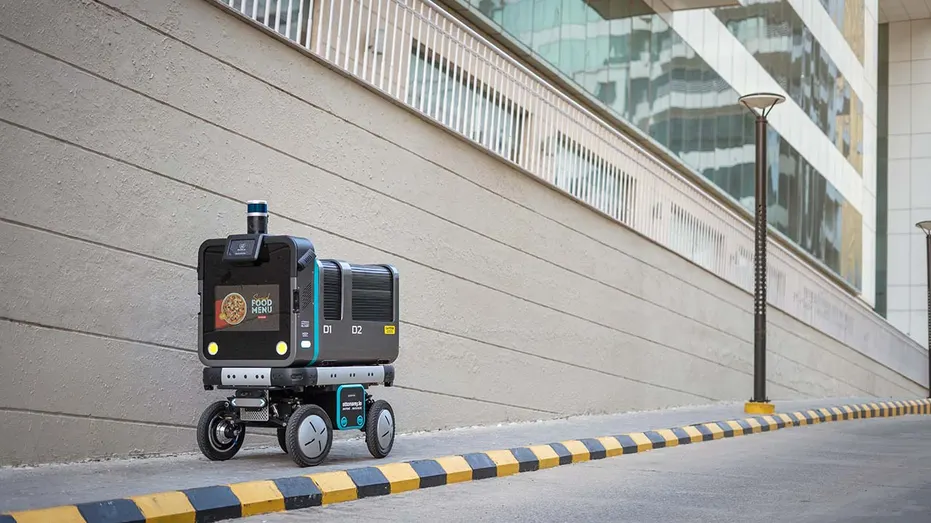
In everyday terms, LOMBY’s flagship LM-A model operates essentially as a self-driving locker on wheels.
The electric vehicles are specifically designed to navigate pedestrian sidewalks rather than open vehicle roadways, traveling at a maximum speed of 6 km/h (about 3.7 mph). When a customer places an order via a participating retail store’s smartphone app, staff load the items into the robot's secure cargo compartment using a dedicated tablet and a QR code scanner.
Once loaded, the robot autonomously navigates to the delivery destination. It relies on pre-mapped 3D environmental data combined with real-time sensors to detect pedestrians, avoid obstacles, and obey traffic signals. If the robot encounters a complex situation it cannot navigate autonomously—such as heavy, unpredictable construction—a remote human supervisor can seamlessly take control. Upon arrival, the customer receives a smartphone notification and scans a unique QR code on the robot’s screen to unlock the compartment and retrieve their goods.
Current Deployments and Customers
LOMBY has actively pushed its autonomous delivery robots out of the laboratory and into the real world. Over the past few years, the company has progressed from closed-environment demonstrations on university campuses—including the Hiroshima Institute of Technology and Tokyo Metropolitan University—to active public road trials.
One of its most notable commercial pilot programmes involved a partnership with Seven-Eleven in Japan. The trial allowed customers to order goods via the 7NOW convenience store app, with a LOMBY robot completing the end-to-end delivery directly to residential homes. The company has also tested its robots in highly challenging topographies, including a high-profile integration with elevators in high-rise buildings in Hiroshima City, and operational trials in the mountainous rural areas of Kitahiroshima Town, proving the technology’s viability beyond dense, flat urban centers.
Why Autonomous Delivery Is Growing
The demand for AI delivery robots is skyrocketing because the underlying unit economics of traditional delivery are fundamentally flawed. Employing a human driver to deliver a single $15 lunch order heavily degrades profit margins for both the restaurant and the logistics platform.
According to LOMBY’s internal estimates, utilizing its autonomous fleet can cut delivery costs by more than half compared to manual labor. Furthermore, robots do not require overtime pay, can operate in heavy rain or at night, and eliminate the need for stores to keep delivery personnel on standby during slow hours. For retailers, adopting a robot delivery service effectively expands their serviceable radius by 2 to 3 kilometers without incurring crippling new overhead costs.
Use of the New Funding
With the LOMBY funding secured, the company is shifting its focus squarely to manufacturing scale. Producing complex robotics hardware at a low cost requires immense supply-chain coordination.
The new capital will be directly channeled into finalizing the mass-production framework for the LM-A robots. Leveraging its ongoing strategic partnership with Suzuki Motor Corporation, LOMBY aims to ensure that its hardware meets automotive-grade robustness while keeping production costs low. Additionally, the funding will be used to expand its software engineering team, improve remote-supervision latency, and deploy larger commercial fleets in new suburban and residential districts across Japan.
Competition in Delivery Robotics
LOMBY is operating in a fiercely competitive global logistics technology startup sector. In the United States, companies like Starship Technologies and Serve Robotics have already deployed thousands of sidewalk robots across college campuses and city grids. In Asia, retail giants like Alibaba and JD.com have invested heavily in autonomous logistics technology.
However, LOMBY differentiates itself by intensely focusing on the unique infrastructure of Japanese cities, which feature narrow sidewalks, dense pedestrian traffic, and complex multi-story residential buildings. By prioritizing seamless integration with existing retail apps and local infrastructure—like its successful elevator navigation tests—the robotics startup is building a highly localized operational moat against international competitors.
Regulation and Operational Challenges
Despite the technological progress, the widespread adoption of autonomous delivery technology faces significant friction. Sidewalk navigation requires precise regulatory approval, as robots must safely share space with pedestrians, cyclists, and wheelchair users.
Operational challenges are equally daunting. Severe weather, such as heavy snow, can blind sensors and block standard 3D mapping routes. Additionally, companies must contend with the realities of vandalism and theft, though LOMBY’s secure, QR-locked compartments mitigate opportunistic tampering. Finally, true autonomy is still a work in progress; maintaining a reliable, ultra-low-latency wireless connection for the remote human supervisors who step in during edge-case scenarios remains a critical infrastructure requirement.
Founder, Investor and Industry Views
Industry leaders view this funding round as a vital step for Japanese logistics. LOMBY CEO Tomoharu Uchiyama has frequently emphasized the societal impact of the technology, noting that the company’s mission is to build a "next-generation labor infrastructure tailored to an aging society".
"Our goal is to create sustainable, automated logistics that support local communities when traditional workforces are stretched to their limits," Uchiyama noted regarding the company's expansion plans.
Logistics analysts echo this sentiment, pointing out that Japan's strict overtime regulations for truck drivers—widely referred to as the "2024 problem"—have forced the entire supply chain to find automated alternatives. Investors at Mercuria Investment see sidewalk robotics not just as a novelty, but as a critical, sustainable utility required to keep local commerce functioning in communities where the working-age population is shrinking.
What Comes Next
Following this capital injection, the industry will be watching to see how quickly LOMBY can transition from successful pilot programmes to fully commercialized, revenue-generating fleet deployments. The company is also actively planning an expansion into personal mobility devices, known as the "LM-P" series, indicating a broader vision for automated outdoor transportation.
Conclusion
The successful LOMBY Series A funding highlights a pragmatic shift in how the technology sector approaches artificial intelligence and robotics. Rather than focusing solely on humanoid robots or heavy autonomous trucks, immense immediate commercial value is being found on the sidewalk. By raising $2.5 million to scale its mass production, LOMBY is proving that autonomous logistics are no longer just a futuristic concept; they are a necessary, practical solution to the very real challenges of modern commerce.
Further reading and useful links
Reader questions
Frequently asked questions
What is LOMBY and who founded it?
LOMBY is a Tokyo-based delivery-robot startup founded in April 2022 by CEO Tomoharu Uchiyama.
How much funding did LOMBY raise in its latest round?
LOMBY secured a $2.5 million Series A funding round led by Mercuria Investment to mass-produce its robots.
What automotive giant previously invested in LOMBY?
Suzuki Motor Corporation participated in a strategic 270 million yen investment round in late 2024.
How do LOMBY's delivery robots operate?
LOMBY's LM-A robots navigate pedestrian sidewalks at up to 6 km/h, utilizing pre-mapped 3D environmental data, real-time sensors, and QR code access for secure package retrieval.
Nexuswild welcomes factual corrections. Email contact@nexuswild.com with evidence and the article URL.