
For years, India’s urban ride-hailing landscape has operated on a familiar asset-light formula. Platforms like Uber and Ola built their empires by acting purely as software aggregators, connecting independent car owners and freelance drivers with passengers while avoiding the massive capital expenditure of owning vehicles.
However, a major new entrant is challenging that traditional paradigm. Backed by Vietnamese conglomerate Vingroup and electric vehicle manufacturer VinFast, Green SM officially rolled out its fully electric taxi service, Green SM Limo, in New Delhi on June 5, 2026. Rather than relying on independent drivers who bring their own cars, Green SM is deploying a direct, company-controlled fleet model. This approach aims to rewrite service standards in the capital region, bringing a completely battery-powered passenger experience to India's bustling mobility market.
Green SM Enters India’s Mobility Market
The launch in Delhi-NCR marks India as the fifth international market for Green SM, following its rapid expansion across Southeast Asia. Initial deployments in the capital region started with an active fleet of approximately 1,000 electric vehicles, with longer-term corporate targets pointing toward a scale of 10,000 vehicles as operations expand across phases.
India represents a uniquely strategic chess piece for the brand. As Indian metropolitan authorities clamp down on fossil-fuel vehicle emissions and push aggressively toward zero-emission public transport, demand for structured electric mobility solutions has surged. By establishing a foothold in Delhi-NCR—a region infamous for winter air pollution and heavy daily commuting—Green SM is positioning itself directly against established local and international players.
How the Direct Driver Model Works
The defining characteristic that separates Green SM from traditional aggregators is its operational control over both the vehicle and the driver workforce.
Conventional ride-hailing platforms often suffer from inconsistent passenger experiences, cancellations, and fluctuating driver availability because drivers operate independently and can log off at will. Green SM addresses this by employing a professional driver team directly. Drivers undergo rigorous corporate training focusing on customer service, safety protocols, and vehicle handling. Instead of absorbing volatile fuel and maintenance expenses out of fluctuating commission splits, these drivers operate company-managed vehicles under structured compensation and welfare arrangements. Company executives have frequently emphasized this philosophy, noting that passengers ultimately remember the person behind the wheel just as much as the car itself.
VinFast Limo Green: The Electric Cab
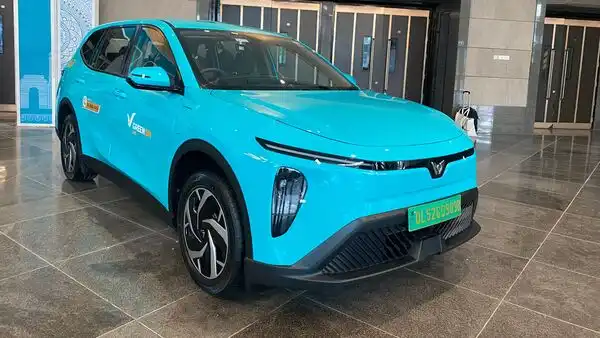
The backbone of Green SM’s Indian fleet is the VinFast Limo Green, a purpose-built electric multipurpose vehicle (MPV). Painted in an eye-catching cyan shade that immediately distinguishes the service in traffic, the vehicle brings robust technical specifications to commercial passenger transport.
Official specifications for the Limo Green variant feature a substantial 60.13 kWh battery pack paired with an electric motor output delivering roughly 201.15 bhp. Certified driving ranges reach up to 512 km on a single charge under optimal test conditions, giving the vehicle ample endurance for double-shift commercial driving in urban and suburban environments. The spacious cabin accommodates passengers across a comfortable layout with generous boot space for airport luggage and heavy bags.
Charging and Fleet Support Ecosystem
Operating a large-scale electric fleet requires reliable, high-speed charging infrastructure to minimize downtime. Green SM leverages synergies within the wider Vingroup ecosystem, integrating closely with charging network partners such as V-Green to secure steady energy access across strategic points in Delhi-NCR.
The Limo Green supports rapid DC fast charging, capable of replenishing battery capacity from 10% to 70% in roughly 30 minutes. By streamlining charging logistics through dedicated depots and partner stations, Green SM attempts to solve the range anxiety and queue bottlenecks that frequently plague independent commercial EV drivers in India.
Fleet-Based Operations vs. Traditional Aggregators
Market analysts point out that while a fleet-based model requires immense upfront capital compared to software-only aggregation, it offers distinct operational advantages.
Control over vehicle maintenance, cleanliness, and driver behavior ensures a uniform brand standard. Furthermore, fleet operators can optimize charging schedules during off-peak hours and secure bulk commercial rates on maintenance and insurance. However, the model is inherently capital-intensive. Purchasing, insuring, and maintaining thousands of electric MPVs places heavy demands on corporate balance sheets, requiring continuous high vehicle utilization to achieve profitability.
Expansion Plans and Wider Strategy
Green SM’s entry into Delhi-NCR is viewed by industry watchers as an initial proving ground. While the immediate focus remains on scaling the capital's fleet toward its multi-thousand vehicle targets, company disclosures suggest that successful execution in Delhi could pave the way for expansion into other high-density Indian commercial hubs, such as Bengaluru, Mumbai, or Pune.
Industry Views and Challenges
Mobility experts note that while consumers increasingly welcome clean, comfortable electric cabs, the path forward is not without hurdles. Capital expenditure requirements, traffic congestion, and the pace of public charging infrastructure buildout remain constant variables. Additionally, driver retention in a highly competitive gig-economy labor market will test the viability of Green SM’s corporate employment model.
Despite these challenges, early passenger feedback has highlighted the comfort of the spacious VinFast MPVs and the reliability of professional drivers.
Conclusion
Green SM’s arrival in Delhi-NCR introduces a capital-intensive, high-service alternative to India's established ride-hailing ecosystem. By combining VinFast’s electric vehicle technology with a professionally managed driver workforce, the company is testing whether a vertically integrated fleet model can thrive in one of the world's most competitive mobility markets. As the fleet scales toward its ambitious targets, the experiment will serve as a vital benchmark for the future of commercial electric transport in South Asia.
Further reading and useful links
Reader questions
Frequently asked questions
When did Green SM launch its service in India?
Green SM officially launched Green SM Limo in New Delhi on June 5, 2026.
What vehicle model does Green SM use in India?
Green SM operates using VinFast Limo Green electric multipurpose vehicles (MPVs).
What is Green SM's initial and target fleet size in Delhi-NCR?
The service launched with about 1,000 electric vehicles in Delhi-NCR, with plans to scale up to 10,000 vehicles.
How does Green SM's driver model differ from traditional aggregators?
Unlike platforms that rely on independent drivers with their own cars, Green SM employs a direct, professional driver team operating company-managed vehicles.
Nexuswild welcomes factual corrections. Email contact@nexuswild.com with evidence and the article URL.