
The raw material is entirely invisible, infinitely abundant, and completely free. Yet, capturing it, breaking it down, and delivering its components is the foundation of one of the world's most quietly profitable industrial empires.
Linde plc operates in a sector that most consumers never think about, but one that underpins almost every physical good on Earth. The company does not simply "sell air." Rather, it utilizes massive, highly complex infrastructure to extract specific, ultra-pure molecules from the atmosphere. By capturing atmospheric oxygen, nitrogen, and argon, and supplementing them with other produced gases like hydrogen and helium, Linde generates tens of billions of dollars annually.
As heavy industries, semiconductor manufacturers, and healthcare networks become increasingly reliant on these foundational elements, the business of Linde industrial gases has evolved into a global powerhouse. Understanding how this company turns the air we breathe into staggering financial returns requires a deep dive into extreme physics, massive capital investment, and one of the strongest recurring revenue models in modern commerce.
How Linde Turns Ordinary Air Into Industrial Gases
At the heart of the industrial gas industry is a fundamental reality: modern industrial processes require pure elements, not the mixed atmospheric cocktail that surrounds us. Ambient air is composed of roughly 78% nitrogen, 21% oxygen, and 1% argon, along with trace amounts of other gases and moisture.
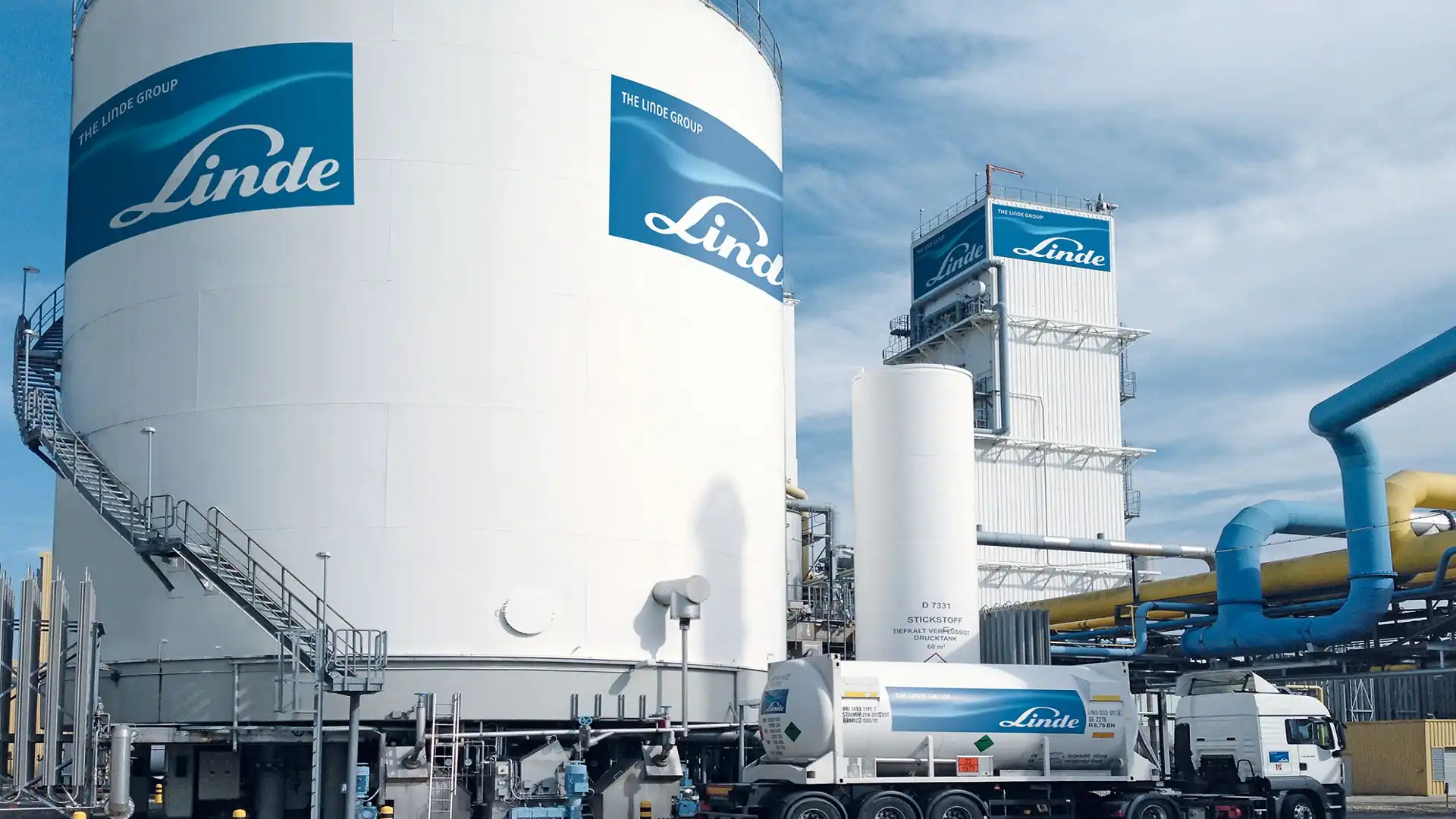
To separate these elements, Linde relies on air separation technology. The company builds and operates massive industrial facilities known as Air Separation Units (ASUs). These plants are essentially highly pressurized, ultra-cold refineries for the sky. Instead of separating crude oil into gasoline and diesel, an ASU separates ambient air into highly purified streams of Linde oxygen nitrogen and argon. The product isn't manufactured from scratch; it is isolated, purified, and pressurized to meet exact commercial specifications.
The Science Behind Air Separation
The extraction process relies on cryogenic air separation, a method rooted in extreme temperature manipulation.
The journey begins when massive compressors suck in thousands of cubic feet of ambient air. Before the air can be cooled, it must be rigorously purified. The compressed air passes through molecular sieve adsorbers—specialized materials that trap and remove carbon dioxide, moisture, and stray hydrocarbons. If these impurities were not removed early on, they would freeze into solid ice blocks and destroy the facility's internal piping.
Once purified, the air is pushed through expansion turbines, where it undergoes a sudden drop in pressure. Following a thermodynamic principle known as the Joule-Thomson effect, this rapid expansion causes the air’s temperature to plummet. The air is cooled to an astonishing -196°C (-320°F), at which point the invisible gas condenses into a frigid, rolling liquid.
This liquid air is then fed into a towering Linde double-column distillation system. Because different elements boil at different temperatures, the liquid can be separated through fractional distillation. Nitrogen, being the most volatile, boils first at -196°C, rising to the top of the column as a pure gas. Oxygen, which requires a slightly warmer -183°C to boil, remains liquid and pools at the bottom of the column. Argon, boiling at -186°C, is tapped off from a specialized middle section. The result is a continuous stream of pure, separated elements.
Where Oxygen, Nitrogen and Argon Are Used
Once these elements are isolated, they become critical supply-chain inputs for the global economy.
Oxygen is defined by its ability to accelerate combustion and sustain biological life. Global steel manufacturers pipe massive quantities of oxygen into their blast furnaces to burn off impurities and achieve extreme melting temperatures. In the healthcare sector, ultra-high purity medical oxygen is a non-negotiable requirement for life support, surgical procedures, and respiratory treatments.
Nitrogen serves the exact opposite physical purpose: it is entirely inert. Because it prevents oxidation and combustion, nitrogen is used to safely blanket highly explosive chemicals, freeze food rapidly to maintain freshness, and prevent spoilage in commercial packaging.
Argon, the atmospheric trace element, is prized for its absolute chemical stability. It is the primary shielding gas used in advanced arc welding, preventing molten metal from reacting with the atmosphere.
How Linde Makes Money From Industrial Gases
Producing these gases is a triumph of physics, but the Linde business model is a masterclass in logistics and contract economics. The company monetizes its production through three distinct distribution channels, each tailored to a specific scale of demand.
For the world's largest consumers—such as steel mills, chemical refineries, and mega-fab semiconductor plants—Linde builds an ASU directly adjacent to or on the customer’s property. The gases are delivered continuously through an over-the-fence pipeline.
For mid-sized customers, such as regional hospitals or medium-scale manufacturing plants, Linde utilizes its merchant liquid business. The gases are super-cooled into a liquid state to reduce their volume, loaded onto a fleet of specialized cryogenic tanker trucks, and delivered to bulk storage tanks installed at the customer's site.
Finally, for the smallest consumers—local welding shops, dentists, or independent laboratories—the company compresses the gases into high-pressure steel cylinders, forming its packaged gas business.
Why the Business Generates Recurring Revenue
The financial brilliance of the global industrial gas market lies in its unshakeable recurring revenue. Once a customer integrates Linde's gas into their manufacturing infrastructure, switching providers is logistically and financially prohibitive.
In the on-site pipeline business, Linde signs long-term "take-or-pay" contracts with its clients, often lasting 15 to 20 years. These contracts require the customer to pay a fixed minimum facility fee regardless of whether they actually use the gas, ensuring Linde covers the heavy initial capital investment required to build the ASU. Furthermore, the variable cost of the electricity required to run the plant is typically passed directly through to the customer. This structure insulates Linde from energy price spikes and economic downturns, creating a defensive, highly predictable cash-flow machine.
Linde’s Role in Semiconductors, Healthcare and Manufacturing
While traditional heavy industries provide the baseload volume, advanced technology sectors are currently driving high-margin growth. Linde semiconductor gases are now a cornerstone of the global electronics supply chain.
Manufacturing a modern microchip requires completely sterile, chemically inert environments. A single semiconductor fabrication plant demands thousands of cubic meters of ultra-high purity nitrogen every hour to purge wafer-handling chambers. As the artificial intelligence boom triggers a massive global buildout of new semiconductor fabs across the United States, Europe, and Asia, Linde is securing decades-long contracts to provide the specialized gas infrastructure these facilities require.
Energy Use and the Environmental Challenge
Despite its financial success, how Linde makes oxygen and nitrogen presents a significant environmental challenge. Compressing and refrigerating millions of cubic feet of air requires colossal amounts of electricity.
Consequently, Linde’s Scope 2 greenhouse gas emissions—the indirect emissions generated by the power plants supplying electricity to its ASUs—are substantial. To mitigate this impact, the company has aggressively pivoted its energy procurement strategy. Linde is signing large-scale renewable power purchase agreements (PPAs) globally, securing wind and solar electricity to power its air separation units. This effectively decarbonizes the core production process and lowers the carbon footprint of the industrial gases it ultimately sells.
Linde’s Hydrogen and Clean-Technology Strategy
While oxygen and nitrogen are pulled directly from the sky, Linde’s other major growth pillar—hydrogen—must be extracted from molecules like water or natural gas.
The Linde hydrogen business is expanding rapidly as heavy transportation and manufacturing industries look to replace fossil fuels with clean-burning alternatives. The company is investing heavily in both "blue" hydrogen (produced from natural gas, with the resulting carbon emissions captured and stored underground) and "green" hydrogen (produced by splitting water using renewable electricity). Because Linde already possesses the pipeline networks, cryogenic storage technology, and engineering expertise required to handle volatile gases safely, it is uniquely positioned to capitalize on the emerging hydrogen economy.
Global Competition and Market Position
Linde does not operate in a vacuum. Following decades of fierce consolidation, the industrial gases explained by market analysts today operate as a strict global oligopoly.
Linde, which underwent a massive merger with American rival Praxair in 2018, sits at the top of the market. Its primary competitors are the French multinational Air Liquide and the American firm Air Products. Because building an ASU requires massive upfront capital, the barrier to entry for new competitors is virtually insurmountable. This oligopolistic structure allows the major players to maintain pricing power and protect their profit margins.
Financial Performance and Key Numbers
The financial output of this business model is formidable. In its full-year financial disclosures for the 12 months ending December 31, 2025, Linde plc demonstrated the sheer scale of its operations.
For the full year 2025, Linde revenue reached an imposing $34.0 billion. More importantly, the company generated an operating profit of $8.9 billion (with an adjusted operating profit of $10.1 billion), translating to an enviable adjusted operating profit margin of 29.8%.
Because the business requires continuous infrastructure investment, capital expenditures run high. In 2025, Linde deployed $5.26 billion in capital expenditures to build new plants and maintain its existing global networks. However, the recurring nature of its long-term contracts ensured the business remained highly liquid, with operating cash flow surging to $10.4 billion for the year. These figures, officially reported in February 2026, confirm that the company is effectively converting atmospheric elements into immense shareholder value.
Expert and Company Views
Leadership at the company attributes this sustained performance to stringent operational discipline. CEO Sanjiv Lamba has consistently highlighted the company's dual mandate: driving relentless internal productivity while positioning the firm as a key enabler of global decarbonization.
"We continue to deliver strong shareholder returns and expand our resilient network by pairing disciplined capital allocation with long-term, high-reliability customer contracts," CEO Sanjiv Lamba noted in recent financial briefings.
Industry analysts routinely echo this sentiment, categorizing Linde not just as a chemical supplier, but as an indispensable infrastructure utility for the global manufacturing sector.
Conclusion
The next time a rocket launches into space, a steel beam is forged, a microchip is printed, or a patient breathes through a ventilator, there is a high probability that the invisible gases powering those processes were harvested by Linde. By applying extreme thermodynamics to the everyday air around us, and wrapping that science in an impenetrable, long-term contract structure, Linde has constructed one of the most reliable and lucrative business models in industrial history. It is a testament to modern engineering that a company can build a $34 billion empire primarily out of thin air.
Further reading and useful links
Reader questions
Frequently asked questions
How does Linde produce industrial gases like oxygen and nitrogen?
Linde uses cryogenic air separation in massive Air Separation Units (ASUs) to compress, purify, and cool ambient air to -196°C, separating it via fractional distillation.
What was Linde's revenue for full-year 2025?
Linde reported full-year 2025 revenue of $34.0 billion, with an adjusted operating profit of $10.1 billion.
What makes Linde's business model resilient?
Linde secures 15-to-20-year 'take-or-pay' pipeline contracts with major industrial clients, guaranteeing stable, recurring revenue and passing electricity costs through to customers.
Who are Linde's primary global competitors?
Linde operates within a global oligopoly alongside Air Liquide (France) and Air Products (USA).
Nexuswild welcomes factual corrections. Email contact@nexuswild.com with evidence and the article URL.