
Human conversation remains the most dense and valuable source of information in the modern business world. However, capturing, understanding, and archiving that information in real time has historically been a bottleneck. While generative artificial intelligence has rapidly transformed text generation, the underlying infrastructure for conversational AI has faced persistent challenges regarding data privacy, latency, and regional dialects. Today, a new wave of European AI startups is emerging to solve these exact problems.
Leading this charge is Klang, a Swedish speech AI startup that has quietly built a formidable business by keeping enterprise conversations off American cloud servers. In late September 2026, the company announced a fresh injection of capital to accelerate its unique approach to voice AI technology. By proving that high-accuracy speech models can run locally and efficiently on standard hardware, Klang is positioning itself at the forefront of the global movement toward data sovereignty and edge computing.
Klang’s €1.32 Million Funding Round
To aggressively scale its operations and product development, Klang has successfully closed a new seed funding round. The company raised €1.32 million (approximately SEK 15 million), pushing its post-money valuation to an impressive €13.2 million (SEK 150 million).
For an AI voice startup, this capital injection sits at the leaner end of the funding spectrum compared to the multi-hundred-million-dollar mega-rounds seen in Silicon Valley. However, Klang’s financial strategy is built on extreme capital efficiency and rapid commercialization. The round was heavily backed by existing owners and led by prominent Nordic entrepreneur and tech investor Johan Lenander. The syndicate also featured notable regional founders, including Emil Sjödin, founder of Refined, and Daniel Gadd, co-founder of Position Green. Their participation signals strong regional confidence in Klang’s ability to capture the burgeoning market for secure, localized speech technology.
Who Is Klang?
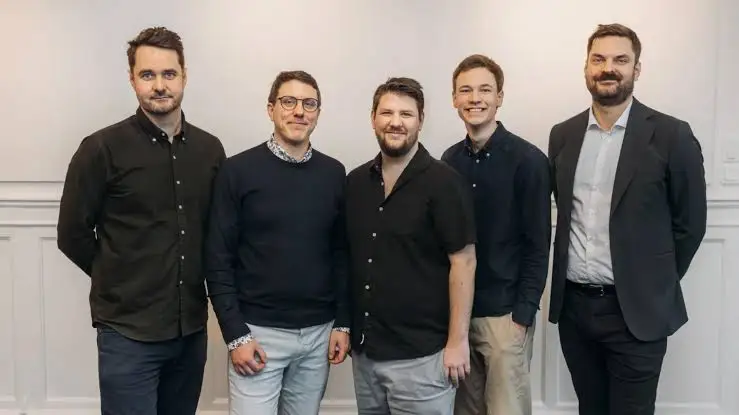
Founded in 2023 and headquartered in the coastal city of Helsingborg, Sweden, Klang is a specialized AI company focused entirely on the spoken word. The founding team—comprising Niklas Silfverström, Viktor Silfverström, Andreas Argelius, Mattias Fält, and Jacob Andersson—identified a glaring vulnerability in the enterprise AI boom.
Most companies currently rely on third-party, cloud-based transcription services to summarize meetings and analyze interviews. For highly regulated industries, sending sensitive internal dialogues to massive US-based data centers presents an unacceptable cybersecurity and compliance risk. Klang was explicitly designed to solve this by providing AI solutions that transcribe, summarize, and analyze dialogues directly at the source. The startup’s core mission is to empower organizations to extract value from their daily interactions without compromising on data residency or user privacy.
How Klang’s AI Speech Technology Works
The secret to Klang’s rapid growth lies in its proprietary approach to speech recognition AI. Rather than simply acting as a wrapper for existing APIs, Klang has heavily invested in developing its own foundational speech and language models.
This year, the company made headlines in the open-source community by releasing "Pianissimo," an open speech-to-text model specifically trained for the nuances of the Swedish language and its various regional dialects. At a high level, Pianissimo is built upon the architecture of Nvidia Parakeet, an open model known for extremely fast and efficient transcription. What makes Klang’s technology remarkable is its extreme optimization. The model is lightweight enough to run entirely locally on a standard corporate laptop. This means the AI processes the audio, converts the speech to text, and runs its natural-language processing analysis without ever requiring an internet connection to send audio files to the cloud.
Products and Real-World Applications
Klang’s software suite is built for enterprise utility. Beyond simple dictation, the platform acts as an intelligent conversational agent that can instantly generate meeting minutes, extract actionable insights from customer interviews, and analyze sentiment across complex dialogues.
The real-world applications for this localized speech technology startup are vast. In healthcare, doctors can securely transcribe patient consultations directly on their devices, ensuring strict compliance with European health data regulations. In the legal and financial sectors, sensitive negotiations and client meetings can be archived and summarized without violating client confidentiality. Furthermore, the technology holds immense promise for customer service and call centers, where real-time conversational AI can support human agents by instantly retrieving relevant information based on the live dialogue.
Customers, Partnerships and Market Traction
Investors are backing Klang because the startup is already proving its business model. Despite its lean team, the company has demonstrated explosive commercial traction. Annual recurring revenue (ARR) has more than doubled over the past year, surging from roughly $967,000 in May of last year to over $2.42 million (USD) today.
This revenue growth is being driven by aggressive geographic expansion. While deeply rooted in Sweden, Klang has already begun pushing beyond European borders. In August 2026, the company successfully launched its operations in Japan, offering a fully localized web platform, iOS, and Android applications that allow Japanese users to securely record, transcribe, and summarize conversations in their native language. This ability to adapt its speech engines to entirely different linguistic structures proves the versatility of Klang's core AI architecture.
Why Voice AI Is Growing
The broader market for AI speech technology and synthetic voice technology is experiencing unprecedented growth. As remote work and digital collaboration have become permanent fixtures of the global economy, the volume of recorded conversational data has skyrocketed.
Simultaneously, businesses are realizing that text-based analytics only capture a fraction of corporate knowledge. AI voice agents and advanced speech recognition systems bridge the gap between unstructured audio and structured, searchable data. The ability to instantly recall exactly what was agreed upon in a meeting—and have an AI instantly generate follow-up tasks—is shifting voice technology from a novelty into a mandatory enterprise productivity tool.
Use of the New Funding
The newly secured Klang €1.32 million capital will be deployed strategically to maintain the company’s current momentum. CEO Niklas Silfverström has emphasized that Klang intends to remain a capital-efficient operation, proving that a small, highly technical team can outmaneuver legacy tech giants.
The primary use of funds will be international market expansion. In the near term, the startup plans to solidify its presence across the Nordics, the Benelux region, and the DACH region (Germany, Austria, and Switzerland), while simultaneously supporting its new user base in Japan. To execute this, Klang plans to hire approximately ten new employees across research and development, software engineering, and regional marketing. A significant portion of the R&D budget will also be dedicated to refining its natural-language models to support even more complex, multi-speaker conversational environments.
Competition and Industry Challenges
The conversational AI space is heavily contested. Klang faces competition from global behemoths like Microsoft, Google, and OpenAI (the creator of the Whisper model), as well as highly funded European AI startups like London-based PolyAI.
However, Klang’s focus on edge computing and specific regional dialects gives it a distinct operational moat. For example, in internal benchmarks, Klang’s Pianissimo model achieved accuracy rates comparable to KB Whisper Large—the leading open Swedish model developed by the National Library of Sweden—while operating roughly 60 times faster.
Despite these technical triumphs, the industry faces ongoing challenges. Accurately transcribing cross-talk (multiple people speaking at once), handling heavy background noise, and eliminating algorithmic bias against certain regional accents remain difficult engineering hurdles. Furthermore, as synthetic voice technology advances, startups must navigate complex ethical questions regarding data security and the potential misuse of voice-cloning technologies.
Founder, Investor and Expert Views
The philosophy driving Klang is rooted in elevating human interaction. CEO Niklas Silfverström captured this vision clearly following the funding announcement:
"In a world where AI performs more and more tasks, human conversation becomes an increasingly important source of information," Silfverström stated.
Silfverström further elaborated on the ultimate goal of their technology, noting, "We want to create a perfect memory of every conversation – a memory that not only remembers what was said, but also understands the conversation as well as, or even better than, the people in the room." Investors backing the €1.32 million round echoed this sentiment, pointing to Klang's ability to double its recurring revenue while remaining fiercely independent of American cloud infrastructure as a massive competitive advantage in the privacy-conscious European market.
What Comes Next
Looking ahead, Klang is poised to release further updates to its open-source models, inviting the global developer community to build upon its high-speed architecture. As the company expands into Germany and the wider DACH region, adapting its speech recognition AI to handle the immense complexities of regional German dialects will be its next major technical proving ground.
Conclusion
Klang’s successful €1.32 million funding round is a testament to the evolving demands of the global AI market. As corporations awaken to the risks of sending their most sensitive conversations to centralized, overseas cloud servers, the demand for fast, accurate, and localized speech technology is surging. By building capital-efficient, blazing-fast language models that run directly on the user's laptop, this Swedish startup is not just recording conversations—it is redefining how businesses secure and understand their own knowledge.
Further reading and useful links
Reader questions
Frequently asked questions
How much funding did Klang raise in its recent round?
Klang raised €1.32 million (approximately SEK 15 million) at a valuation of €13.2 million.
Who led Klang's seed funding round?
The round was led by tech entrepreneur and investor Johan Lenander, alongside existing owners and regional founders.
What is Klang's flagship open-source model?
Klang released 'Pianissimo,' an open speech-to-text model optimized for Swedish dialects that can run locally on a standard laptop.
Where is Klang headquartered?
Klang is headquartered in Helsingborg, Sweden, and was founded in 2023.
Nexuswild welcomes factual corrections. Email contact@nexuswild.com with evidence and the article URL.