
India’s climate technology sector is drawing venture capital because businesses, banks and farms are facing more risk from weather disruptions. In this trend mistEO, a climate intelligence startup from Thiruvananthapuram has raised ₹18 crore in a seed funding round. MGF‑Kavachh led the round and Seafund and other investors also joined.
The funding was announced on November 12 2026 at Huddle Global 2026 the edition of Kerala’s startup and technology festival.
Founded in 2019 by Samuel John and Ambarish Narayanan mistEO creates forecasting and climate‑risk intelligence systems. These systems help institutions see not what weather may happen but also how that weather could impact particular assets, operations and financial exposures.
The new money will help mistEO grow its Climate Decision Intelligence (CDI) platform in banks, insurers and farms across India and Asia. It will also fund forecasting and risk models, more staff and new partnerships.
This investment shows a change in climate technology. Weather intelligence is now used for lending decisions, insurance plans, farm planning, energy management and infrastructure work. For mistEO the business chance is to link weather forecasts with decisions that institutions can use.
A Seed Investment in India’s Climate Intelligence Market
The ₹18 crore round is led by MGF‑Kavachh, a SEBI‑registered Category II Alternative Investment Fund. Seafund and other investors also joined. Key Venture acted as the adviser for the deal.
Announcing the deal at Huddle Global put mistEO into Kerala’s plan to bring investment into tech businesses and boost its startup ecosystem. The event, held at Kovalam from November 12 to 14 brought together founders, investors, companies, policymakers and tech participants.
For mistEO the money comes at a time when mistEO’s technology's ready for more institutional uses. MistEO wants to grow beyond forecasting cases into a platform that can help with financial risk assessment and operational planning.
The funding announcement did not share a plan for how the ₹18 crore will be used on separate projects. The main priorities are to grow the CDI platform improve forecasting and risk models add staff and build partnerships across India and Asia.
That difference matters to investors and readers. The round gives growth money. The exact spending schedule, commercial goals and revenue targets are not publicly known.
From Weather Forecasting to Climate Decision Intelligence
Traditional weather forecasts tell you expected conditions like rain, temperature, wind speed and storms. Those details matter,. They do not automatically show a bank, insurer or farm what a specific weather event means for their work.
A lender might need to know if a borrower’s farm faces a dry spell. An insurer might need to estimate if a place is likely to reach a rain or temperature limit. A renewable energy operator might need to foresee how weather could affect generation.
mistEO’s Climate Decision Intelligence approach is made to bridge this gap.
The platform mixes weather modelling with asset‑level data to turn forecasts into risk assessments and possible operational responses. The intended users are banks, insurers, farms and businesses that manage infrastructure.
The goal is to move from a statement that a region may get heavy rain to a more specific view of which assets, activities or financial exposures could be affected.
This approach could make climate data more useful in business work.. Its value depends on forecast quality, local data coverage, how well it fits with customer systems and whether institutions can act on the recommendations.
How the Indra Forecasting Model Works
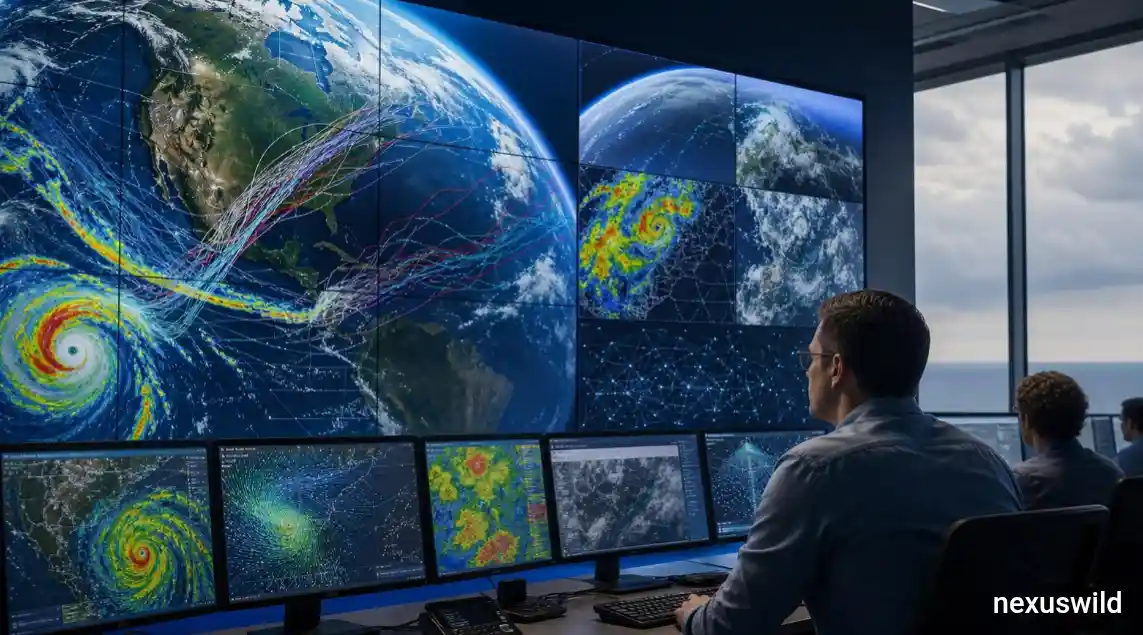
At the heart of mistEO’s technology is Indra, mistEO’s weather forecasting model.
According to mistEO and the funding news Indra gives forecasts with a resolution of about three kilometres. Indra works in three forecast windows:
- Zero to six hours aimed at weather monitoring and nowcasting.
- Six to 24 hours, supporting near‑term decisions.
- Twenty‑four to 48 hours providing a short‑term planning window.
The system mixes physics‑based weather prediction with artificial intelligence and machine learning. It also uses data sources, such, as satellite images, Doppler radar, Internet of Things devices, geographic data and ground‑based sensors.
The combination is designed to capture both the physical behaviour of the atmosphere and patterns that machine‑learning systems can spot from large data sets.
A three‑kilometre forecast grid can give localised information than broad regional forecasts but resolution alone does not guarantee accuracy. Forecast performance also depends on the quality and density of observations, model calibration, terrain, local weather patterns and the time horizon being predicted.
MistEOs differentiation therefore rests not on producing a high‑resolution forecast but on connecting that forecast to the specific needs of customers.
Why Banks and Insurers Need Granular Weather Data**
Climate exposure is becoming an important consideration for financial institutions because extreme weather can affect borrowers, collateral, infrastructure and repayment capacity.
Agricultural lenders face a challenge. A loan portfolio may be spread across districts with different rainfall patterns, crop cycles and exposure to heat, floods or drought. A broad seasonal forecast may not give detail to assess the vulnerability of individual borrowers or agricultural clusters.
Location‑specific climate intelligence could help lenders identify areas where weather conditions may affect crop production or income generation. Location‑specific climate intelligence may also support monitoring of exposed loan portfolios and informed risk assessment.
Insurers face a problem. Conventional insurance claims often require assessment of damage which can involve inspections, documentation and time‑consuming loss adjustment. Parametric insurance uses predefined conditions—such as rainfall, wind speed or temperature thresholds—to determine whether a payout is triggered.
For products to work reliably the underlying weather information must be sufficiently accurate, transparent and appropriate for the insured location.
MistEOs platform is designed to provide this type of information. MistEOs commercial opportunity will depend on whether financial institutions trust the data integrate mistEO into their systems and find value in using mistEO for underwriting, monitoring and product design.
DiCRA Work Connects the Startup With Agricultural Climate Resilience
One of mistEOs reported Indian engagements is mistEOs work with NABARD and the United Nations Development Programme on the Digital Climate Risk and Agriculture initiative, known as DiCRA.
The initiative provides open‑access climate resilience information for agriculture and related sectors. Such data can support an understanding of climate exposure across agricultural areas and help stakeholders identify vulnerabilities.
Agriculture remains highly sensitive to changes in rainfall, temperature, soil moisture and extreme weather. Climate information can be useful for planning crop activities assessing hazards and supporting adaptation measures.
For a technology company participation in an initiative such as DiCRA can provide an opportunity to demonstrate how climate intelligence may serve public‑interest applications well as commercial customers.
However the presence of mistEO in the initiative should not be interpreted as evidence of a commercial contract with NABARD or UNDP. The reported work is best described as a contribution to an open‑access agricultural climate resilience initiative.
The longer‑term opportunity lies in connecting information with lenders, insurers, farmer organisations and agricultural businesses that need more detailed location‑specific risk intelligence.
Australia: Heat‑Stress Warnings for Livestock
mistEO also reports activity in Australia, where mistEOs livestock early‑warning system is designed to alert cattle farmers to heat‑stress conditions up to seven days in advance.
Heat stress can affect animal welfare, productivity, feed intake and farm economics. High temperatures combined with humidity and other local conditions can create risks for livestock particularly when farmers do not have sufficient time to prepare.
Early warnings may allow operators to adjust livestock management provide water and shade change handling schedules or take other protective measures.
The company has stated that the system supports than AUD 1 billion worth of livestock assets. This is a company‑reported coverage or asset‑protection figure, not independently audited evidence of losses prevented or insurance value.
Nevertheless the use case illustrates how weather intelligence can be connected to an operational decision. Of simply reporting a temperature forecast mistEO aims to identify the likelihood of a damaging condition and provide time for a response.
Australia could also provide a market for mistEOs international expansion because agricultural operations are geographically dispersed and exposed to heat, drought, rainfall variability and other climate hazards.
Uzbekistan and the Development of Parametric Insurance
mistEO is also reported to be deploying a weather‑parametric insurance platform in Uzbekistan.
The model is designed to connect predefined weather conditions, with insurance triggers. If a specified condition is reached mistEO can support the initiation of a payout without relying on traditional on‑site damage assessment.
Farmers and livestock operators can benefit from a structure that makes weather‑related insurance products faster and clearer. Insurers can use weather data to design products set prices and keep track of the exposure that is insured.
However the technology must still meet requirements. Trigger levels must match the risk that insured assets face. Weather measurements must be trustworthy. The system must handle the chance that a weather station or model grid point records conditions that are not the same as those felt by a particular farm.
The Uzbekistan deployment that has been reported is an international example but it should not be seen as proof that large payouts have already taken place. The commercial importance will become clearer as the platform goes through deployment gains customers and is used in insurance operations.
Defence Applications and Indias Strategic Weather Requirements
mistEO also works on weather intelligence.
mistEO is reported to be developing a nowcasting model for the Indian Air Force under the Innovations for Defence Excellence programme. MistEO is also working on early‑warning systems for the Indian Navy.
Weather conditions can affect aviation safety, flight planning, maritime operations and the movement of people and equipment. Thunderstorms, wind changes, heavy rain and fast atmospheric changes can create risks that need timely information.
Short‑term nowcasting is especially important because some weather events happen quickly. A useful warning system must give information and present it in a way that operational users can understand.
The projects that have been reported show that mistEO is looking at uses beyond agriculture and financial services. They also put mistEO in India’s effort to grow domestic technology skills for strategic sectors.
However development work and programme participation should not be mixed with operational commissioning. Public reporting does not prove that the systems have been adopted as deployed defence infrastructure.
New Markets: Ports, Energy and Logistics
The ₹18 crore funding is expected to help develop more applications in sectors where weather has direct financial or operational effects.
Ports and maritime operators need data on wind, rain, storms and sea conditions to plan movements and manage risk. Localised forecasts could help with scheduling and early‑warning processes.
Renewable energy operators face another set of weather‑related challenges. Solar output changes with cloud cover and atmospheric conditions while wind output depends on wind speed, direction and variability. Better forecasting can help grid operators and energy companies plan supply manage balancing needs and improve decisions.
Transport and logistics fleets may also gain from weather routing. Heavy rain, flooding, strong winds and low visibility can affect route choice, delivery times and safety.
Disaster‑response agencies need data on heavy rain and flood risk to support preparation and resource deployment.
These are the areas that mistEO has stated for development and expansion. MistEO’s commercial value will depend on the number of paying customers, integration with existing systems and mistEO’s ability to deliver services at scale.
El Niño Expectations Add to the Climate‑Risk Discussion
The funding coverage also mentioned mistEO founder Samuel John talking about an El Niño that could continue into early 2027.
El Niño is a climate pattern linked to changes in ocean temperatures in the eastern tropical Pacific. It can affect rainfall, temperature and seasonal weather patterns around the world. The effects vary by region and event.
For India the link between El Niño and the monsoon is a part of climate monitoring. However one El Niño outlook does not automatically decide the rainfall outcome for every state, district or agricultural area.
mistEO’s reference to an event should therefore be seen as its stated outlook in the funding coverage not as a promise of specific weather conditions.
For mistEO’s business the main point is that institutions need tools that can monitor changing conditions and turn them into decisions. Climate risk management needs observation and updated forecasts not just one seasonal prediction.
The Competitive Challenge: Turning Forecasts Into Commercial Products
The climate intelligence market offers potential but it is also technically demanding.
Forecasting systems must be tested in locations, seasons and weather conditions. A model that works well in one area may need calibration before it can be trusted in another.
Financial institutions also have requirements, for data quality, auditability, governance and integration. An insurer using a weather trigger for a payout needs confidence that the underlying measurement's transparent and defensible. A bank looking at climate exposure needs data that can be built into risk systems.
mistEO must show more than high model resolution or many data sources. MistEO must prove that its forecasts bring measurable benefits to customer decisions.
mistEO will also compete with established weather providers, specialist climate analytics companies, public meteorological services and international technology businesses.
mistEO can stand out by mixing forecasting, physical modelling, AI analytics and sector‑specific decision workflows.
What the ₹18 Crore Funding Could Change
The seed round gives mistEO resources to improve its technology and reach a wider commercial market.
The first priority for mistEO will be to strengthen the forecasting and risk models that support its CDI platform. Better data coverage, model calibration and local adaptation can make mistEO’s services more useful in markets.
The second priority for mistEO is to expand. Banks, insurers and agricultural businesses are customers but they will need proof that mistEO is reliable, clear pricing and easy integration with their existing workflows.
The third priority for mistEO is to build partnerships. Climate intelligence becomes more valuable when it links to products, agricultural services, operational systems and local data networks.
International expansion can give mistEO growth chances, especially in places where agriculture and infrastructure face big weather risks.. Each market has its own rules, data availability and customer economics.
Thus the funding should be seen as a chance for mistEO to advance product development and market adoption not as proof that mistEO already has large‑scale success.
What Investors Should Watch Next
Several indicators will show whether mistEO can turn its seed funding into a lasting climate technology business.
First investors should watch the number and quality of contracts with banks, insurers and agricultural organisations. Announced partnerships are useful. Regular paying customers give stronger proof of business traction.
Second mistEO’s model performance should be checked with validation across many weather conditions and regions. Forecast resolution matters,. Accuracy and reliability decide if customers can trust the data.
Third the Uzbekistan insurance deployment and Australian livestock application should show how mistEO’s platform works in operational settings.
Fourth defence‑related projects may show mistEO’s technology can serve institutional users but development milestones and real use should be reported separately.
Finally revenue growth, customer retention, gross margins and the cost of keeping forecasting infrastructure will show if mistEO can grow sustainably.
Building Financial Intelligence From Weather Data
mistEO’s ₹18 crore seed funding round shows that investors are increasingly interested in climate technology that links information with economic decisions.
mistEO’s Indra forecasting model and Climate Decision Intelligence platform aim to turn high‑resolution weather data into assessments for agriculture, finance, insurance and infrastructure.
mistEO’s reported engagements, in India, Australia and Uzbekistan plus defence‑related projects give uses for the technology. The opportunity matters because climate exposure is no longer limited
Nexuswild welcomes factual corrections. Email contact@nexuswild.com with evidence and the article URL.