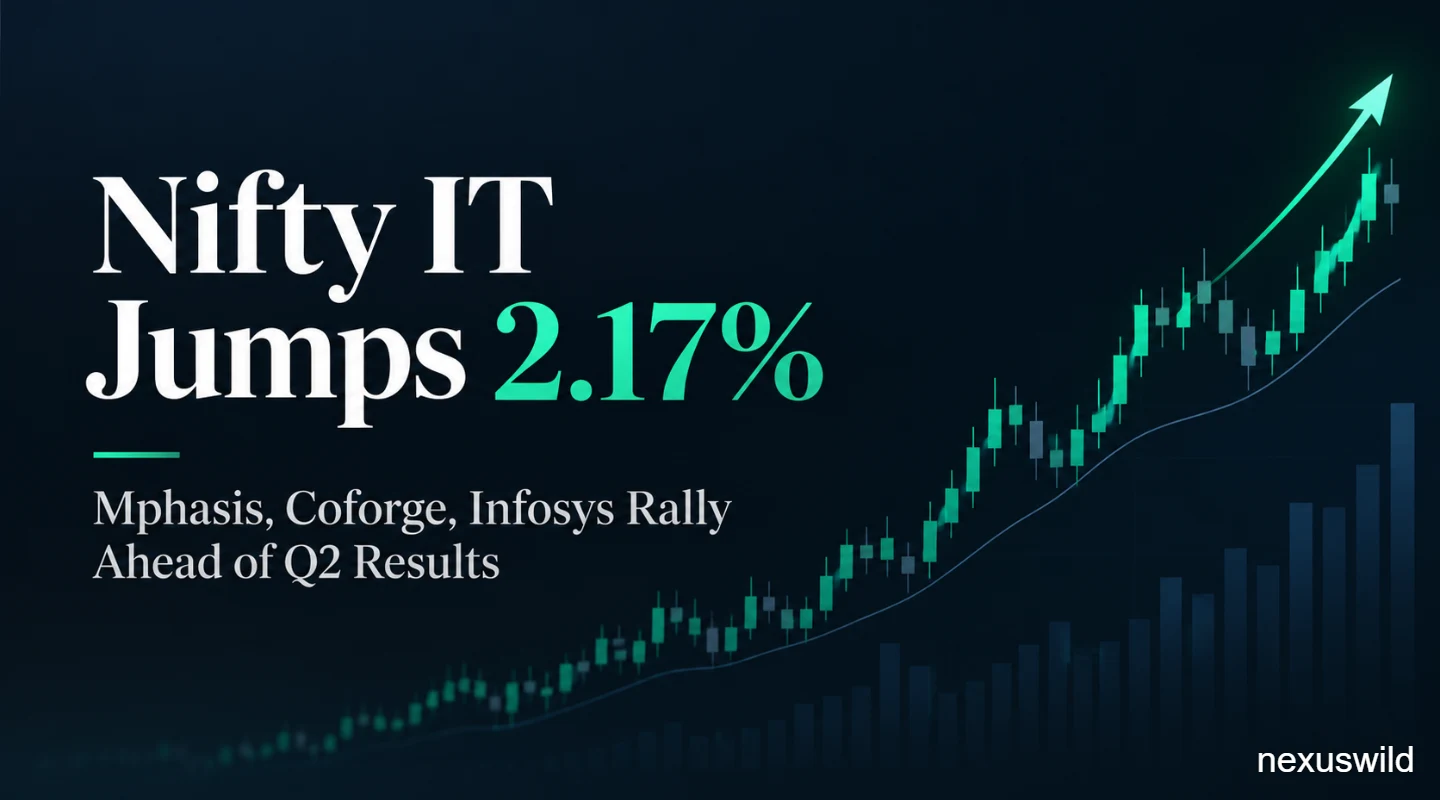

Indian technology shares broke sharply away from the broader market on Thursday, October 1, as investors returned to IT stocks ahead of the September-quarter earnings season.
The Nifty IT index closed at 28,304.70, up 2.17%, after trading between 27,732.95 and 28,304.70 during the session. It was the strongest major sectoral performer even as most other sectors finished in the red. The contrast was unusually sharp: the Nifty 50 closed 0.88% lower at 22,421.95, while the Sensex ended 0.79% lower at 71,909.70.
The rally was broad but not universal.
Mphasis and Coforge were among the day's strongest performers, while Infosys gathered momentum through the afternoon. TCS, HCLTech, Tech Mahindra, Persistent Systems and Wipro also ended higher. LTIMindtree and Oracle Financial Services Software, however, closed lower.
That divergence matters because Thursday's move was not a simple sector-wide declaration that the outlook for Indian IT had suddenly improved.
Instead, it reflected a mix of currency support, positioning ahead of earnings and expectations that some mid-sized companies could deliver better sequential growth than the largest IT-services firms.
Nifty IT's 2% Rise on October 1
At around 10:52 a.m. IST, Nifty IT was already up about 2.1%, with nine of its ten constituents then trading higher. Mphasis was up roughly 4.44%, Coforge 3.85%, Infosys 2.42%, TCS 1.70%, HCLTech 1.56% and Tech Mahindra 1.44%.
The closing numbers showed that some of those early gains strengthened further.
Data available around 3:59 p.m. IST showed Mphasis at ₹2,250.20, up 4.45%, while Coforge closed at ₹1,826, up 4.40%. Infosys finished at ₹1,035, with the Economic Times market feed showing a 4.12% gain.
TCS closed at ₹2,075, while HCLTech ended near ₹1,243.10 and Tech Mahindra at ₹1,533. Wipro finished at ₹159.35. Persistent Systems closed around ₹5,367.
LTIMindtree ended at ₹4,007, down ₹38 on the session, while Oracle Financial Services Software closed at ₹10,420, down ₹210.
October 1 IT Stock Snapshot
| Stock | October 1 Move | Latest Price | Q2 FY27 Catalyst | Relevant Company Update |
|---|---|---|---|---|
| Mphasis | +4.45% | ₹2,250.20 | Mid-cap growth expectations | Investors watching deal execution and AI-led services |
| Coforge | +4.40% | ₹1,826 | Stronger mid-cap growth expectations | Encora integration and European AI expansion |
| Infosys | +4.12% | ₹1,035 | Revenue guidance and demand commentary | Analysts watching potential guidance revision |
| TCS | Higher | ₹2,075 | Results due October 8 | First major IT company to report Q2 FY27 |
| Persistent Systems | Higher | ₹5,367 | Strong mid-cap growth expectations | Large-deal ramp-ups remain important |
| HCLTech | +1.07% | ₹1,243.10 | Growth guidance | Seen by some brokerages as relatively stronger among large caps |
| Tech Mahindra | +0.60% | ₹1,533 | Growth and margin execution | AI partnerships remain a focus |
| Wipro | +0.54% | ₹159.35 | Revenue trajectory | Investors watching discretionary spending |
| LTIMindtree | About -0.9% | ₹4,007 | Deal ramp-ups | Closed lower despite sector rally |
| OFSS | About -2.0% | ₹10,420 | Company-specific earnings | Remained an outlier on the downside |
Price data: October 1, 2026, around 3:56–4:00 p.m. IST.
Why IT Stocks Rose Despite Broader Market Weakness
One of the most immediate supports for the sector was the rupee.
The Indian currency traded near ₹95.8–₹96 to the US dollar during the session. A weaker rupee can help Indian IT companies because a large share of their revenue is earned in dollars, euros, pounds and other foreign currencies, while much of their employee cost remains rupee-denominated.
The benefit is not automatic.
Companies hedge their currency exposure, and adverse foreign-exchange movements can also generate accounting losses. Reuters noted that currency movements could support margins for some companies while foreign-exchange losses may partly offset that advantage for others, including companies such as Tech Mahindra and Coforge.
Meanwhile, the wider market was wrestling with very different pressures.
Foreign investor selling, elevated crude oil prices, rising US Treasury yields and concerns about domestic inflation weighed on Indian equities. Brent crude was trading around the high-$90s per barrel, adding another layer of concern for an economy that imports much of its energy.
Against that background, export-oriented IT companies offered investors a relatively different earnings profile.
Q2 FY27 Earnings Season Comes Into Focus
The next major test begins on October 8, 2026, when Tata Consultancy Services is scheduled to report its September-quarter results.
TCS disclosed the board-meeting date in a September 22 corporate announcement. The board is also expected to consider a second interim dividend.
The results matter beyond TCS itself.
As India's largest IT-services company, TCS often provides an early reading on client spending, large-deal conversion, pricing, employee utilisation, margins and demand across major markets such as North America and Europe.
Its previous quarter offered a mixed starting point.
For Q1 FY27, TCS reported revenue of $7.624 billion, with constant-currency growth of 0.4% sequentially and total contract value of $9.5 billion. The company also said annualised AI revenue had reached $2.6 billion.
Investors will now want to know whether signed deals are translating into revenue quickly enough to overcome weakness in discretionary projects.
What Analysts Expect From Indian IT Companies
Expectations remain restrained.
Jefferies expects companies under its IT coverage to post around 1.7% sequential constant-currency revenue growth in Q2 FY27, but estimates organic growth at only about 0.8%. It expects mid-sized IT companies to grow roughly 3.5% quarter-on-quarter, compared with about 0.5% for large IT companies.
A broader consensus cited by Business Standard puts sequential constant-currency growth for large companies in a range of roughly -0.5% to 3%, while some mid-cap companies could post materially stronger growth, in certain cases helped by acquisitions or large contract ramp-ups.
Kotak Institutional Equities has argued that demand conditions have neither materially improved nor deteriorated since the June quarter. It expects Persistent Systems, Coforge and Mphasis to be among the stronger-growing mid-tier names, while HCLTech could stand out among the larger companies.
Those are brokerage estimates, not confirmed results.
Rupee, AI and Client Spending
The bigger issue facing Indian IT is not simply whether Q2 revenue rises by 1% or 3%.
It is whether the industry can adapt its business model to artificial intelligence.
AI tools are helping software engineers write code faster, automate testing, modernise older systems and handle repetitive support work with fewer people.
For clients, that can reduce the number of billable hours required for a project.
For IT-services companies, it creates pricing pressure.
Reuters reported that AI-related productivity gains are already challenging the industry's traditional billing model, while new AI-related revenue is not yet large enough across the sector to fully offset pressure on existing work.
Kotak has described this as AI-led "deflation" in the base business, with automation lowering the effort required to deliver some services.
That does not mean AI is purely negative.
It can also generate consulting work, cloud modernisation, data engineering, cybersecurity requirements and large enterprise-transformation contracts.
The question is whether those newer revenue streams can scale faster than automation compresses pricing in traditional outsourcing.
Large-Cap vs Mid-Cap IT Trends
This is one reason mid-cap IT companies may show a different growth profile from their larger peers.
Coforge, for example, completed its acquisition of Encora earlier in 2026. The company said Encora's financials would be consolidated from May 1 and expected the combination to contribute positively to FY27 growth and margins.
Coforge has also been expanding its AI and engineering operations. Its Krakow engineering centre now supports multiple industries, with the company planning further expansion as demand grows.
Mphasis, meanwhile, announced a strategic agreement with TechnoPro Holdings in September aimed at accelerating AI-led services, according to exchange-related company disclosures reported by Moneycontrol.
For TCS, the focus is more about scale.
Its Q1 deal book was already substantial, and its ability to convert those contracts into revenue while protecting margins will help shape expectations for the broader large-cap IT pack.
Key Risks and Uncertainties
Thursday's rally should not be confused with proof that the IT sector has entered a sustained recovery.
The Nifty IT index was still down more than 10% over the preceding month and roughly 16.5% over one year at the October 1 close.
Demand also remains sensitive to interest rates, geopolitical uncertainty, high energy costs and cautious technology budgets.
Motilal Oswal Financial Services expects decision cycles to remain slow because of macroeconomic pressure, AI disruption and geopolitical risks, while seasonal furloughs could weigh on the following quarter as well.
Reuters similarly reported that the industry's six largest companies are heading into what could be their weakest quarterly growth performance in around three years.
Conclusion
The October 1 move in Nifty IT was notable because it happened on a day when almost everything else was under pressure.
The index gained 2.17% while the broader Nifty declined, helped by a weaker rupee, positioning ahead of Q2 earnings and optimism around selected mid-cap IT companies.
But the earnings season beginning with TCS on October 8 will determine whether that optimism has a fundamental base.
Investors will be watching revenue growth, margins, deal conversion and guidance. Just as importantly, they will be listening for evidence about how quickly artificial intelligence is reshaping pricing and delivery economics.
For Indian IT, Q2 FY27 is therefore about more than quarterly growth.
It is an early test of how the industry is adapting to a world where clients still need more technology, but increasingly expect fewer people, faster delivery and lower costs to produce it.
Nexuswild welcomes factual corrections. Email contact@nexuswild.com with evidence and the article URL.