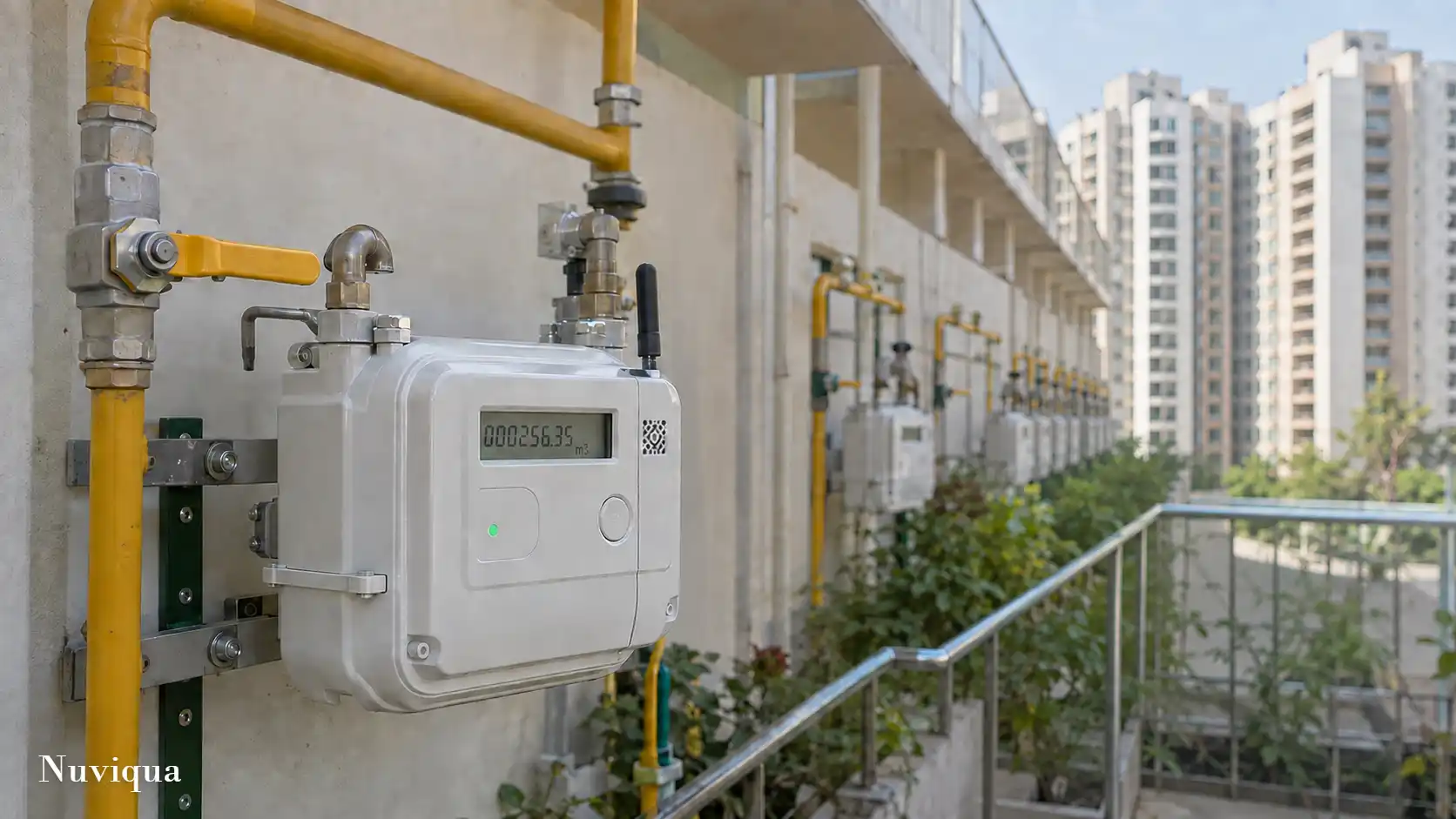

NEW DELHI — The Petroleum and Natural Gas Regulatory Board and state-owned Energy Efficiency Services Limited have signed a memorandum of understanding to create the regulatory, procurement and implementation framework needed for large-scale deployment of smart domestic piped natural gas meters across the City Gas Distribution sector.
The agreement brings PNGRB’s regulatory oversight together with EESL’s experience in demand aggregation, competitive procurement and long-term smart-meter project management.
However, the MoU is not a completed nationwide rollout. It does not announce how many gas meters will be installed, which households will receive them, how much the programme will cost or when deployment will begin. Those details will depend on subsequent decisions by PNGRB, EESL, CGD companies and other participating organisations.
The MoU was signed by PNGRB Secretary Anjan Kumar Mishra and EESL Chief Executive Officer Akhilesh Kumar Dixit, according to the announcement reported by PTI.
What PNGRB and EESL have agreed to do
PNGRB will support the initiative from the regulatory and sectoral side. Its responsibilities include sharing information on metering standards, certification, regulatory developments, conformity assessment and inspection requirements.
The regulator will also facilitate consultations and interactions involving CGD companies and other stakeholders. This work is intended to help establish common requirements before procurement and installation begin on a larger scale.
EESL will focus on bringing together demand for smart domestic PNG meters across multiple CGD companies. Aggregating orders can create a larger procurement pool, potentially giving suppliers greater production visibility and helping purchasers discover more competitive prices.
EESL will also undertake market assessments and technical evaluations. It will explore competitive procurement, price discovery and suitable commercial models covering the supply, installation, operation and maintenance of smart gas meters.
Possible project structures could combine equipment procurement with installation and multi-year maintenance. The MoU does not select a final model, and no tender value or implementation contract has been announced.
The two organisations intend to bring CGD operators, meter manufacturers, technology providers, system integrators and other relevant participants into a common smart-metering ecosystem. No specific manufacturer, technology vendor or CGD company was identified as a confirmed participant in the announcement.
What smart PNG meters could change for consumers
Conventional household gas meters generally require a physical reading or a reading submitted by the consumer. Smart meters can add communication systems that allow consumption information to be transmitted to the gas distributor.
In principle, this could enable remote meter reading, more regular consumption monitoring and greater automation in bill preparation. Consumers could receive bills based on transmitted readings instead of estimated consumption or infrequent physical inspections.
Access to more timely consumption data could also help households understand changes in their gas use and identify unexpectedly high readings. For CGD operators, automated readings could reduce the need for repeated home visits, lower manual data-entry requirements and improve visibility across their customer base.
These are expected benefits of smart metering, not results already demonstrated by the new PNGRB-EESL initiative. Actual performance will depend on meter accuracy, network connectivity, data systems, maintenance standards and how effectively each CGD company integrates the meters with its billing platform.
The MoU does not specify whether future meters will operate on a prepaid basis, a postpaid basis or support both. A PNGRB-appointed expert committee previously recommended prepaid smart PNG metering, but a committee recommendation is not the same as a final nationwide requirement.
The latest agreement also does not establish that smart meters are immediately mandatory for every household connection.
Standardisation and cybersecurity will be critical
Large-scale deployment across different CGD networks will require meters and associated software to follow compatible standards. Without interoperability, companies could become dependent on individual suppliers or face difficulty connecting meters from multiple manufacturers to their billing and data-management systems.
PNGRB and EESL said the collaboration is expected to promote standardisation, interoperability, innovation and efficient implementation.
Cybersecurity is another important requirement because smart meters introduce communication links, software platforms and consumer data into a system that was previously more dependent on local mechanical readings. Meter authentication, encrypted communications, access controls, software updates and restrictions on who can view or modify consumption information will need to be addressed through technical standards and procurement conditions.
A PNGRB-appointed committee examining smart domestic PNG metering previously recommended uniform data-communication and cybersecurity protocols, alongside cooperation with standards and technology institutions. The August MoU can help create the structure for that work, but it does not itself disclose a completed cybersecurity architecture.
EESL’s electricity-meter experience
EESL has implemented more than 44.5 lakh smart electricity meters across Uttar Pradesh, Haryana, Bihar, Delhi, Rajasthan and the Andaman and Nicobar Islands. It is also responsible for operating and maintaining those electricity meters for periods of eight to ten years.
That figure represents EESL’s existing experience in the electricity sector. It does not mean that EESL has installed 44.5 lakh smart PNG meters.
The electricity programme nevertheless gives EESL experience in aggregating utility demand, conducting procurement, managing installations and supporting metering infrastructure over extended contract periods. The organisation is expected to apply relevant parts of that experience to gas metering, although PNG meters have different safety, measurement, certification and operational requirements.
A growing domestic PNG network
The smart-metering initiative comes as the domestic PNG network expands rapidly. PNGRB’s current dashboard reports 17,405,020 domestic PNG connections, or approximately 1.74 crore, as of June 2026. The Ministry of Petroleum and Natural Gas separately cited 1.74 crore connections in August.
PNGRB’s Minimum Work Programme sets a target of 12.63 crore domestic PNG connections by 2034, along with 18,336 CNG stations and extensive additional pipeline infrastructure.
Government releases have generally cited 307 authorised geographical areas created through the CGD bidding rounds and covering almost the entire mainland. PNGRB’s current dashboard describes its June 2026 CGD data as covering 312 geographical areas, indicating an updated reporting scope. In either case, authorised CGD coverage now extends across nearly the entire country, although the availability and active use of household PNG connections vary significantly between areas.
As the network grows from around 1.74 crore installed domestic connections toward the much larger 2034 target, manual meter reading could become increasingly difficult and expensive to manage. A coordinated smart-metering framework could therefore become important for scaling billing, monitoring and customer service.
The PNGRB-EESL MoU is an early institutional step toward that framework. Its practical effect will become clearer only after participating CGD companies aggregate their requirements and subsequent technical specifications, procurement packages, financing arrangements and deployment schedules are officially released.
Further reading and useful links
Reader questions
Frequently asked questions
What is the purpose of the PNGRB and EESL agreement?
The memorandum of understanding aims to create the regulatory, procurement, and implementation framework necessary for the large-scale deployment of smart domestic piped natural gas (PNG) meters across India's City Gas Distribution (CGD) sector.
Are smart PNG meters now mandatory for all households in India?
No. The current agreement is an early framework to standardize and aggregate demand for procurement. It does not make smart meters immediately mandatory, nor does it specify exact rollout timelines or which households will receive them first.
Why is EESL involved in a natural gas metering project?
EESL brings extensive experience in utility demand aggregation and smart meter deployment. The organization has already implemented and maintained over 44.5 lakh smart electricity meters across various Indian states, and it plans to apply that logistical and procurement expertise to the PNG sector.
Nexuswild welcomes factual corrections. Email contact@nexuswild.com with evidence and the article URL.