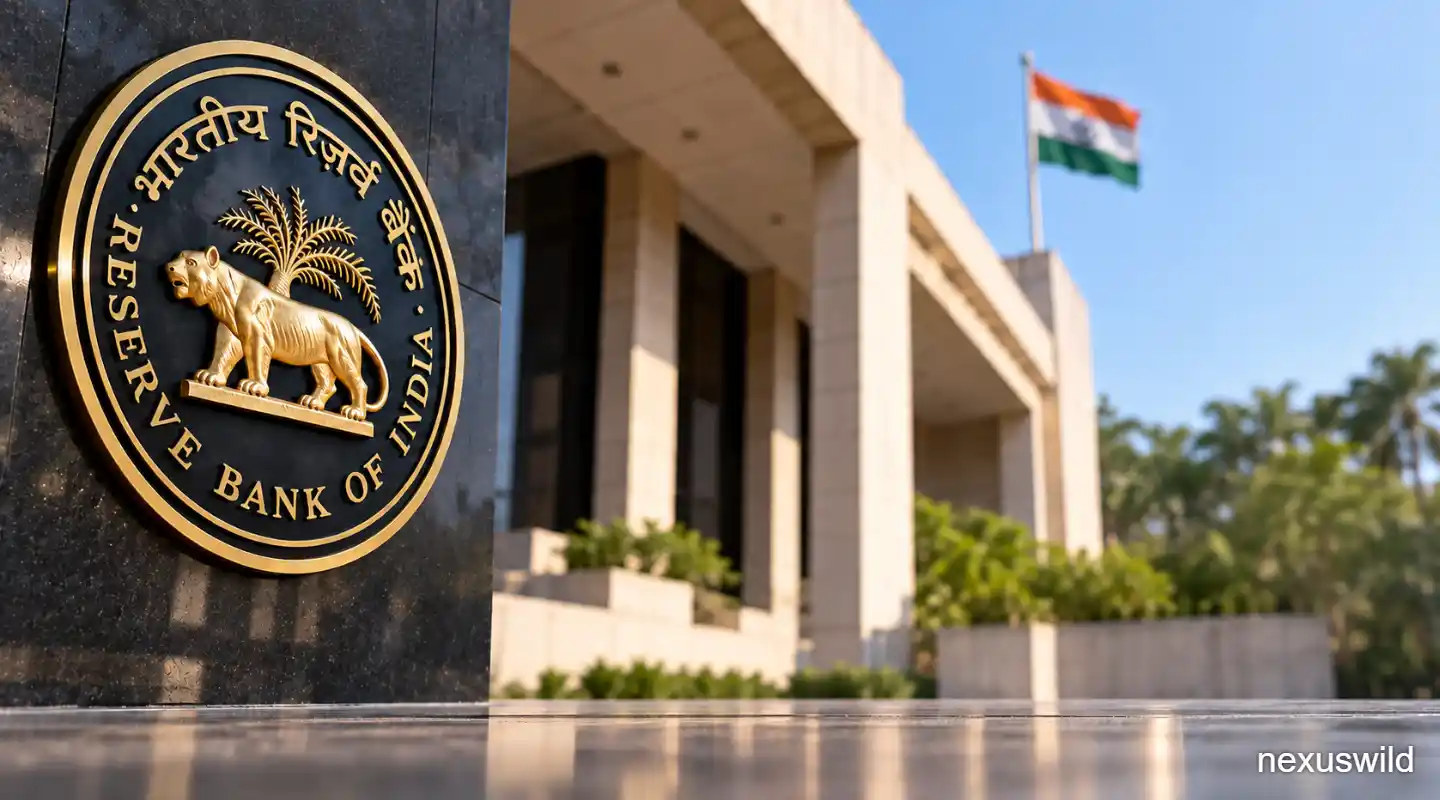

The Reserve Bank of India announced on 16 November 2026 that the Government of India would sell two dated securities with a combined notified amount of 33,000 crore rupees. The auction, scheduled for Friday 20 November, comprises a re-issue of the 6.53% Government Security maturing in 2031 for 19,000 crore rupees and a re-issue of the 7.71% Government Security maturing in 2066 for 14,000 crore rupees. Both issues carry repayment dates specified in the notification: 7 September 2031 for the shorter security and 18 May 2066 for the longer one. The central bank said the government may retain additional subscription of up to 2,000 crore rupees against each security, giving the sale a potential upside of 4,000 crore rupees above the notified total. Bids were to be submitted electronically through the Reserve Bank's e-Kuber system, with settlement on 23 November. The announcement was published as press release 2026-2027/1505 and is one in a regular series of dated-security auctions through which the government finances its borrowing programme. Such auctions are closely followed by bond traders, banks and primary dealers because they set benchmark yields across the curve and influence the pricing of other debt instruments. The Reserve Bank released the auction results on the same day as the sale, showing full acceptance of both securities and no devolvement on primary dealers.
What the Reserve Bank announced
The press release states that the Government of India has announced the sale, by way of re-issue, of two dated securities for a notified amount of 33,000 crore rupees. The first is the 6.53% GS 2031, with a repayment date of 7 September 2031 and a notified amount of 19,000 crore rupees. The second is the 7.71% GS 2066, repayable on 18 May 2066, with a notified amount of 14,000 crore rupees. The government-issued notification for the sale is numbered F.No.4(1)-B(W&M)/2026 and dated 16 November 2026. The Reserve Bank said the securities would be sold through its Mumbai office at Fort, Mumbai 400001, subject to the terms in that specific notification and in the general notification F.No.4(2)-B(W&M)/2018 dated 26 March 2025. The central bank also reserved an option for the government to retain additional subscription of up to 2,000 crore rupees on each of the two securities. That option is a standard feature of Indian government securities auctions and allows the authorities to absorb stronger demand without announcing a larger sale in advance. The total notified amount of 33,000 crore rupees is the sum of the two tranches, and the auction date and settlement date were specified as 20 and 23 November 2026 respectively. The release was signed by Ajit Prasad, Deputy General Manager in the Reserve Bank's communications function.
The two securities on offer
Both securities in the sale were re-issues, meaning they add to existing bonds with the same coupon and maturity rather than creating new instruments. The 6.53% GS 2031 carries a coupon of 6.53% and matures on 7 September 2031, placing it in the medium-to-long segment of the yield curve. Its notified size of 19,000 crore rupees represents slightly more than half of the total on offer. The 7.71% GS 2066 has a coupon of 7.71% and a repayment date of 18 May 2066, making it a very long-dated security with a residual maturity of roughly four decades. Its notified amount was 14,000 crore rupees. The difference in coupons reflects the different interest-rate environments in which the two securities were originally issued, not a change in the current yield demanded by investors. Because both are re-issues, the auction is price-based rather than yield-based: bidders quote the price they are willing to pay, and the implicit yield is derived from that price. The Reserve Bank's annex to the release states that auctions are yield-based for new securities and price-based for securities that are re-issued. The two repayment dates also matter for portfolio management. Institutional investors with long-dated liabilities, such as insurers and pension funds, often show demand for securities at the far end of the curve, while banks and mutual funds tend to be more active in the medium segment.
Auction mechanics and timing
The Reserve Bank specified a detailed timetable for the 20 November auction. Both competitive and non-competitive bids had to be submitted in electronic form through the e-Kuber platform, the central bank's core banking solution. The non-competitive bidding window opened at 10:30 a.m. and closed at 11:00 a.m., while the competitive window ran from 10:30 a.m. to 11:30 a.m. Results were to be announced on the same day, with successful bidders required to make payment on Monday 23 November. Primary Dealers were given a separate window for underwriting bids: applications for the Additional Competitive Underwriting portion could be submitted between 9:00 a.m. and 9:30 a.m. on the auction day, also through e-Kuber. The central bank said the securities would be eligible for "when issued" trading from 17 November to 20 November, a period that begins before the auction takes place. This allows market participants to trade the yet-to-be-issued bonds in advance of settlement, a practice that supports price discovery. The release also notes that physical bids will not be accepted except in extraordinary circumstances, and sets out a business continuity process for system failures, with submissions to the Public Debt Office in Mumbai by email or telephone. Separate contact details are provided for core banking operations and for auction-related difficulties handled by the IDMD auction team.
How the multiple-price auction works
The Reserve Bank stated that the auction would be conducted using the multiple-price method. Under this format, successful bidders are allotted securities at the price or yield they themselves quoted, rather than at a single common cut-off. The annex to the release explains the distinction directly: in a multiple-price auction, successful bids receive acceptance at their respective quoted yield or price, while in a uniform-price auction, bids are accepted at the cut-off yield or price determined in the auction. Because both securities in this sale are re-issues, the bidding is price-based, and bidders quote the price they are prepared to pay for a given face amount. The Reserve Bank determines the minimum price, or maximum yield, up to which tenders will be accepted. Bids quoted below the minimum price or above the maximum yield are rejected. The central bank retains full discretion to accept or reject any or all bids, wholly or partially, without assigning a reason. It also states that an investor may submit more than one competitive bid electronically, but the aggregate amount bid by any one investor may not exceed the notified amount of the auction. The multiple-price format is designed to encourage bidders to reflect their own valuation of the security, although it also means that successful bidders pay different prices depending on where their bids were placed in the order book.
The competitive and non-competitive segments
Every auction of Indian government securities includes both a competitive and a non-competitive segment. The Reserve Bank's annex says that up to 5% of the notified amount for each individual security is allotted to eligible individuals and institutions under the Scheme for Non-competitive Bidding Facility in Auctions of Government Securities. Non-competitive bidders do not quote a price; instead, they are allotted securities at the weighted average rate of yield or price that emerges from the competitive bidding. This arrangement gives smaller investors a route into the primary market without having to compete with large dealers. Individual investors can also place bids through the Retail Direct portal, operated at rbiretaildirect.org.in. Banks and Primary Dealers may submit a single consolidated non-competitive bid on behalf of their constituents, based on firm orders received from those clients. The minimum bid size for the securities is 10,000 rupees nominal, with multiples of 10,000 rupees thereafter. This low threshold is intended to keep the retail segment accessible. In this particular auction, the non-competitive window was half an hour long, compared with one hour for competitive bids. The Reserve Bank notes that allotment under the non-competitive segment is calculated from the weighted average of successful competitive bids, which means non-competitive investors share the average outcome rather than the price at the margin.
Underwriting and the primary dealer role
Primary Dealers occupy a specific position in the government securities market, and the Reserve Bank's arrangements reflect that. The annex to the release says underwriting of government securities in auctions follows the Revised Scheme of Underwriting Commitment and Liquidity Support announced by the Reserve Bank in circular RBI/2007-08/186 dated 14 November 2007, as amended from time to time. In practical terms, Primary Dealers commit to bidding for a minimum share of the amount on offer, supporting the auction even if demand is weaker than expected. Ahead of the 20 November sale, the Reserve Bank published a separate release setting out underwriting amounts. The notified amounts of 19,000 crore rupees for the 2031 security and 14,000 crore rupees for the 2066 security were each matched by minimum underwriting commitments per dealer of 453 crore rupees and 334 crore rupees respectively. A further release published after the auction set the Additional Competitive Underwriting commission cut-off rates at 0.39 paise per 100 rupees for the 6.53% GS 2031 and 0.78 paise per 100 rupees for the 7.71% GS 2066. The Additional Competitive Underwriting portion is a mechanism through which dealers can bid for additional commitments beyond their mandatory minimum. The combination of minimum commitments and additional underwriting is intended to spread the financing burden across the dealer community and reduce the risk of a failed auction.
When-issued trading and settlement arrangements
The "when issued" period running from 17 to 20 November allowed participants to trade the two securities before the auction result was known and before settlement. The Reserve Bank says eligibility for such trading follows its circular on when-issued transactions in central government securities, numbered RBI/2018-19/25 and dated 24 July 2018, as amended. When-issued trading is a common feature of primary debt markets and gives dealers and investors a way to hedge exposure or position ahead of the sale. Settlement was set for 23 November 2026, three calendar days after the auction, and successful bidders were required to make payment on that date. Securities are issued to successful bidders by credit to a Subsidiary General Ledger account or a Constituents' Subsidiary General Ledger account maintained with the Reserve Bank. Interest on government securities is generally paid half-yearly, except for securities with non-standard maturities, and the exact periodicity is specified in the notification for each issue. The release also confirms that the securities will be eligible for repurchase transactions under the Reserve Bank's Master Direction on Repurchase Transactions, dated 2025, as amended. That eligibility makes the bonds usable as collateral in the repo market, an important consideration for banks and other institutions that fund positions in government debt.
Eligibility, retail access and non-resident investment
The annex to the Reserve Bank's announcement sets out several categories of eligibility and access. The non-competitive scheme, as noted, is open to eligible individuals and institutions, with a five-percent allocation cap per individual security. Retail investors can participate through the Retail Direct portal, a platform operated by the Reserve Bank that allows individuals to hold government securities directly. Banks and Primary Dealers can aggregate firm orders from their clients into a single consolidated non-competitive bid. The minimum investment of 10,000 rupees and multiples thereafter applies to both securities. For non-resident investors, the release states that investment is subject to the Fully Accessible Route for investment in government securities and other related guidelines issued by the Reserve Bank from time to time. The Fully Accessible Route is a channel through which specified government securities can be purchased by non-residents without quantitative limits. The central bank also reiterates its standard position on bid submission: electronic bids are the norm, physical bids are accepted only in extraordinary circumstances such as an IT failure under the business continuity plan, and the Reserve Bank may reject bids quoted outside the accepted price or yield range. These provisions are boilerplate in Indian government securities auctions but are included in each release for completeness.
The broader borrowing context
The 33,000-crore-rupee sale sits within the government's regular programme of dated-security issuance, which is used to finance the fiscal deficit and refinance maturing debt. The Reserve Bank conducts such auctions on a recurring schedule, typically announcing them a few days in advance and publishing results on the day of the sale. The announcement on 16 November also came during a busy period for the central bank's liquidity operations. In the days surrounding the auction, the Reserve Bank conducted a series of short-term variable rate repo auctions under its liquidity adjustment facility, including a three-day operation on 20 November and a four-day operation announced on 20 November for 23 November. Those operations are separate from the securities sale but form part of the same task of managing cash conditions in the banking system. Bond market participants watch the size and timing of dated-security auctions because large issuance can put upward pressure on yields if demand is insufficient. The option to retain an additional 2,000 crore rupees on each security gives the authorities some flexibility to absorb demand without changing the announced size. The two securities also add to the outstanding stock of government debt at the medium and very long ends of the curve, which matters for benchmark pricing and for institutions thatuse government bonds as collateral.
What the auction results showed
The Reserve Bank published the cut-off results for the auction on 20 November, the same day the bids were submitted. According to press release 2026-2027/1533, the cut-off price for the 6.53% GS 2031 was 97.66 rupees, implying a yield of 7.1116% at that price. The cut-off price for the 7.71% GS 2066 was 98.80 rupees, with an implicit yield of 7.8083%. The central bank accepted the full notified amounts: 19,000 crore rupees of the 2031 security and 14,000 crore rupees of the 2066 security. Devolvement on Primary Dealers was recorded as nil for both securities, meaning dealers were not left holding unsold portions of the issue. Market coverage published after the sale reported strong bid volumes, with the competitive segment for the shorter security attracting bids well above the amount on offer. The results show that the government was able to raise the full 33,000 crore rupees notified on 16 November. Because the auction used the multiple-price method, successful bidders paid prices according to their own bids, subject to the cut-off. The gap between the implied yields of the two securities reflects their different maturities and the shape of the yield curve at the time. The additional subscription option was not needed to meet the notified amount, although the results release does not state whether any additional amount was retained.
Why the auction matters for markets
Government securities auctions are a central mechanism for channeling savings into public finances, and their outcomes ripple through the financial system. The 6.53% GS 2031 and the 7.71% GS 2066 become reference points for pricing other debt, including corporate bonds, loans and interest-rate derivatives. A full subscription with no devolvement indicates sufficient investor appetite at the prevailing yield levels, while a weak result would have raised questions about demand and could have pushed yields higher in secondary trading. The absence of devolvement also means Primary Dealers were not required to absorb unsold inventory, which would have affected their balance sheets. For banks, the eligibility of both securities for repo transactions determines how effectively the bonds can be used as collateral for short-term funding. For retail investors, the availability of the non-competitive window and the Retail Direct platform provides a direct route into the primary market at the weighted average price. The very long maturity of the 2066 security is notable because it extends the range of instruments available to investors with long-horizon liabilities. Taken together, the auction results offer a snapshot of demand across two different points on the curve and provide the government with the full amount it sought to raise. The next auctions in the series will be assessed against this benchmark.
Nexuswild welcomes factual corrections. Email contact@nexuswild.com with evidence and the article URL.