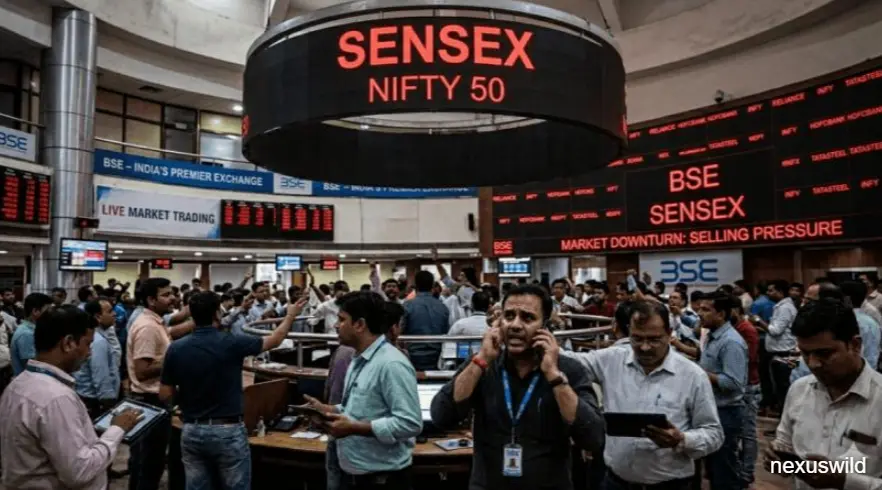

Indian equity markets closed lower on Monday, October 12, as concerns over oil prices, inflation and the monsoon outlook overshadowed recent efforts by the Reserve Bank of India (RBI) to support the rupee.
The BSE Sensex fell 0.76% to close at 71,924.68, while the NSE Nifty 50 declined 0.7% to 22,363.35, according to Reuters. The Nifty finished below the closely watched 22,400 level, while selling pressure affected technology and banking shares. The decline followed a rebound on Friday, when both benchmarks had ended their longest weekly losing streaks in 25 years.
The session highlighted the difficulty facing investors as domestic policy measures, corporate earnings and global commodity prices pulled market sentiment in different directions. Although the rupee strengthened after the RBI's latest steps, equity investors remained cautious about the possible effect of expensive energy on inflation, consumption and company profits.
Sensex and Nifty surrender early gains
Indian benchmarks began the session with some support but lost ground as trading progressed. The closing levels showed that the recovery seen at the end of the previous week had not yet established a sustained upward trend.
The Nifty 50's close at 22,363.35 placed it below the 22,400 mark cited by traders as a near-term reference level. Such thresholds can influence market positioning, but a break below a round-number level does not by itself determine the direction of the next session.
The broader market picture was mixed rather than uniformly negative. Reuters reported that 12 of the 16 major sectoral indexes advanced. Small-cap shares rose 1.4%, while mid-caps gained 0.1%, supported by domestic fund inflows. By contrast, the banking index fell 0.6% and the IT index lost 0.8%, giving investors a more divided picture of market performance.
Tech Mahindra and DMart come under pressure
Tech Mahindra shares declined as investors looked ahead to the company's September-quarter results and assessed concerns about competition in telecom services. The stock fell around 3% during Monday's session. The company had scheduled its Q2 FY27 results for October 15, with its board also due to consider an interim dividend and a proposed bonus share issue.
The share-price decline came amid wider weakness in IT stocks. Investors will be watching the company's results and management commentary for indications of demand, margins and the outlook for its communications-related business. The market's reaction ahead of results also reflected concerns that competition from satellite-based mobile services could affect telecom spending, as reported by Reuters.
Avenue Supermarts, the operator of DMart, also fell after releasing its second-quarter results. The stock dropped as much as 3.3% to ₹3,405 on the BSE, despite the company reporting an 8.5% year-on-year increase in consolidated net profit to ₹743 crore. Revenue rose 17.8% to ₹19,644 crore.
Investors appeared concerned about profitability rather than revenue growth alone. DMart's consolidated EBITDA margin narrowed to 7.1% from 7.3% a year earlier, while its profit margin declined to 3.8% from 4.1%. The figures illustrate why strong sales growth may not be enough to satisfy investors when operating expenses and margin pressures remain important.
Oil prices and the monsoon weigh on sentiment
Elevated crude oil prices remained a central concern for the Indian market. India imports a large share of the oil it consumes, leaving its economy exposed to increases in global energy costs. A sustained rise in crude can raise the cost of fuel imports, increase pressure on inflation and put additional strain on businesses that depend heavily on transport or energy.
Reuters reported that Brent crude rose to around $106 a barrel amid persistent Middle East tensions. A weaker monsoon was another concern for investors because rainfall conditions can influence agricultural output, rural incomes and demand for consumer goods. Market participants were watching whether these pressures would feed into inflation and constrain corporate earnings.
The effects can vary by sector. Higher fuel costs may weigh on transport operators and energy-intensive businesses, while pressure on household budgets can affect discretionary spending. For companies such as consumer-goods retailers, the ability to manage costs while maintaining sales and margins is particularly important.
RBI measures support the rupee, but equities remain cautious
The RBI introduced measures over the weekend aimed at managing dollar demand and currency-market pressures. The steps included redirecting oil companies' dollar purchases and tightening hedging rules. Reuters reported that the rupee recovered around 1% from near-record lows, marking its sharpest rally in six months.
That recovery provided a measure of relief in currency markets, but it did not remove the concerns affecting equities. Investors were still weighing the potential impact of crude prices, inflation and foreign investor outflows. Reuters also noted that activity in the primary market was diverting some liquidity from secondary-market stocks, adding another factor to the trading environment.
A stronger rupee can help reduce the local-currency cost of imports, including oil, if the improvement persists. However, the currency's direction will also depend on global conditions, capital flows and demand for dollars. One day's recovery is not enough to establish a durable change in the exchange-rate trend.
Inflation data and earnings in focus
Investors are now looking toward upcoming domestic inflation data for further clues about the policy outlook, particularly after the RBI raised interest rates the previous week. Inflation figures may help markets assess whether price pressures are broadening and how they could affect future monetary policy.
Corporate earnings are another near-term test. Results and management guidance will help investors evaluate whether businesses can sustain revenue growth while managing higher costs and uncertain demand. Tech Mahindra's scheduled results and the market's response to DMart's margins are examples of the company-specific factors likely to influence individual stocks.
For the next session, traders will monitor crude prices, the rupee, foreign fund flows and the Nifty's position around the 22,400 level. Monday's decline shows that currency support alone may not be sufficient to restore confidence while energy and inflation risks remain unresolved. The next round of economic data and corporate updates should provide a clearer indication of whether the market can stabilise or faces further pressure.
Nexuswild welcomes factual corrections. Email contact@nexuswild.com with evidence and the article URL.