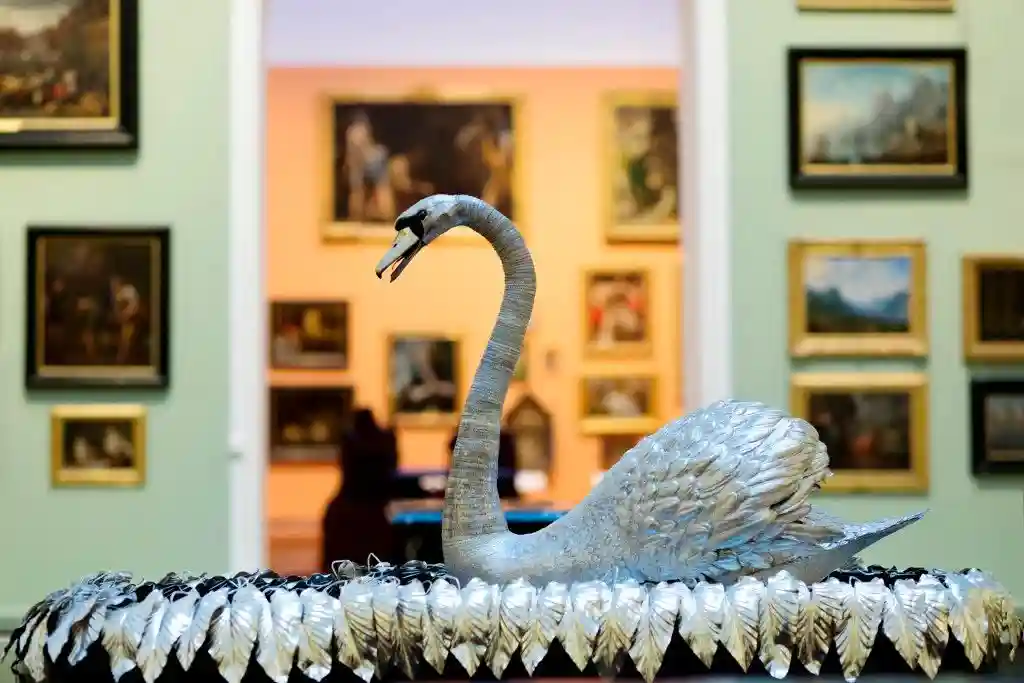

The fish that the Silver Swan appears to catch and swallow each day was never actually swimming. It stays hidden inside the mechanism until the final seconds of the performance, when the swan's head dips down and reveals it, an illusion that has fooled and delighted audiences for close to 250 years.
The Silver Swan is a life-size clockwork automaton, not a modern robot in the electronic sense, though it is often described that way because of how convincingly it mimics living movement using 18th-century mechanical engineering alone.
Origins in London's Mechanical Museum
The swan was built around 1773 and first recorded on public display in 1774, at the Mechanical Museum of James Cox, a London jeweller and entrepreneur known for elaborate clockwork curiosities.
The internal mechanism was designed by John Joseph Merlin, an inventor born in the Prince-Bishopric of Liège who moved to England in 1760 and became Cox's chief mechanician. Merlin is credited separately with inventing the roller skate.
Historical accounts differ slightly on how directly Cox himself was involved in the swan's construction, but Merlin's mechanical design is well documented.
Three Clockwork Mechanisms
According to the Bowes Museum, which now owns and displays the Silver Swan, the automaton's lifelike motion comes from three separate clockwork mechanisms housed inside its silver body, powering the neck, the rotating glass rods and a built-in music box.
When wound with a large key, the mechanisms activate together. The swan turns its head from side to side and appears to preen the feathers along its back, driven by a sequence of cams and linkages inside the neck that translate the clockwork's rotation into smooth, curved movements.
Simulating Water and a Catch
Beneath the swan, a bed of twisted glass rods represents a flowing stream. When the mechanism runs, these rods rotate, creating a shimmering effect that gives the visual impression of moving water, interspersed with small silver fish that appear to swim.
After preening and looking around, the swan bends its neck down toward the stream, appears to spot one of the fish, and catches it in its beak before lifting its head and going through a swallowing motion.
As several historical accounts note, the fish involved in this final sequence is not actually retrieved from the stream but has been positioned within the mechanism the whole time, timed to appear at the right moment.
The full performance lasts roughly 30 to 40 seconds, depending on the account, and ends with the swan's head returning to an upright resting position.
From Cox's Museum to the Bowes
After Cox's museum closed in 1782, the Silver Swan passed through private ownership and later appeared at the 1867 Exposition Universelle in Paris, where its performance reportedly captivated visitors, including the American writer Mark Twain, who described its lifelike movement in *The Innocents Abroad*.
John and Joséphine Bowes, founders of what became the Bowes Museum, purchased the automaton from a Parisian jeweller in 1872 for £200, a considerable sum at the time.
It has been part of the museum's collection in Barnard Castle, County Durham, England, ever since, and remains one of its best-known objects.
A Lasting Piece of Mechanical History
The Silver Swan is widely regarded as one of the finest surviving examples of 18th-century automata, a category of intricate clockwork devices built to demonstrate mechanical skill and delight audiences rather than serve any practical function.
Its combination of horological precision and sculptural artistry places it alongside other celebrated automata of the era, such as the Peacock Clock now held at Russia's Hermitage Museum, which Cox's workshop also had a hand in producing.
Today, the Bowes Museum runs the Silver Swan once daily, drawing visitors who come specifically to watch a nearly 250-year-old mechanism perform the same sequence of movements it has repeated since the reign of King George III.
Key Takeaway
The Silver Swan is a remarkable example of 18th-century mechanical engineering that uses clockwork, cams, linkages and rotating glass rods to create the illusion of a living bird swimming, preening and catching a fish. Built around 1773, it remains one of the best-known surviving automata from the period.
Reader questions
Frequently asked questions
What is the Silver Swan?
The Silver Swan is a life-size 18th-century clockwork automaton designed to imitate the movements of a living swan using purely mechanical systems.
When was the Silver Swan made?
The Silver Swan was built around 1773 and was recorded on public display at James Cox's Mechanical Museum in London by 1774.
Who designed the Silver Swan?
The internal mechanism is attributed to inventor and mechanician John Joseph Merlin, who worked with London jeweller and entrepreneur James Cox.
How does the Silver Swan move?
The automaton uses three clockwork mechanisms, along with cams and linkages, to move the swan's neck, rotate glass rods that simulate flowing water and operate its music.
Does the Silver Swan really catch a fish?
The fish used in the final catching sequence is hidden within the mechanism and appears at the correct moment, creating the illusion that the swan has caught it from the stream.
Where is the Silver Swan today?
The Silver Swan is part of the Bowes Museum collection in Barnard Castle, County Durham, England.
Nexuswild welcomes factual corrections. Email contact@nexuswild.com with evidence and the article URL.