
By Nexuswild Business Desk
Published: October 11, 2026 Category: Business & Technology Reading time: 7–9 minutes
SoftBank explores a $100 billion fundraising drive
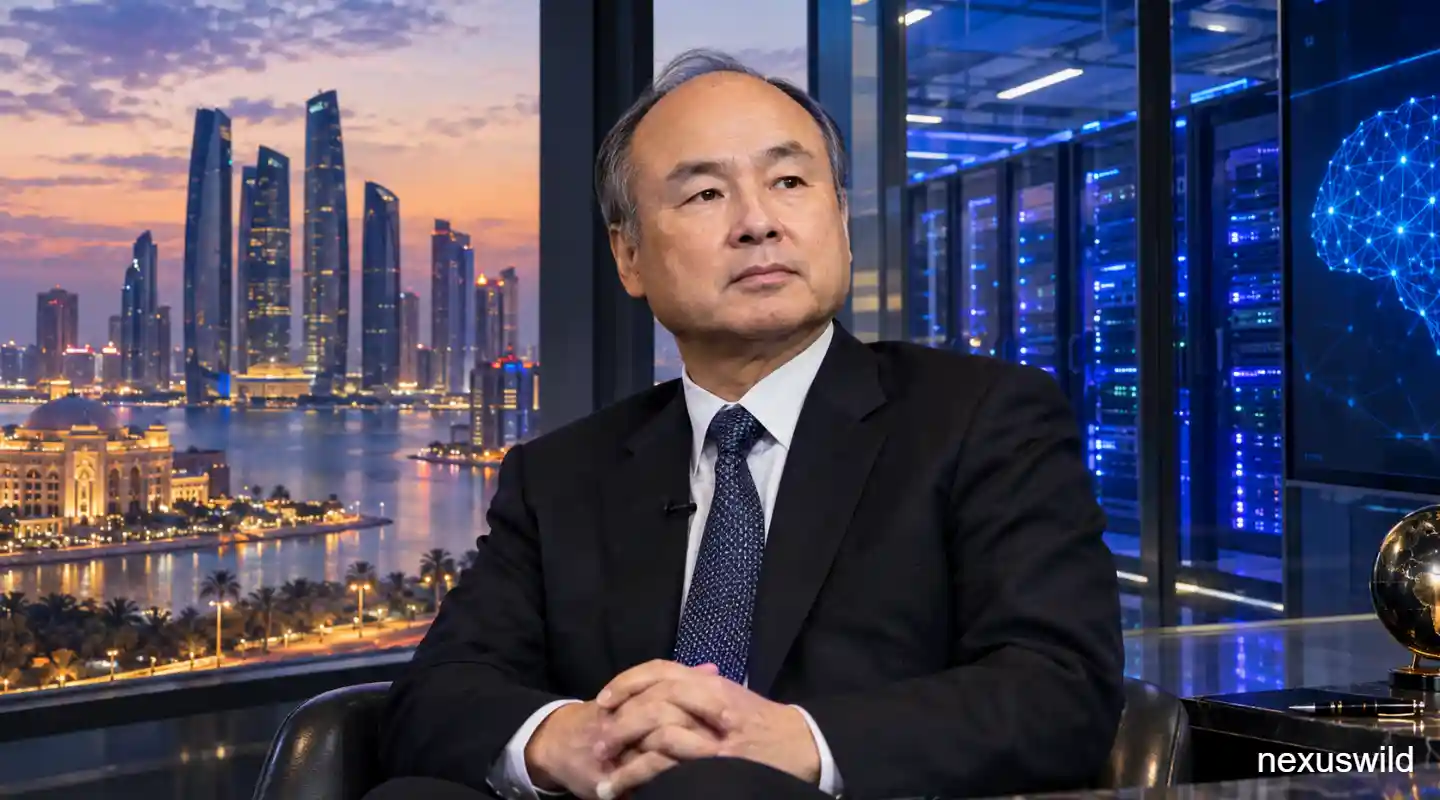
SoftBank Group founder Masayoshi Son is seeking to raise as much as $100 billion from investors in the Gulf region to finance a new wave of artificial intelligence investments, according to a report by the Financial Times.
Son has held discussions in recent weeks with senior figures in the Middle East, including potential investors in the United Arab Emirates, about the proposed fundraising. The discussions remain preliminary, and there is no guarantee that they will lead to a completed investment agreement.
According to the reported plan, the money would support a new fund designed to acquire companies and improve their operations through artificial intelligence, automation and other advanced technologies. SoftBank’s robotics business, Roze, is expected to play a role in the strategy.
The proposal would represent another substantial step in Son’s effort to position SoftBank at the centre of the global AI economy. It would also require the Japanese technology investor to secure commitments on an extraordinary scale at a time when questions about AI valuations, borrowing and future returns are attracting increased scrutiny.
Reuters reported that it could not independently verify the fundraising details and that SoftBank had not responded to a request for comment at the time of its report. The proposed $100 billion fund should therefore be treated as a reported plan rather than a confirmed financial transaction. (Reuters)
A new strategy: Buy companies and transform them with AI
The proposed fund would differ from a conventional technology investment vehicle in an important respect. Rather than focusing exclusively on taking stakes in companies developing AI models or manufacturing chips, it would seek to acquire businesses and use advanced technologies to improve their operations.
That approach could involve deploying AI software, automated systems and robotics to change how companies perform routine tasks, manage resources and deliver services.
The potential applications extend across industries, including manufacturing, logistics and other operations where automation could improve productivity. However, the precise acquisition targets, investment commitments and structure of the proposed fund have not been publicly confirmed.
SoftBank's robotics and physical AI activities could become an important part of this strategy. Physical AI refers to systems that interact with the real world, including robots capable of performing tasks in industrial or commercial environments.
The commercial opportunity is significant if companies can use these technologies to reduce costs, improve efficiency or increase output. Yet achieving those gains requires more than acquiring software or robots. Businesses must integrate new systems into existing operations, train employees, maintain equipment and demonstrate measurable financial benefits.
The proposed fund would therefore be betting not only on AI adoption, but also on SoftBank's ability to identify businesses where technology-led changes can produce returns that justify the acquisition price and implementation costs.
Gulf investors become central to SoftBank’s ambitions
The Gulf region has emerged as an important source of capital for large technology and AI projects. Sovereign wealth funds and state-backed investment organisations in countries such as the United Arab Emirates and Saudi Arabia have pursued opportunities to diversify their economies and expand their exposure to advanced technology.
For SoftBank, these investors are familiar potential partners.
In 2017, Son secured major commitments from Middle Eastern investors for the first SoftBank Vision Fund, a roughly $100 billion investment vehicle. Saudi Arabia’s Public Investment Fund and Abu Dhabi-based Mubadala were among its prominent backers.
The earlier fundraising demonstrated the ability of Gulf capital to support technology investments on a global scale. It also established a relationship that SoftBank could seek to build on as AI becomes a larger part of its investment strategy.
However, previous participation does not guarantee that investors will support the new proposal. Potential backers must assess the fund’s investment mandate, expected returns, risk exposure, governance and the amount of capital they would be required to commit.
A fundraising target of $100 billion would be exceptionally ambitious, and the final amount, if any, would depend on negotiations and investor appetite.
For Gulf investors, the opportunity could provide exposure to businesses undergoing AI-driven transformation. The challenge would be determining whether the expected productivity gains translate into attractive returns after accounting for acquisition costs, financing and execution risks.
OpenAI investment increases SoftBank’s AI exposure
The proposed fund comes as SoftBank deepens its financial commitment to artificial intelligence, particularly through its investment in OpenAI, the company behind ChatGPT.
Recent reporting places SoftBank’s cumulative OpenAI investment at approximately $65 billion. Reuters reported that SoftBank completed a $30 billion investment tranche as part of OpenAI’s latest fundraising round, adding to its already substantial exposure to the AI developer. (Reuters)
OpenAI is one of the most prominent businesses in the generative AI market, but its long-term commercial prospects remain tied to factors such as revenue growth, computing costs, competition and the substantial investment needed to develop and operate advanced AI systems.
The timing of a potential OpenAI public listing has also become a consideration for investors evaluating SoftBank’s financial commitments.
A new $100 billion fundraising effort would add another dimension to this strategy. If successful, it could give SoftBank access to outside capital for additional acquisitions without requiring the entire investment programme to be funded directly from its own balance sheet.
Nevertheless, managing a large portfolio of AI-related investments would expose the group to risks if valuations fall, technology adoption develops more slowly than expected or the companies it acquires fail to deliver anticipated efficiency improvements.
Financing the AI boom is becoming more complicated
SoftBank’s plans are unfolding during a period of enormous investment in AI computing, semiconductor technology and data-centre infrastructure.
The expansion of generative AI has encouraged companies to commit substantial resources to computing capacity, specialised chips and the facilities needed to train and operate AI models. Investors have also backed businesses that aim to commercialise AI across a growing range of industries.
Yet the cost of financing this expansion has become an increasingly important consideration.
SoftBank raised approximately $11.1 billion through a high-yield corporate bond offering in September 2026, according to reporting by Reuters and other financial outlets. The transaction illustrated the scale of financing being mobilised to support the group's AI ambitions.
Borrowing can provide capital for expansion, but it also creates repayment obligations and interest costs. Those obligations become more difficult to manage if investment returns take longer to materialise or market valuations decline.
The proposed Gulf-backed fund could help SoftBank bring in additional investors and distribute some investment exposure across a wider group of capital providers. But raising money from external investors would not remove the underlying commercial risks associated with AI.
The fund would still need to acquire suitable businesses at prices that leave room for profitable improvements. It would also need to demonstrate that AI adoption can deliver tangible results rather than relying solely on expectations of future technological progress.
What the proposal means for the AI industry
If the fundraising advances, the initiative could become a significant source of capital for companies positioned to benefit from AI-driven operational changes.
Startups developing robotics, automation and enterprise AI technologies could potentially find new opportunities through acquisitions or partnerships. Established companies might also attract interest if investors believe their operations can be improved through modern technology.
For the wider market, the proposal would signal that large investors continue to search for ways to turn AI development into commercial value beyond the businesses building foundation models and chips.
However, the size of the proposed fund should not be confused with the amount of money that will actually be invested. Fundraising discussions can change, negotiations can stall, and final commitments may differ considerably from initial targets.
Investors will also need to distinguish between businesses with realistic opportunities for operational improvement and those whose valuations already assume substantial future gains.
What happens next?
The immediate question is whether Son can convert preliminary discussions with Gulf investors into formal commitments.
Important details remain unresolved, including the fund's final size, investment structure, timetable, acquisition strategy and the identities of any investors willing to participate. Until SoftBank or the prospective backers confirm those details, the initiative remains a reported fundraising effort.
Investors will also be watching how SoftBank manages its existing AI commitments, particularly its OpenAI exposure, alongside its broader investments in robotics, semiconductor technology and infrastructure.
The bottom line: Masayoshi Son is reportedly seeking up to $100 billion from Gulf investors to accelerate SoftBank’s AI strategy through acquisitions and technology-led business transformation. The proposal reflects the scale of capital being pursued in the AI economy, but its significance will ultimately depend on whether the fundraising succeeds and whether the investments generate sustainable commercial returns.
Topics
SoftBank, Masayoshi Son, Artificial Intelligence, Gulf Investors, UAE Sovereign Wealth Funds, OpenAI, Robotics, AI Investment, Technology Acquisitions, Global Markets
Corrections and Updates
This article is based on reporting available as of October 11, 2026. The proposed $100 billion fundraising has not been confirmed as completed. Details of the potential fund and investor discussions are based on media reports citing people familiar with the matter.
Nexuswild will update this article if SoftBank announces formal fundraising commitments, identifies participating investors or confirms the fund's structure.
Reader Feedback
What will determine the success of large AI investment funds: access to capital, the quality of acquisitions, or measurable productivity improvements?
Readers can send questions and feedback to the Nexuswild editorial team.
Article Information
Article type: Business news and analysis
Primary company: SoftBank Group
Key individual: Masayoshi Son
Main development: Reported effort to raise up to $100 billion from Gulf investors
Primary source: Financial Times
Additional reporting: Reuters and other financial news outlets
Editorial status: Fundraising discussions reported; no completed $100 billion transaction confirmed
Related Coverage
How SoftBank is expanding its investment in OpenAI
Why Gulf sovereign wealth funds are investing in AI
The growing role of robotics in industrial automation
How AI investment is reshaping global technology markets
Read Next
Follow Nexuswild for continuing coverage of artificial intelligence, global investment, technology companies and the financial decisions shaping the next phase of the AI industry.
Nexuswild — Independent coverage of business, technology and the forces shaping tomorrow.
Nexuswild welcomes factual corrections. Email contact@nexuswild.com with evidence and the article URL.