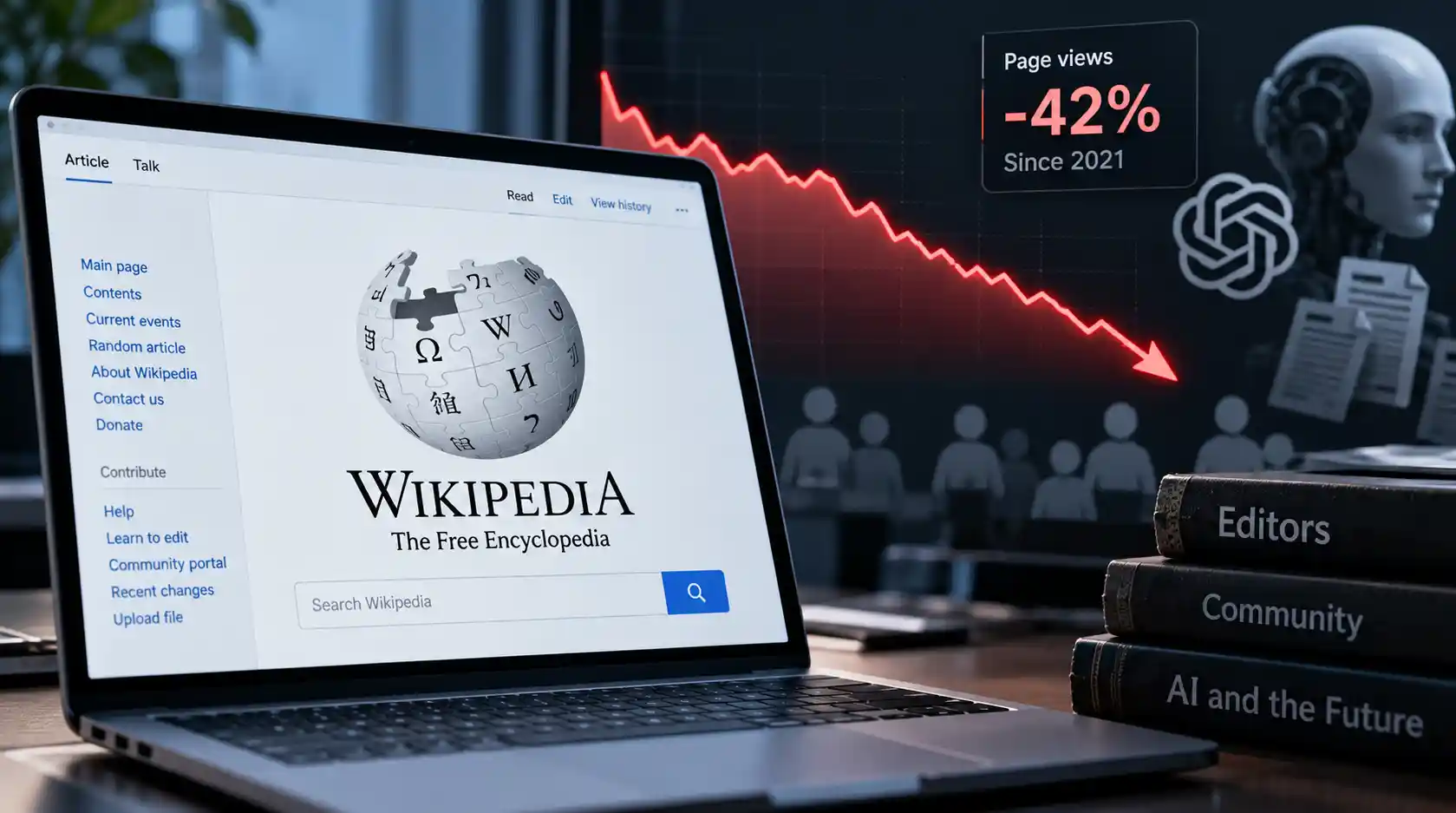

Wikipedia is not disappearing, but its old growth model is breaking
Wikipedia entered 2026 as one of the most important information systems ever created.
The Wikimedia Foundation says the encyclopedia contains more than 65 million articles across more than 300 languages, reaches more than 1.5 billion unique devices each month and receives close to 15 billion monthly pageviews. Nearly 250,000 registered volunteer editors make at least one edit in a typical month.
Those figures make any claim that Wikipedia has simply 'died' or 'collapsed' inaccurate.
But underneath its enormous scale, something important has changed.
Since roughly 2021, several of the mechanisms that historically supplied Wikipedia with new readers, registered users, editors, administrators and donors have weakened.
Wikimedia researchers have documented a major decline in new account registrations. Human pageviews have recently fallen. Referral traffic from Google is under pressure. The number of experienced volunteers in several important parts of the ecosystem has declined. At the same time, artificial-intelligence companies, search engines and automated crawlers increasingly consume Wikipedia's content without necessarily sending users to Wikipedia itself.
The result is a paradox.
Wikipedia's information may be more influential than ever, while fewer people may need to visit Wikipedia directly to receive that information.
That is the real post-2021 Wikipedia story.
What changed around 2021?
Wikimedia Foundation research into account registrations found a persistent decline that began sometime between mid-2020 and mid-2021.
By the time researchers studied the trend in late 2024 and early 2025, registrations had fallen approximately 35% compared with 2019.
The decline was not isolated to one Wikipedia language, one interface or accounts without verified email addresses. Researchers observed it across multiple parts of the Wikimedia ecosystem.
Importantly, the Foundation's analysis did not identify a single major software change that explained the decline.
The introduction of the Vector 2022 interface, for example, did not line up with the beginning of the registration drop.
Instead, researchers found that declining registrations closely tracked another trend: fewer edits from unregistered IP users.
That suggested a broader external change in how people were interacting with Wikipedia and the wider web.
The researchers explicitly considered possibilities such as declining authentic readership, changes in people's willingness to contribute, and traffic measurement increasingly distorted by unidentified automated systems.
The registration gap matters more than it first appears
A Wikipedia account registration is not the same thing as an editor.
Many people create accounts and never become regular contributors.
But Wikipedia depends on a funnel.
Readers become registered users.
A fraction of registered users make edits.
A smaller fraction become repeat contributors.
Some eventually become highly experienced editors, patrollers, administrators, CheckUsers, oversighters or other trusted volunteers responsible for protecting the encyclopedia.
When fewer people enter the beginning of that funnel, the effect can become visible years later in the more experienced layers of the community.
That is why a 35% decline in registrations is strategically significant even if Wikipedia continues to attract billions of pageviews.
The issue is not merely how many people read Wikipedia today.
It is whether enough of today's readers become the volunteers who will maintain Wikipedia five, ten or twenty years from now.
Wikipedia's editor numbers also show pressure
Different Wikimedia reports use different editor definitions, which can make headline numbers appear contradictory.
For its 25th anniversary in January 2026, the Wikimedia Foundation said nearly 250,000 registered editors make at least one edit across Wikipedia in a typical month.
The Foundation's 2026-2027 planning documents use a broader estimate of approximately 273,000 editors when accounting for registered Wikipedia editors and an estimate for unregistered contributors.
But another important metric counts 'active editors' more strictly, generally requiring multiple edits in a month.
Using that type of measurement, Wikimedia planning material reported that active editors had fallen to just under 85,000 by November 2024, down approximately 3.4% year over year.
Returning active editors were around 71,000 and had declined approximately 2.9% year over year.
By December 2025, Wikimedia's Movement Metrics reported another roughly 2% year-over-year decline in active editors across projects, while returning active editors fell about 4%.
The Foundation described this as part of a gradual decline following the unusually high participation seen during the COVID-19 period.
Wikipedia has a retention problem as well as a recruitment problem
New contributors are only one part of the issue.
Wikipedia must also retain people who have already learned its rules, editing tools and social conventions.
Returning active editors are particularly important because they have already crossed the initial learning barrier.
Editing Wikipedia can be substantially harder than reading it.
A contributor may need to understand reliable-source policies, neutral point of view, citation formatting, notability, conflict-of-interest rules, page histories, talk pages, templates, deletion discussions and community consensus.
Wikimedia's Product and Technology Advisory Council has described the experience of becoming a new editor as an obstacle that can feel overwhelming to potential contributors.
This creates one of Wikipedia's most important product problems.
Its interface must serve casual readers who want a fact in seconds while also supporting contributors working inside an extremely complex collaborative knowledge system.
The administrator gap may be even more important
The volunteer shortage becomes more serious at the upper levels of Wikipedia's governance structure.
Administrators are experienced editors who can perform actions such as deleting pages, blocking abusive accounts, protecting pages and managing user rights.
Other trusted groups perform even more specialized tasks involving abuse investigation, privacy and cross-project administration.
Wikimedia Foundation research found that more than half of a sampled group of 21 larger Wikipedias had experienced declines in monthly active administrators since 2018.
English, Russian and Portuguese Wikipedia were among the examples showing decline.
Administrator inflow had also been decreasing annually across many of the large Wikipedia editions studied.
The issue appeared to be recruitment more than sudden mass departures.
People were still serving as administrators, but fewer new volunteers were moving into those roles quickly enough to replace long-term attrition.
This creates a maintenance problem similar to what happens in major open-source software projects: the system can remain enormous while responsibility becomes increasingly concentrated among a relatively small number of experienced people.
The COVID-era peak disguised part of the long-term shift
Wikipedia experienced unusual participation during the pandemic period.
In 2021, when former Wikimedia Foundation CEO Katherine Maher stepped down, the Foundation reported that monthly active editors had increased more than 18% since 2016, including an 8.1% increase in the final quarter of 2020.
That period matters when interpreting subsequent decline.
Some post-2021 falls represent normalization from elevated pandemic-era activity rather than evidence of an immediate collapse.
But the registration research is harder to dismiss as simple normalization because Wikimedia found that the downward trend continued for years and affected multiple interfaces and wikis.
By 2025 and 2026, the Foundation was treating volunteer recruitment and retention as a long-term strategic issue.
Then AI changed the reader side of Wikipedia
The next disruption was not primarily inside Wikipedia.
It happened above Wikipedia in the information-discovery layer of the internet.
For much of its history, Wikipedia benefited from search engines.
A user typed a question into Google.
Google displayed a Wikipedia result.
The user clicked it.
Some of those visitors returned later, created accounts, donated money or eventually edited an article.
The Wikimedia Foundation's 2026-2027 annual plan says nearly 90% of Wikipedia visitors historically arrived through Google search.
That traffic was extraordinarily valuable because Wikipedia did not need to buy it.
The Foundation describes this system as a kind of historical waterfall of free referral traffic.
That waterfall is now weakening.
Search engines increasingly answer the question themselves
Modern search interfaces increasingly provide answers before a user visits the source website.
Knowledge panels had already moved in this direction years earlier.
Generative AI accelerated it.
A user can now search a question and receive an AI-generated summary directly inside a search engine.
Another user may ask ChatGPT, Gemini, Perplexity or another AI assistant and receive an answer without opening Wikipedia at all.
The remarkable part is that Wikipedia frequently remains somewhere underneath that answer.
Wikipedia is one of the most widely reused structured collections of human-curated information on the internet and has been extensively incorporated into search systems, knowledge graphs and large-language-model training datasets.
This produces a fundamental economic and strategic tension.
Wikipedia can become more valuable to the internet while simultaneously receiving less direct traffic from the internet.
Human Wikipedia pageviews are now falling
In October 2025, the Wikimedia Foundation published an important update on human traffic.
Its analytics teams had discovered that some sophisticated bots were being incorrectly classified as human visitors.
After improving its detection system and reclassifying traffic from March through August 2025, Wikimedia concluded that human Wikipedia pageviews had fallen roughly 8% compared with the equivalent months in 2024.
The Foundation linked the decline to changing information habits, particularly generative AI, search engines answering questions directly and younger users obtaining information through social-video platforms.
By 2026, Wikimedia's annual planning went further and described declining pageviews and Google referrals as a structural shift rather than a temporary fluctuation.
That wording is significant.
Wikipedia's operator is now planning for an internet in which search engines may permanently send less traffic to websites than they did during the traditional web era.
Independent traffic estimates show the same direction
Third-party analytics should be treated differently from Wikimedia's first-party data because firms such as Similarweb and Semrush estimate traffic using their own models.
But their reported direction is similar.
DataReportal's analysis of Semrush figures estimated that Wikipedia's organic search visits declined from roughly 5.8 billion in January 2022 to about 4.3 billion in March 2025, a decline of approximately 26%.
Its analysis of Similarweb data indicated an approximately 23% fall in organic search traffic over a similar three-year period.
Similarweb data cited by DataReportal also suggested direct traffic declined more modestly, while organic search accounted for the overwhelming majority of the measured loss.
These are estimates rather than Wikimedia's internal analytics, but they reinforce the conclusion that search referral pressure predates the Foundation's 2025 human-pageview warning.
The strange new gap: billions consume Wikipedia without visiting Wikipedia
Wikimedia's 2026-2027 planning documents illustrate the scale of the problem with an audience funnel.
The Foundation estimates that approximately 5 billion internet users consume Wikipedia content in some form, including content reused through third-party products.
About 3.3 billion people are estimated to know Wikipedia exists.
Approximately 1.5 billion read Wikipedia directly on Wikimedia sites each month.
Only around 273,000 are represented in the Foundation's editor estimate.
That means the distance between consuming Wikipedia knowledge and participating in Wikipedia itself is enormous.
In the AI era, that gap may become even wider.
Someone can consume a fact derived from Wikipedia inside a chatbot, search summary, voice assistant or knowledge panel without seeing Wikipedia's interface, citations, edit history, discussion page or donation request.
That person benefits from Wikipedia but may never enter Wikipedia's reader-to-contributor funnel.
Wikipedia faces a visibility paradox
The traditional web rewarded websites with visits.
The AI web can reward a source with influence while removing the visit.
For Wikipedia, this is especially consequential because traffic does more than generate advertising revenue.
Wikipedia does not operate a conventional advertising business.
Traffic produces something else: potential contributors, donors, community members and public awareness of where information originates.
When a search engine or AI assistant reproduces the useful part of an answer but removes the need to click through, Wikipedia loses an opportunity to convert a passive information consumer into a participant.
Wikimedia has therefore begun emphasizing attribution and responsible reuse, not simply raw distribution.
AI also created a completely different infrastructure problem
AI systems do not only reduce potential referral traffic.
They also increase traffic to Wikimedia's servers.
That sounds contradictory until human and machine traffic are separated.
A human reader may visit five or ten popular articles.
A crawler building a search index or AI dataset may request millions of pages, media objects and obscure resources.
The crawler therefore produces enormous infrastructure demand even when those requests do not translate into human readership.
Wikimedia says automated requests have grown rapidly since early 2024 as organizations collect text, images and other data for AI systems and related services.
Bots produce 65% of Wikipedia's most expensive traffic
The most striking infrastructure statistic came from Wikimedia engineers in 2025.
They found that bots accounted for at least 65% of the most resource-intensive website traffic reaching Wikimedia's core datacenters.
Bots represented a smaller share of total measured pageviews, around 35%, but they disproportionately generated expensive requests.
The reason is technical.
Human readers cluster around popular topics.
Those pages are likely to already exist in regional caches located near users.
A crawler behaves differently.
It may request obscure pages across enormous parts of Wikipedia and Wikimedia Commons.
Those objects are less likely to exist in edge caches and therefore require more requests to travel back toward core infrastructure.
A relatively small number of automated systems can consequently create much greater computing, storage and network pressure than their raw pageview share suggests.
Wikimedia's multimedia bandwidth rose 50%
The same pattern is visible in Wikimedia Commons.
From January 2024, Wikimedia observed approximately 50% growth in bandwidth used to download multimedia content.
The Foundation said much of the increase was driven not by human readers but by automated systems scraping the Commons catalogue of openly licensed images and other files.
This creates a fundamental problem for open infrastructure.
The content is intentionally free.
Serving unlimited copies of that content is not free.
Servers, network transit, storage, engineering, security and datacenters all cost money.
How Wikipedia's technical infrastructure actually works
Understanding the crawler problem requires understanding Wikipedia's architecture.
Wikipedia runs on MediaWiki, the open-source wiki software originally created for the encyclopedia.
MediaWiki is primarily written in PHP.
Wikimedia's production environment uses relational databases based on MariaDB/MySQL architecture to store pages, revisions, users, recent changes and related data.
But a site receiving billions of pageviews cannot send every reader request directly to a database.
Caching therefore sits at the center of Wikipedia's scalability model.
Wikimedia uses reverse caching systems including Varnish and Apache Traffic Server.
For many anonymous page reads, a regional cache can return a rendered page without sending the request to MediaWiki's application layer or primary databases.
The architecture also uses multiple layers of object caching, replicated databases and asynchronous job processing.
Expensive work can be moved into queues instead of delaying every reader request.
This is one reason Wikipedia can remain fast despite operating at enormous scale.
Caching explains why AI crawlers are unusually expensive
Caching works best when many people ask for the same things.
If millions of readers suddenly want one major breaking-news article, an edge cache can serve repeated copies efficiently.
But an AI crawler may systematically request millions of different pages.
Its access pattern intentionally explores the long tail.
That produces more cache misses.
Cache misses force deeper layers of Wikimedia's infrastructure to perform work.
This means a scraper that makes fewer requests than millions of human readers can still consume disproportionate backend resources.
For Wikimedia's Site Reliability Engineering teams, the challenge is therefore not simply total bandwidth.
It is the shape and cost of traffic.
Wikipedia's bot-detection problem became an analytics problem too
Bots introduced another difficulty: Wikimedia could no longer assume that traffic that looked human actually was human.
Traditional crawlers often identify themselves through user-agent strings or predictable request patterns.
Modern scraping systems may attempt to resemble ordinary browser traffic.
Some use distributed IP addresses, residential proxies or other techniques that make classification harder.
That means bot traffic can distort statistics intended to measure actual readers.
In 2025, Wikimedia discovered unusually high apparent human traffic, particularly associated with Brazil.
Investigation showed that substantial amounts were sophisticated bots avoiding existing detection methods.
After reclassification, the underlying decline in human pageviews became clearer.
This is why current Wikimedia reports repeatedly warn that raw pageview trends must be interpreted carefully.
Some readership metrics became too contaminated to trust normally
Wikimedia's Movement Metrics reporting eventually stopped prominently using certain unique-device measures because undetected automated traffic had distorted them so substantially.
More recent reports have warned that even pageviews are affected.
One report showed user pageviews declining around 4% year over year while mobile-web pageviews, considered less affected by bot contamination, were down approximately 16% year over year.
Wikimedia cautioned that the headline figure could therefore understate the true decline in human readership.
This does not mean every region or language edition is declining at the same rate.
It means measuring human attention itself has become more technically difficult.
Wikimedia Enterprise is part of the response
The Wikimedia Foundation anticipated large-scale commercial reuse before the generative-AI explosion.
In 2021 it began developing Wikimedia Enterprise, a commercial service designed for organizations that need Wikimedia data at high volume, high frequency and predictable quality.
The distinction is important.
Wikipedia content remains free.
Wikimedia Enterprise charges large commercial users for specialized access infrastructure rather than licensing ownership of the underlying encyclopedia.
Its APIs offer normalized, high-volume and near-real-time access without forcing every large technology company to crawl the ordinary public website aggressively.
By 2026, Wikimedia said Enterprise had repaid its initial investment and was contributing to the Foundation's sustainability.
Big AI and technology companies are now Enterprise customers
The relationship between Wikipedia and artificial intelligence has increasingly become formalized.
Existing Wikimedia Enterprise partners include Amazon, Google and Meta.
During the period leading into Wikipedia's 25th anniversary, additional companies including Microsoft, Mistral AI, Perplexity, Ecosia, Pleias and ProRata joined as partners.
This demonstrates another paradox in Wikipedia's future.
AI companies are simultaneously competitors for user attention and major consumers of Wikipedia's knowledge.
The strategic goal is therefore not to stop reuse.
Wikipedia's open licenses are designed to enable reuse.
The goal is to make large-scale reuse sustainable, attributable and less damaging to the infrastructure that generates the knowledge in the first place.
Wikimedia is now rate-limiting some large-scale reusers
By 2026, the Foundation had begun moving beyond voluntary cooperation.
Wikimedia said it was rate-limiting large-scale users of public APIs when their access placed excessive pressure on shared infrastructure.
The public APIs remain available.
But organizations requiring extremely high volume or speed are increasingly being directed toward Wikimedia Enterprise.
The change reflects a broader transition across the open web.
Open access to content does not necessarily imply unlimited free access to another organization's computing infrastructure.
AI is a threat and an opportunity for Wikipedia
It would be too simple to describe generative AI only as a threat.
Wikipedia is also one of AI's most important beneficiaries and inputs.
AI tools can potentially help volunteers translate articles, identify vandalism, classify edits, discover missing citations, perform repetitive moderation tasks and make complicated editing workflows easier.
Wikimedia already operates machine-learning systems such as ORES for supporting edit-quality and vandalism workflows.
The Foundation's newer AI strategy explicitly emphasizes tools that help human contributors rather than replacing them.
This is critical because Wikipedia's value comes from its human editorial processes: sourcing, disagreement, discussion, revision and consensus.
Automatically generating more text is not necessarily the same as producing better encyclopedic knowledge.
The machine-generated-content problem is growing
Generative AI dramatically reduces the cost of creating plausible-looking text.
For Wikipedia, that creates an asymmetric moderation problem.
Producing several paragraphs with an AI system can take seconds.
Checking whether every factual claim is correct, whether the citations actually support the text and whether sources satisfy Wikipedia's reliability standards can take far longer.
The result is potentially a verification burden placed on volunteers.
Wikipedia therefore faces a future in which generating text becomes cheap while verifying text remains expensive.
That makes trusted editors more valuable at exactly the same moment that editor recruitment is becoming more difficult.
Why fewer editors can become a knowledge-quality problem
Wikipedia does not work because anyone can write anything permanently.
It works because edits can be challenged, reverted, sourced, discussed and reviewed by other people.
That model assumes sufficient volunteer capacity.
If participation declines while article volume, geopolitical conflict, misinformation and machine-generated submissions rise, workload can become increasingly concentrated among experienced editors.
This does not automatically mean quality falls.
Automation, better tools and more efficient moderation can offset some labour shortages.
But Wikipedia's governance model ultimately depends on humans making judgments that software cannot safely automate completely.
The geographic gap remains part of the problem
Wikipedia is not one encyclopedia in one language.
It is a federation of hundreds of language communities with dramatically different sizes, resources and editorial capacity.
The English Wikipedia has millions of articles and a large volunteer ecosystem.
Smaller-language editions may depend on far fewer active contributors.
A decline of ten experienced editors means something very different for a massive Wikipedia than for a community with only dozens of highly active volunteers.
Wikimedia's metrics have shown that some emerging-language communities experienced sharper contributor declines than developed Wikipedia communities.
This matters for global knowledge equity.
If contribution becomes concentrated in languages with larger communities and stronger digital infrastructure, information gaps between languages can widen even while total article counts continue increasing.
Wikipedia still remains extraordinarily large
None of these challenges erase Wikipedia's scale.
In 2025 alone, people spent an estimated 5.4 billion hours reading Wikipedia across all languages, according to Wikimedia's year-in-review data.
English Wikipedia alone accounted for approximately 2.8 billion hours of reading.
Editors made more than 94 million changes during the year across Wikipedia languages.
In July 2026, the Wikimedia Foundation said Wikipedia contained more than 67 million articles across more than 300 languages.
The important question is therefore not whether Wikipedia disappears tomorrow.
It is how the platform replenishes the humans and traffic flows that made that scale possible.
Is Wikipedia losing users?
The most accurate answer is: some important measures of direct human engagement are declining, but Wikipedia still maintains enormous global reach.
Wikimedia reported an approximately 8% year-over-year decline in human pageviews for a set of months in 2025 after correcting bot classification.
Account registrations have declined approximately 35% from 2019 levels, with the trend beginning around 2020-2021.
Active and returning editors have also shown declines under stricter activity definitions.
At the same time, approximately 1.5 billion devices still access Wikipedia each month, and Wikipedia content reaches billions more indirectly through search engines, AI systems and other services.
So the problem is better described as weakening direct participation and traffic rather than disappearance.
Is Wikipedia dying because of AI?
No evidence supports saying Wikipedia is currently dying because of AI.
But AI is changing the economics and distribution of Wikipedia knowledge.
Search summaries and chatbots can answer questions using information ultimately derived from Wikipedia without requiring a Wikipedia visit.
AI crawlers also place unusually high loads on Wikimedia infrastructure.
The Foundation itself considers these changes structural enough to redesign traffic, product and infrastructure strategy around them.
The more precise conclusion is that AI is disrupting Wikipedia's traditional relationship with the web.
Why 2021 now looks like an important boundary
There was no single event in 2021 that suddenly broke Wikipedia.
Instead, several long-term trends converge around the period.
Account registrations began their sustained decline around mid-2020 to mid-2021.
Pandemic-era editor growth peaked and normalized.
Wikimedia Enterprise was established to address large-scale commercial reuse.
Search and information discovery subsequently shifted toward answer engines and generative AI.
By 2024, automated scraping traffic was putting materially greater pressure on Wikimedia infrastructure.
By 2025, revised bot detection exposed declining human pageviews.
By 2026, Wikimedia was explicitly describing Google referral declines as structural rather than temporary.
Seen together, these events make the early 2020s a transition between two versions of Wikipedia's internet environment.
The old Wikipedia growth loop
For roughly two decades, the system looked like this:
Google sent readers to Wikipedia.
Readers discovered the site.
Some returned directly.
A small percentage created accounts.
A smaller percentage became editors.
Some editors became administrators and long-term community members.
Readers also became donors.
Search traffic therefore indirectly supported both Wikipedia's volunteer workforce and its financial model.
The new AI-era loop is different
The emerging flow can look more like this:
Wikipedia editors create and verify knowledge.
Search engines and AI companies ingest it.
Users receive an answer on another platform.
The external platform captures the interaction.
Wikipedia may receive no visit.
The user may never see Wikipedia's citations or contribution tools.
At the same time, the external platform may send automated systems back to Wikipedia to collect additional information.
This can produce the worst combination for an open knowledge project: fewer human referrals and more machine traffic.
That is the structural challenge Wikimedia is now trying to solve.
Wikipedia's response is becoming a product strategy, not just an encyclopedia strategy
The Foundation's 2026-2027 plan prioritizes increasing direct reach, deepening engagement, protecting Wikimedia projects and improving infrastructure efficiency.
That includes reducing dependence on traditional Google referrals.
The Foundation is investing in mobile apps, personalized reading features, reading lists, activity statistics and other mechanisms intended to give users reasons to return directly.
Wikipedia's mobile applications now emphasize features including offline reading, saved lists, nearby places, reading statistics and year-in-review experiences.
These features are strategically important because they transform Wikipedia from a website someone visits after a search into a destination with an ongoing relationship with the reader.
Wikipedia must compete for habits, not only rankings
Historically, Wikipedia was exceptionally good at being the page users reached after entering a question into Google.
The AI era requires a different skill.
Wikipedia needs users to deliberately choose Wikipedia.
That may mean stronger apps, personalized utilities, notifications, discovery tools, games, topic feeds and other experiences that encourage repeated direct use without undermining the encyclopedia's nonprofit identity.
The challenge is difficult because Wikipedia's simplicity is one of its greatest strengths.
Adding engagement features cannot turn it into the kind of attention-maximizing social platform many users specifically visit Wikipedia to avoid.
Wikipedia's biggest asset may be exactly what AI cannot easily reproduce
Large language models can generate fluent answers instantly.
Wikipedia's value lies somewhere different.
Every important claim can potentially be traced to a cited source.
Every edit has a history.
Every disagreement can be examined through discussion pages.
Rules are publicly documented.
Editors can challenge one another.
Articles can change as evidence changes.
That process can be slow, contentious and imperfect.
But it produces something increasingly scarce on the AI-generated internet: visible provenance.
As synthetic content becomes abundant, human-curated knowledge with transparent sourcing may become more valuable rather than less.
The real risk is invisibility, not immediate extinction
Wikipedia may continue powering the world's information systems even if fewer users type wikipedia.org into a browser.
That is precisely why its current challenge is unusual.
The encyclopedia could remain foundational while becoming less visible.
If users stop knowing where facts originate, fewer may become contributors.
If fewer contributors enter, the volunteer base becomes harder to replenish.
If AI companies continue using the content without responsible infrastructure access, serving those companies becomes more expensive.
Those three forces connect the traffic problem, editor problem and technical problem.
They are not independent trends.
Wikipedia after 2021 is a transition, not a collapse
The strongest evidence does not support declaring Wikipedia dead.
It supports something more consequential.
Wikipedia's original growth mechanism is being rewritten.
The site that once depended on search engines to deliver an almost automatic supply of readers now operates in an environment where search engines increasingly answer questions themselves.
The encyclopedia that once needed to distinguish humans from relatively obvious crawlers now faces sophisticated automated systems consuming its long-tail content at enormous scale.
The volunteer community that expanded during earlier periods must now replenish editors and administrators while competing with social platforms, AI assistants and increasingly passive forms of information consumption.
Yet Wikipedia remains one of the largest repositories of human-curated knowledge ever built.
Its 2026 challenge is therefore not survival in the ordinary startup sense.
It is maintaining the human, technical and economic loop that makes its knowledge trustworthy while the rest of the internet becomes increasingly automated.
That makes Wikipedia's next chapter potentially more important than its last.
Reader questions
Frequently asked questions
Is Wikipedia dying?
No. Wikipedia remains one of the world's largest websites, receiving close to 15 billion monthly pageviews and reaching more than 1.5 billion devices. However, Wikimedia has documented declines in human traffic, registrations, returning editors and Google referral traffic that create long-term sustainability challenges.
Is Wikipedia losing users?
Some direct-engagement metrics are declining. Wikimedia said human Wikipedia pageviews were roughly 8% lower year over year during several months of 2025 after correcting for bots, while account registrations have fallen about 35% from 2019 levels.
When did Wikipedia's user decline start?
Wikimedia Foundation research found that the sustained decline in account registrations began sometime between mid-2020 and mid-2021. Researchers did not find evidence that a single major software change caused it.
How many people use Wikipedia in 2026?
The Wikimedia Foundation estimates that more than 1.5 billion unique devices access Wikipedia each month and that roughly 5 billion internet users consume Wikipedia-derived content either directly or through third-party services.
How many editors does Wikipedia have?
The Wikimedia Foundation reported nearly 250,000 registered editors making at least one edit per month around Wikipedia's 25th anniversary. Other active-editor metrics use stricter thresholds and therefore produce lower totals.
Why is Wikipedia traffic declining?
Wikimedia attributes the change partly to generative AI, search engines providing answers directly without requiring clicks, social-video information consumption and a broader shift away from traditional web referral patterns.
Has Google stopped sending traffic to Wikipedia?
No, Google remains an important traffic source. However, Wikimedia says Google referral traffic is in structural decline. The Foundation says nearly 90% of Wikipedia visitors historically arrived through Google search, making this shift strategically important.
Does AI use Wikipedia?
Yes. Wikipedia is widely used by search engines, AI systems, voice assistants and large language models. Wikimedia describes Wikipedia as one of the important high-quality human-created datasets used across modern AI systems.
Is AI reducing Wikipedia traffic?
Wikimedia believes generative-AI search experiences are one important reason direct human pageviews and referrals are declining because users can increasingly receive answers without opening Wikipedia.
How much Wikipedia traffic comes from bots?
In Wikimedia's 2025 analysis, bots represented roughly 35% of overall pageviews but produced at least 65% of the most resource-intensive traffic reaching core infrastructure.
Why are AI crawlers expensive for Wikipedia?
Human readers often request popular pages already stored in regional caches. Crawlers systematically request enormous numbers of less-popular pages, producing more cache misses and forcing requests deeper into Wikimedia's core infrastructure.
What technology does Wikipedia use?
Wikipedia runs on MediaWiki, an open-source application primarily written in PHP. Wikimedia uses MariaDB-based relational databases, reverse caching layers including Varnish and Apache Traffic Server, replicated databases, object caching and asynchronous processing to operate at global scale.
What is Wikimedia Enterprise?
Wikimedia Enterprise is a commercial high-volume data-access service for companies that reuse Wikimedia content at scale. It charges for specialized infrastructure and service rather than licensing ownership of Wikipedia's freely licensed content.
Why does Wikipedia need editors if AI can generate articles?
Wikipedia depends on source verification, neutrality, discussion and consensus rather than text generation alone. AI can produce text quickly, but human contributors are still needed to verify claims, judge sources, resolve disagreements and enforce editorial standards.
Are Wikipedia administrators declining?
Research commissioned by Wikimedia found declining monthly active administrator numbers in more than half of a sample of 21 large Wikipedia language editions. Reduced recruitment rather than unusually high departure rates was a major issue.
Will Wikipedia disappear because of ChatGPT and AI search?
There is no evidence that Wikipedia is about to disappear. The bigger risk is that its knowledge becomes increasingly consumed through third-party AI and search products while fewer users directly visit, contribute to or donate to the underlying encyclopedia.
What changed for Wikipedia after 2021?
After 2021, account registrations continued a sustained decline, pandemic-era editor growth faded, AI-powered answer engines changed search behavior, crawler traffic increased dramatically and Wikipedia's historical dependence on Google referrals became a strategic vulnerability.
What is the biggest long-term challenge facing Wikipedia?
The central challenge is keeping the cycle between readers, editors, trusted volunteers, donors and infrastructure sustainable while more Wikipedia information is consumed outside Wikipedia through search engines and AI systems.
Nexuswild welcomes factual corrections. Email [email protected] with evidence and the article URL.